
Growing Orchids Successfully in a Greenhouse
Bloomcabin Ireland / Growing under glass
Raising Orchids Successfully Under Glass
A greenhouse for orchids is a controlled growing room, not an imitation rainforest: it depends on softened light, steady air circulation, clean water and roots that regain air after each soaking.
The epiphyte principle
A successful orchid collection is organised around the air between its roots, not the colour of its flowers.
Epiphytes make up many familiar greenhouse orchids. In the wild, they use branches, bark or stone as an anchor, but do not feed from that support. Their roots take in rain, dew and decaying organic matter, with air around them once the moisture passes. Under glass, growers can reproduce that pattern using screened brightness, freely circulating humid air and modest differences between daytime and night-time temperatures.
Poor practice also becomes more obvious under glass. Compact houses can overheat during bright Irish weather; crowded pots may stay damp long after irrigation; and pests can arrive on a single purchase. Rather than maintaining a permanent rainforest display, create an even, easily monitored environment. Compatible plants can then move through wet and dry periods, active development and dormancy at the pace each orchid requires.
Use accurate labels from the outset. A recorded genus, species or hybrid, together with the nursery’s instructions, tells you more than prescribing one watering day for everything. Drying rates shift with light, shelf height, container size, medium, season, weather and the plant’s current activity. Organise the house so comparable orchids share an area and every pot and root system can be examined without constant rearrangement.
For beginners, adaptable, clearly labelled hybrids are a wiser choice than demanding rarities. A considered layout with accessible benches, air routes and reachable growing zones, as in a Classic aluminium greenhousewill help the plants more than generous space without organisation.
An important distinctionEpiphyte describes a plant’s growing habit, not a parasite. A branch, bark or mount is simply its support.Terrestrial orchids occupy soil-like mixes and commonly follow another watering pattern. Always defer to the requirements of the named species or hybrid.
01 / Choose an achievable climate
Choose orchids by habitat, growth habit and experience
Treat temperature categories as useful design guides, never firm promises. Requirements may vary markedly even among members of one genus, so prioritise the plant label, recorded provenance and reputable instructions from specialist nurseries.
Warm
Shelter and warmth in winterIntermediate
Measured shift from day to nightCool
Protection during summer warmthOrchids for warm growing
Warmth-loving types belong where winter nights stay dependably gentle and nearby cold glass cannot cool their foliage. Many Phalaenopsishybrids, Vandas and Dendrobiums raised warm fit this group, despite needing different light levels. Typical guidance suggests 20–29 °C in daytime, with nights not remaining much below 18 °C. Ventilate even a heated house: combining warmth and moisture with stale air increases disease pressure instead of reproducing healthy tropical conditions.
Orchids for intermediate growing
For mixed orchids under Irish glass, the intermediate band usually provides the easiest place to begin. Cattleya hybrids, relatives of Oncidium,Brassia and selected Dendrobiums appreciate bright days, moving air and a clear, though moderate, fall after dusk. Depending on the cultivar, daytime temperatures near 18–26 °C and nights around 13–18 °C may work. That span accommodates both brighter positions and more protected spots along one bench.
Orchids for cool growing
Orchids from high elevations and mist forests are striking, yet Irish summer conditions often determine whether they thrive. Certain Masdevallias, Coelogynes and older Odontoglossum forms call for brightness, substantial humidity, constant fresh airflow and truly cooler temperatures. Cymbidiums may also suffer during extended heat. Before choosing a cool-growing specimen for its bloom, check whether temperatures at foliage level regularly become high in July.
For an Irish collection, make a stable warm or intermediate section your initial priority. Consider cooler specialists only after logging the highest summer readings where the pots actually sit. Conditions recorded near the roof may differ considerably from those measured alongside the foliage.
02 / Place determines light exposure
Glazing, staging height and screening form graduated bands of light
Greenhouse sectionSeasonal sun
Upper levelBright, filtered light
Bench levelModerate exposure
Lower levelSheltered partial shade
Air routeFrom intake to roof vent
Notes on seasonal shading
Observe first. Shade next. Adjust again.
An Irish greenhouse may struggle for brightness in January yet receive intense sun during a clear July period. Use a meter if available, while also watching the orchid. Deep green, soft foliage coupled with feeble development may indicate too little light. Conversely, bleaching, yellowing, unusual reddish stress or hot leaves can point to excess. Colour is evidence, but other causes must be considered before drawing a conclusion.
The highest space generally receives most warmth and brightness, so reserve it for higher-light orchids acclimatised in stages. Benches around mid-height commonly suit an intermediate group. Recessed and low positions can protect shade lovers, provided moisture-laden air keeps circulating. No orchid benefits from being hidden in a stagnant corner simply because it tolerates shade.
Exterior screens, including covers mounted clear of the glazing, intercept part of the sun’s heat outside the house. Internal cloth remains useful but reduces incoming warmth less. Movable seasonal screening gives finer control than permanent heavy cover. Our guide to aluminium greenhouses explains why ventilation, shade and the height of plant supports need to be planned together.
Introduce a newly acquired orchid to its allotted light in gradual steps. Stock previously kept beneath lamps or nursery shade cannot safely be moved straight under a glass roof on a bright March weekend. Shift it progressively and watch for changes over the following days. Cool spring air offers no protection from the high foliage temperatures that direct sunshine can produce close to glass.
03 / Reading the root zone
Soak completely, then restore air around the roots.
With epiphytic orchids, the key skill is understanding each plant’s drying curve rather than imposing a calendar.
Interpreting the cycle between soaking and drying
Exposed healthy roots are commonly pale or silver-green after drying, then show stronger green tones as they absorb moisture. Velamen, the layered sheath around the root, helps create this visible change. It is only one clue. Opaque containers, degraded mix and terrestrial orchids require other checks, so assess the roots alongside container weight, medium texture, recent weather and the stage of development.
Velamen cycle
Dry
Wet
Absorb
Drain
Aerate
A morning soak is preferable because foliage, crowns and interior surfaces have time to shed moisture before the coldest part of the night. Saturate the mix until the pot drains freely instead of sprinkling its top. Empty decorative pots and trays, clear water beneath the bench, and blot sensitive rosettes. In hot conditions a small mounted plant might require daily attention, whereas a shaded, substantial bark-filled pot can take far longer to dry. Either pattern may be appropriate.
Assess water quality and humidity separately
Many growers favour rainwater for its generally low level of dissolved minerals, but collection and storage must remain hygienic. If tap or well water is used, find out what it contains. Mineral hardness, alkalinity and salts may collect on roots and within bark; light-coloured rings around a pot can signal trouble. Flush periodically with appropriate water, keep fertiliser dilute, and monitor leaf and root tips so a minor water-quality issue does not become lasting stress.
Moist air benefits orchids, but roots still need direct watering. Guidance for numerous tropical groups often mentions relative humidity of roughly 40 to 70 percent, although individual species differ. What matters is the relationship with airflow. Still, damp air on cool nights favours condensation and disease; an aggressive fan causes dehydration. Aim for mild circulation that barely stirs foliage, disperses damp pockets and avoids both cold draughts and desiccating wind.
Roof and side ventilation, supported by circulation fans, should be planned together to control heat, moisture and disease pressure. Useful starting points are the Classic aluminium greenhouse and the overview of aluminium greenhouses when coordinating the overall layout.
04 / Growing medium is architecture
The container must suit roots, climate and care routine
Orchid medium behaves as a temporary framework rather than ordinary earth: it offers modest moisture storage, open air channels, physical support and inspectable access around the roots.
Container
Open basket
Mounted plant
Using a pot
Containers provide support and a controllable store of moisture. For some orchids, clear nursery pots simplify checks on roots and dampness, though they need protection from direct sunshine. Slots add ventilation around the mix. Choose bark particle size and moisture capacity for the plant’s root thickness, local conditions and your watering habits, rather than selecting by appearance alone.
Using a basket
Basket culture drains quickly and allows strong roots to spread. It may suit vigorous, pendant orchids where warmth and adequate humidity are dependable. The trade-off is a need for more frequent watering and consistent moisture in the surrounding air. This is not automatically superior to pot culture; it merely speeds drying, and that rhythm must be practical for both grower and plant.
Mounting
Fixing an orchid to cork or appropriate timber displays the roots openly and closely resembles its natural habit. Such plants can be both vigorous and dramatic, yet lose moisture quickly. Choose mounting only where the greenhouse environment and your everyday schedule can support frequent, accurately directed watering.
In a moisture-rich greenhouse, larger bark pieces can help compensate for slower evaporation caused by regular irrigation and damp ambient air. Fine-grade mixes or abundant sphagnum may hold moisture excessively when conditions are unsuitable. By contrast, fine-rooted orchids or plants in warmer, drier locations might require extra retention. Coarseness alone says nothing about quality. Choose material that releases surplus water, preserves air gaps and reaches the next suitable watering point at a rate matched to the orchid.
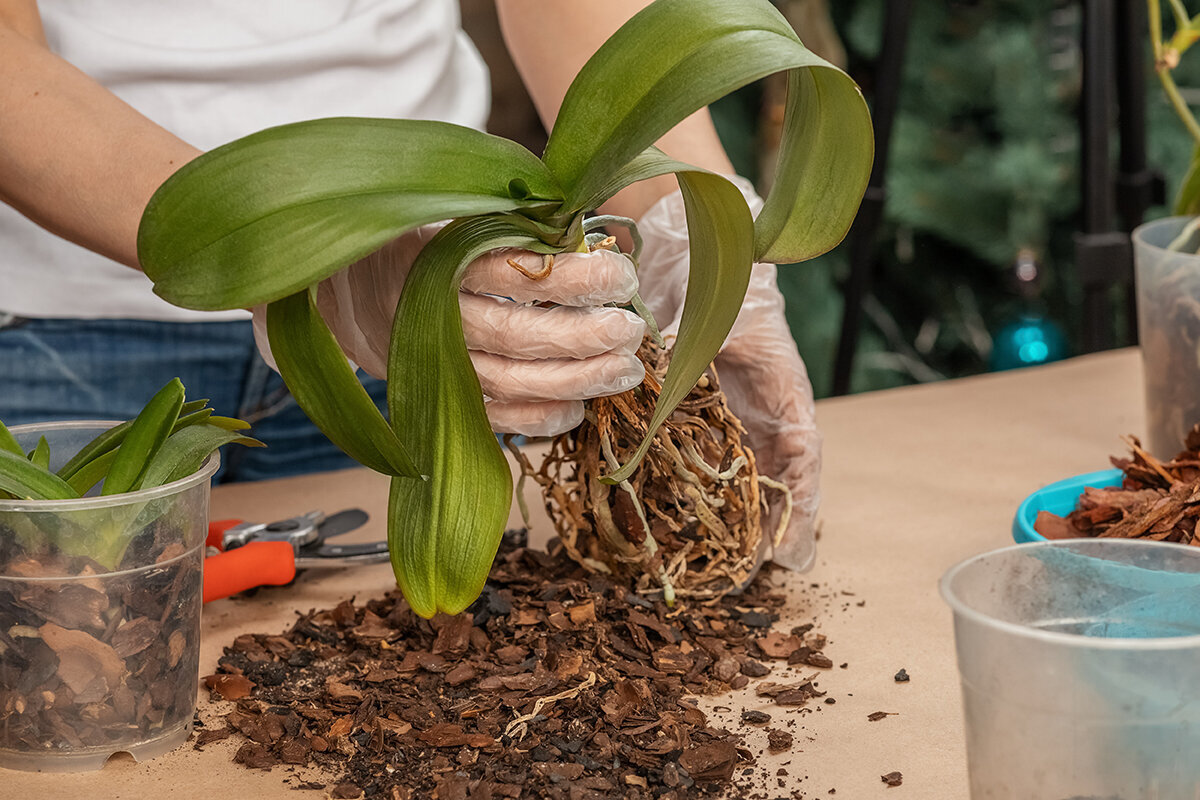
Change the mix when bark visibly decomposes, the centre becomes dense, drainage slows, salts are deposited or expanding roots break the vessel. Many sympodial orchids recover most readily when moved as fresh root growth starts. Sterilise the tools, trim only tissue that is unmistakably rotten or dead, then anchor the orchid so it cannot rock. Increase pot size only modestly: an oversized container can remain damp through an Irish winter and undermine root health.
05 / Let new growth set the schedule
Time feeding and repotting to periods of active development
Water and nutrient demand changes as an orchid makes new roots or leaves, enlarges pseudobulbs, enters dormancy or initiates blooms.
Roots
Leaves
Pseudobulbs
Flowering stems
Dormancy
Freshly emerging root tips indicate a stage when repotted plants settle readily and can make active use of supplied nutrients.
A monopodial orchid extends along one central axis. Protect its vulnerable crown by clearing any water that lingers there.
Thickened stems in sympodial orchids retain reserves of moisture and energy. Keep older pseudobulbs, as they can continue sustaining the next shoot.
Flower spikes may emerge from leaf axils, nodes, mature new growth, shoots or close to the central stem, depending on the orchid. Blanket pruning rules are unsuitable.
Some orchids need a drier, cooler or less nutrient-rich phase. A seasonal rest is not automatically poor care.
Fertiliser: weak, regular, flushed
Choose a completely soluble orchid feed and comply with its maker’s directions. Apply small amounts at regular intervals while that orchid is producing growth. Cut back or stop when seasonal light and warmth diminish, development slows, or the species enters its normal rest. Modest controlled strength is preferable to occasional heavy applications. Pre-wet a parched mix before adding nutrients, and rinse it with plain water about once a month to limit salt accumulation.
New flowers: check the setting first
When a healthy-looking plant fails to bloom, confirm its identity and reassess illumination before anything else. Next examine daily temperature variation, required dormancy, roots, maturity and nutrition. A fully grown Cattleya hybrid usually wants considerably more brightness than Phalaenopsis, while certain Dendrobiums and Cymbidiums rely on a defined cool or dry interval. Advice for another orchid is no reason to use excessive feed, severe cutting or unplanned chilling in an attempt to trigger flowers.
06 / A controlled quarantine area
A valuable collection needs a disciplined threshold
Heat and moisture under glass can hasten outbreaks of disease and pests. Observe every incoming orchid thoroughly before moving it onto the established benches.
Bringing in new plants
- Place each arrival well apart from existing plants, preferably in another growing room or, failing that, within a clearly separated section.
- Examine lower leaf surfaces, axils, young shoots, roots, pot edges and blooms for scale, mealybug, thrips, mites, snails, slugs or suspect lesions.
- Remove dead material, clean the bench and tools, and prevent drainage water from the new plant reaching established orchids.
- Continue checks long enough to reveal problems, including after warmer days. Log the buying date and anything unusual; dated images help track subsequent change.
Interpreting symptoms
- Soft, dark roots or broken-down medium: check drainage, medium condition and watering frequency; isolate the plant promptly if rot progresses.
- Sunken or spreading spots: strengthen hygiene and airflow, separate the orchid, and obtain a reliable identification of the problem before applying anything.
- Sticky coatings or cottony nests: check neighbouring plants for sap-sucking pests, remove them mechanically and repeat necessary treatment consistently.
- Collapsed leaves: resist adding water immediately. Damaged roots, overheating, accumulated salts or dense media may block absorption even while the container remains wet.
Do not make precautionary chemical spraying routine. First identify the problem, then combine physical removal and corrected care with products authorised for amateur garden use in Ireland, strictly following their labels. Avoid sharing tools when rings, streaking or other abnormal patterns appear. For persistent damage or possible virus, seek a specialist orchid nursery, the German Orchid Society or suitably qualified horticultural guidance.
07 / Build the collection calmly and clearly
Group by climate, not flower colour
Watering, screening and inspection become simpler when orchids sharing a bench also share broadly compatible environmental cycles.
Keep moisture-hungry, shade-preferring orchids in an easy-to-check position that still receives circulation. Give raised or more exposed locations to brighter-growing plants that dry rapidly. Put mounted specimens together, preventing their frequent wetting schedule from controlling care for every potted plant. Reserve a small accessible work zone for recent purchases, recovering orchids and tasks in progress.
Use the house’s height as well as its floor. Suspended orchids occupy the lighter, warmer space above, and lower staging may remain more temperate. Never sacrifice access: each plant, label and root area should be within reach and visible. Space between specimens has a purpose, giving you time to spot a developing change before it travels farther.
Your Classic aluminium greenhouse can become a dedicated, screened growing area for orchids instead of overflow storage. Preserve a central route for work and an unobstructed path for air. Set up one reliable intermediate or warm bench, then introduce shade, fans and extra levels in response to observations. For ideas on the structure itself, the Classic aluminium greenhouse illustrates how glazing, dimensions and workable growing space can support a coherent layout in an Irish garden.
Bright levelHanging orchids
Middle benchHardy hybrids
Lower zoneSheltered shade
ThresholdQuarantine
Treat the plan as an opening arrangement rather than an instruction that cannot change. Your greenhouse’s measured brightness, airflow and rate of drying should decide the long-term position of every group.
Frequently asked questions
Questions that arise once growers have completed a season
What temperature range works for orchids under glass?
Orchids do not share one ideal temperature. For initial planning, numerous Phalaenopsis hybrids and similar warmth-loving types often suit 20–29 °C days, provided nights do not stay substantially below 18 °C. Intermediate orchids accept lower night readings, whereas cool types require meaningful respite from summer heat. Follow the named plant’s label above general ranges, and take both daytime and night-time measurements beside the foliage.
Do greenhouse orchids need high humidity?
Moderate or elevated humidity benefits many orchids; figures near 40 to 70 percent are commonly suggested. More important than targeting one reading is maintaining an effective relationship between moisture and circulation. Damp, motionless air promotes overnight condensation and disease, but forceful airflow can dehydrate the plants. Keep air moving gently and steadily, allow foliage to dry properly, and water roots according to each orchid’s condition.
How often should greenhouse orchids be watered?
Wait until the mix reaches the dryness required by that orchid; do not irrigate merely because a set day has arrived. Container size, bark texture, root volume, illumination, heat, humidity, season and current development all alter the interval. Inspect daily if needed, but act on actual conditions. Together, container weight, root appearance and a touch check of the medium give the clearest picture.
Is mains water suitable for orchids?
For hardy hybrids, tap water is often workable, although its chemistry matters. High mineral hardness or dissolved salts may leave deposits in the mix and make feeding harder to control. Consult information from the local supplier and watch for pale crusts. Sensitive orchids may benefit from hygienically harvested rainwater or properly prepared water with low mineral content. Household-softened water can be inappropriate because the treatment may add salts.
Why are orchid leaves wrinkled although the pot is wet?
Wrinkling points to a water imbalance, not necessarily a need for another soak. Rotten roots, degraded compacted mix, salt accumulation, severe heat or pests may prevent uptake from a damp container. Inspect roots and medium, confirm free drainage and check temperatures under glass. Adding water before finding the cause can worsen it.
Will cool-climate orchids cope in a standard garden greenhouse?
They can, but only where suitable conditions persist through the warmest part of the year. Across Ireland, heat accumulating beneath glazing may be more limiting than winter cold. Moving air by itself cannot recreate a cool mist-forest environment in a hot structure. Substantial ventilation, effective shade and careful siting are essential, yet certain specialist orchids may remain impractical.
Technical background
Sources and
further reading
Cultivation guidance differs between genera, species and hybrids. These specialist sources support the general information on epiphytes, roots, greenhouse climate and typical problems. For rare orchids, current advice from specialist growers and documented origin take priority. Editorial review: August 2026.
More from Bloomcabin: greenhouse curtains and premium shading · summer greenhouse care · Bloomcabin greenhouse and conservatory solutions
- German Orchid Society – orchid cultivation knowledge
- University of Göttingen – rainforest house and epiphytes
- Iowa State University Extension – advice on raising orchids
- Iowa State University Extension – identifying problems in orchids
- University of Alaska Fairbanks – managing greenhouse air and climate
- University of Illinois Extension – how epiphytic orchid roots work
