
Hot Tub Delivery: Gates, Access Routes and Lifting Arrangements
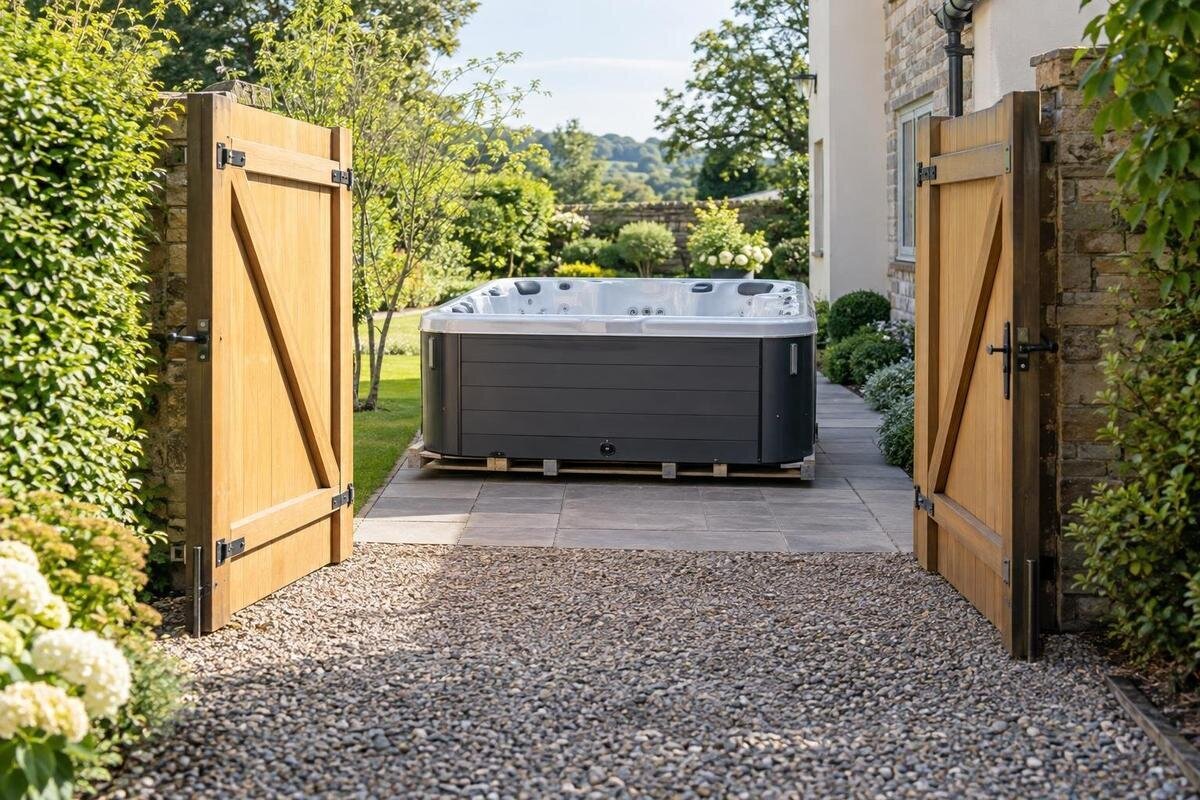
Hot tub delivery access
A hot tub can fit in its intended position and still be impossible to get there. Before ordering, trace the route from the place where the delivery vehicle could stop to the final position, measure the tightest openings and turns, and ask the supplier to assess the chosen model’s packaged dimensions and handling instructions. This replaces a hopeful ‘it should fit’ with a practical, model-specific delivery plan.
01
Mapping the route from the unloading point
Start at the point where a delivery vehicle could actually stop, then walk the proposed route to the hot tub’s intended position. List every section in order: driveway or lane, property entrance, side passage, gate, turns and final approach. Mark where the route narrows, changes direction or passes a fixed obstacle; a wide space at either end does not show whether the load can negotiate the route between them. The aim is to map one continuous way from unloading point to destination for the selected unit and the handling method the supplier approves. If more than one route is possible, sketch each separately rather than combining the easiest measurements from different options.
Draw a simple plan from above and add measured lengths and clear widths to each segment, rather than relying on descriptions such as ‘down the side of the house’. Mark gates, walls, fixed posts, steps and points where a person or equipment would need to turn. Use arrows to show the direction of travel and note whether a gate or door opens into the passage. Take overview photos from both ends and close-ups of pinch points; include a tape measure where it makes a reading clear. Match each photo to the sketch. Mark unmeasured sections as unknown and request a site assessment instead of assuming they are clear.
Measuring gates and narrow openings
Measure each gate and narrow opening at its narrowest clear point: open the gate as far as it can normally swing, then measure between the nearest obstructions, not simply between the posts or from the gate’s advertised width. Check hinges, latch plates, handles, fence caps, wall returns and pipes that project into the passage. Record the clear width at more than one height if the opening is not uniform, plus usable height beneath an arch, lintel or other restriction. Note the opening shape and where the tightest point occurs. If a stop or uneven ground limits the gate’s swing, record that too. Removing a gate leaf is a separate possibility until you have permission and know who would do it.
Compare the route measurements with delivery dimensions supplied for the exact hot tub, not a remembered figure or a photograph. Ask whether the quoted dimensions refer to the unwrapped product or the packaged unit, what packaging remains during movement and which orientation the delivery team will use. Do not assume a tub can be tilted, stood on edge or stripped of packaging to squeeze through. For an enquiry about the Cove 2, ask the supplier for current model-specific figures and confirmation against your narrowest opening. Send measurements in clearly labelled units and say whether handles or other projections are included; do not infer size from the model name.
02
Space needed at turns
A straight passage can be wide enough yet still fail at a corner. At each turn, measure the approach length, the space beyond the corner and the clear area available to rotate or reposition the load. Note inside and outside obstructions—a wall return, downpipe, fence post, step or projecting sill—and photograph the turn from both directions. A sketch with only the path width leaves out the shape of the manoeuvre: the delivery team needs to understand where the package enters, where it must face next and what restricts movement. If two turns are close together, measure the straight section between them as well; the load may need space to be repositioned between corners.
Do not judge a turn by picturing the bare tub alone: the package and the supplier-approved way of carrying or moving it determine the space needed. Ask whether the measured corner can be negotiated without changing the permitted orientation and whether there must be room beyond the opening to reposition the load. Never assume the crew can pivot it, lift it over a wall or turn it on its side. If you are considering Haven 6, include your route measurements and annotated photos in the enquiry so the response refers to that exact model. A diagonal measurement across a corner is not a substitute for the supplier confirming the actual manoeuvre.
Steps, slopes and changes in level
List every step, kerb, threshold and change in level, including a single raised lip that may disappear in a wide photograph. Note the number of steps, approximate rise and tread depth, any landing between flights and the space available at the top and bottom. On a sloping section, record where the slope begins and ends, its direction and the route length; a side-on photograph can make the profile easier to understand. Also note handrails, side walls or other features that narrow the usable width, and whether a landing is large enough for the proposed turn. These observations describe the route—they do not establish that a person, trolley or other equipment can safely move the load over it.
Tell the supplier if access depends on a particular step, ramp, handrail or other feature being moved, and do not treat removal as automatic. Ask what the manufacturer permits for transporting the chosen model and whether the proposed delivery method can handle the recorded level changes. If an answer relies on carrying or lifting rather than a wheeled route, ask who assesses that method and what information they need before quoting. For Bloomcabin Hot Tub Fjord 8, request an assessment that covers every recorded change in level along your route. If a separate specialist is needed, establish who will coordinate that work before setting a delivery date.
03
Surface conditions along the route
Describe the surface along each part of the route rather than calling the whole way paved or clear. Note whether it is concrete, paving, gravel, grass or another finish; flag loose or uneven sections, soft ground, raised edges, drain covers and places where the path narrows. A delivery method using wheels may have different route requirements from one that does not, so a surface that is easy to walk on is not proof that it suits the planned equipment. Point out any cover that could shift or any edge the package or equipment would have to pass. This is access information, not an assessment of the final base or support.
Add close-up photographs where the surface changes or has a damaged, loose or sloping section, and say whether its condition varies after rain or at certain times of year. Mention temporary obstructions that could be present on the delivery date, such as a vehicle, bins or a gate that is usually locked. If any part of the path is shared with others, mark that section on the plan and raise it with the supplier in advance. Ask which transport equipment is proposed and what surface conditions it requires. Do not promise that a path will be usable simply because it appears firm in dry weather or because you can walk along it comfortably.
Overhead obstacles and low clearances
Look above the whole route as well as at ground level. Record low eaves, gutters, branches, canopies, lights, clothes lines, archways and overhead cables, noting where each begins and ends and the lowest point you can identify safely. Measure available height only if you can do so without climbing or putting yourself near a hazard; otherwise mark it for a proper assessment. Include low points at gates and turns, not just over the open path. A short obstruction may matter more than a long passage if the package has to pass beneath it in a particular orientation, so photograph the obstacle together with the route below and from the direction of approach.
Compare the overhead measurements with the packaged height and approved handling position supplied for the model; the bare product’s height is not a substitute. If access appears to depend on trimming a branch, removing a fixture or moving a line, identify that before ordering and establish who can arrange it and whether permission is needed. Do not touch cables or dismantle fittings to create clearance. Ask the supplier to assess your photos and measurements for Aurora 10 against its current handling information. Record any work needed to create overhead clearance as an outstanding condition of the plan, rather than describing the route as already clear.
04
Vehicle access and unloading space
Check how the delivery vehicle would reach the proposed unloading point, not just whether a car can enter the driveway. Note entrance width and height, turning or reversing space, the road or lane approach, surface, gradient, low branches and where a vehicle could stop. Tell the supplier if access is limited by a narrow lane, parked cars, a shared entrance or a time restriction. Ask what type and approximate size of vehicle the quoted service assumes, whether it needs a particular approach and what unloading space is required. If a large vehicle cannot enter, the alternative stopping point must be assessed as the start of the remaining route; ask whether it can manoeuvre and leave from there too.
Agree exactly where delivery ends. A quote may describe transport to a kerb, driveway, property entrance or another unloading point; the word delivery on its own does not tell you whether the team will move the hot tub through the garden to its intended position. Ask what equipment and labour are included, who moves it beyond the vehicle and which route the crew will use. If the vehicle must stop outside the property, ask the supplier to assess the full remaining path from there. Record the answer for Bloomcabin Hot Tub Cove 2 or whichever model you choose; do not assume the same arrangement applies to every order.
Handling options and lifting responsibilities
If the measurements reveal a restriction, ask the supplier to compare options rather than deciding in advance that a crane is necessary. Depending on the exact unit, access route and service offered, ordinary unloading equipment, specialist handling or a crane may be considered; only a site-specific assessment can establish whether an option is available and workable. A crane is one possibility to discuss, not a conclusion drawn from a narrow gate. Ask whether the supplier assesses access from photos, arranges a site visit, provides a lifting service itself or works with a separate contractor. Find out what information each party needs before you commit to an order, and whether the delivery and any lifting work need to be coordinated.
Clarify who is responsible for each part of the arrangement: the supplier, delivery company, lifting contractor, property owner or another party. Ask who provides equipment and operator, who confirms that the route is ready, who checks whether access or traffic arrangements are needed, and who decides what happens if the agreed method cannot be used. Also ask how the tub and surrounding property are to be protected, and which party handles a damage claim. For Bloomcabin Hot Tub Haven 6, have the supplier tie its response to that exact model and the applicable handling information, not just a general description of hot tub delivery. Put responsibilities in writing.
05
Permissions, insurance and possible extra charges
Ask for access-related costs in a written quotation before committing. The supplier should state what standard delivery includes and whether the price assumes a particular unloading point, vehicle, route or crew. Possible cost variables include a site survey, specialist lifting equipment or contractor, extra time, a restricted vehicle approach, traffic management or a return visit; these are matters to ask about, not charges to assume. Ask which items are included, which are optional and what could change the quoted amount if the route differs from the information you supplied. Request a revised written quote if the proposed access plan changes.
If a lift or vehicle would use a shared area, a neighbour’s land or public space, ask the supplier what permissions or traffic arrangements may need checking and who will verify them with the relevant owner or authority. Requirements depend on the exact location and plan, so do not assume one Irish rule applies to every site. Ask whose insurance covers the delivery and any lifting operation, what property damage or exclusions are relevant, and whether written evidence can be provided. Have the estimate for Fjord 8 identify its assumptions, any separate contractor and who is responsible for confirming permissions and cover.
Model-specific confirmation before ordering
Before treating the route as workable, obtain the manufacturer’s current dimensions for the exact model, including the packaged dimensions, and its weight and handling instructions. Check what each measurement refers to, whether packaging stays on during movement and whether the instructions specify a permitted orientation or lifting points. Ask for information that covers transport of the packaged item, not only the product’s intended position after delivery. Give the details to the supplier or delivery specialist and request written confirmation that the measured route, planned vehicle and proposed handling method are compatible. Ask whether photos and measurements are sufficient for that assessment or whether an in-person review is needed. For Bloomcabin hot tub Aurora 10, request the relevant figures rather than estimating them from the name.
Keep a short record of the decision: a route sketch, measurements, dated photographs, exact model, written delivery scope, proposed lifting method and responsibilities, confirmed costs and permission checks. If the plan depends on moving an obstacle, using a particular vehicle stopping point or arranging specialist equipment, treat that as unresolved until the responsible person confirms it. A verbal estimate or a response that says only that delivery should be possible is not a firm route plan. If no workable route or confirmed alternative emerges, pause before ordering and ask whether another model or a professional site review is the sensible option. The decision should reflect the access route you have, not the appearance of a product image.
Frequently asked questions
How should I measure a garden gate?
Open it as far as it can normally swing, then measure the clear gap between the closest points of the gate, hinges, latch, posts or walls. Check the opening at more than one height if it narrows, and record the usable height too. If the gate leaf would need to come off, treat that as a possible change, not existing clearance, and confirm who can remove it and whether you have permission.
Should I use the hot tub dimensions or the packaged dimensions?
Ask for both, and ask which measurements the delivery team uses when assessing the route. Packaging and the approved way of transporting the unit may affect the space required; do not assume the unwrapped product’s footprint represents what has to pass through a gate. Send the figures for the exact model and ask the supplier to compare them with your measurements.
Does a narrow gate mean I need a crane?
Not necessarily. A crane is one option to discuss, but whether lifting is suitable depends on the exact unit, its packaging, the route, overhead obstacles and the available unloading space. Ask the supplier to assess the model and site before arranging anything. Do not book a lifting service based on gate width alone or assume that a particular method will be available.
What does hot tub delivery include?
Confirm the scope with the supplier rather than relying on the word delivery. Ask where the vehicle will unload, whether the crew will move the tub from there to its intended position, what equipment and labour are included, and whether a separate lifting contractor is needed. Get the agreed end point and any additional work in writing.
What if the route uses a neighbour’s land or public space?
Ask the supplier who will check whether permission or traffic arrangements are needed, and confirm the answer with the relevant property owner or authority. The details depend on the location and proposed plan, so do not assume one requirement applies everywhere. Also ask whose insurance covers delivery or lifting and who is responsible for checking it; record these points in writing.
Treat access as part of choosing a hot tub, not a problem to solve after ordering. A workable delivery plan connects the vehicle’s stopping point to the intended position and accounts for the chosen model, the route’s restrictions and any lifting arrangements. If an obstacle still needs moving or specialist equipment has yet to be arranged, keep that condition open until the responsible party confirms it. Order once the route and agreed delivery service work together.
