
Is a Greenhouse Worth Having in Shade or Part Shade?
Assessing your garden site
Is a Greenhouse Worth Having in Shade or Part Shade?
A shaded greenhouse is worthwhile when the intended jobs, chosen crops and expected results reflect the light that reaches it. Count more than bright hours: consider their timing, the objects casting shadows and whether your growing plan can change with conditions.
In brief: part shade often works; deep shade needs a defined purpose
Part shade may suit salads, herbs, seedlings and numerous leafy vegetables. Tomatoes, peppers and aubergines, by contrast, generally perform better with reliable direct sunshine because they demand greater warmth and light. Study how the site changes through the seasons before selecting the greenhouse.
Heavy shade need not disqualify the site, although it seldom supports a typical summer-vegetable scheme particularly well. Instead, the structure might serve for propagation, harvesting or sheltered garden work. Expect to manage airflow, irrigation and lingering moisture more closely.

01
A good starting point
Several bright intervals can make part shade viable, particularly when sunshine extends beyond the cool early morning.
02
A challenging position
Long-lasting shadows from structures or thick vegetation reduce heat and light, complicating demanding fruit-crop plans.
03
Buying decision
Observe the position first; only then decide on dimensions, construction and fittings that suit its genuine light levels.
Practical guidance for parts of the garden receiving limited sunshine.
An entirely sunny corner is absent from many gardens. Walls, established hedges, old trees and nearby properties reshape the available light by hour and season. A greenhouse may still be viable, but the position deserves honest appraisal: restricted sun alters temperature gain, plant development, moisture and the range of realistic crops more noticeably than an exposed sunny plot.
Part shade should not be confused with unbroken heavy shade. Morning or afternoon sun may support a useful range of planting. Under a broad canopy, or beside a north-facing wall that rarely brightens, summer crops needing abundant light become harder to grow. Watching your own plot carefully provides a sounder basis for judging whether the benefits justify the work.
The discussion here is deliberately limited to suitability for lower-light positions. It covers ways to read the available light, separate manageable shadows from troublesome ones and shape a workable growing purpose. That turns a broad buying question into a reasoned choice grounded in your plot and gardening priorities.
Inspection 01 · Checkpoint 01
Assess light patterns, not snapshots
Do not rely on how bright the garden feels during one visit. Watch the proposed position over several days, checking morning, midday and afternoon conditions and noting when direct sun enters and leaves. Repeat this in different seasons: lower spring sunshine and changing vegetation can produce a markedly different pattern from high summer.
Record direct rays separately from bright ambient light. Diffuse brightness can support certain plants, yet contributes less solar warmth indoors. Plot each shadow cast by the dwelling, boundary, shed and vegetation. The resulting notes distinguish momentary cover from regular partial shade and long stretches without sun, giving later decisions a reliable foundation.
Include the visible sky in your assessment rather than mapping only the future footprint. A slim sunny band may travel across the site without illuminating every bed. Add its edges to a drawing of the plot. This will help position benches, shelves and plants where each can use the available brightness sensibly.
- Keep a light diary across different weekdays, recording both cloudy and sunny conditions.
- Give spring conditions particular attention because early seedlings and propagation depend heavily on adequate brightness.
Once you understand a garden position clearly, a standard Classic greenhouse can become a practical starting point for your chosen growing purpose.
Inspection 02 · Checkpoint 02
Identify sources of shade
Trees and buildings produce different shadow patterns. A wall tends to cast a defined, predictable area whose duration follows the sun’s route. Tree cover shifts, flickers and changes as the year progresses. Emerging leaves reduce brightness, while roots, leaf fall and water dripping from branches introduce further practical considerations.
A location under a thick canopy presents particular difficulties: illumination is weaker, drying takes longer, and falling leaves or branches add maintenance. A position beside a wall may be more promising when ample sky remains exposed. Confirm that the foundation fits and that access, doors, windows and paths can stay unobstructed.
Pale walls and hard landscaping may bounce light into a darker corner and make it look more promising. Reflected brightness, however, is not a substitute for direct sunshine. Review the site under varied skies rather than trusting an unusually radiant summer afternoon; the pattern that returns repeatedly is the useful measure.
Trace water arriving from eaves and overhead branches as well. Repeated drips can alter surrounding moisture, path conditions and routine upkeep.
- Around trees, account for leafy summer cover together with roots, branches, leaf fall and future maintenance.
- Judge each wall individually, taking its aspect, clearance and visible portion of sky into account.
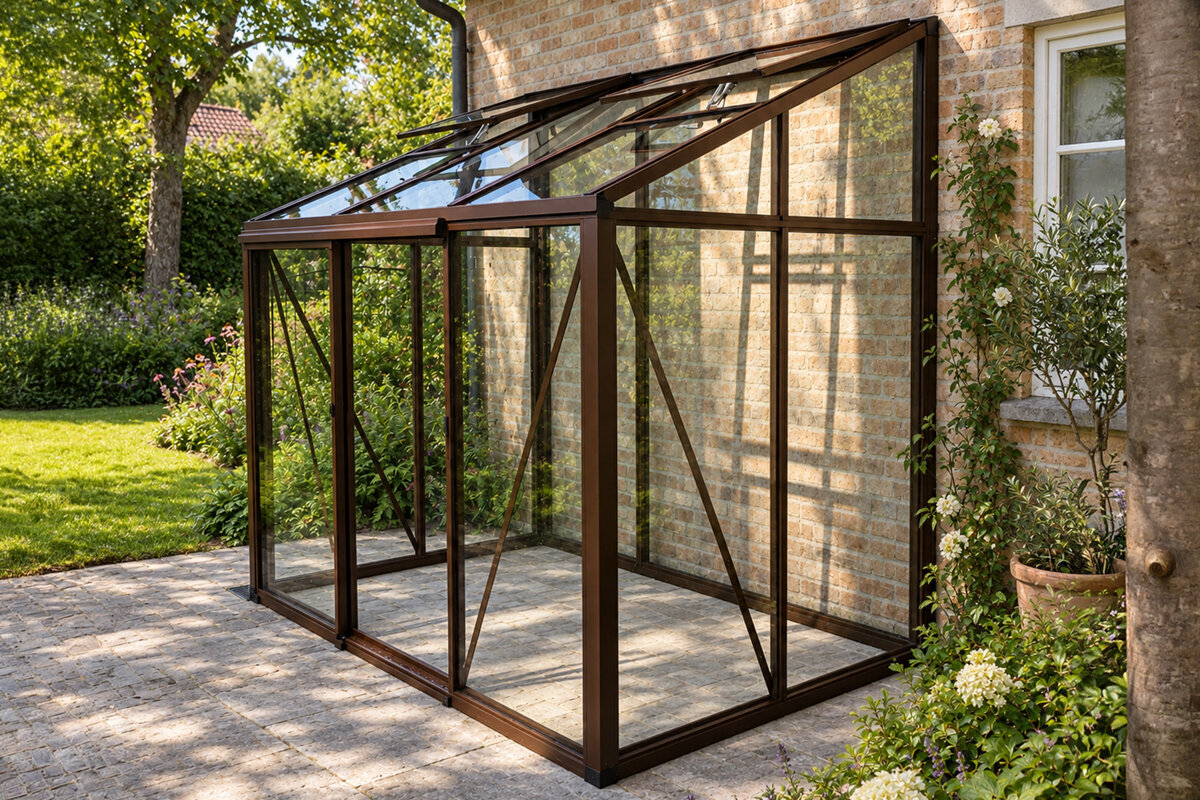
Along a suitable clear section of wall, a substantial lean-to greenhouse may organise that outdoor area effectively.
Inspection 03 · Checkpoint 03
Match part shade to the right use
Use the particular advantages of a partly shaded position. Leaf vegetables, culinary herbs, seedlings and crops favouring cooler conditions generally ask for less solar energy than Mediterranean fruiting plants. The greenhouse may instead provide shelter for pricking out, vulnerable pots, season extension or other tasks where intense summer heat is unnecessary.
Arrange planting around the calendar as well as species. Spring makes each brighter interval valuable, whereas softer illumination may moderate conditions during summer. Autumn brings a further decline in intensity and exposes the limitations of an already dim location. Rotating crops to suit each season prevents expectations from exceeding what the position can deliver.
Divide the interior according to brightness. Give the sunniest pockets to demanding plants, while using dimmer sections for herbs, seed raising or equipment. Check whether tall growth throws new shadows across adjacent beds. Containers that can be moved and a flexible layout let you respond as the seasonal pattern shifts.
- Give the brightest zone to sun-seeking fruit crops and place sturdier leaves and herbs around the margins.
- Revise the planting arrangement each season rather than repeating one sequence despite altered illumination.
For adaptable planting on an open garden plot, the standard Classic greenhouse gives changing crops an accessible setting.
Inspection 04 · Checkpoint 04
Consider warmth, moisture and airflow
Reduced sunshine usually slows warming. While welcome in very hot weather, this also means plants and growing media remain wet longer during cool spells. Moist leaves or surfaces do not by themselves make the site unsuitable, but they require careful management. Irrigate only when required, prevent pooling and monitor the actual movement of air indoors.
Shade does not remove the need for active ventilation. Base opening and closing decisions on current heat, humidity and weather rather than a fixed timetable. A corner enclosed by a wall and thick hedge may escape strong wind yet receive poor circulation. Preserve space for air and maintenance instead of crowding paths and planting areas.
Sun exposure is only one influence on dampness. Dense planting, saturated paths and tight clearances beside other structures may all slow evaporation. Maintain sensible spacing and inspect low-level areas and wall edges often. A tidy arrangement makes condensation, excess moisture and emerging maintenance issues easier to notice before they develop.
- Before adopting a watering schedule, inspect morning condensation, leaf wetness and moisture in the growing medium.
- Leave clear space outside vents and doors so vegetation, containers and stored objects cannot restrict airflow.
If the side of the house proves suitable, a substantial wall-attached lean-to greenhouse provides a convenient space that is easy to monitor during daily care.
Inspection 05 · Checkpoint 05
Choose crops without unrealistic expectations
Many gardeners chiefly associate greenhouses with tomatoes, cucumbers, peppers and aubergines. Those plants normally respond strongly to generous sunshine and warmth. Under heavy shade, growth may be slower and ripening uncertain. If harvesting these crops is your priority, allocate the best-lit position and remember that glazing cannot compensate for inadequate incoming light.
Salad leaves, spinach, Asian greens, parsley, chives and seedlings offer different possibilities. A cooler microclimate may suit them, subject to the variety and time of year. Use modest test batches before filling every bed. Results from your garden then provide practical evidence for adjusting future crop choices and rotations.
Match the planting plan to the time you can spend gardening. Weekend-only care often favours a straightforward group of robust crops over a complicated mixture. Keep notes after your first attempts, identifying what remained manageable in that position. Such local experience will guide the following season more effectively than a generic list.
Everyday convenience matters as well. A nearby entrance encourages frequent observation, whereas awkward access may undermine the usefulness of an otherwise brighter location.
- Before buying, define your key crops and give each a realistic light requirement.
- During the first growing season, compare several zones instead of confining sensitive plants to the darkest corner.
For trial crops and beds that change, the Classic greenhouse standard model offers a sound base for an evolving planting scheme.
Inspection 06 · Checkpoint 06
Choose the form for your garden
Appearance is only one consideration when choosing the structure; the form must also suit space, approach routes and illumination. A freestanding model can occupy the portion with the widest exposure to the sky. Also consider water, paths and future landscaping, since maturing trees, new screening or planned shrubs may darken a currently open location.
Placing the greenhouse at a wall can shorten the walk and use an awkward strip efficiently, but success in part shade turns on aspect and surrounding obstructions. Measure the footprint and leave room for foundations, maintenance and door travel. Before ordering, review installation needs and ask the local planning authority about requirements applying to the proposal.
Plan circulation routes alongside the structure itself. A conveniently placed doorway simplifies harvesting, routine inspections and moving water or growing media. Keep adjacent ground available for doors, tools and upkeep. Beside a dwelling, existing planting, windows and rainwater pipes may constrain the arrangement and should appear on the plan from the outset.
- Add the footprint, doorway, access path and usable beds to an accurately scaled drawing of the garden.
- Include planned planting and privacy features so that later growth does not erase the present lighting advantage.
Where a suitable house wall is available, you might examine a conventional, full-height lean-to greenhouse while allowing generous access around every relevant side.
Inspection 07 · Checkpoint 07
Test the site before buying
A temporary on-site trial gives stronger evidence than guesswork. Outline the proposed dimensions or set containers around them for several weeks. This shows the shadow’s path, the comfort of the approach and places where rainwater remains. Taking photographs from one viewpoint at consistent hours makes comparisons between days much clearer.
Use this trial to define the greenhouse’s main job. Perhaps you want herbs close at hand, extensive beds, or chiefly somewhere to raise seedlings. Moderate brightness near the house may support everyday activity better than a remote sunny corner. Decide which benefit matters most, then judge what trade-off you are prepared to accept.
Repeat the mock-up after contrasting weather if possible. Soft ground, pooling water and uncomfortable access may then become apparent. Check whether fences, hedging or outdoor furniture reduce the space available for work. Testing the complete arrangement before construction exposes conflicts while they can still be resolved easily.
- Use string or stakes to outline the footprint and entrance, revealing real sightlines, passages and moving shadows.
- After rain or routine gardening, record standing water, dripping edges and any restricted passageways.
When the trial confirms the location, a freestanding Classic greenhouse can be positioned where daylight and practical movement complement one another.
Inspection 08 · Checkpoint 08
Secure your decision for the long term
Part shade can justify a greenhouse when you value more than the largest possible summer yield. Consider seed raising, sheltered work, seasonal planting and gardening enjoyment together. Compare versions against the measured plot, intended foundations and purpose. For current specifications and available options, make an individual enquiry instead of relying on general price assumptions.
Study the current product details, assembly instructions and written conditions before purchase. Identify any ground preparation and refer uncertain local matters to the appropriate authority. If the greenhouse might be added to household or buildings insurance, describe the exact proposal to the insurer. These steps address the administrative side of choosing the position.
Summarise the assessment under five practical headings: available light, usable area, preferred crops, access and required care. The list exposes compromises and makes product comparisons more focused. A location intended for only a limited set of tasks can still be successful, provided the planting plan and expectations reflect those limits.
- Put a purchase decision on your priorities only after a light diary, site measurements and a clear crop plan.
- For foundations, boundary distances or insurance cover, obtain binding advice from the relevant contacts.
For a wall-side plan with a clear use in mind, consider a house-wall lean-to greenhouse in a full-size format using current product information as your basis.

Comparison
Comparing site types
This comparison is a starting point rather than a substitute for studying the plot itself. Base crop and maintenance expectations on when light arrives, how long it lasts and its character at that exact position.
| Site type | Light pattern | Suitable focus |
|---|---|---|
| Open sunny site | Long direct sunshine, usually warming well. | Wide crop choice, including heat-loving fruiting vegetables. |
| Light part shade | Direct sun in clear daily windows. | Salads, herbs, propagation and selected fruiting crops. |
| Part shade by a wall | Sun windows depend on orientation and building shade. | Short routes; check light and access carefully. |
| Dense tree shade | Variable light, often with more moisture. | More specialised use, resilient leafy crops and propagation. |
| Continuous building shade | Little direct sun, slow drying. | Plan only with very modest harvest expectations. |
A five-step plan
Follow these stages to judge a shaded greenhouse location before deciding which construction and dimensions to order.
01
Map the light
Review the proposed ground morning, midday and afternoon and repeat the exercise across seasons where practical. Distinguish direct rays, ambient brightness and persistent shadow.
02
Identify the shade source
Assign every shadow to a cause: building, hedge, tree or future planting. Check how dependable and seasonally variable that cause is.
03
Prioritise use
Decide whether propagation, herbs, leafy vegetables or heat-loving fruits matter most. A clear priority reveals site compromises.
04
Simulate the space
Outline the base, doorway and working paths. After rainfall and during normal garden activity, verify that drainage, access and maintenance remain convenient.
05
Check the information
Match the proposed setup and measurements to the latest product details. Settle planning and insurance queries, where relevant, before making the commitment.
Checklist for shaded sites
Complete this review before selecting a structure for a garden area receiving partial or sustained shade.
01. Sunlight was checked at different hours and under more than one day’s conditions.
02. The source of shade is identified, including changes through season or growth.
03. The priority crops are realistic for the recorded brightness rather than based solely on preference.
04. A plan exists for ventilation, need-based watering and drying damp areas.
05. You have physically outlined the base, doorway, working paths and space required for upkeep.
06. The effects of trees, hedges, run-off and repeated dripping have been assessed at the proposed location.
07. Current product instructions guide preparation of both the foundation and installation.
08. Planning questions and any insurance implications are investigated individually when relevant.


Questions gardeners ask about shaded greenhouses
Can a greenhouse in part shade be worthwhile?
It can, especially if useful daylight recurs or sunshine reaches the structure during part of the day. Leaf vegetables, herbs and seedlings may be suitable occupants. First map the changing illumination, and avoid basing the purchase entirely on summer crops that require abundant warmth.
What level of sunshine is useful?
No single duration applies to every garden because crops, season and the source of shadow all affect the outcome. Abundant sun favours a diverse collection of warmth-seeking plants. Seedlings, herbs and leafy vegetables may manage with bright partial shade. Base the decision on the sunny intervals recorded on your plot.
Is tree shade more problematic than building shade?
Neither source is always worse. Trees create shifting cover that changes after leaf emergence, while dripping and fallen debris add upkeep. A building casts a more stable shadow, though that shadow may remain heavy for hours. Compare how long each lasts, when it occurs and how much unobstructed sky remains visible.
Which plants suit a shadier greenhouse?
Begin with small amounts of spinach, salad leaves, herbs or seedlings. The best cultivars and positions will vary with season and actual illumination, so compare different parts of the interior. Reserve the brightest section for warmth-seeking fruit crops and set more modest yield expectations than you would for an open sunny site.
Can a greenhouse make up for missing sunlight?
Glazing provides shelter rather than creating sunshine. When incoming light is weak, the ground and interior tend to gain heat more slowly, and plants cannot receive light that never reaches the position. The benefit therefore comes from appropriate crops, attentive management and a purpose suited to the site’s genuine conditions.
Must an Irish garden greenhouse have planning permission?
Requirements vary with the site, dimensions and design. Do not infer exempt status from general guidance or another county’s experience. Ask the relevant planning authority to assess the proposal, especially near boundaries, with foundations or against a wall. Irish exemptions carry conditions and do not answer every site-specific planning question.
Plan your site consciously
Conclusion: assess light honestly, plan use accordingly
The case for a shaded greenhouse rests on how well its purpose reflects your garden, not on a universal promise. Bright partial shade can support seed raising, herbs and leaf vegetables. Where illumination stays weak, narrow the crop selection and adjust likely yields to match the conditions.
Keep a record of light and test the proposed footprint before committing. The results should indicate whether a wall-side or freestanding position is more practical and what role will remain rewarding. A measured assessment favours the structure that works with your gardening routine, rather than the idea that merely appears sunniest.
Explore greenhouse options once you have carefully considered the light pattern, dimensions and crops you prefer.
