
Powdery Mildew in the Greenhouse: Stop the Second Surface
Plant health · Greenhouse guide
Powdery Mildew in the Greenhouse: Stop the Second Surface
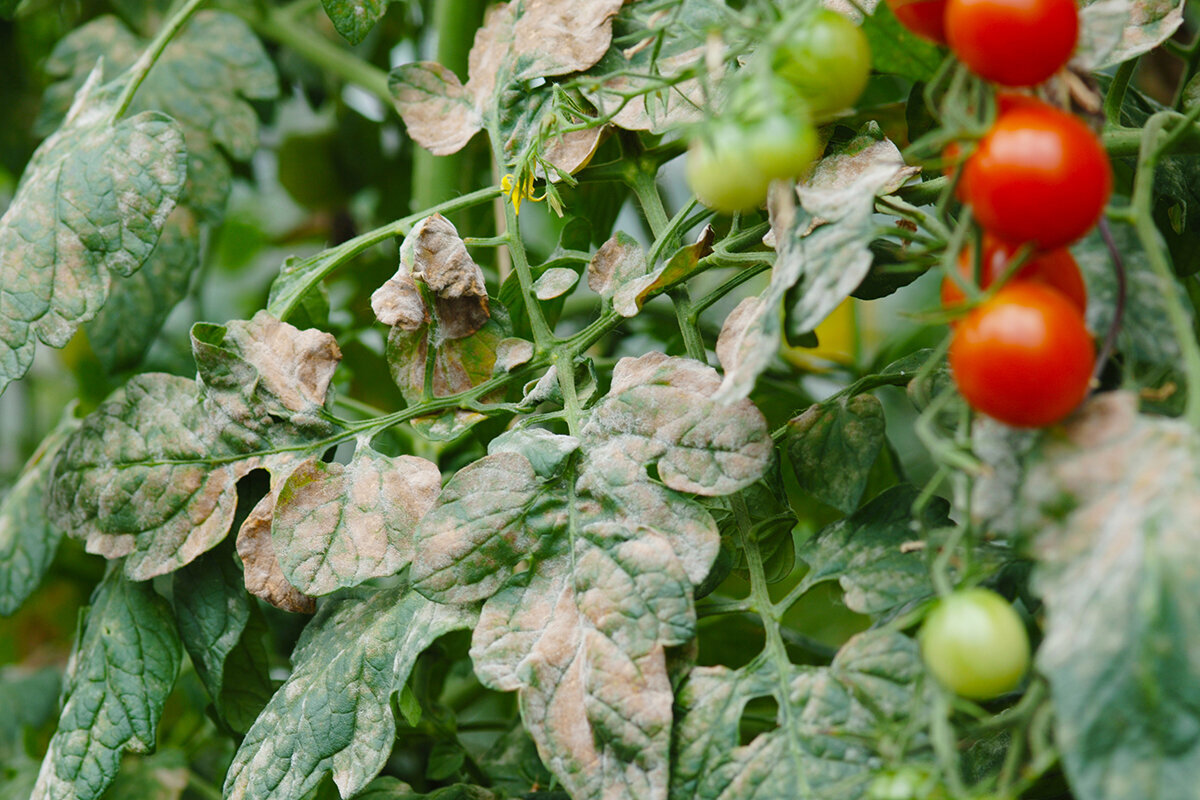
Seen across the greenhouse, a whitish dusting may seem insignificant. When it sits on living leaves, pause and act methodically: determine what coats them, curb transfer, and create better surroundings for emerging, unmarked foliage.
+
Diagnosis note A white mark is not automatically mildew; nor does rubbing off fungal growth restore infected tissue. Sound action requires accurate identification, isolation, a more open canopy and treatments lawfully authorised for that particular crop.
First response
Contain it first, then investigate the cause
A glimpse of white often sends growers straight to the spray bottle because powdery mildew is familiar. Pause instead. First keep a possibly active patch from spreading across surfaces throughout the house, without destroying clues needed for identification. These fungi occupy living host tissue; their spores can be moved by air, hands, clothes, tools and ordinary tending. Yet each infection is not equivalent. What develops on courgette cannot, by itself, identify a light deposit found on rose, mint, cucumber or zinnia.
That caution becomes crucial where a greenhouse holds many kinds of plants. Food crops share space with ornamentals, seedlings with established containers, and resistant varieties with sensitive ones. A control or growing practice that suits one species may be unsuitable or lack authorisation for another. Begin with the affected plant, the way symptoms are distributed and the immediate growing conditions, rather than reaching for a universal household remedy.
01
Limit movement Move affected pots or trays apart, provided you can lift them without touching sound leaves. Stop foliage meeting adjacent plants and use a position that is straightforward to monitor.
02
Record both leaf surfaces Take a close photograph of the coating and another showing where the whole plant stands. Record any symptoms on fresh shoots, older foliage, shaded interiors, stems, buds or flowers.
03
Check neighbouring plants Inspect at least as far as the next row. Focus on dense plant centres and areas by glazing, walls, shelving and obstacles in the airflow.
04
Reconstruct conditions A sequence of warm days, cool nights, closed vents, crowded leaves, evening watering or condensation reveals more than a single humidity reading taken centrally.
Lookalikes
Read the coating, not just its colour
Powdery mildew commonly forms a white or greyish layer with a dusty or fine felt-like texture. Small patches expand and may join into larger areas. Dried sprays, lime-rich water deposits, natural leaf wax and unrelated diseases can produce light-coloured traces too. Visual examination offers an initial indication, never laboratory confirmation. Do not rub several leaves while checking: friction may distribute spores and injure tender tissue.
Soft colony Droplet edge Natural wax layer Tissue damage
| Surface checked | What it looks like | Pattern across the plant | Low-risk check | What the quick check cannot show |
|---|---|---|---|---|
| Powdery mildew | Soft white, cream or grey colonies; circular patches may merge into a powdery veil. | Leaves and tender shoots are usual sites. The particular fungus and host determine whether upper surfaces, undersides, stalks, buds or blooms are involved. | A small colony may transfer partly to a dark, dry cloth. The leaf can become dull, yellow, distorted or later develop brown or corky areas. | Visible powder may be removed partly although fungal structures remain connected to living plant tissue. |
| Spray residue | A more even film, dots, droplet rings or streaks; the surface may shine rather than look fluffy. | The deposit often follows the spray pattern and repeats on exposed leaves, pots, labels, glass or nearby surfaces. | Relate the marks to recent spraying, the water used and the direction of the nozzle. Examine protected undersides as well. | Residue and mildew may occur together when an already infected crop has been sprayed or treated. |
| Mineral deposit | Chalky patches or hard rings left after individual droplets dry. | Typical on leaf tops, glazing and dark pot rims after overhead watering or spraying with mineral-rich, hard water. | Look for the same residue on non-living surfaces. The trace usually follows a dried droplet’s edge. | An early infection may hide beneath water marking, so monitor how the tissue changes and inspect emerging leaves as well. |
| Natural wax layer or hairs | Uniform bluish-white or silver colouring incorporated into the surface, unlike distinct colonies that enlarge unevenly. | A comparable covering is usually found on healthy foliage, stalks or fruit belonging to that variety or species. | The coating belongs to the plant’s outer layer and does not advance as separate, cloud-shaped patches. | Do not rub hard. Natural wax layers may protect the plant and vary with species, variety and growing conditions. |
| Other leaf diseases | They may start pale but develop angular spots, grey mould, water-soaked lesions or dead tissue. | The pattern may follow leaf wetness, splash, injuries or the particular susceptibility of a crop or plant family. | Look for necrotic centres, yellow halos, differently coloured spores, stem lesions, angular margins or rapid collapse. | Where symptoms remain unclear or a valuable food crop is involved, plant-health advice is more dependable than diagnosis by sight alone. |
Use this table for preliminary sorting only. Wiping provides no diagnosis, and host species can alter how powdery mildew appears.
The hidden space around the leaf
Acceptable room readings may mask motionless foliage
Conditions measured in the greenhouse do not fully describe those beside a leaf. Warmth, moisture and moving air vary among crowded foliage, behind containers, below shelving and deep inside shaded plants. Even when the wider house seems well managed, this narrow boundary layer may favour mildew.
Tight spacing narrows the air route
Leaves that overlap create shade, but they also obstruct circulation, postpone drying after irrigation or overnight moisture, and hide the first patches. Space plants for the width they will reach at maturity rather than for the footprint of each container on arrival.
Cooling activates retained moisture locally
Plants and compost release moisture during a warm day, and some remains inside afterwards. Falling temperatures increase relative humidity, while cooler surfaces may collect condensation. If the weather and crop permit, ventilating promptly and adding modest late-afternoon warmth can provide a drier start to the night. Plant requirements, outdoor temperature and energy demand should guide the choice.
Shade changes the microclimate as well as light
Crowded interiors, shelf corners kept in shadow and leaves held against walls tend to be cool with poor air movement. Numerous mildew species favour mild temperatures, shade and humid air, yet respond differently when water coats the leaf. One universal humidity rule cannot account for this.
Weak circulation and harsh draughts are different problems
Directing a fan continuously at one crop may dehydrate or strain certain leaves while nearby rows receive no movement. Seek a mild flow throughout the foliage, alongside an unobstructed passage that carries used indoor air out and draws outside air in.
The host matters
Powdery mildew is not one single disease
Many powdery mildew fungi have a narrow range of suitable plants. Their seasonal pressure, symptom location and useful controls consequently vary with both pathogen and crop. Treat the groups below as prompts for closer observation, not as a diagnosis. When selecting seed or young stock, look for recorded tolerance or reduced susceptibility that specifically names the relevant species and variety.
I
Cucurbits
Cucumbers, melons, courgettes and squash may develop conspicuous light colonies spreading across their foliage. Vigorous growth quickly produces a shaded canopy that is difficult to examine, especially when neighbouring vines have been tied in too close together.
- Inspect older and inner leaves.
- Train vines neatly, openly and accessibly.
- Verify resistance information against the named crop.
II
Herbs and edible leafy crops
Mint, sage, rosemary and the many other herbs differ in their host relationships. Closely packed containers and shallow picking still produce concealed pockets. For edible plants, comply with the product’s authorised scope, label, harvest interval and stated purpose.
- Keep ornamental-only treatments away from edible plants.
- Harvest only with clean tools.
- Do not let pots grow into one closed canopy.
III
Flowering and ornamental plants
Rose, zinnia, petunia and verbena can be susceptible but do not always show the same picture. Alongside powdery growth, distorted new shoots and dry, corky or scabby areas with little visible white may occur.
- Examine lower leaves, developing shoots and flower buds.
- Keep new plants apart for observation before bringing them in.
- Record variety observations over several seasons.
IV
Overwintered and permanent stock
Plants kept through winter, surviving host material and year-round crops may carry certain host–pathogen pairings from one season into another. Consequently, living hosts inside an apparently clean post-summer greenhouse still require regular inspection.
- Inspect overwintered plants thoroughly before spring filling.
- Remove remaining diseased tissue.
- Keep propagation separate from mature stock where possible.
Work from the affected crop itself: identify it, then select control accordingly. Authorisation, specialist advice and cultivation practices must all relate to that plant, rather than simply to the category “powdery mildew”.
Air choreography
Give air a route and foliage enough room
Ventilation replaces indoor air, allowing warm moisture-laden air to escape as outside air comes in. Circulation, by contrast, moves air around inside. Each process loses effectiveness when shelving is overcrowded or foliage forms a barrier. Judge conditions with plants at their current mature size, rather than recalling the sparse arrangement used for young stock.
Our Classic Aluminium Greenhouse offers configurable choices for glazing, roof vents and equipment while preserving an easily organised cultivation area. Its page sets out available dimensions, openings and design details for the Classic Aluminium Greenhouse.
Upper outlet
Rising air ↑ route
Roof opening
Circulation fan
Open canopy
Sheltered zone
Lower inlet
Clear route →
Remove obstacle
Morning: Inspect leaves and overnight condensation before daytime warmth erases the evidence. This is the best time to find misted panes, cool interior foliage, drips and persistently stagnant corners.
Midday: Open vents, adjust shade and circulate air so excess heat escapes without stagnation among the leaves. Aim the fan along a row with a mild flow instead of continually buffeting a single plant.
Late afternoon: Avoid adding moisture shortly before temperatures fall. Adjust ventilation and any modest heating to the weather and crop. Make certain that openings, circulation routes and fans remain unobstructed.
Ordered treatment
Address both infection and the growing environment behind it
No treatment can keep an overcrowded, damp canopy healthy indefinitely when ventilation is poor. Equally, improving cultivation may not suffice once colonies are advancing through sensitive plants. Follow a deliberate sequence: lower the available spore load, improve the local climate, select products whose labels cover the crop and use, then assess progress from unmarked new foliage instead of demanding flawless older leaves.
Step 01 / remove
Decide deliberately about removal
For a limited, well-defined outbreak, taking away badly affected foliage, shoots or an entire plant can substantially lower the source of spores. Choose clean scissors and, if practical, reserve them for this task. Place cuttings immediately inside a sack or lidded container; never carry them uncovered through healthy foliage. Where a weakened plant is easy to replace and stands among vulnerable neighbours, discarding it entirely can be preferable to keeping a continuing infection source.
Do not strip foliage so severely that the plant is suddenly stressed or exposed to sun. The goal is fewer active colonies and a better air route, not cosmetic perfection.
Step 02 / correct
Reduce crop stress
Create openings among the leaves by increasing gaps, pruning selectively and arranging shelving and containers clearly. Water near the roots in the morning where practical, rather than sending plants damp and cool into night. Limit avoidable wetting of foliage when other diseases are also a concern, and avoid overfeeding that produces soft, congested replacement shoots.
Clean your hands and disinfect tools between specimens. Collect dropped foliage, dead plant matter and standing water, and remove any other material that remains damp for a long time.
Step 03 / select
Choose products by crop and label
If colonies continue advancing, a plant-protection product or biological preparation authorised in Ireland may be appropriate for the crop and intended setting. Authorisation, availability, efficacy and plant tolerance vary widely. Oils, sulphur-based treatments, biological preparations and fungicides may carry restrictions involving timing, temperature, mixtures or plant injury. Generic household recipes cannot replace checking the particular crop.
Read the current label in full: crop, target organism, use location, dose, interval, number of applications, protective measures and harvest interval must fit. If crop safety is uncertain, treat a small inconspicuous test group only within label directions.
Step 04 / rotate and check
Avoid relying repeatedly on one action group
For repeated fungicide programmes, use the label, appropriate advice and active-ingredient classification to plan rotation and resistance management. Applying more often, or exceeding the authorised rate, will not overcome resistance. Keep notes of the treatment, active ingredient or classification, plant, date, conditions and outcome; this record exposes accidental repetition and supports later review.
Reassess once fresh leaves begin to develop. Foliage infected before intervention may retain permanent marks. Progress means that emerging leaves remain unblemished and adjacent plants do not acquire further colonies.
Legal checkpoint
In Ireland, choose a plant-protection product only where its authorisation covers the intended use. Amateur home-and-garden users must select products approved for amateur use and obey the label. The named crop, target pest or disease, place of use and user category all need to correspond. For edible plants, pay particular attention to harvest intervals. Verify the entry through DAFM’s pesticide register; approval on ornamentals does not confer approval on cucumber, tomato or herbs.
Checking containment
Judge recovery by the next leaf
Earlier injury records what happened; it does not alone describe the current state. Yellowing, scars, misshapen leaves and dull patches may persist even when advance has ceased. Rather than expecting every affected leaf to regain a perfect appearance, seek a consistent change across the planting: new tissue remains clear, nearby plants develop no additional colonies, and crowded pockets do not become humid and stagnant again.
Choose a defined monitoring period and walk the same inspection route each time. That discipline prevents two mistakes: calling a stable, older mark a failed treatment, or accepting one clear leaf as evidence that unexamined plants are also healthy.
After 48 hours
Revisit the isolated crop and the closest plants around it. Record any expansion of colonies, injury following treatment, and whether a soft, even movement of air reaches every part of the foliage.
After 7 days
Review new symptoms, hygiene, watering time and ventilation routine. Keep prescribed application intervals exactly and do not improvise extra treatments.
At new growth
Date the first clean leaves in your crop records. If fresh foliage is colonised again, reconsider diagnosis, host susceptibility, application and microclimate correction.
Earlier injury
Growing colony
After treatment
Unmarked growth
- Earlier injury Can remain evident once expansion ends; restoring appearance is not the purpose of treatment.
- Growing colony New powder expands onto fresh tissue or develops elsewhere among nearby plants.
- After treatment Monitor for plant injury and other reactions before drawing an early conclusion.
- Unmarked growth The strongest indication that isolation and environmental changes have succeeded.
FAQ
Key questions before the next treatment
Can powdery mildew spread on dry foliage?
Yes. Unlike numerous foliar diseases, powdery mildew can infect without liquid water coating the leaf. Mild temperatures, shaded foliage, humid nights and limited circulation may assist it. Careful watering remains important, however, because condensation or foliage that stays wet for long periods can support other damaging diseases.
Should I wash powdery mildew away or spray the foliage?
Rinsing should not be treated as a universal remedy. Some visible dust may disappear while infection in the leaf remains; handling and splashing may also move spores or unrelated disease organisms. For a greenhouse containing mixed plants, first establish the diagnosis, increase spacing, remove severely affected material selectively and establish mild, consistent circulation instead of washing indiscriminately.
Can a fan stop powdery mildew on its own?
No. Moving air helps disrupt stagnant pockets, but it neither cures infection nor substitutes for sanitation, adequate spacing or an exchange with outdoor air. Find sheltered areas behind containers, shelves and taller plants, then combine mild circulation with venting and a suitable routine of morning irrigation.
Does one mildew treatment suit vegetables and ornamental plants?
No assumption should be made. Authorised crops, dose, harvest interval, plant tolerance and permitted setting vary between products. A treatment restricted to ornamental use may not be applied to edible plants unless its authorisation says so. Consult the latest label for the named crop and comply with Ireland’s directions for amateur users.
Do all plants develop an identical powdery mildew?
No. The term covers several fungi, and many infect only defined plants or related groups. Both appearance and suitable control can therefore vary. Base the diagnosis on the affected crop itself; mildew observed on cucumbers cannot account for every light-coloured mark elsewhere in the greenhouse.
Sources and further guidance
Deepen the crop-specific diagnosis
The guide draws on specialist material from Germany and international university sources. Since labels and product permissions may be revised, consult DAFM’s current Irish pesticide information before applying anything, and obtain qualified horticultural or plant-health advice when identification remains doubtful.
More from Bloomcabin: Bespoke aluminium greenhouses · Classic aluminium greenhouse · Premium aluminium greenhouses for Ireland
- LWG Bavaria – vegetable symptoms in greenhouses
- NRW Agriculture Chamber – cucumber downy mildew
- Hortipendium – greenhouse cucumbers and plant protection
- BVL – home-garden plant-protection guidance
- DAFM – Irish guidance for amateur pesticide users
- Cornell Greenhouse Horticulture – powdery mildew factsheet
Keep the next leaf clean
A healthy greenhouse is built through small, visible decisions
Open the canopy.
Check the diagnosis.
Protect new growth.
For practical inspiration, see how ventilation, glazing, access and configurable features can shape an orderly growing area, using the Classic Aluminium Greenhouse as one example, then compare the broader range in our overview of the Classic Aluminium Greenhouse.
