
Buying a 44 mm wooden garden shed: what wall thickness means
Garden shed buying guide
Choosing a wooden garden shed by its wall figure alone can leave important questions unanswered. A 44 mm measurement is one specification to interpret, not a complete promise about warmth, strength, weather resistance or service life. Before buying, find out exactly which part of the wall the figure describes, then consider the shed’s complete construction, usable space, intended use, site and ordering details. This guide explains what to confirm so that you can compare candidates fairly without treating a larger number as an automatic upgrade.
01
What a 44 mm wall measurement describes
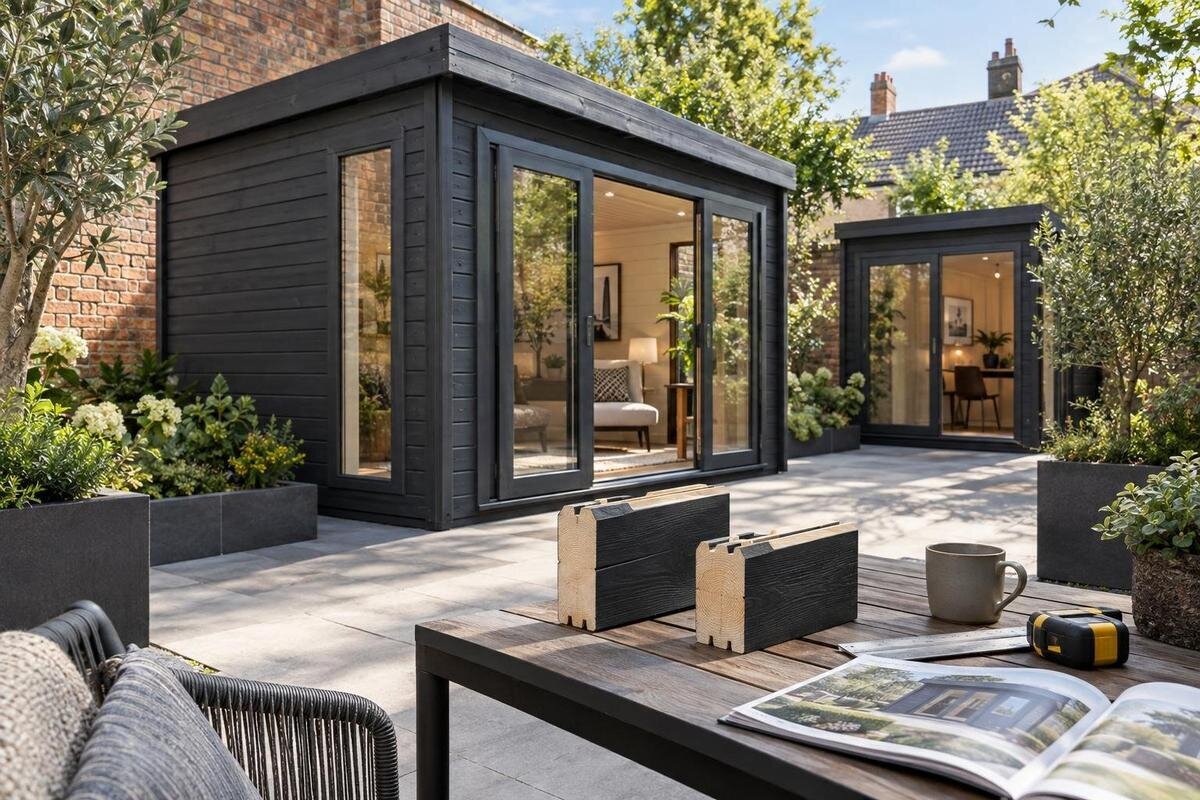
A 44 mm figure on a wooden garden shed description is a thickness measurement for a stated wall element; 44 mm is 4.4 cm. It is not the shed’s height, floor area or outside width. “44 mm walls” is useful shorthand, but it does not explain how those walls are put together. A design might use interlocking timber sections, panels or another construction, and those terms describe more than the number alone. Read the figure as one part of the building specification, not as a summary of the shed’s materials, finish or expected performance. The exact wording for the model you are considering is what matters.
Before using the figure to screen options, check which part is measured: a timber component, the completed wall, or another dimension identified in a plan. Confirm whether it applies to all external walls or only to a named element, and whether the supplier describes it as a nominal or finished size. It is also worth checking whether the stated measurement excludes surface finishes or refers to the timber before assembly. If a drawing or technical sheet is available, look for a section that labels the wall build-up. A product page such as the Verdana 1 listing is a place to check model-specific information, not a reason to assume the wall is 44 mm. If the wording is unclear, ask the seller to explain it and record the answer alongside the product name.
Why thickness is not a performance rating
Thickness describes one dimension; it is not an insulation value, a temperature rating or a statement that the inside will stay comfortable in any season. The number does not show how air moves through joints or how a wall meets the roof, floor, doors and windows. Nor does it tell you whether the shed is designed for occasional storage or for a controlled interior. If you want to keep items that are sensitive to damp or temperature changes, check the complete building description and any performance information rather than relying on the wall measurement. The same caution applies if you plan to use the shed as a workroom: ventilation, glazing and the floor need their own consideration.
It is also not a stand-alone measure of strength, lifespan or resistance to weather. Timber type and condition, design, connections, protection, maintenance and the way the whole shed is supported all matter; the wall measurement cannot replace those details. Thickness also says nothing by itself about how well individual components are protected from water entering at joints or openings. If the listing makes a specific claim you care about, ask what part of the structure it covers and what documentation supports it. Use the Verdana 2 product page only to check that model’s stated facts; do not infer insulation, durability or other performance from its name or from 44 mm. This distinction helps prevent a number from being mistaken for a guarantee.
02
Confirm which part of the wall measures 44 mm
Wall descriptions can be easy to misread because a single figure may refer to a component rather than the completed wall. Check the construction wording: does it identify solid timber, an interlocking wall element, a framed panel or another arrangement? Look for whether inner or outer layers are mentioned, how corners are joined, and whether a diagram labels a complete section. Some specifications give the size of a board; others describe the depth of a wall assembly. Ask which measurement applies, rather than assuming that the same 44 mm wording means identical construction across two sellers.
If the product information gives only a headline figure, ask for a labelled drawing or a clear written explanation. Confirm whether all walls share the quoted dimension and whether openings or adjoining sections use different construction. Ask whether the stated figure is taken before or after any machining that forms the interlocking profile, since the answer clarifies what is being compared. A product page such as the Durano garden shed listing can be included in your comparison, but its title or photograph is not a substitute for those answers. Keep the seller’s explanation with your notes. It is easier to compare two options when both describe the same part in the same way, rather than when you are comparing numbers with uncertain meanings.
Choose a wall specification in light of the shed’s use
Describe the job the shed needs to do before deciding whether 44 mm belongs on your shortlist. Consider what must fit, how often you will enter, and whether you need covered storage or a place where you expect to spend time. Tools, bicycles, outdoor furniture and hobby equipment may call for different layouts and indoor conditions. If the contents are sensitive to damp or changes in temperature, that requirement needs more than a wall measurement to answer. The number does not tell you how the shed will function in daily use or whether its design matches your plans.
Use the wall figure as a comparison point after you have set those requirements. Check each candidate’s stated construction and intended use, as well as details such as ventilation, doors, windows and floor information where relevant. Think about how the contents will be brought in, arranged and taken out, rather than considering the wall specification separately from the layout. If another option shows a larger thickness, compare the whole design and the information supplied; do not assume that a larger number automatically means better comfort, strength or value. You can include the Veltor 1 page in a shortlist, but assess it using facts stated for that model rather than assigning it a use based on its name.
03
Check outside dimensions and usable space
A shed’s outside measurements and the room you can actually use inside are not the same thing. Wall construction takes up space, so check whether the plan gives external dimensions, internal dimensions or both. Confirm the usable floor area and any restrictions created by the layout before deciding that your stored items will fit. Note the position of doors and windows too, as these can limit where tall shelving or bulky equipment can be placed. Do not calculate an interior size from the 44 mm figure alone: corners, framing and the design of the complete building can affect the finished space. A dimensioned plan is more useful than a product photograph when you are planning around shelves, equipment or a clear walking route.
Measure the intended position and consider access to the entrance, space needed to open doors, and room for assembly or future maintenance. Look at the site’s shape and surface, and ask the supplier what the shed’s base or support requirements are. If ground conditions, boundaries, service routes or property restrictions could affect the choice, check with a qualified local professional or relevant authority before ordering. The Orello 1 listing is another product page to assess by its own stated dimensions; do not carry measurements over from a different model or infer them from the wall thickness.
Read the complete building specification
The walls are only one part of a garden shed. Read the information about the roof, floor, frame, doors, windows, fixings and finish, and check whether those parts are included in the product you are considering. A photograph or model name may not make clear what is supplied as standard, what is optional or what you need to arrange separately. Check whether product documents distinguish between the building kit and any accessories shown in photographs, so your comparison is based on the actual package. Pay attention to assembly information too: the product description should help you understand whether assembly is included, whether you need to arrange it, and what guidance the manufacturer provides.
Ask how the recommended base or support relates to the complete shed, rather than treating wall thickness as a guide to foundation design. For site-specific support, anchoring or structural questions, use the manufacturer’s guidance and consult a qualified local installer or other appropriate professional. This is particularly important if the ground is uneven or the proposed position has unusual constraints; do not make engineering decisions from a single dimension. You can inspect the Modano 1 product page as one candidate record, while checking its own assembly and component details instead of assuming them from its appearance.
04
Allow for the site and timber care
The same shed can face different conditions depending on where it stands. For a Maltese garden, consider the actual plot: an open position in strong sun, a site exposed to wind or nearby sea air, and a sheltered, shaded corner raise different questions about finish and upkeep. A 44 mm wall figure does not say how the timber has been treated, what finish is supplied or how the product should be maintained. It also does not establish that the shed is suitable for every exposure. Look for care information that applies to the particular model and intended location.
Ask the seller what timber and finish are specified, whether any treatment is supplied, and what maintenance the manufacturer recommends over time. Check whether the care instructions explain what to do if the finish needs attention, and whether any options change what is included. Keep the instructions with your order documents, as the recommended routine may be specific to the finish supplied. Do not assume that extra wall thickness removes the need for appropriate care or protection. A listing such as the wooden garden shed M page can be part of your research, but confirm the model’s own materials and care guidance rather than transferring details from another timber shed.
Confirm what the order includes
Before you place an order, make sure you know exactly which model and configuration the quote describes. Check the stated wall specification, external dimensions, finish, included components and any selected options against the product information. Clarify whether the floor, accessories or assembly service are included or need to be arranged separately. Check that any chosen options are identified clearly enough that they cannot be confused with items merely shown in promotional images. Do not assume that two product pages with similar descriptions cover the same contents. A written order summary makes it easier to spot a mismatch between the shed you compared and the one you intend to buy.
Consider delivery and unloading as practical parts of the purchase. Check the seller’s current terms, what access is needed to the delivery point, and whether the route into your garden presents a constraint. If you need an installer, establish who is responsible for arranging the work and what information they need before the shed arrives. Compare the full quoted cost using the same inclusions for each candidate, rather than judging a headline price without its options. The wooden garden storage shed S listing can help identify one item for review; rely on its current order details for what is actually included.
05
Compare like with like
When you compare listings, put the same questions to each seller. Note the stated wall thickness and exactly what it measures, then compare construction wording, internal and external dimensions, roof and floor details, door layout, finish and care instructions. Record assembly responsibilities and included components as well. If one listing gives a clear wall description and another only shows a number, treat that difference in available information as relevant. A similar figure does not establish that two sheds have equivalent construction, and a missing detail should not be filled in by guesswork.
Use product drawings, written specifications and clear answers to settle points that matter to your choice. If a feature is important, ask the seller to confirm it for the exact model and configuration in your quote. Where an answer is verbal, request written confirmation so it can be compared with the listing and order summary later. Compare costs only after checking that the options and services are equivalent; otherwise the totals may describe different purchases. Keep notes in a simple written comparison so that you can see which questions are answered and which remain open. The aim is not to find the largest wall number, but to identify the shed whose documented details fit your intended use and site.
Make the decision using the full specification
Separate essential requirements from preferences before choosing. Your essentials might include enough usable space, a suitable entrance, a workable position in the garden and clear information about how the walls are built. Treat 44 mm as a firm requirement only if that precise specification matters to your plans; otherwise, use it as one detail among several. Rank unresolved questions according to their practical importance, so that a minor finish preference does not distract from uncertainty about space, access or construction. A candidate that matches the number but leaves an important question about construction, care or assembly unanswered may be a poorer-informed choice than one whose overall details are clearer.
For your final review, match the product name and configuration in the order summary to the model you assessed, then check the stated dimensions, wall description, inclusions and agreed options. Resolve any remaining uncertainty before confirming the purchase, especially if it concerns the shed’s intended use or the site where it will be installed. Where a decision depends on local conditions, base support or property requirements, get advice from the relevant professional or authority. A considered choice rests on the complete product information, not on the 44 mm figure in isolation.
Frequently asked questions
What does 44 mm wall thickness mean on a garden shed?
It is the stated thickness of a wall element, equivalent to 4.4 cm. Check the product information to see whether the number describes a timber component or the completed wall, and which walls it applies to.
Does a 44 mm wall mean the shed is insulated?
No. Wall thickness alone does not confirm insulation or tell you what indoor conditions to expect. If temperature or damp control matters, look for information about the complete construction and any stated performance, rather than relying on the wall measurement.
Is a 44 mm wall automatically stronger than a thinner one?
The number alone is not enough to compare strength. Construction, connections, materials and the support for the whole shed also matter. Look for the manufacturer’s specifications and avoid treating thickness as a stand-alone strength rating.
How can I tell whether a 44 mm shed suits my intended use?
First decide what you will store or do inside and whether you need particular indoor conditions. Then check the shed’s full construction, usable dimensions and stated intended use. A 44 mm measurement by itself cannot confirm suitability.
What should I do if the listing does not explain the 44 mm figure?
Ask the seller which part is measured, whether the figure applies to all external walls and how the wall is constructed. Request a labelled drawing or a written explanation, then keep the answer with your comparison notes.
A 44 mm wall thickness is useful information when its meaning is clear, but it cannot answer every question about a wooden garden shed. Confirm the measured part, compare the whole construction and dimensions, and check that the product details suit both your plans and the garden where it will stand. With those facts in view, you can weigh the specification sensibly instead of buying on the strength of one number.
