
Growing aubergines in a greenhouse
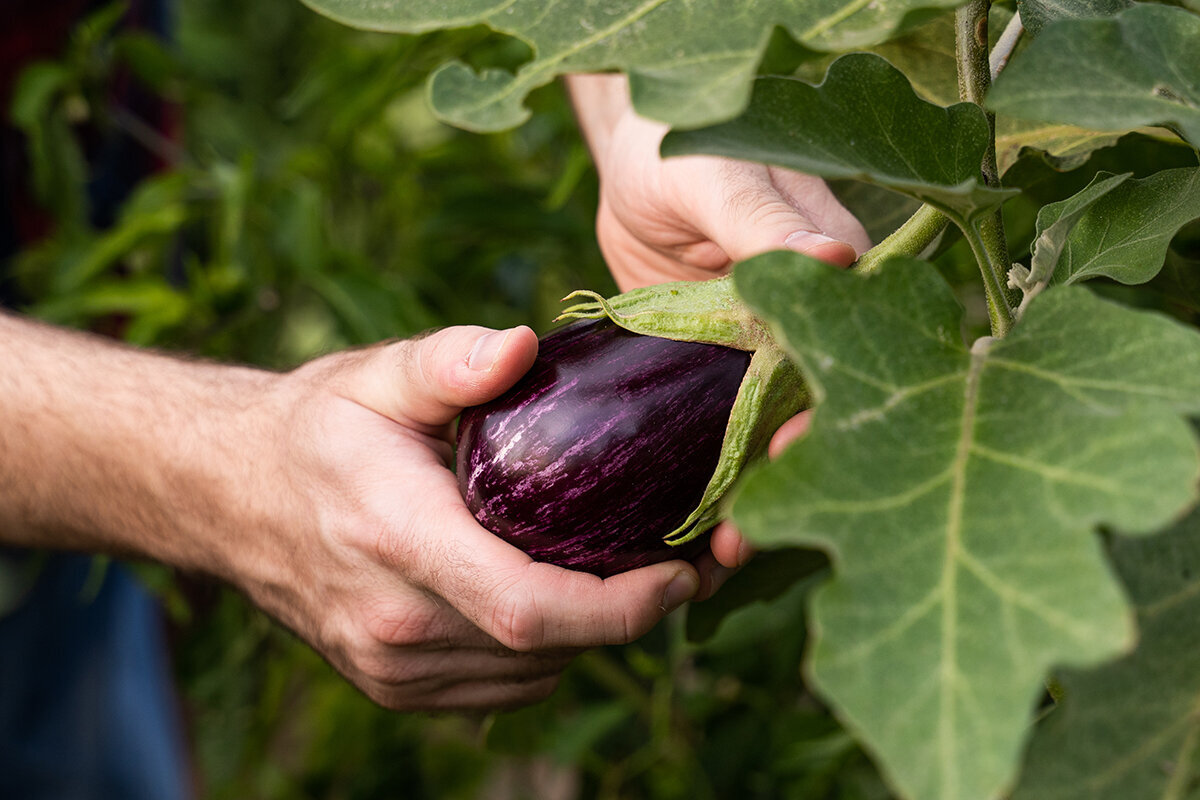
Greenhouse crop 02 · Solanum melongena · Malta
Growing aubergines in a greenhouse
The shiniest fruit of the summer greenhouse is also among the most demanding: aubergines need steady warmth, an undisturbed root zone, clear support and attention while flowering.
Under glass, aubergines become a carefully managed crop for a long season. The reward is not simply an earlier harvest. Roots stay more evenly warm, leaves gain protection from weather extremes, air can be guided, and fruit can keep developing when outdoor plants struggle with wind, rain or cooler nights.
First principle · climate before variety
Do not merely shelter aubergines.
Create a warmer growing space.Consistency, not occasional heat, is this crop’s real luxury.
Create a warmer growing space.Consistency, not occasional heat, is this crop’s real luxury.
A greenhouse turns warmth into a manageable growing tool.
Aubergines are heat-loving nightshades and react badly to a cool start. Cold nights, a waterlogged root ball and abrupt changes slow growth, encourage flower drop and waste valuable season time. In Malta, the greenhouse is especially useful for giving plants a protected early start and for managing wind, rain and sudden temperature swings.
The aim is not tropical excess, but a balanced warm space with a watchful ventilation routine. Cool compost, a pot standing in runoff water, prolonged shading or a closed house on a humid day can each check the plant differently. Well-managed aubergines look almost calm: upright leaves, compact growth, steady flowers and fruit growing without sharp shifts in water supply.
Plan the greenhouse as a working growing space, not only a weatherproof shell. Keep the route from water to beds and pots short, leave vents accessible and make sure every leaf underside can be inspected. Our classic aluminium greenhouse guide helps you plan height, benches, paths, ventilation and usable root space before the first aubergine moves in.
The thermal orbit
Warm, but never airless.
Measure at leaf height and treat the thermometer as a growing tool, not decoration. For germination, compost at about 22 to 25 °C is useful; onward growth succeeds with reliable warmth and plenty of light. A greenhouse can overheat very quickly in strong sun, however. Open roof vents and the door early, then add shade if needed, rather than trying to rescue wilted leaves late in the afternoon.
22–25 °Cwarm germination
Gentle startReliable setVent earlyShade peaks
Germination
Sow into compost warmed to about 22 to 25 °C so seeds emerge evenly rather than after weeks of delay.
Growth
Bright, warm days encourage sturdy stems and healthy leaf area without soft, light-seeking growth.
Fruit set
Protect flowering plants from cool nights, stagnant humidity and prolonged spells of extreme midday heat.
Stress zone
Cool nights, dry pots and a sealed, overheated greenhouse can interrupt both flowering and fruit development.
A practical rhythm: close in good time before a cool early-season night, open before morning heat builds, and move air through the canopy without creating a cold draught corridor.
Choosing varieties
Choose fruit shape to suit the space, pot and kitchen.
There is no single ideal aubergine. A compact variety may make better sense beside a narrow greenhouse path, while a traditional large-fruited type earns its extra root room, height and robust support. Choose for the space you can genuinely offer throughout summer, not for the largest young plant at the garden centre.
Compact
Mini and patio types
Ideal for generous pots and lower houses. Smaller fruit often ripens earlier, while compact growth makes it easier to keep air around every leaf.
Slender
Asian fruit types
Long, slim fruit is easy to inspect and suits frequent picking. Train shoots so fruit hangs freely, without pressing against foliage or glazing.
Classic large
Dark oval fruit
The sculptural classic. Give it a roomy pot, a strong cane or string, and enough room for a deliberately limited fruit load that can ripen reliably.
Distinctive
Striped, white or small
Lovely for a varied collection under glass. Their appeal is not only visual, but also lies in differing ripening times, sizes and kitchen uses.
If your greenhouse is also a considered garden space, explore Bloomcabin aluminium greenhouses and match shading, usable height, circulation space and benches to the needs of your chosen varieties.
Propagation plan
Start slowly enough to grow strongly.
In Malta, raise young plants early enough to use the mild spring, while avoiding weak seedlings caused by insufficient light or excessive indoor heat. Sow when you can provide dependable warmth and strong light; an unnecessarily early start rarely gives an advantage without both.
A good young plant has a sturdy stem, closely spaced leaves and a rooted ball that holds together without becoming heavily matted. Avoid plants with leaf spots, soft stretched growth or a tiny exhausted pot. The aim is a brief establishment period, not a lengthy recovery from cold, crowding or damaged roots.
- 01
Sow into warm compost
Place seeds about 0.5 to 1 cm deep in fresh, fine seed compost. A heat mat supports germination, but check moisture often: warm seed trays dry faster than their surface suggests.
- 02
Give light from above
Once seedlings emerge, they need strong overhead light and even, moderate moisture. Prick them out individually early, so stems do not stretch towards a distant window and roots can continue undisturbed.
- 03
Wait for stable conditions
Plant aubergines out only when greenhouse nights are reliably mild and the bed or potting compost is no longer cool. In Malta, judge this by local conditions rather than a fixed calendar. A short delay is better than a month of stalled growth.
- 04
Support at planting time
Install a cane, string or frame when planting. Adding it later disturbs roots and makes it harder to lift shoots that are already flowering or carrying fruit.
The root zone
Enough compost creates an even reserve.
Pots: volume steadies the climate.
Aubergines grow well in pots, but a small container repeatedly creates the same problems: water, nutrients and root temperature fluctuate faster. 20 litres is a lower limit for a mature plant; 25 to 30 litres of stable vegetable or container compost is more comfortable. Large drainage holes are essential. Position the pot so excess water drains completely and it never stands permanently in a full saucer.
Dark containers can warm roots in spring but can become very hot in strong sunshine. Site pots in good light, while protecting their sides from intense midday sun and reflected heat where necessary. On hot days, check the root ball’s temperature and moisture as well as the leaves.
Beds: depth and breathing room.
Work mature compost into a greenhouse bed if drainage already works well. Avoid an excessively rich, wet planting spot that produces impressive leaves but unreliable flowers. Around 50 to 60 cm between plants is a useful starting point. Adjust this for vigour, training method and the width of the access path.
Set the root collar no deeper than it was in the nursery pot. Water in carefully and mulch the surface lightly if useful, without trapping moisture at the stem base. In permanent beds, consider crop rotation: tomatoes, peppers, potatoes and aubergines are all nightshades and should not occupy the same untreated greenhouse soil year after year.
Vertical training
Train for access, air and supported fruit.
Plant structure · main shoots, ties and fruit load
Support comes before fruit weight.
Aubergine shoots seem sturdy until fruit gains weight. A vertical cane, soft ties or one to three deliberately trained main shoots all work in a home greenhouse. The best approach is the one that keeps every plant inspectable and lets you harvest without fighting through a dense wall of leaves and branches.
Keep the main shoot and a few strong, well-spaced side shoots. Gradually remove weak, inward-growing or ground-touching shoots; never strip a healthy plant all at once. Tie stems at loose intervals with soft material, ideally in a figure of eight. Once fruit forms, check that each branch has enough leaf area and strength to carry it safely.
A slightly reduced fruit load often produces larger, better-ripened aubergines with less breakage. For large-fruited varieties, about five to six well-developed fruits per plant is a useful guide. Clear training also improves airflow and makes early pest checks easier.
Flowering intervention
The flower is bisexual – but the greenhouse still needs to help.
Aubergine flowers carry both male and female organs. Under glass, they may lack wind movement and regular insect visits. Light, targeted vibration during flowering can improve pollen contact. Use restraint rather than vigorous daily shaking or continual handling of each flower.
Air
Regular ventilation gently moves flowers and leaves, preventing humid, stagnant air from remaining in the plant canopy.
Vibration
On a dry day in late morning, gently tap the cane or lightly flick the flower cluster. This brief mechanical stimulus is usually enough as a hand-pollination aid.
Humidity
Trapped high humidity makes pollen release harder and encourages disease. Ventilate and water the root zone instead of regularly wetting leaves and flowers.
Temperature
If flowers drop, check climate readings first. A cool night, a dried-out pot or an overheated closed greenhouse usually explains more than the fertiliser bottle.
Not every flower needs to become fruit. Look instead for a continuing sequence of retained flowers and growing aubergines. If flower drop becomes a pattern, simplify diagnosis: check night temperature, midday heat, compost moisture, airflow and overly soft leaf growth caused by excessive nitrogen.
Input and response
Water and feed for consistency, not drama.
Aubergine quality is closely linked to even moisture in the root zone. Repeated drying followed by flooding can weaken growth and yield, encourage bitterness and trigger physiological problems. In a greenhouse, rain no longer makes the decision for you. That is only an advantage when watering follows observation rather than a rigid calendar.
Water supply
Thorough and measured
Water in the morning directly at the base until the whole root ball is moist. Then wait until the upper centimetres have dried. Check several pots: a position by a sunny door may dry far faster than a shadier back corner.
Water in the morning directly at the base until the whole root ball is moist. Then wait until the upper centimetres have dried. Check several pots: a position by a sunny door may dry far faster than a shadier back corner.
Plant response
Firm leaves, even growth and fruit that develops without shrivelling are better guides than an unchanging daily watering schedule.
Firm leaves, even growth and fruit that develops without shrivelling are better guides than an unchanging daily watering schedule.
Nutrient supply
Balanced feeding
Feed according to the compost and manufacturer’s directions. In pots, regular moderate applications of a potassium-rich liquid feed from first fruit set are usually better than one large late correction.
Feed according to the compost and manufacturer’s directions. In pots, regular moderate applications of a potassium-rich liquid feed from first fruit set are usually better than one large late correction.
Watch the canopy
Too much nitrogen creates impressive foliage at the expense of flowers. Pale older leaves may indicate exhausted compost, but first rule out a cold or waterlogged root zone.
Too much nitrogen creates impressive foliage at the expense of flowers. Pale older leaves may indicate exhausted compost, but first rule out a cold or waterlogged root zone.
Drainage
Water must escape
Never leave a pot standing in drainage water. In beds, investigate slow drainage before automatically adding more water or fertiliser.
Never leave a pot standing in drainage water. In beds, investigate slow drainage before automatically adding more water or fertiliser.
What roots say
Repeated wilting in wet compost, yellowing and stalled growth point to a root problem, not thirst. Correct drainage and temperature before expecting fresh growth.
Repeated wilting in wet compost, yellowing and stalled growth point to a root problem, not thirst. Correct drainage and temperature before expecting fresh growth.
A timed drip system can be very useful, but set it only after observing several watering cycles. Adjust run times seasonally: a cloudy spring day, a hot July week and a heavily cropping plant do not use water at the same rate.
Regional climate management
In summer, the skill is releasing heat early.
Aubergines enjoy warmth, yet a closed greenhouse in full sun becomes hostile faster than the crop can use that energy. In humid weather, ventilation also helps leaves dry and shortens stagnant-air periods. In Malta’s dry, very sunny conditions, airflow should be paired with targeted shading and more frequent pot checks because compost can lose water surprisingly fast.
Adopt a regular opening routine: roof vents first, then the door or lower openings, creating a gentle chimney effect. A small circulation fan can clear still zones, but should not blow continuously at one plant. On genuinely hot days, blinds or shade netting soften peak light without unnecessarily darkening the house all season.
Watch fruit as carefully as leaves. In intense heat and dry air, exposed aubergines can develop sunscald. Resist the urge to prune heavily immediately before a heatwave: healthy leaves form part of the plant’s protective architecture.
Calm diagnosis
Read the symptom, then correct the space.
Yellow speckling and fine webbing
These signs often fit spider mites, which favour warm, dry greenhouse air. They can weaken plants before an infestation is obvious from a distance, so inspect leaf undersides closely.
Bronzing or dusty leaf undersides
Spider mites often multiply especially quickly in hot, dry conditions. Examine undersides with a magnifying lens; early damage may look only like a vague loss of gloss and vitality.
Yellowing, curling and slow collapse
Root problems need a different response from ordinary thirst. Cold, saturated compost can block water uptake. Do not keep watering an already wet root ball; check moisture, smell and drainage instead.
Dull, seedy or bitter fruit
This is often a ripeness issue, not a variety fault. Aubergines change quickly after their best picking point. Harvest more often during peak production and judge by gloss and firmness.
Correction rail
Inspect leaf undersides, shoot tips and tight branch junctions twice each week. Isolate heavily affected pots early. Remove badly damaged leaves only far enough to leave the plant sufficient healthy area for photosynthesis and fruit protection.
For pests
Yellow sticky traps are monitoring tools, not a complete solution. Remove badly infested material, avoid crowding plants and, where appropriate, use suitable beneficial organisms correctly. Before applying any plant-protection product, verify its current Maltese authorisation, label, permitted crop use and user category.
For climate problems
Review the previous week rather than only the last hour. Note night lows, high midday temperatures, missed watering, drainage issues and changes in feeding. The pattern provides the useful clues.
For disease risks
Keep foliage dry, remove fallen leaves and overripe fruit, clean tools and do not repeatedly grow nightshades in the same untreated greenhouse soil.
For an overview of formats, access, ventilation options and long-term growing-space planning, explore the Bloomcabin range of greenhouses and conservatories. A greenhouse is most productive when its climate management makes plant care easier to observe, not when it encourages you to leave the interior to itself.
The gloss test
Harvest at peak gloss.
Aubergines are not a crop for one weekly picking round. Cut fruit when it is full-sized for its variety, firm and glossy. As it becomes overripe, the skin turns dull, seeds become more obvious and the flesh can grow spongy or bitter. Use clean, sharp scissors and leave a short stem with the calyx attached. Do not twist or tear fruit from the shoot.
Too youngReady to harvestToo late
The skin may already shine, but the fruit is still small and has not fully developed its typical variety shape. Let it become a little broader or longer.
Look for firm fruit, taut glossy skin, characteristic colour and a fresh-looking calyx. The surface should spring back gently under light finger pressure.
When gloss fades and seeds stand out clearly, the flesh becomes spongier. Harvest it anyway, then shorten the interval before the next inspection.
Use aubergines as soon as possible after harvest. They are sensitive to cold and do not tolerate long storage in the coldest part of the fridge. If brief storage is needed, keep them cool rather than icy. Their best next destination is usually the kitchen: grilled, roasted, layered or braised.
Questions from the greenhouse path
Aubergine FAQ
Will aubergines grow in an unheated greenhouse?
Yes, provided the greenhouse is warm enough when plants move in and you are extending the season rather than asking plants to overcome wintry conditions. Reliable mild nights and a root zone that is no longer cold matter most. During a cool spell, wait longer or provide a protected frost-free transition.
How many plants fit in a small greenhouse?
Usually fewer than expected. Allow around 50 to 60 cm between plants and reserve a walkable path for watering, pollinating, tying in and checking leaf undersides. Two to four well-trained plants can produce more useful harvest than a dense, humid, inaccessible row.
Why are aubergine flowers dropping?
Check the climate first: cool nights, extreme heat, dry pots and stagnant humid air can interrupt fruit set. Then consider nutrient balance; too much nitrogen promotes leaves instead of flowers. Where airflow and insects are absent, a brief gentle vibration of the cane or flower cluster can help.
Should I prune greenhouse aubergines?
Prune only with a clear purpose. Remove damaged leaves, weak shoots and growth that makes the plant centre too dense. Keep enough healthy foliage to feed and shade fruit. Tie in main shoots early and reduce fruit load if a branch is visibly overburdened.
How often should I water potted aubergines?
There is no universal number. Check moisture a few centimetres below the surface and water thoroughly when the root zone needs it. Heavily fruiting plants may need daily attention in summer heat, while cooler cloudy weather reduces demand. Avoid tiny surface splashes and standing water.
When are aubergines ready to harvest?
Harvest when fruit is firm, fully coloured for its variety and distinctly glossy. Dull skin, obvious mature seeds and spongy flesh show it has hung too long. Cut with scissors, leave a short stem and pick regularly so the plant can develop further fruit.
Garden archive · sources and further reading
The horticultural foundations behind this growing space.
- Bavarian State Institute for Viticulture and Horticulture, Garden Academy:Aubergine – growing guidance for Germany– advice on sowing, temperatures, raising plants, planting, care and harvesting Solanum melongena.
- Royal Horticultural Society:Growing aubergines– horticultural overview of sowing, planting, care, training, harvesting and common growing problems.
- University of Minnesota Extension:Growing Eggplant in Home Gardens– English-language advice on site, planting, watering, feeding, harvesting and common problems.
- University of Minnesota Extension:Harvesting and Storing Home Garden Vegetables– guidance on harvest maturity, harvesting technique and storing home-grown vegetables.
- UC Davis Postharvest Research and Extension Center:Eggplant Produce Facts– technical information on aubergine quality, ripeness, storage conditions and postharvest behaviour.
Adapt every recommendation to the variety, local weather, greenhouse design and manufacturer instructions. Verify plant-protection products against the current Maltese authorisation and label; follow applicable product information and requirements for beneficial organisms and fertilisers. Seek qualified local horticultural advice for uncertain diseases or serious pest outbreaks.
A longer season, carefully composed
Create a warmer space for long-season crops.
A high-quality greenhouse shows its special value when planned as a productive climate space: with usable height for trained plants, roof vents to release heat, a bench for propagation and a clear route for daily checks. With aubergines, these details decide whether plants merely endure summer or finish it with a glossy harvest.
Classic aluminium greenhouseSee how a classic aluminium greenhouse can provide an elegant, adaptable base for heat-loving crops, carefully arranged benches and the daily ventilation routine aubergines need in Malta’s summer.
