
Growing and safely harvesting figs in a greenhouse
Bloomcabin guide for Malta
Growing and safely harvesting figs in a greenhouse
A fig under glass succeeds when its vigour is guided deliberately: ample light and warmth, clearly limited roots and branches, and every ripe fruit within easy reach.
01 / The principle of restraint
A greenhouse does not make a fig small. It makes consistent training even more important.
The practical advantage
A greenhouse can extend the growing season, shelter fruit from heavy rain and create a drier harvest window. In Malta, weather protection may matter more than extra warmth, so good ventilation is essential during hot, settled periods.
Yet figs are naturally vigorous and can quickly shade a modest glazed space. Treat yours as a permanent fruit tree with limited room, not a houseplant that happens to fruit. Good planning starts with controlled root volume, a branch framework below the ridge, checkable watering and a clear route for harvesting without constantly brushing latex-bearing leaves and shoots.
A well-ventilated classic aluminium greenhouse provides a lasting architectural setting: plentiful light, usable roof ventilation and a structure planned around the mature canopy, not merely the young plant.
02 / Choose for climate and fruit type
One crop may be enough. Two are a welcome possibility.
Choose a named common fig for fresh eating that suits the length of your local season. Common figs generally produce edible fruit without pollination. That is not true of every fig type. Smyrna types and related cultivars have different pollination needs and are not a dependable choice for an uncomplicated home greenhouse.
Previous year's wood{
Breba crop
Breba figs form on shoots grown during the previous year. They can ripen early and are especially valuable where the season ends abruptly. Their weakness is exposed overwintering: severe frost, late frost or hard winter pruning can remove much of this first crop before spring properly begins.
In Malta's cooler or exposed locations, a greenhouse can shelter the permanent framework and encourage earlier growth, but careful ventilation remains essential. Where summer conditions are demanding, locally proven early-ripening varieties are wiser than promises of an exceptionally large but very late main crop.
Shoots of the current season{
Main crop
The main crop forms on new growth. A greenhouse encourages this growth, but excess nitrogen, water and unused space can easily produce large leaves and long shoots instead of timely ripening. The aim is not maximum shoot length, but well-lit, ripening fruiting wood with figs that finish before warmth and daylight decline markedly.
Brown Turkey, Ronde de Bordeaux and Madeleine des Deux Saisons are often offered for cooler European settings. This is a useful shortlist, not a yield guarantee. Ask a good local nursery about common-fig type, ripening time and local experience; plant age, seasonal conditions, light and pruning also greatly affect the crop.
Read the wood before pruning: smooth green or brown previous-year shoots may carry breba buds; new shoots after budbreak form the basis of the main crop. Before every substantial cut, consider which harvest window you could be removing.
03 / The key space decision
Set the root boundary before the fig does.
Figs do not need to be starved to set fruit, and root restriction is not a magic switch. It does keep a vigorous tree in proportion with the greenhouse. A defined root zone also makes watering, feeding, repotting and later renewal more controllable.
For most home greenhouses, either a large stable container or a purpose-made planting pit with side boundaries works well. Open greenhouse soil only makes sense where ample volume is available and the canopy will be trained consistently for years. If the fig reaches surrounding ground unchecked, balancing its vigour at household scale becomes difficult.
Below ground: three root zones
Large container
Bounded planting pit
Open ground
Large container
Flexible and fully contained. Use structurally stable, peat-free growing medium with a mineral component, generous drainage holes and a vessel that buffers summer moisture swings. Repot to a planned rhythm and renew exhausted compost.
Bounded planting pit
A pit lined at the sides with durable panels or a suitable root barrier gives more soil volume and thermal mass while retaining a firm boundary. About 60 cm in depth and width is a useful planning starting point. Drainage, watering access and renewability remain essential.
Open ground
The most vigorous option. Use it only with deep, well-drained soil, generous roof volume and a long-term pruning plan that keeps the permanent branch structure low, airy and reachable.
04 / Position and access
Plant for the mature tree.
Place the fig on the brightest suitable side without blocking the door, roof vents, controls or central path. In a freestanding greenhouse, the sunniest long side often suits a low fan or open bush form. Around 30 cm from the glazing helps with cleaning and airflow, and keeps leaves from constantly touching hot glass.
Before buying, measure from the floor to the eaves and ridge. The intended final height should sit comfortably below the lowest structural line, so you can reach over and around the canopy. About 1.8 to 2.2 m is often practical. A greenhouse gains nothing from a tree that needs a ladder for every harvest.
For spatial planning, consider the classic aluminium greenhouse and its classic aluminium greenhouse features together. Treat floor area, roof volume, doors, ventilation, shelving and watering as one composition, rather than separate equipment choices.
05 / Training and pruning
Keep the framework calm and fruiting wood productive.
Start training early. A low trunk with three to five well-spaced scaffold branches, or a fan against a suitable rear wall, keeps fruit visible and light within the canopy. Direct shoots outward rather than into the central path. Remove unnecessary competing and basal shoots early while pruning wounds are small.
A simplified branch framework under glass
This shape is a planning aid, not a rigid botanical formula. The aim is a low, open crown with reachable scaffold branches, evenly distributed fruiting wood and enough leaves to protect bark and fruit from sudden exposure.
- Permanent scaffold branches Keep these branches low, strong and spaced apart. Renew an ageing framework gradually instead of cutting the whole tree back drastically in one season.
- One-year shoot This may bear breba figs. Check it before winter pruning; hard cutting during dormancy can remove the early crop completely.
- Current summer shoot It contributes to the main-crop potential. In summer, shorten only excessively long shoots that shade fruit, obstruct ventilation or grow into areas that will later be inaccessible.
- Suitable reduction point Cut back to a healthy, well-placed outward-facing side shoot or suitable bud. Avoid long stubs. First remove dead, frost-damaged, rubbing and inward-growing wood.
Use late winter or early spring for structural work and prune lightly in summer. If the breba crop matters, enough healthy previous-year wood must remain. When space becomes tight, correct the basic framework first. Repeated random tipping easily creates a dense hedge of weak new shoots. Avoid hard pruning after midyear.
06 / Water, food and controlled growth
Give roots rhythm, not excess.
Spring
As growth starts, resume regular watering. Moisten the root zone thoroughly and let the surface dry slightly before the next application. Increase water gradually. Feed sparingly at first, particularly where the tree is already growing strongly.
Summer
Hot days under glass need frequent checks, especially for containers. Drip irrigation or slow, measured watering is better than irregular flooding. Ventilate early so the tree does not lose excessive water in trapped heat.
Late summer and autumn
Keep moisture even while fruit swells and ripens, but do not use nitrogen-rich feeding to force lush late growth. The goal is ripe figs and well-hardened wood, not a flush of soft shoots before cooler weather.
Winter rest
After leaf fall and when growth has stopped, water only sparingly. The rootball must not remain dust-dry for months, but a cool resting fig uses little water. Cold waterlogging is far more dangerous.
Controllable ventilation is particularly important when the greenhouse is unattended during the hottest hours. Consider the classic aluminium greenhouse when planning, and make sure warm air can escape before extreme heat builds around the canopy.
07 / Fruit retention
Do not blame pollination first.
Most common figs grown in home gardens develop edible fruit without fig wasps or hand pollination. Ask for this fruit type to be confirmed when buying. That single decision prevents unnecessarily complicated greenhouse troubleshooting later.
If a suitable common fig drops small fruit, first consider stress and timing: sudden drying, weak light, an overloaded young tree, sharp temperature changes, recent repotting, pest pressure or fruit set that is too late. A greenhouse extends warmth, but cannot overcome inadequate late-season light or a variety's genetically fixed ripening time.
Do not remove every small fruitlet as a precaution. Keep the tree balanced instead, take off clearly damaged fruit and focus on even soil moisture, good light distribution and a variety whose ripening period suits the local season.
08 / Summer under glass
Warmth helps. Trapped heat does not.
Figs enjoy warmth, but a closed greenhouse can overheat very quickly on sunny days. Open doors and roof vents early, creating an air route where cooler air enters low down and warm air leaves above. Shade is useful only when leaves genuinely scorch or the root zone cannot keep pace with water demand. Moving air can reduce still, humid pockets in a dense canopy, but it does not replace effective natural ventilation area.
Keep the canopy away from glazing. Remove a few carefully chosen inner shoots instead of stripping leaves widely. Foliage supplies energy for ripening while also shading sensitive bark. Collect fallen figs and old leaves promptly, particularly in humid weather, so fruit flies, mould and souring have fewer places to develop.
09 / The harvest zone
Judge posture and texture, not colour alone.
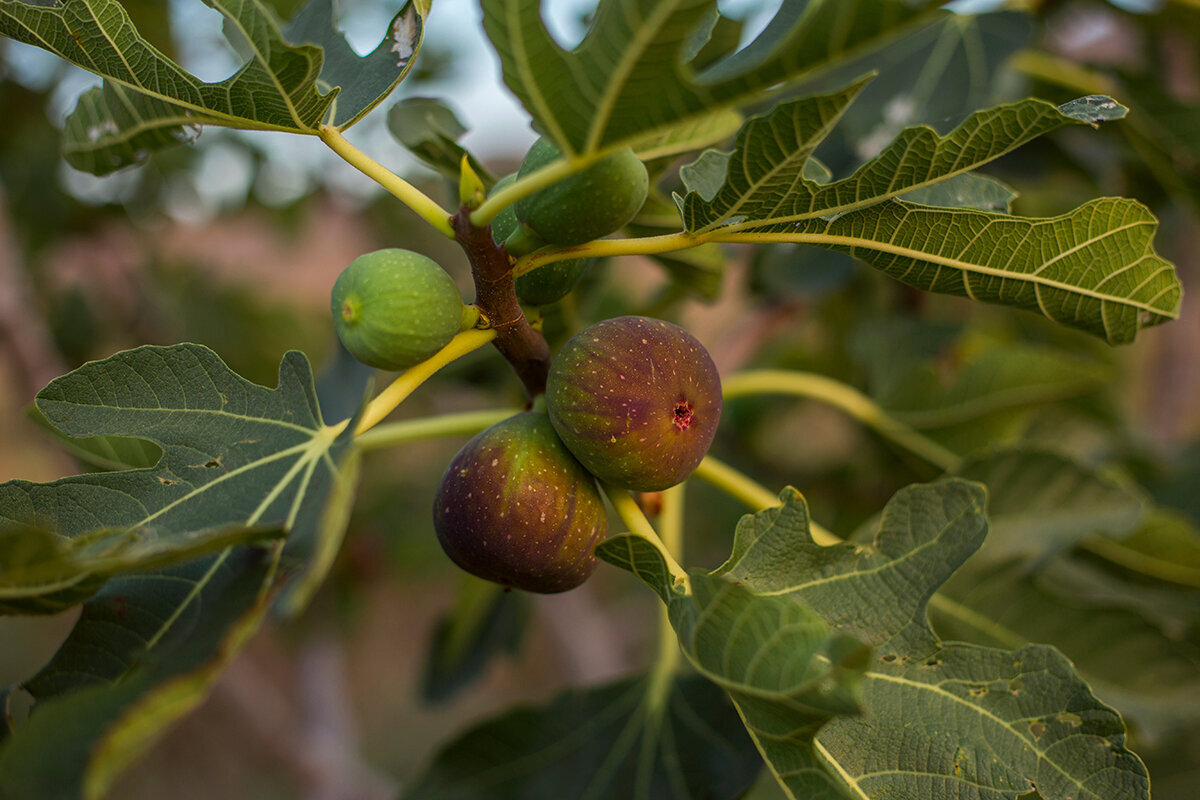
Skin colour varies greatly by variety. A ripe green fig may remain green, while other fruit turns yellow-green, brown or deep purple. Read the whole fruit: increasing fullness, soft skin, a yielding neck, a clearly drooping posture and less milky latex at the stem are more dependable signs. Figs barely ripen after picking, so harvest in several rounds.
1 / Upright
Wait
Firm body, taut neck, upright posture: this fig remains on the tree.
2 / Swelling
Watch
The fruit becomes fuller and yields slightly. Continue watering evenly.
3 / Drooping
Harvest
The neck softens and bends, and the fruit feels supple. Lift it gently and release it cleanly at the stem.
4 / Split
Check immediately
A small clean crack can be harmless on a fully ripe fig. Discard fruit that smells fermented, leaks, moulds or is clearly affected by insects.
Take care with latex
Wear gloves and long sleeves when pruning and during substantial harvesting work. Milky sap from leaves, shoots and stems can irritate skin and eyes. Work from below upwards where possible so latex does not run over hands and forearms, wash splashes off promptly and clean tools after diseased or suspicious shoots. Harvest delicate fruit in the morning when it is cool and easier to handle.
10 / The winter zone
Let this deciduous fig rest.
A fig is deciduous. Leaf fall is not a greenhouse failure, but the beginning of an important rest and maintenance phase. Observe the branch framework, remove fruit remnants and dead leaves, and inspect wood and buds. Structural pruning is best delayed until the risk of the strongest cold has passed and damage or overwintered fruit buds are clearer.
Although Malta has mild winters, container roots, young plants and tender shoot tips can still need protection during unusual cold or exposed conditions. Put the pot on an insulating base, move it against a sheltered inner wall and wrap the container if needed. Do not seal the entire plant airtight or stimulate soft growth with heavy feeding before winter.
Close doors and vents before unusually cold nights and use breathable horticultural fleece if required. Ventilate again on frost-free days, as a greenhouse can heat strongly even in winter. Also check drainage holes and saucers. The resting period is the right time to reassess root space, canopy height and the harvest route for the coming season.
11 / Common problem areas
Recognise the pattern before changing everything.
Fruit drop
Check variety suitability, sudden dryness, waterlogging, recent root disturbance, weak light and possibly late fruit set. Correct the visible stress first. A sudden heavy dose of fertiliser often worsens the problem.
Splitting
This usually involves both water management and weather. Avoid major dry-to-wet swings, improve drainage, ventilate after humid nights and pick ripe fruit promptly.
Spider mites
Look for dull stippling, fine webbing and weakened foliage in warm, dry, still areas. Inspect leaf undersides and young shoots regularly, isolate badly affected neighbouring plants and first improve ventilation and growing conditions.
Scale insects
Inspect one- and two-year-old wood closely, especially during the resting period. Fixed small scales and sticky honeydew deserve attention. Remove heavily affected plant parts, keep the canopy open and use only products authorised for the crop and setting, exactly as stated on the label.
Rotting or souring fruit
Remove split, leaking, fermented-smelling or insect-damaged figs immediately. Harvest more often, improve air movement and do not leave fallen fruit beneath the canopy.
Poor ripening
Thin a dense canopy moderately, reduce a self-shading tree to outward side branches and lower nitrogen inputs. Also check the variety's ripening period. In challenging seasons, a protected breba crop may be more dependable than a very late main crop.
Where plant-protection measures are needed, use only products authorised in Malta for the particular crop and use setting, following the current label exactly. Start with sound identification, hygiene and improved growing conditions. A closed greenhouse rewards regular monitoring far more than rushed, indiscriminate spraying.
12 / Annual calendar
A dependable annual rhythm for figs.
Exact timing shifts with locality, weather, greenhouse and variety. Use this calendar as a sequence of observations and tasks, rather than fixed dates. Even in an unheated greenhouse, seasonal conditions continue to set the pace.
| Period | Observe | Act |
|---|---|---|
| January–February | Resting period, branch structure, overwintered buds, container condition and cold damage. | Keep only slightly moist, protect roots and young tips if cold is forecast, ventilate on mild days and plan pruning carefully first. |
| March–April | Budbreak, retained breba buds, dead shoot tips and direction of new shoots. | Increase water slowly, remove damaged wood, correct scaffold branches, repot if needed and avoid heavy feeding. |
| May–June | Heat development, fruit set, shoot length, canopy density and early pest signs. | Ventilate early, water evenly, train selected shoots, pinch troublesome extensions moderately and inspect leaf undersides regularly. |
| July–August | Swelling fruit, ripening sequence, water demand and risk of splitting. | Harvest often, remove fallen fruit, keep water steady, maintain an airy fruit zone and avoid encouraging soft late growth. |
| September–October | End of the main crop, unripe late figs, leaf colour and cooler nights. | Pick ripe fruit continuously, remove spoiled and clearly hopeless large unripe fruit, reduce feeding and water more sparingly as growth slows. |
| November–December | Leaf fall, bare framework, standing water and space needs for the following season. | Prepare cold protection, avoid damp stagnant air and assess canopy height, ventilation, harvest route and root boundary before the next growth flush. |
13 / FAQ
Questions from the fig greenhouse.
Can a fig stay in the greenhouse all year?
Yes, provided it has sufficient sun, ventilation, a defined root zone and enough space for pruning and harvesting. In Malta, an unheated greenhouse extends the growing season but can still need management during unusual cold spells. Containers, young plants and tender shoots may need targeted breathable protection.
Do greenhouse figs need pollination?
Common figs for home growing produce edible fruit without pollination. Other fig types depend on specialist pollination and are therefore unsuitable for usual greenhouse culture. Buy a named common variety deliberately if you do not have a specialised pollination system.
How large should a fig container be?
Choose a large, stable, very well-drained container that allows a healthy rootball without driving the canopy out of control. Repot young plants gradually. More important than a fixed litre capacity is reliable summer watering, rootball checks, compost renewal and being able to reach the mature tree comfortably.
Should a fig be pruned hard every winter?
Usually not. Remove dead, damaged, rubbing and poorly placed wood, and reduce height by cutting back to suitable side branches. Hard winter pruning can remove breba wood and provoke strong growth that crowds the greenhouse again.
Why are there many leaves but no ripe figs?
Common causes are excess nitrogen, an oversized root zone, heavy self-shading, irregular watering, insufficient warmth late in the season or a variety that ripens too late for the site. Simplify the branch framework first, then correct the strongest visible growth or stress factor instead of changing everything at once.
Which greenhouse features matter most for a fig?
Look for usable roof height, enough floor area, a clear harvest route, accessible doors, controllable ventilation and a stable base. The product overview for the classic aluminium greenhouse is a useful starting point for questions of size and equipment. The finished structure should serve the mature tree, not only its first season as a small plant.
14 / Sources and further information
Plan further with reliable sources.
How well a fig crops depends greatly on its location. The following international specialist sources explore winter care, root restriction, pruning, fruit types, watering and plant health, and complement this guide when choosing a locally suitable growing plan.
More from Bloomcabin: Planning premium aluminium greenhouses for Maltese gardens · Premium aluminium greenhouses and conservatories · Bloomcabin blog
- Bavarian State Institute for Viticulture and Horticulture:Preparing container plants for winter
- Royal Horticultural Society, practical guide:How to grow figs
- Royal Horticultural Society, pruning guide:How to prune a fig
- University of California Agriculture and Natural Resources:Figs – fruit types, pollination, breba and main crops
- UC Statewide IPM Program, growing advice:Cultural Tips for Growing Fig
- UC Statewide IPM Program, troubleshooting:Fig Drop or No Fruit
- UC Statewide IPM Program, overview:Fig – plant health, pests and cultivation measures
Plan the greenhouse around the tree
Give your fig boundaries in which to thrive.
Choose greenhouse volume to suit root control, reachable canopy height, ventilation and an unobstructed harvest route. A carefully planned structure turns fig growing from an annual battle with overlong shoots into a calm, productive rhythm of care, observation and ripe fruit.
Classic aluminium greenhouse