
Growing Orchids Successfully in a Greenhouse
Bloomcabin / Greenhouse knowledge
Growing Orchids Successfully in a Greenhouse
An orchid greenhouse is not a tropical fantasy, but a carefully managed space with filtered light, moving air, clean water and roots that can breathe again after watering.
The epiphyte principle
A successful orchid collection is organised around the space between the roots, not the colour of its flowers.
Many popular greenhouse orchids are epiphytes: plants that anchor themselves to branches, bark or rock in nature without taking nutrients from their support. Their roots collect water from rain, dew and organic debris, remaining surrounded by air between showers. A glazed greenhouse lets you create these conditions deliberately: bright filtered light, humidity without stagnant air, and gentle temperature changes between day and night.
A greenhouse can also magnify care mistakes. In Malta, even a small structure can heat up rapidly in summer, a tightly packed collection may remain wet for too long after watering, and one new plant can introduce pests. The aim is not permanent jungle scenery, but a stable, observable habitat where compatible orchids follow their own rhythm of wetting, drying, growth and rest.
Begin with reliable labels. The genus, species or hybrid name and the grower’s care notes are more useful than a blanket instruction such as “water weekly”. Light, bench height, pot size, growing medium, season, growth stage and weather all alter drying speed. A clearly arranged collection is easier to care for: orchids with similar needs stand together, while roots and pots remain easy to inspect without constant rearranging.
For beginners, adaptable and clearly labelled hybrids are more sensible than demanding rarities. A well-planned layout with accessible benches, air routes and easy-to-reach growing zones – such as in a Classic aluminium greenhouse– serves plants better than a large but disorganised collection.
An important distinctionEpiphyte describes a plant that grows on another surface, not a parasite. A branch, bark or mount provides support only.Terrestrial orchids grow in soil-like media and often need a different moisture rhythm. The requirements of the individual species or hybrid always remain decisive.
01 / Choose a manageable climate
Select orchids by habitat, growth habit and experience
Temperature groups are planning tools, not guarantees. Species and hybrids within one genus can differ greatly. The plant label, documented origin and trustworthy care guidance from specialist growers therefore always take priority.
Warm
Protected winter warmthIntermediate
Moderate day-night rhythmCool
Relief from summer heatOrchids for warm growing
Heat-loving orchids suit a greenhouse whose winter nights remain dependably mild and where cold glazing does not chill foliage. Many Phalaenopsis hybrids, vandas and warm-growing dendrobiums fit this direction, although their light needs vary. A broad guide is often 20–29 °C by day and nights that do not remain well below 18 °C. A warm house still needs ventilation: heat and humidity without air exchange do not create a tropical climate, but raise disease risk.
Orchids for intermediate growing
The middle range is often the most practical starting point for a mixed collection in a Maltese greenhouse. Many Cattleya hybrids, Oncidium relatives,Brassia and selected dendrobiums respond well to bright days, circulating air and a noticeable but not extreme night-time drop. Depending on the plant, around 18–26 °C by day and 13–18 °C at night may suit. This range leaves room for brighter and more protected positions on the same greenhouse bench.
Orchids for cool growing
Highland and cloud-forest orchids can be exceptional, but their cultivation is often decided in summer. Some Masdevallias, Coelogynes and former Odontoglossum types need bright light, high humidity, continuously fresh air and genuinely lower temperatures. Cymbidiums also often react badly to prolonged heat. Do not buy a cool-growing orchid for its flowers alone if the greenhouse regularly becomes hot at plant level in July.
A sensible rule for Malta: first establish a reliable intermediate or warm zone. Add cool-growing specialists only after recording summer maximum temperatures at bench height. A thermometer near the roof shows different conditions from one placed beside the leaves.
02 / Light is a position, not a setting
Glazing, bench height and shade create a layered light pavilion
Greenhouse sectionSeasonal sun
TopBright, filtered light
Bench levelModerate exposure
BottomProtected partial shade
Air routeFrom inlet to roof vent
Notes on seasonal shading
Observe first. Shade next. Adjust again.
The same Maltese greenhouse can be relatively gentle in winter and relentlessly bright in summer. Measure light levels where possible, but read the plant too. Very dark green, soft-looking leaves and weak growth can indicate insufficient light. Yellowish, pale or unusually reddish stressed areas, along with distinctly warm leaves, are more likely to indicate excess. Leaf colour offers useful clues, but is not a complete diagnosis on its own.
The upper part is usually the brightest and warmest area of the greenhouse. It suits only orchids gradually acclimatised to higher light. Middle bench positions often become the core of an intermediate collection. Lower or set-back places can help shade-tolerant plants, provided humid air does not stagnate there. Even a shade orchid does not belong in a still, hard-to-see corner.
External shading, or shading fitted away from the glazing, intercepts some solar energy before it reaches the interior. Internal fabric can also help, but limits heat gain less effectively. Seasonal movable shading is more nuanced than heavy year-round darkening. The overview of aluminium greenhouses shows why shading, plant levels and ventilation should always be planned as one connected system.
Acclimatise every new orchid gradually to its position. A plant raised under artificial light or in a shaded nursery should not move directly beneath the glass roof on its first bright spring weekend. Change its position in stages and observe its response over several days. Even when outside air is cool, clear spring sun can create surprisingly high leaf temperatures beside glazing.
03 / The root laboratory
Water thoroughly. Then let oxygen return.
With epiphytic orchids, the essential skill is understanding each plant’s drying curve rather than imposing a calendar.
Reading the wet-dry cycle
Healthy exposed roots often look silvery green or pale when dry and become greener after taking up water. One reason is velamen, a multi-layered root covering whose appearance changes when wet. This cue is useful but not universal. Roots in opaque pots, old media or terrestrial culture need different assessment. Combine root appearance with pot weight, medium structure, weather and growth stage.
Velamen cycle
Dry
Wet
Absorb
Drain
Aerate
Water preferably in the morning. This allows leaves, crowns and greenhouse surfaces to dry before the coolest part of the night. Soak the medium fully until water runs freely from the pot rather than giving a superficial sip. Do not leave standing water in cachepots, trays or beneath bench grating, and remove water from sensitive leaf rosettes. A small mount may need water every day in hot weather, while a large bark pot in shade dries far more slowly. Both can be correct.
Assess water quality and humidity separately
Rainwater is popular with many orchid growers because it usually contains few dissolved salts, but it must be collected and stored cleanly. Anyone using tap or borehole water should know its properties. Hardness, alkalinity and dissolved salts can accumulate in bark and on roots. Pale pot rims are a warning sign. Regular flushing with suitable water, restrained fertiliser concentrations, and observation of root and leaf tips prevent a minor water issue from becoming chronic stress.
Humidity supports an orchid but does not replace water at the roots. A relative range of around 40 to 70 percent is often mentioned for many tropical groups, though the individual species may differ. Balance matters most. High humidity without air movement encourages condensation and disease, while an overly powerful fan dries plants out. Gentle circulation should only lightly move leaves, disperse damp pockets and create neither dry wind nor cold draughts.
Roof vents, side openings and circulation fans address heat, humidity and disease pressure together. As a structural base for matching equipment, consider a Classic aluminium greenhouse and the overview of aluminium greenhouses for coordinated planning.
04 / Growing medium is architecture
The container must suit roots, climate and care routine
Orchid growing medium is not soil. It creates a temporary structure of limited water storage, air spaces, support and controllable access to the root zone.
Pot
Basket
Mount
Pot
A pot provides stability and a controllable moisture reserve. Transparent growing pots make it easier to inspect roots and moisture for some orchids, but should not stand unprotected in direct sun. Slotted pots improve gas exchange. Match bark grade and water retention to root thickness, microclimate and watering routine instead of choosing a container only for its appearance.
Basket
A basket drains quickly and gives vigorous roots room. This can be ideal for fast-growing, trailing orchids in a warm, sufficiently humid area. At the same time, this growing method requires dependable humidity and more frequent watering. A basket is not inherently better than a pot; it simply creates a quicker drying rhythm that must suit both plant and daily life.
Mount
Mounting on cork or suitable wood creates an airy, natural display with clearly visible roots. Mounted orchids can grow healthily and impressively, but dry quickly. Reserve this method for a greenhouse climate and a daily routine that reliably allow frequent, accurate wetting.
Coarse bark is often useful in a humid greenhouse because regular watering and higher ambient humidity slow drying. Fine mixes or large amounts of sphagnum can remain wet too long in unsuitable conditions. Conversely, small-rooted plants or those in warmer, drier positions may need more water retention. The coarsest mix is not proof of quality. The right medium drains freely, retains air and still permits an interval to the next watering that suits the plant.
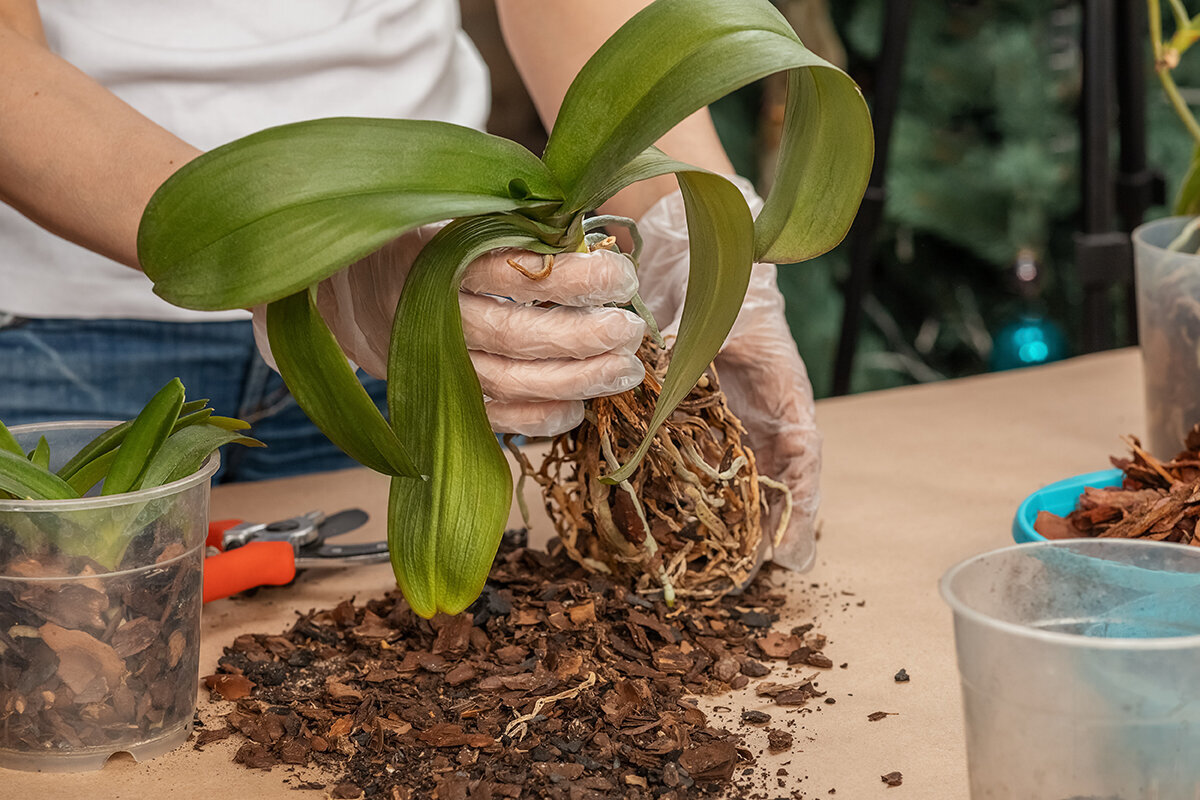
Repot when bark visibly breaks down, the centre becomes compacted, drainage slows, salts accumulate or roots split the container. For many sympodial orchids, changing pots at the start of new root growth improves establishment. Use clean tools, remove only clearly dead or rotten roots, and secure the plant against wobbling. The new pot should be only slightly larger. Oversized containers can dry slowly during cooler periods and weaken the root system.
05 / Growth sets the calendar
Feed and repot when the plant is actively growing
Orchids use water and nutrients differently depending on whether they are extending roots, forming leaves, building pseudobulbs, resting or preparing flowers.
Roots
Leaves
Pseudobulbs
Flower spikes
Rest
Fresh root tips mark a phase when the plant can establish well after repotting and actively process nutrients.
Monopodial orchids grow from a continuing central axis. Do not allow water to stand in the sensitive crown for long.
Many sympodial orchids store water and energy in swollen shoots. Old pseudobulbs can continue feeding new growth and should therefore remain.
Depending on the orchid, flower spikes emerge from leaf axils, nodes, mature new growths, shoots or near the central axis. Blanket cutting rules are unsuitable.
Some orchids need a drier, cooler or less nutrient-rich phase. A seasonal pause is not automatically poor care.
Fertiliser: weak, regular, flushed
Use a fully soluble orchid fertiliser and always follow the manufacturer’s instructions. Feed lightly but regularly while the suitable orchid is actively growing. Reduce or pause feeding when light, temperature and growth decline, or when a species-specific rest period begins. Low, controlled concentrations are usually easier to manage than rare strong doses. Moisten a very dry medium before fertilising. Flush with clear water roughly monthly to reduce accumulated fertiliser salts.
New flowers: check the environment first
If an otherwise healthy orchid does not flower, begin with identification and light. Then assess day-night differences, seasonal rest, root condition, maturity and fertilising. A mature Cattleya hybrid may require much brighter conditions than a Phalaenopsis. Some dendrobiums or cymbidiums need a particular cooler or drier phase. Do not try to force flowering with extra fertiliser, severe pruning or arbitrary cold if the advice was intended for another orchid.
06 / A controlled quarantine area
A valuable collection needs a disciplined threshold
Warm, humid greenhouse conditions can accelerate pests and diseases. Every new orchid should earn its place on the main bench only after careful observation.
Introducing new plants
- Keep the newcomer separate from the collection, ideally in its own growing space or at least in a clearly isolated zone.
- Inspect leaf undersides, leaf axils, new growth, roots, pot rim and flowers for scale insects, mealybugs, thrips, mites, slugs and suspicious marks.
- Remove dead material, clean the bench and tools, and prevent runoff from the new plant reaching established orchids.
- Observe over a meaningful period, especially after warm days. Note the purchase date and abnormalities; photographs make later changes easier to track.
Interpreting symptoms
- Soft, dark roots or crumbling medium: check drainage, medium condition and watering frequency; isolate the plant immediately if rot progresses.
- Sunken or expanding spots: improve hygiene and air movement, isolate the plant and seek a sound diagnosis before indiscriminate treatment.
- Sticky deposits or cottony nests: inspect neighbouring plants for sap-sucking pests, remove them mechanically and repeat necessary treatment consistently.
- Wrinkled leaves: do not automatically water more. Root loss, heat, salt damage or compacted medium can prevent uptake despite a wet pot.
Avoid routine chemical treatments “just in case”. Identify the problem accurately; check the Maltese register and current label for the product, crop, intended use and user category, then follow that label. Mechanical removal and correcting growing conditions are safer than indiscriminate spraying in a closed greenhouse. Do not share tools where suspicious streaks, rings or unusual patterns appear. For persistent problems or suspected viruses, consult specialist growers or qualified horticultural advisers.
07 / Build the collection calmly and clearly
Group by climate, not flower colour
An orchid bench is easier to water, shade and inspect when neighbouring plants share the same environmental rhythm.
Place thirstier, lower-light orchids where you naturally inspect them while air movement remains present. Plants needing brighter conditions and drying faster take higher or more exposed positions. Group mounted orchids so their frequent watering does not dictate the rhythm of all potted orchids. Keep a small, accessible area free for newcomers, weakened plants and ongoing work.
Think vertically. Hanging plants use the warm, bright upper volume, while lower benches can offer more moderate conditions. Access remains essential: every orchid must be reachable, its label readable and its root zone inspectable. Good spacing is not wasted room. It gives you the chance to spot a change before it spreads through the collection.
A Classic aluminium greenhouse can be planned as a filtered orchid zone rather than an unspecific storage area. Keep a central working path and air corridor clear, establish a warm or intermediate bench first, then add shading, circulation and plant levels according to observed needs. As an architectural starting point, a Classic aluminium greenhouse shows how size, glazing and usable growing space can be considered together for a Maltese garden.
Bright levelHanging orchids
Middle benchResilient hybrids
Lower zoneProtected shade
ThresholdQuarantine
Use this layout as a starting composition, not a rigid rule. Actual light, air movement and the drying pattern in your own greenhouse determine where each group should stand permanently.
Frequently asked questions
What orchid growers want to know after the first season
What temperature should a greenhouse have for orchids?
There is no single orchid temperature. As a broad planning guide, many Phalaenopsis hybrids and other warm-growing plants prefer around 20–29 °C by day and nights that do not remain well below 18 °C. Intermediate groups tolerate cooler nights, while cool-growing plants need genuine relief from summer heat. The label for the specific species or hybrid takes priority. Measure day and night temperatures directly at plant level.
Do orchids need high humidity in a greenhouse?
Many orchids benefit from moderate to higher humidity; a range of around 40 to 70 percent is often quoted. The deciding factor is not one number, however, but balance. Humidity without air movement can encourage disease and night-time condensation. An excessively strong fan, by contrast, dries plants. Provide gentle continuous air circulation, foliage that dries appropriately and roots supplied to suit the plant.
How often should greenhouse orchids be watered?
Water when the medium has reached the drying stage suitable for that orchid, not by a rigid weekly timetable. Pot size, bark grade, root mass, light, temperature, humidity, season and growth influence the interval. Check daily if necessary, but water only according to the actual condition. Pot weight, root appearance and the feel of the medium are especially informative together.
Can I use tap water for orchids?
Often yes, especially for resilient hybrids. Water chemistry still matters. Very hard water or high dissolved-salt content can cause deposits in the medium and make fertilising more difficult. Check local water values and watch for pale salt rims. Cleanly collected rainwater or suitably treated low-mineral water can help sensitive species. Softened water is unsuitable because it may carry salts.
Why are orchid leaves wrinkled although the pot is wet?
Wrinkled leaves indicate disturbed water balance, but are not automatically a request for more water. Roots damaged by rot, old compacted medium, salt stress, intense heat or pests can prevent uptake despite a wet pot. Check roots, medium, drainage and greenhouse temperature first. More water may otherwise worsen the underlying problem.
Can cool-growing orchids live in an ordinary garden greenhouse?
Only if the greenhouse can maintain their conditions during the hottest weeks. In Malta, summer heat beneath glass, rather than winter, is often the deciding limit. A fan alone does not turn a hot greenhouse into a suitable cloud-forest habitat. Effective shading, generous ventilation and a favourable location are necessary; some specialists may still remain unsuitable.
Technical foundations
Sources and
further reading
Care requirements differ by genus, species and hybrid. These technical sources support the general statements on epiphytes, roots, greenhouse climate and common problems. For rare orchids, current advice from specialist growers and documented origin take priority. Editorial review: August 2026.
More from Bloomcabin: Greenhouse curtains and premium shading · Summer greenhouse care · Greenhouse and conservatory solutions from Bloomcabin
- German Orchid Society – orchid-growing expertise
- University of Göttingen – rainforest house and epiphytes
- Iowa State University Extension – growing orchids
- Iowa State University Extension – diagnosing orchid issues
- University of Alaska Fairbanks – greenhouse climate and ventilation
- University of Illinois Extension – epiphytic orchid roots
