
Hot Tub Delivery in Malta: Gates, Routes and Lifting
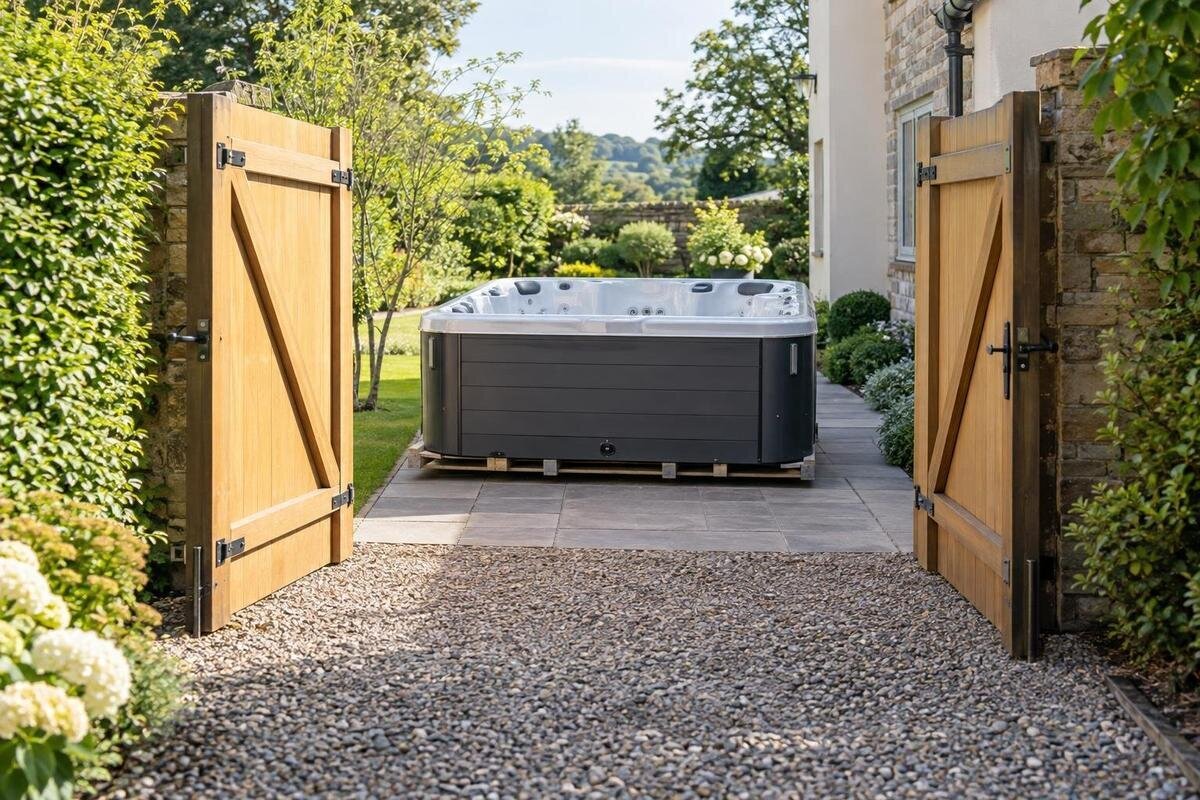
Hot tub delivery access
Hot tub delivery is an access question to settle before ordering, not a problem to leave to delivery day. A clear gate is only one part of the route: the packaged tub, the equipment used to move it, every turn and change in level, overhead clearance and the vehicle’s stopping point all matter. For a property in Malta, map the complete path to the intended position and share it with the supplier. If ordinary access will not work, ask whether a professionally arranged lift, a different position or another model is practical and can be confirmed.
01
Ask the supplier how the hot tub will be delivered
Before measuring a gate, find out what the supplier means by delivery. Ask whether the hot tub arrives with protective packaging, what the carrier is expected to do after unloading, and where standard delivery ends: at the vehicle, at the property boundary or at an agreed position inside the property. Do not assume a delivery charge includes moving the tub through a house, courtyard or garden. For Bloomcabin Hot Tub Cove 2, as for any model, the catalogue name gives no transport measurements or handling instructions; request current information for the exact unit from the supplier or manufacturer.
Ask for the packaged transport length, width, height and weight, together with any drawing or handling information used by the delivery team. Check whether those measurements include wrapping, a pallet or other transport equipment, and what additional clearance the moving equipment and crew need. Ask which orientations and handling methods are permitted, including whether the package may be turned or tilted. The useful comparison is not the bare tub against a gate opening; it is the authorised delivery configuration against the whole route. If a detail is missing, ask the supplier to obtain it rather than filling the gap with an estimate.
Trace the route from the delivery vehicle
Begin at the place where the delivery vehicle can actually stop and unload, not at the driveway gate shown on a plan. Trace one continuous path from there to the intended position, noting every gate, doorway, passage, turn, step, ramp and raised edge. Include the route used by the delivery equipment as well as the tub: a trolley or other handling device may need more width, turning room or headroom than the package. If the vehicle can stop only at the street, include the distance and every change in level or direction between that point and the property entrance. For Bloomcabin hot tub Haven 6, request exact transport information instead of treating the model name as a size guide.
Walk the route and make a simple sketch with each segment labelled. Photograph entrances from both directions, and take close-ups of tight points with a tape measure visible. Note door swings, shared passages, locked gates and any feature that changes the usable approach. Record measurements consistently in metric units and mark each one clearly so the supplier can distinguish a width from a height or distance. If a route uses shared or neighbouring property, include it only after access has been agreed. Annotated photographs and a route sketch give the supplier context that a message saying the gate is wide cannot provide.
02
Measure gates, doorways and narrow passages
Measure each gate, door and passage at its smallest usable point with the opening in the position it would need to be during transport. Include posts, hinges, handles, latches, door closers, wall returns and any lip that reduces the clear space. A nominal opening size on a plan is not necessarily the space available on site. Where the opening is irregular, take measurements at more than one height and record the clear height as well as the width, including beneath a lintel or arch. For Bloomcabin Hot Tub Fjord 8, compare these figures with the supplier-confirmed packaged dimensions and the clearance required for the approved moving equipment.
Then check whether the route allows the package to reach the opening in the orientation specified by the supplier. A wide gate followed immediately by a post, wall or sharp turn may be more restrictive than the opening itself. If you are considering removing a gate leaf, ask who can arrange it, how much clearance this would create and who would be responsible for putting it back. Do not assume the package can be unpacked or made narrower to pass; ask the manufacturer or supplier what changes, if any, are permitted. Send the actual measurements and photos so the supplier can review the opening in context.
Allow for corners and changes of direction
A straight measurement does not describe a corner. At each turn, record the usable space before and after it, including the lengths and widths of the approach and exit passages, wall projections, pillars, door swings and any landing where the unit might need to change direction. A route can have enough width for a package in one orientation yet offer no room to turn it. Ask the supplier to compare the measured corner with its stated handling method and the dimensions of the moving equipment. When discussing Bloomcabin hot tub Aurora 10, for example, ask for this assessment for that exact item; its catalogue name does not establish whether it can be tilted or turned.
Sketch each corner from above and photograph it from both the approach and exit sides. Include the distance between the opening and the next obstruction, the width between opposing walls and any point where the route bends back on itself. Note fixed items that project into the path, such as pipes, meters or lights, but do not dismantle or move them based on a rough estimate. If photographs are not enough for the supplier to assess a manoeuvre, ask whether a site survey is needed before ordering. Treat a suggestion to angle the tub through as unconfirmed until the delivery team states the orientation and clearance its method allows.
03
Check overhead clearance along the whole route
Check the route above head height, not just the door frame. Measure beneath balconies, eaves, canopies and beams, and note branches, clothes lines or other items hanging over the path. Clear width at ground level is not enough if the package or approved moving equipment must pass beneath a lower obstruction. Record the lowest point, where it occurs and whether the obstruction moves or might be removed. For Cove 2 from Bloomcabin, as with any selected model, ask the supplier which overall transport height and handling clearance to use rather than estimating from a product image.
If a lift is being considered, the overhead check still matters. The lifting contractor needs to assess the equipment’s approach and movement, the intended path of the load and any obstruction above or beside it. Photograph wires and cables from a safe distance and tell the contractor where they are; do not touch, move or work around utility lines yourself. Ask who will determine whether anything overhead needs professional attention. A canopy or other removable feature is not automatically a solution: confirm who may arrange its removal and whether that work is part of the plan.
Record steps, slopes and thresholds
Record every step, staircase, ramp, threshold, sloping stretch and raised lip between the vehicle and the intended position. Measure step heights, landing dimensions and clear stair width, and note handrails or door leaves that reduce usable space. For a sloping route, mark where the gradient changes or the surface changes abruptly rather than describing it only as slightly inclined. These details let the supplier or mover assess whether the approved method can negotiate the route. Ask specifically whether the handling equipment can travel over those changes and whether a different method is needed for the exact package; do not assume a small step is harmless.
Point out uneven edges, loose covers, channels or drain grates that the moving equipment would cross. This is an access assessment, not a judgement about the final base: the question here is whether the delivery route and equipment can be used safely. Do not try to drag or carry the tub to test the path. Send pictures of stairs and transitions with a measurement for scale, and ask whether a professional site survey is needed. If the answer depends on a limit for a slope, step or landing, request the relevant written limit for the exact handling method. For Haven 6, use confirmed unit data, not the number in its name, when raising the query.
04
Consider a lift if the route cannot be confirmed
A lift may be worth exploring when a fixed gate, narrow corridor, staircase or tight turn cannot accommodate the supplier-approved route, or when the ordinary moving method is not permitted for the tub. It may offer an alternative to extensive access changes, but it is not a shortcut that automatically solves the problem. The lifting contractor must establish whether equipment can reach the address, set up in a suitable place, handle the exact packaged unit by an approved method and move it along an unobstructed path to the intended point. Ask the supplier whether it accepts the proposed lift and handling arrangement before equipment is booked.
Compare the options while the order is still flexible: keep the intended position and arrange a confirmed lift; choose a more accessible position; or select a model whose verified transport package and permitted handling method suit an available route. Catalogue names and photographs cannot settle that comparison. A proposed access change, such as removing a gate, also needs agreement and a clear plan for reinstatement. If no supplier or contractor will confirm the method for the exact unit, address and route, treat the question as unresolved rather than assuming the delivery team will improvise. Request the same model-specific confirmation for Fjord 8 from Bloomcabin before comparing access options.
Assess access for the lifting equipment
A crane or other lifting machine needs its own access route and working area. Ask the contractor which equipment it proposes, how it reaches the property, where it can be set up and what space and surface conditions its operation requires. The contractor, not a customer measuring by eye, must assess reach, load, lifting points and the route the load will follow. Share the verified transport weight and packaging details for Bloomcabin hot tub Aurora 10; do not expect the contractor to infer them from the model name. If those details are unavailable, the choice of equipment cannot be confirmed reliably.
Ask the lifting contractor and hot-tub supplier to coordinate the hand-off. Clarify who checks that the equipment and the manufacturer’s permitted handling method match, who agrees the set-down point and what must be clear along the full lifting path. If the machine or its working area may use a public road or shared space, ask who will check with the relevant authority or property manager about any permissions or traffic arrangements that could apply to that address. This needs to be resolved for the proposed plan rather than assumed to be the same everywhere. Request a site visit if photos cannot establish the equipment’s route, set-up space or overhead clearance.
05
Agree responsibilities, exclusions and costs in writing
Put the division of work in writing before ordering. The supplier may quote for delivery while a specialist contractor provides any lift separately; do not assume one party has arranged the other’s equipment, survey or booking. The written scope should identify the exact model and transport information being used, where delivery responsibility begins and ends, the route or lift method, the intended placement point and who handles each part. Ask what is excluded, such as movement beyond the vehicle, stairs, extra handling, gate removal, protection or reinstatement of property, lifting equipment or packaging removal. If responsibility changes at hand-over, ask both parties to state when that happens.
Request a current quote that separates the standard delivery scope from any lift or access work and lists its assumptions. Costs can depend on route length, crew and equipment, site visits, access constraints and any arrangements for a road or shared space; without a site-specific quotation, a price would be guesswork. Ask what changes could add a charge, what happens if the route differs from the information supplied and whether cancellation or rescheduling has a fee. Confirm who must be contacted if the model, package, vehicle position or proposed method changes. This makes the options easier to compare by scope rather than by headline delivery price.
Choose the model and position after access is confirmed
Make the purchase decision once the actual delivery configuration has been compared with the full route. If the supplier confirms that the exact packaged model can pass by the specified method, keep that confirmation with the quote and note any conditions, such as a particular opening being available. If a critical measurement or handling instruction is missing, obtain it before committing. If the ordinary route will not work, decide whether a lift, another position, an agreed access change or a different model is practical and confirmed. A measurement showing that the tub fits through one gate is not approval of the complete delivery route.
A useful pre-order message can include a route sketch, annotated photos, narrowest openings, lowest overhead point, turns, level changes, vehicle stopping place and any proposed lift access. Ask the supplier to confirm the exact model’s packaged transport dimensions, weight, permitted handling method, delivery boundary and whether it accepts the proposed route. Where relevant, ask the lifting contractor to confirm its separate scope and conditions. Have both parties review the same information and state any exclusions. If no workable method can be confirmed, keep the model or position flexible rather than relying on a delivery crew to resolve an unknown access problem.
Frequently asked questions
Which measurements should I send to the supplier?
Send the narrowest clear width and height at every gate, door and passage, plus measurements for corners, landings, steps, slopes and the lowest overhead point. Show the route from the delivery vehicle’s possible stopping place to the intended position on a simple sketch. Label each measurement, attach photos and ask the supplier to compare them with the exact unit’s confirmed transport details and handling method.
If the hot tub fits through the gate, can it be delivered?
Not necessarily. The package and the equipment used to move it need to pass along the entire route, including turns and changes in level. Headroom, a narrow passage beyond the gate, the vehicle’s stopping point and the permitted handling method all matter. Ask the supplier to confirm the complete route, not just the gate opening.
Will a crane solve a difficult access route?
A lift may be an option, but it is not suitable for every property or hot tub. A lifting contractor must assess the exact package and its approved handling method, equipment access and set-up space, the route through the air and the intended set-down point. Ask about any road or shared-space arrangements that may apply to the proposed plan.
Who should arrange a lift?
Check whether the supplier includes lifting in its delivery offer or expects you to appoint a separate contractor. If the services are separate, agree who provides the model information, surveys the route and coordinates the hand-off. Get each party’s responsibilities, exclusions and any conditions in writing before booking equipment.
Should I order before the route has been surveyed?
Only proceed if the supplier has enough accurate information to confirm a workable delivery method for the exact model and position. If measurements, package details or a difficult manoeuvre remain uncertain, ask whether a site survey is needed. Keep the model, location or lifting option flexible until the access plan is confirmed.
A useful access plan matches the exact tub and package with the full route and a handling method the supplier or lifting contractor has agreed to provide. Gate measurements are important, but turns, headroom, level changes, equipment access and clear responsibilities also determine whether delivery is feasible. If any part remains uncertain, keep the model and position flexible until the relevant parties confirm a practical method in writing.
