
Powdery mildew in the greenhouse: stop the spread
Plant health · Greenhouse guide
Powdery mildew in the greenhouse: stop the spread
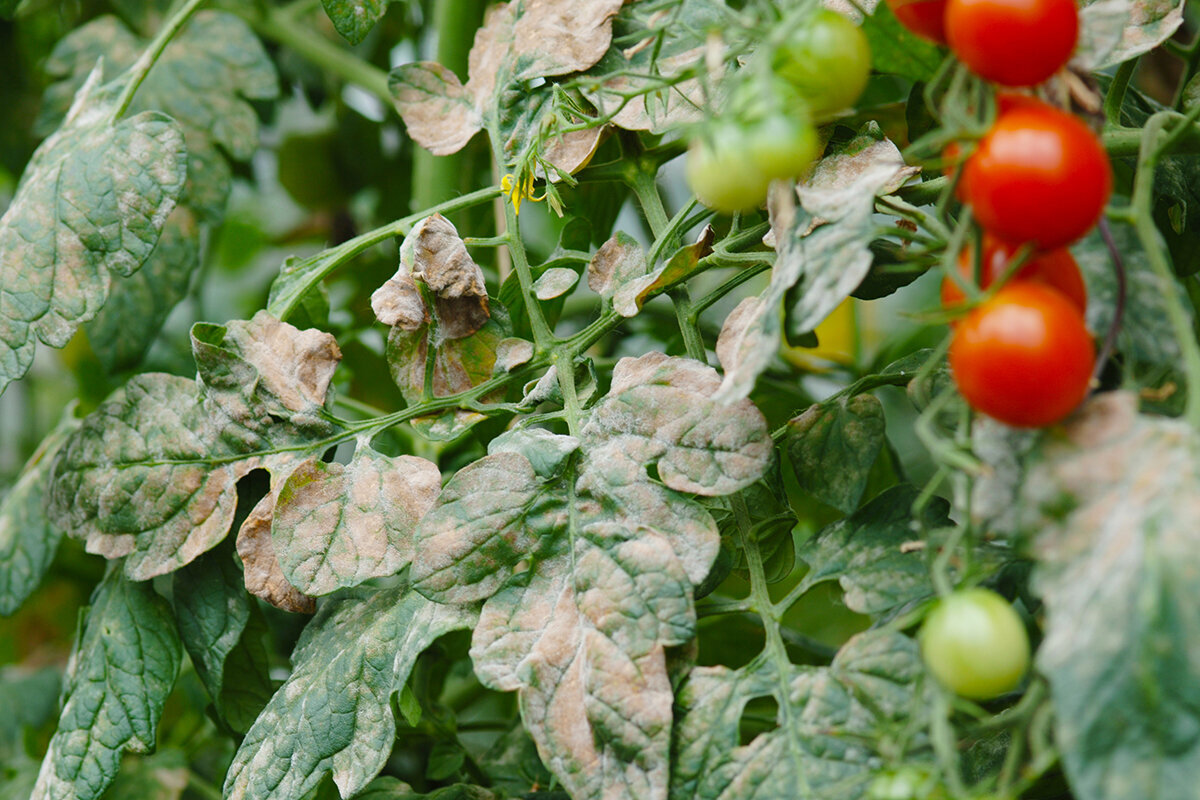
A pale, powdery coating can look almost harmless from a distance. On living foliage, it calls for deliberate action: identify the surface, interrupt the spread and improve the climate around the next clean leaf.
+
Diagnosis note Not every white trace is mildew, and wiping a colony away does not cure an infected leaf. A reliable response combines careful diagnosis, separation, canopy correction and only crop-specific approved measures.
First response
Contain first, then investigate the cause
Powdery mildew is common enough for a white patch to prompt an immediate reach for the sprayer. Resist that impulse. First prevent a potentially active colony becoming a second surface across the greenhouse, while retaining enough features for a sound assessment. Powdery mildew fungi live on living host tissue and produce spores that can travel through air movement, touch, clothing and plant work. They are not interchangeable: mildew on courgettes does not automatically explain a pale coating on roses, mint, cucumbers or zinnias.
This distinction matters especially in a mixed greenhouse. Edible crops stand beside ornamentals, young plants beside established containers, and varieties have very different sensitivities. A product or growing measure suitable for one plant may be unsuitable or unapproved for another. Start with the affected plant species, symptom distribution and conditions within the crop, rather than a blanket home remedy.
01
Limit movement Separate affected pots or trays if this can be done without contact with healthy foliage. Prevent leaf contact with neighbouring plants and choose a place that can be monitored easily.
02
Document both leaf surfaces Photograph the coating close up and also show the position of the whole plant. Note whether new growth, older leaves, shaded inner areas, stems, buds or flowers are affected.
03
Check neighbouring plants Inspect at least as far as the next row. Focus on dense plant centres and areas by glazing, walls, shelves and obstacles in the airflow.
04
Reconstruct conditions Warm days, cool nights, closed vents, dense foliage, late watering or condensation provide more useful context than one centrally measured humidity reading.
Lookalikes
Read the coating – not just its colour
Powdery mildew often appears as a white to grey-white, powdery or finely felted coating. Individual islands enlarge and can merge into sheets. Dried spray products, mineral deposits from hard water, natural wax layers and other leaf diseases also leave pale marks. Careful visual inspection is an initial assessment, not laboratory proof. Avoid rubbing across several leaves, as this can spread spores and damage delicate tissue.
Soft colony Droplet edge Natural wax layer Tissue damage
| Checked surface | Typical appearance | Distribution clue | Careful check | Limit of a quick check |
|---|---|---|---|---|
| Powdery mildew | Soft white, cream or grey colonies; individual round islands may merge into a powdery veil. | Often on leaves and young shoots. Depending on the host and mildew species, upper or lower surfaces, stems, buds or flowers may be affected. | A small colony may partly transfer to a dark, dry cloth. The leaf can become dull, yellow, distorted, or later develop brown or corky patches. | Visible powder may partly come away although fungal structures remain connected to living plant tissue. |
| Spray residue | A more even film, separate dots, droplet rings or streaks; the surface may look shiny rather than fluffy. | The coating often follows the spray pattern and repeats on exposed leaves, pots, labels, glass or nearby surfaces. | Compare the pattern with the last application, water quality and nozzle direction. Also inspect protected leaf undersides. | Residue and mildew can occur together where an already infected crop was previously sprayed or treated. |
| Mineral deposit | Chalky marks or hard rings left when individual water droplets dry. | Typical on leaf tops, glazing and dark pot rims after overhead watering or spraying with mineral-rich, hard water. | Look for the same deposit on non-living surfaces. The trace usually clearly follows the edge of a dried droplet. | Water marks can conceal an emerging disease. Also observe tissue response and new growth. |
| Natural wax layer or hairs | A uniform, integrated bluish-white or silvery surface rather than clearly bounded, irregularly growing colonies. | Usually present to a similar degree on normal leaves, stems or fruit of the same species or variety. | It appears part of the plant surface and does not spread in separate cloudy infection islands. | Do not rub hard. Natural wax layers can have protective functions and vary by species, variety and growing conditions. |
| Other leaf diseases | They may start pale but develop into angular spots, grey mould growth, watery lesions or dead tissue. | The pattern may follow leaf wetness, splash water, injury or the particular susceptibility of a crop or plant family. | Watch for necrotic centres, yellow halos, differently coloured spores, stem lesions, angular boundaries or rapid collapse. | If symptoms remain unclear or a valuable food crop is involved, plant-protection advice is more reliable than visual diagnosis alone. |
This comparison is for practical first assessment. A wipe test is not proof, and powdery mildew does not look the same on every host plant.
The hidden space around the leaf
Good room readings can hide a still canopy
The greenhouse climate is not the same as the leaf climate. Air movement, warmth and moisture change among dense foliage, behind pots, under shelves and in the shaded interior of tall plants. In this thin boundary layer, an apparently well-managed greenhouse may still provide conditions favouring powdery mildew.
Tight spacing narrows the air route
Overlapping leaves do more than shade each other. They restrict moving air, delay drying after watering or condensation, and conceal early colonies. Allow mature plants their final width, not merely the space their pot needs when moved in.
Cooling makes stored moisture matter locally
After a warm day, moisture from plants and growing media remains in the greenhouse. As temperature falls, relative humidity rises and condensation can form on cool surfaces. Where the crop and weather allow, timely ventilation and gentle late-afternoon heating can help the night begin less damp. The right approach depends on plant needs, outdoor temperature and energy use.
Shade is a climate condition, not merely low light
Overgrown inner areas, permanently shaded shelf corners and foliage pressed against walls often remain cooler and less ventilated. Many mildew species benefit from moderate temperatures, shade and high humidity, yet respond differently to free water films. Blanket humidity rules are therefore inadequate.
Weak circulation and harsh draughts are different problems
A fan aimed directly at a crop can dry or stress individual leaves while another row remains still. The aim is gentle circulation through the whole canopy, with a clear route for used air to leave and outside air to enter.
The host matters
Powdery mildew is not one single form
Powdery mildew pathogens are often specialised to particular hosts or host groups. Symptom position and form, seasonal disease pressure and suitable measures therefore vary by crop and pathogen. Use the following groups for focused observation, not automatic diagnosis. When buying seed or young plants, look for documented tolerance or lower susceptibility, always for the specific species and variety.
I
Cucurbits
Cucumber, melon, courgette and squash can develop conspicuous pale colonies that spread across the leaves. Their rapid growth soon creates a shaded canopy that is hard to inspect, especially where vines are trained too closely.
- Inspect older and inner leaves.
- Train vines neatly, openly and accessibly.
- Check resistance claims for the exact crop.
II
Herbs and edible leaf crops
Mint, sage, rosemary and other herbs are not interchangeable hosts. Dense pots and superficial harvesting nevertheless create pockets that are difficult to see. On edible crops, authorisation, label, harvest interval and intended use of a product must be observed.
- Do not use ornamental-only products on edible crops.
- Harvest only with clean tools.
- Do not let pots grow into one canopy.
III
Flowering and ornamental plants
Roses, zinnias, petunias and verbena can be susceptible but do not always show the same picture. Alongside powdery coatings, distorted growth and dry, corky or scabby patches with little visible white are possible.
- Inspect buds, young shoots and lower foliage.
- Observe new plants separately before bringing them in.
- Record variety observations across several seasons.
IV
Overwintered and permanent stock
Overwintered plants, retained host tissue and year-round collections can connect seasons for some host-pathogen combinations. A greenhouse that appears clean after summer may therefore still contain living host plants needing regular checks.
- Check overwintered plants thoroughly before spring planting.
- Remove remaining diseased tissue.
- Keep propagation separate from mature stock where possible.
A useful rule is: diagnose and treat the crop actually affected. Approval, advice and growing method must fit the plant, not merely the general name “powdery mildew”.
Air choreography
Give air a route and foliage enough space
Ventilation means air exchange: warm, humid indoor air leaves the greenhouse and fresh outdoor air enters. Air circulation instead means movement within it. Both matter, but work only to a limited extent with fully occupied shelves or a blocking canopy. Assess the greenhouse in its current, mature condition, not as it looked when young plants were moved in.
The Classic aluminium greenhouse combines configurable glazing, roof-vent and equipment options with clearly usable growing space. Details of available sizes, openings and design features are available directly on the Classic aluminium greenhouse.
Upper outlet
Rising air ↑ route
Roof opening
Circulation fan
Open canopy
Sheltered zone
Lower inlet
Clear route →
Remove obstacle
Morning: Check foliage and condensation before warming hides the night’s clues. Misted glazing, cool inner leaves, drip points and persistently still corners are especially easy to spot now.
Midday: Use vents, shading and air circulation to release heat without letting the canopy stagnate. A fan should guide air gently along rows, not expose one plant continuously to a harsh stream.
Late afternoon: Do not carry unnecessary moisture into a cool night. Match ventilation and, where appropriate, gentle heating to the crop and weather. Check that vents, air routes and the fan remain clear.
Structured treatment
Treat the infestation and the conditions that support it
No rescue product can keep a dense, damp, poorly ventilated canopy healthy for long. Conversely, crop corrections may not suffice once colonies are spreading in a susceptible crop. A successful plan follows a clear sequence: reduce the spore source, correct the microclimate, select only label-compliant and crop-appropriate products, and judge success by clean new growth rather than perfect-looking old leaves.
Folio 01 / remove
Decide consciously about removal
With a small, clearly contained infestation, heavily colonised leaves, shoots or whole plants can be removed if this noticeably reduces the spore source. Use clean scissors reserved for this task where possible. Put material straight into a bag or closed container; do not carry it openly through healthy foliage. If a plant is badly weakened, replaceable and surrounded by sensitive neighbours, complete removal may be more sensible than retaining a permanent infection source.
Do not remove so much foliage that the plant is suddenly stressed or exposed to sun. The aim is fewer active colonies and better airflow, not cosmetic perfection.
Folio 02 / correct
Reduce crop stress
Open the canopy through wider spacing, selective pruning and a clear arrangement of pots and shelves. Prefer watering directly at root level in the morning so crops do not enter the night wet and cool. Avoid unnecessary leaf wetness, especially where other leaf diseases threaten, and do not fertilise so heavily that soft, dense replacement growth develops.
Wash hands, clean tools between plants, remove fallen leaves, and clear dead material, standing water and other deposits that dry poorly from the growing space.
Folio 03 / select
Choose products by crop and label
For advancing infestations, approved plant-protection products or biological preparations may be considered according to plant species and use. Availability, authorisation, plant tolerance and effectiveness vary greatly. Sulphur products, oils, biological products and other fungicides may also have restrictions on temperature, timing, mixing or phytotoxicity. Generic home remedies are not a substitute for crop-specific assessment.
Read the current label in full: crop, target organism, place of use, dose, interval, number of applications, protective measures and harvest interval must fit. If plant tolerance is uncertain, a small inconspicuous test group may only be treated within label instructions.
Folio 04 / rotate and check
Do not repeat one mode of action thoughtlessly
Where fungicides are used repeatedly, rotation and resistance management must follow the label, professional advice and active-substance group. Resistance problems cannot be solved by more frequent applications or a dose above that authorised. Record the product, active substance or group, crop, date, conditions and result. These records prevent unnoticed repetition and support later assessment.
Assess the situation again once fresh growth appears. A leaf colonised before treatment can remain marked. What matters is whether new leaves stay clean and no fresh colonies appear on neighbouring plants.
Legal checkpoint
In Malta, verify each plant-protection product’s current status through the Maltese register route and read its latest label before use. The authorised crop, target organism, place of use and user category must all match. For edible crops, observe the harvest interval. Also check dose, number and spacing of applications, protective measures, temperature guidance and mixability. Authorisation for ornamentals does not automatically cover cucumbers, tomatoes or herbs.
Checking containment
Judge recovery by the next leaf
Old damage is an archive, not a final verdict. Scars, yellowing, distortion and dull patches can remain visible after active spread stops. Do not ask whether every affected leaf looks flawless again. Look for a traceable change across the crop: fresh tissue stays clean, neighbouring plants show no new colonies, and the microclimate does not return to a dense, still state.
Set a fixed observation period and repeatable inspection route. This avoids two common mistakes: reading an unchanged old lesion as treatment failure, or treating one clean leaf as proof that unchecked neighbouring plants are healthy.
After 48 hours
Check separated plants and their nearest neighbours again. Record whether colonies are growing, whether an application caused damage and whether all leaves receive gentle, even air movement.
After 7 days
Assess new symptoms, hygiene, watering time and ventilation routine. Observe required application intervals exactly and do not improvise extra treatments.
At new growth
Date the first clean leaves in your growing records. If fresh foliage is colonised again, reassess diagnosis, host sensitivity, application and microclimate correction.
Old damage
Active colony
Treated tissue
Clean new growth
- Old damage May remain visible after spread stops; cosmetic restoration is not the treatment goal.
- Active colony Fresh coating grows, reaches new tissue or appears on neighbouring plants.
- Treated tissue Watch for plant response and phytotoxicity without judging the result too soon.
- Clean new growth The clearest sign that containment and climate correction are working.
FAQ
Important questions before the next treatment
Can powdery mildew spread on dry foliage?
Yes. Powdery mildew differs from many other leaf diseases because infection does not necessarily require a free water film on the leaf. Moderate temperatures, shade, high night-time humidity and weak air movement can favour it. Water management still matters, as condensation and long wet-leaf periods may encourage other harmful diseases.
Should I wash powdery mildew off or spray the foliage?
Do not regard rinsing as a general treatment. Visible powder may partly disappear without healing the infected leaf area; touch and water can also spread spores or other pathogens. In a mixed hobby greenhouse, careful diagnosis, adequate spacing, targeted removal of badly affected parts and gentle airflow are more dependable first priorities than indiscriminate washing.
Can a fan stop powdery mildew on its own?
No. A fan can reduce still air pockets, but cannot remove an existing infection or replace hygiene, plant spacing and fresh-air exchange. Look for unmoving zones behind pots, shelves and tall plants. Then combine gentle circulation with ventilation and a suitable morning watering routine.
Can I use the same mildew product on vegetables and ornamentals?
Not automatically. Authorisation, dose, harvest interval, plant tolerance and permitted location differ. A product authorised only for ornamentals is not necessarily suitable for edible crops. For the exact crop, intended use and user category, verify current status through the Maltese register route and read the latest label.
Is powdery mildew the same disease on every plant?
No. Powdery mildew is a collective term for different fungi, many specialised to particular hosts or host groups. Symptoms and suitable measures can therefore differ. Diagnose the plant actually affected instead of assuming mildew on cucumbers explains every pale patch in the greenhouse.
Sources and further guidance
Deepen your crop-specific diagnosis
This guide draws on German specialist information, Malta’s plant-protection register route and international university sources. Authorisations and labels can change. Before each application, verify the product’s current status through that register route, read the latest label and seek qualified plant-protection or horticultural advice if the diagnosis is uncertain.
More from Bloomcabin: Made-to-measure aluminium greenhouses · Classic aluminium greenhouse · Premium aluminium greenhouses for Maltese gardens
- LWG Bavaria – vegetable disease symptoms in greenhouses
- North Rhine-Westphalia Chamber of Agriculture – downy mildew on cucumbers
- Hortipendium – greenhouse cucumbers and plant protection
- BVL – plant-protection products for home and allotment gardens
- EPPO – Malta plant-protection register lookup
- Cornell University Greenhouse Horticulture – Powdery Mildew
Keep the next leaf clean
A healthy greenhouse is built through small, visible decisions
Open the canopy.
Check the diagnosis.
Protect new growth.
Thoughtful equipment supports this daily routine. See how ventilation, glazing, accessibility and configurable details create a clearly organised growing space in the Classic aluminium greenhouse and the complete product overview for the Classic aluminium greenhouse.
