
Moving an Aluminium Pergola to a New Site
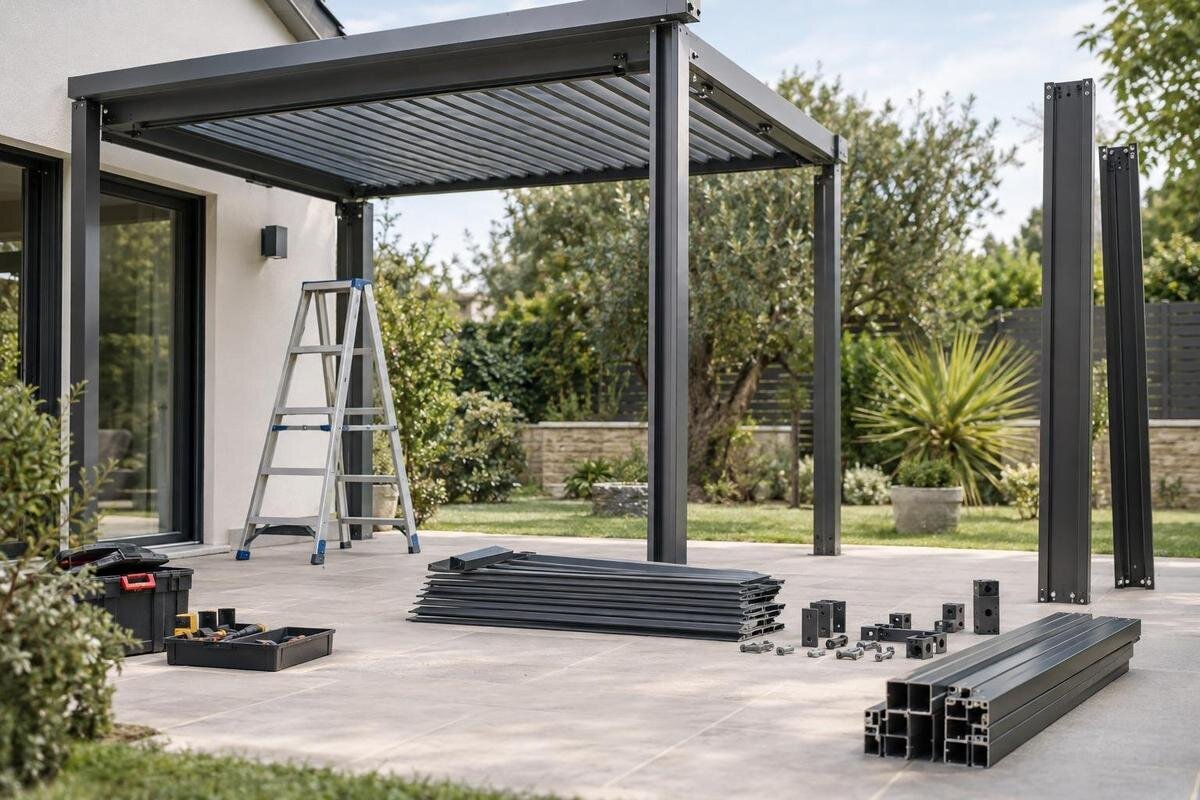
Pergola relocation guide
Moving an aluminium pergola can be possible, but taking it apart and reinstalling it is not simply a repeat of the original build. Old connections may be damaged, and the new site may need a different layout or support. Assess the frame, its records and the destination before deciding what can be reused.

01
Can an aluminium pergola be moved and reused?
An aluminium pergola may be dismantled and installed again, but not every structure is suitable for relocation. The answer depends on the exact system, its condition, the way it was originally assembled, whether all components can still be identified and sourced, and whether the new location can support the intended configuration. A frame that comes apart is not automatically fit to go back up: hidden damage, worn connection points, missing hardware or a changed footprint can make reuse impractical. Nor does a successful first installation prove that the original support or fixing approach will suit a different surface, wall or level of exposure. Base the decision on the structure’s condition and suitability, not its appearance.
Treat the move as two linked projects: taking down and preserving the pergola, then checking, designing and reinstalling it at the new address. Ask the original supplier, manufacturer or a pergola installer to review the exact model details and clear photos before anything is loosened. They can help establish whether instructions exist for the system, which components need to remain matched, and what must be checked at the destination. Avoid basing a decision on a similar-looking frame or a generic online guide. The new layout may change anchoring, wall connections, drainage, access and exposure, so complete the site assessment first. If the structure’s identity or condition cannot be established, delay dismantling until that gap is resolved.
Find the exact model and installation records
Gather all records that identify how the pergola was supplied and installed: the order confirmation, invoice, model or serial label, assembly manual, technical drawings, installer notes, and records of repairs or replacement parts. Photograph the complete structure from several angles and take clear close-ups of labels and visible joints, brackets, drainage parts, roof members and controls, without removing components to get a better view. Note its approximate age, who installed it and which parts have been changed. Keep any spare components with the records, and note the original layout. This information helps a supplier distinguish an exact version from a similar model and lets an installer prepare specific questions before a site visit.
A catalogue can help identify a product family, but it cannot identify your particular frame by itself. The Bloomcabin Pergola product page names a model; a similar appearance or name does not prove that an older pergola shares its joints, member lengths or roof components. Match the product label and original documents against the supplier’s records, and ask which version the drawings cover. If the manual is missing, request the correct assembly information rather than copying a layout from photographs. Keep any drawings you obtain with the frame’s records so the dismantling crew and the installer at the new site are working from the same reference.
02
Assess the frame and components for reuse
Have someone qualified assess the frame before committing to relocation costs. Record signs worth reporting, including bent or distorted members, cracks, loose or missing hardware, damage around connection holes, and changes to the surface finish. These observations are prompts for assessment, not a home pass-or-fail test: a mark may be cosmetic, while a connection can need attention even if it looks tidy. Photograph any concern alongside a clear view of where it sits, and note whether it was present before the move. Ask the installer or supplier to distinguish ordinary finish wear from damage that could affect alignment, connections or the planned reuse.
Review the complete set of parts, not only the visible posts and beams. Include roof members, louvres or other moving pieces if fitted, brackets, fasteners, drainage components, covers, motors, controls and wiring. List missing items, previous repairs, parts that have been replaced, and functions that were already unreliable; this gives the service team a clearer picture of the intended configuration. Do not force a stuck component or assume a loose-looking part is interchangeable. A written inventory checked against the exact model is more useful than a general impression that the aluminium frame looks sound. Agree what can be reused only after that review.
Treat the old fixings as site-specific
Fixings are part of the connection between a pergola and its original support. A bolt or anchor may look reusable after removal, yet the new site can have a different substrate, thickness, condition, edge position or layout. Holes left in a slab or wall will not necessarily line up with the new post positions, and a fastener that fits a hole is not proof that it is suitable. Unless the original instructions and a qualified professional confirm otherwise, plan on the basis that the old fixings are specific to the original site rather than automatically reusable. This is worth resolving before dismantling, when the original support and post positions can still be inspected.
The new support might be a concrete base, timber deck, paving over another surface or a building wall; the visible finish alone does not establish what lies beneath or what it can support. Have the installer check the actual construction and select a fixing method for the new design. When discussing a wall-attached structure, identify whether it is the Bloomcabin Wall-Mounted Pergola or another model so the installer can assess the relevant brackets and connections. Existing fixings still need to be assessed for the new wall. Do not order anchors by appearance or by a measurement from an old fixing. Match the required components to the exact instructions and the assessment of the new site.

03
Survey the new site before dismantling
Survey the proposed position while the old pergola is still assembled, if access allows, so you can check the apparent fit before transport is booked. Measure the proposed footprint and post positions from a reliable plan or with the installer; do not assume the old area can simply be marked out again. Check clearances around doors and windows, paths, steps, outdoor equipment, boundaries and overhead obstructions, and consider how people will move through the area. Include the space needed to use and maintain nearby features. A frame may fit on a plan yet block a door, narrow a route or leave too little room for access once the layout is marked on the ground.
Record changes in ground level, drainage routes and where water may discharge. Note whether the new site is more exposed or less sheltered than the original, and tell the installer about any difference that could affect the design. These conditions may change the layout or support required; they are not problems to resolve by shifting a post on guesswork. Also check access for transport and the installation team, and whether the new plan involves a building attachment. If you are relocating a Bloomcabin Pergola, use drawings for your exact version and measurements of the destination to assess the footprint, rather than relying on the catalogue listing. If council, landlord or shared-property review may apply, ask about it before the move.
Check whether the new layout matches the original
Compare the original assembly drawing with the proposed layout, not just the overall outside measurements. Post spacing, beam orientation, roof arrangement, brackets, drainage parts and access to moving components may be designed as a matched set. The new site may tempt you to rotate the frame, shorten a member or shift posts to avoid an obstruction. Do not assume those changes are acceptable simply because the parts can be brought together. Ask the supplier or a qualified installer whether the exact model allows the proposed configuration and what documentation supports it. If there is no confirmed arrangement, a different layout or replacement may be more practical than an improvised fit.
Check compatibility at component level, rather than relying on model names. If your structure is a Bloomcabin Bioclimatic Pergola, establish its exact version before requesting parts; the product family name alone does not establish whether components from an older unit or another model will interchange. Keep part labels and photographs with measurements from your own unit, then request a match for any component you need. Connection details may differ between pergolas that look similar, including when they attach to a building rather than stand separately. Do not combine parts from separate sets or change the configuration unless the supplier or a competent installer confirms the exact combination for your system.
04
Plan dismantling, labelling and transport
Agree who will dismantle, transport and reinstall the pergola, and which party is responsible for each task. A qualified installer can plan how the structure will be supported during dismantling and whether specialist handling is needed, particularly for large or connected components. Arrange access, parking, handling, storage and delivery to the new site, and discuss how weather could affect the schedule before booking. Do not start loosening a structure that is still attached or carrying loads, or work beneath a component that is no longer supported. If the frame is fixed to a building or includes services, involve the appropriate trade before work begins. Clear responsibilities also make it easier to pause if unexpected damage or incompatible parts are found.
Make an inventory and label each part by its original position and orientation before packing, using a method that will not damage the finish. Photograph joints as they are exposed, keep each set of fixings with the relevant assembly, and note anything that comes apart differently than expected. Protect coated surfaces from knocks, abrasion and loose hardware during storage and transport; keep long pieces grouped so they are not confused with one another. The Bloomcabin Pergola page is a product listing, not a dismantling manual, so use instructions for the exact version you own. Check the inventory before the load leaves, rather than finding out at the new site that a labelled part or its matching hardware is missing.
Give moving roofs and electrical parts specialist attention
Some pergolas include moving roof parts, motors, lighting, sensors or other controls; others do not. Record which features are actually fitted and whether they operated normally before dismantling. Do not force a jammed louvre or mechanism to make it easier to pack, and do not assume that a drive, cable or control can be disconnected and reused as a single unit. A qualified service technician should advise on relevant mechanical components, while a qualified electrician should handle electrical disconnection and reconnection. Keep wiring alterations outside general dismantling work; do not cut, splice or improvise a connection. If the system was already unreliable, describe the fault before anyone attempts to move it.
Confirm separately whether moving parts can be transported and reinstalled with the same frame, and whether replacement pieces are available for the exact model. For a Bloomcabin Bioclimatic Pergola, include the version details and a record of the components actually fitted when requesting service advice. Do not assume an older motor, louvre or controller will fit simply because it comes from the same product family. Ask for a model-specific parts check before booking. If the new layout changes the roof arrangement, controls, lighting or drainage, ask the relevant specialist to assess those changes rather than assuming the old arrangement can be copied at the destination.

05
Have the new installation checked by a professional
Reinstallation should follow the manufacturer’s instructions for the exact system and be carried out or overseen by an installer competent with that design. Before assembly, have the new support and fixing approach assessed for the actual site rather than treating the old base as a template. As part of the handover, the team should confirm that the connections are complete, the frame is correctly aligned, moving components operate as intended and water is directed as planned. These checks belong in the installation process, not in unapproved on-site alterations. Keep the completed records, any agreed changes and details of replacement parts with the manual so future servicing starts from an accurate history.
If the pergola will attach to a building, ask a qualified building professional to assess the new wall and attachment detail; cladding or the old hole pattern alone cannot confirm that a connection is appropriate. When relocating a wall-mounted Bloomcabin pergola, have the existing brackets assessed alongside the proposed wall connection rather than assuming they can be transferred unchanged. Check any relevant council, property-owner or body-corporate processes for the new address before work is booked; an arrangement at the old site does not automatically settle the requirements at the new one. Electrical work remains with a qualified electrician, and any change to the installation should be documented for later reference.
Compare relocation costs with replacement
Ask for the likely costs in separate lines before authorising a move: assessment, dismantling, packing, transport, storage, new-site preparation and support, new fixings, replacement parts, reinstallation and any specialist electrical or service work. Confirm what the quote assumes about access, existing bases and reusable components, and what will happen if damage or incompatibility is found once the pergola is apart. A low dismantling fee may not reflect the unresolved work elsewhere in the project. Compare the total relocation plan, including coordination and any period when the pergola cannot be used, with a separate replacement estimate. Do not compare transport alone with the full cost of a new system.
Reuse makes most sense when you can identify the exact system, the condition and component match have been assessed, and an installer accepts the design for the new site. If key parts cannot be traced, the structure has damage or the new layout would require unconfirmed alterations, compare replacement or reuse of only those parts specifically approved for the new installation. If you are considering a Bloomcabin bioclimatic model as a replacement, obtain a separate scope and estimate rather than treating it as a like-for-like substitute for the older pergola. Base the decision on the full scope of work, including confirmed reusable parts, rather than optimism about what might survive dismantling.
Common questions
Can every aluminium pergola be dismantled and reused?
No. Relocation depends on the exact model, its condition, available parts, the installation instructions and whether the new site suits its design. A pergola that can be taken apart is not automatically suitable to reinstall.
Can I reuse the existing anchors and fixings?
Do not assume so. Fixings suit a particular support and layout, and the new site may be made of different materials or have different post positions. Reuse them only if the exact instructions and a qualified professional confirm they are suitable.
Can the frame be altered to fit a different site?
Not without checking the exact system. Moving posts, changing the layout or modifying members may fall outside the approved configuration. Ask the supplier or a competent installer what the model permits before planning alterations.
Who should handle motors and electrical parts?
Use a qualified service technician for relevant mechanical components and a qualified electrician for electrical disconnection and reconnection. Record which features are fitted and ask for model-specific advice before dismantling.
Could moving the pergola affect its warranty?
It depends on the written warranty terms and any conditions around relocation, changes or installation. Check the documents for your exact model and ask the supplier for clarification before work begins. Do not assume coverage transfers unchanged.
Whether an aluminium pergola can be relocated depends on the exact model, the condition of its matched parts and the new site, not simply on whether the frame can be unbolted. Keep the records, have the structure and destination assessed before dismantling, and treat old fixings and site arrangements as specific to their location. Considering compatibility, support, services and handling in advance helps you decide whether to reinstall the complete pergola, reuse only confirmed components or choose another solution before transport costs mount.
