
How to Assess Scratches on a Powder-Coated Pergola
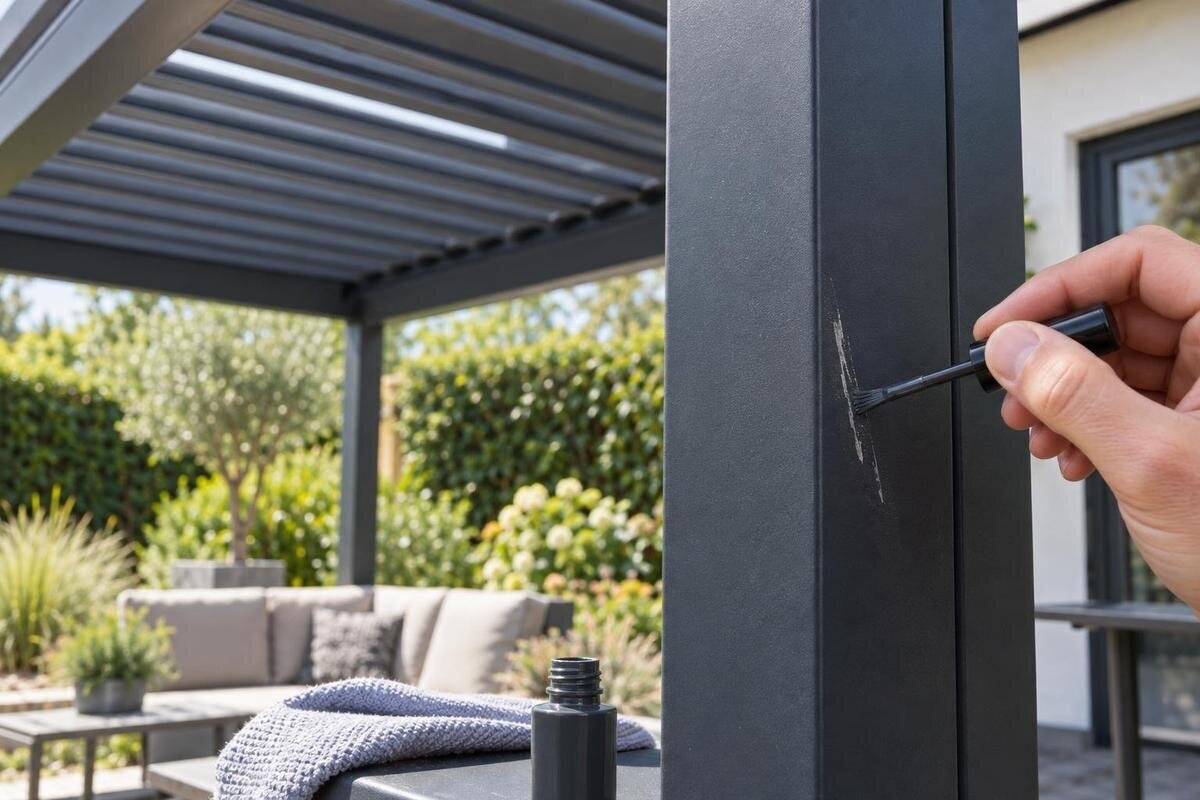
Pergola care and repair
A scratch on a powder-coated pergola may be a mark sitting on top of the finish, a break in the coating, or damage that needs closer assessment. Those possibilities call for different responses. You can make a useful first assessment without scraping, sanding or applying paint: inspect the mark, record its position, and send clear evidence to the manufacturer, installer or supplier. The repair system should be confirmed for the exact pergola and finish, rather than guessed from a similar-looking colour.

01
Identify the pergola before requesting a repair
Before asking for touch-up paint, establish which pergola the scratch is on and which part is marked. Check the order confirmation, invoice, installation paperwork or manual for the exact model name and any product or finish reference. If your records identify a Bloomcabin Bioclimatic Pergola, repeat that wording in your enquiry rather than writing only ‘the pergola’. A broad description may start the conversation, but it does not tell the supplier which finish was supplied. Keep model identity separate from coating compatibility: a model name alone does not confirm the colour, coating formula or suitable repair method. If a finish code appears in your documents, copy it exactly rather than substituting a guess.
Look for a serial or product label only if it is reachable without climbing, removing covers or dismantling a component. If you cannot find one, do not take anything apart to look underneath. Photograph the whole structure, the marked member and any label you can safely read, then note which records you have checked. Identify the location using the product’s own terms where possible: for example, a post, beam, louvre if fitted, or another named part. Keep the invoice or order number nearby. If the pergola has changed hands, say so; the support team can tell you what alternative identification it needs before recommending a repair system. If the previous owner kept the paperwork, ask for the model and finish details before any surface work.
Distinguish a surface scuff from a coating break
Begin with what is visible, not with a depth test. A transferred scuff may sit on the coating as a streak or deposit, while a shallow-looking line can also have cut into it. A mark that looks lighter or darker when viewed from different angles may be a reflection or a change in the surface appearance; it is not proof that the coating is intact. Compare it with the adjacent finish in similar light, and note whether the colour seems to be on top of the surface or part of the surface itself. Do not use a fingernail, blade or abrasive to settle the question.
More concerning signs include a chipped or lifted edge, flaking, a blister, a visible layer beneath the finish, or a stain that appears to come from the underlying material. Record these as observations rather than diagnosing what caused them. Do not assume what the substrate is, or that a particular colour of exposed material means a specific failure. A break in the coating deserves a supplier’s advice on whether a protective repair is needed and how soon; a photo alone may not tell them enough. If there are several marks, show each one and note whether they appeared together. A close-up from another angle may help show an edge without pressing or scraping it.
02
Record exactly where the scratch sits
Map the scratch to a precise place on the pergola. Say which member or panel it is on, which face is affected, and how far it is from an edge, joint, fixing or opening. If the invoice identifies a Bloomcabin Wall-Mounted Pergola, include the exact name, but still describe the marked component; a model title cannot locate the damage. Use everyday directions such as garden-facing or house-facing only if they are clear, and label a quick sketch if words are awkward. This helps the person assessing it connect the close-up with the actual part.
Note whether the mark sits on a flat area, around a corner, or beside a component that moves or meets another surface. That location does not, by itself, prove the pergola is damaged beyond its coating, but it may affect what needs inspecting and whether access should be left to a service person. Record any dent, distortion, looseness, unusual movement or separate coating damage as a separate observation rather than calling everything a scratch. If you are unsure what a part is called, use a wide photograph and point it out in your message instead of removing a cover to identify it. For several marks, number them on a simple sketch so each photo can be matched to its location.
Take photographs that show context and detail
Take three views if you can do so safely: a wider photograph showing where the mark sits on the structure, a middle-distance view showing the whole member, and a close-up of the finish. Keep the scratch and its edges in focus. A ruler held beside the mark, without touching or covering it, can give an approximate scale; say that the measurement is approximate. If your paperwork lists a Bloomcabin Pergola model, include that exact model wording with the images, because a close-up rarely identifies the product on its own. Do not rely on one magnified phone image.
Photograph in even natural light where practical, and take a second angle if glare makes the surface hard to read. Keep the original files: filters, colour correction and heavy sharpening can alter the apparent shade or edge. Include one image of a nearby undamaged area in comparable light, but do not imply that it is a perfect colour reference. Write a short caption for each file, such as ‘garden-facing post, lower edge’ or ‘second mark beside the joint’. Useful labels and context are more valuable than a large batch of near-identical close-ups. Keep each original paired with its caption, and do not crop away the surrounding edge or context.

03
Clean only as the care instructions allow
Photograph the mark before cleaning, then follow the pergola’s care instructions if you need to remove dirt or a deposit. Dust, grime or material transferred from another object can make a surface scuff look like a coating defect, and cleaning may clarify what is left. Use only the method and products specified for that finish; if you cannot find the manual, ask the supplier what is safe before trying a cleaner. Do not treat a successful wipe as proof that the coating below is undamaged. Recheck the same area in similar light and keep the before-and-after images together. If you have already cleaned it, note the method and product used.
Do not escalate from gentle cleaning to a scourer, abrasive pad, blade, solvent or strong household cleaner unless the manufacturer’s instructions explicitly allow it. An unapproved product can leave residue or change the surface appearance, which makes both visual matching and later assessment harder. Avoid pressure washing the mark as a shortcut unless the instructions expressly permit it for your model and finish. If a deposit remains, record that fact and ask for advice rather than scrubbing until the colour changes. The aim is to observe the finish, not to test its resistance.
Colour matching and coating compatibility
A matching colour is only one part of a repair. The repaired spot may differ in sheen or texture, and the existing finish may look different after exposure to light, weather and cleaning. A phone photograph, online image or paint chart can help describe what you see, but it cannot establish the coating formulation or prove that a touch-up product will adhere appropriately. If the pergola’s finish code is recorded, share it; if it is missing, say that it is unknown. Do not choose by a colour name alone, even if a sample looks close in the shop or on a screen.
For a Bloomcabin Wall-Mounted Pergola, give the supplier the model and finish details recorded in your paperwork. The catalogue title and product photograph are not paint references. Ask the manufacturer or authorised supplier to confirm which repair system is intended for the original finish. Clarify whether the proposed repair is meant to protect a small break, improve the appearance, or do both; a local touch-up may remain visible. Ask which finish identifiers or product details you need to check before ordering, rather than trying to match the shade by eye. Confirm that the recommendation applies to the damaged area as well as the surrounding intact coating.
04
Ask for an approved repair system
Make the repair request easy to assess: include the model name, order or invoice number, any serial or product number or finish reference you can safely read, the component and exact location, an approximate size, and the original photographs. If the paperwork identifies a Bioclimatic Pergola from Bloomcabin, copy the title as written; do not guess a different model from the appearance. Describe whether you can see a coating break, a raised edge, an underlying layer or only a surface mark, and distinguish what you observed from what you suspect. If you know when or how the scratch occurred, add that information; if not, say you do not know.
Ask for an approved repair system matched to the exact model and finish, and request its written instructions before buying or applying anything. Confirm which preparation and application steps are permitted, whether a repair is intended for owner application or needs a qualified service provider, and whether a replacement part or professional refinishing is preferred. Ask how the repair relates to the product’s warranty or service terms before work begins; do not assume a touch-up is covered or excluded. If instructions say a qualified person must carry out the work, follow that requirement rather than improvising with a general-purpose kit. Make clear whether you are seeking appearance improvement, protection, or both, as the recommended repair may not achieve an identical appearance.
Know when to seek an in-person assessment
Ask for professional assessment rather than relying on a photo alone if coating is lifting, blistered or flaking, if the underlying material is visible, if the mark is spreading, or if several areas are affected. The same applies when the scratch sits beside a joint, fixing or moving part and you cannot tell whether anything else has shifted. A surface mark does not establish structural condition, but neither can it rule out a separate issue. Report any cracking, bending, looseness or altered movement separately and clearly, without trying to straighten or tighten parts yourself. If the mark changes after cleaning or over time, note when and how it changed instead of repeatedly testing it.
When you contact the installer, supplier or manufacturer, ask whether the photographs and description are sufficient or whether an in-person inspection is needed. Ask whether the remedy is an approved local repair, component replacement or another service. If you own a Wall-Mounted Pergola from Bloomcabin, include the model name from your records and identify the affected member in your own words. Leave trim and components in place rather than dismantling them for a better photograph. If there is a separate concern about stability or a moving part, keep clear of the affected area and wait for qualified advice before operating the pergola or attempting a repair.

05
Avoid trial repairs while you wait
While waiting for an answer, leave the coating alone. Sanding, scraping, metal brushes, polishing compounds and paint pens can remove more finish, alter the edge or cover evidence that would help the supplier choose a remedy. Generic automotive paint, nail polish, marker pens, aerosol paint and clear coats are not substitutes for an approved repair system, even when the colour looks close. A product that dries to a different sheen or texture may make a small defect more noticeable and could complicate a later repair. Do not mix products or layer a second coating over an unconfirmed first attempt.
A catalogue page such as the Bloomcabin Pergola listing identifies a product name; it is not an instruction for a coating repair or approval for a particular touch-up product. Avoid adhesive tape, stickers or filler over the scratch unless the supplier recommends them, as they can conceal the edge or leave another material to remove. Do not dismantle the pergola to expose the area. If a previous owner has already applied something, name the product if known and show it in your photographs; do not cover it with another layer. If the edge feels sharp, do not run a finger across it; describe the hazard and ask the service provider how to manage the area until it is assessed.
Choose a response based on the confirmed damage
If the mark is confirmed to be residue or a superficial scuff and the coating is intact, the appropriate response may be no repair at all; follow the supplier’s advice and keep a dated photograph as a reference. If the coating is broken, ask what protective repair is suitable and whether it is a local touch-up or a service task. A small mark is not, by itself, a reason to replace a pergola, while a broad or recurring defect deserves a fuller assessment. Make the decision on the confirmed condition and the recommended repair, not on the appearance of one close-up. If several marks are present, ask whether they need separate checks or may have a common cause.
If an approved repair is unavailable or unsuitable, ask whether a replacement component or professionally refinished section can address the damage before considering a whole-unit replacement. A replacement product is a separate choice: existing dimensions, attachment, finish and accessories may not match a new model, so confirm those matters through the supplier rather than assuming interchangeability. For a separate product comparison, Bloomcabin’s Bioclimatic Pergola listing is one catalogue option to review, not confirmation that it will replace or match your installed pergola. A repair enquiry can establish the available route first.
Frequently asked questions
Can I test a scratch with my fingernail?
It is better not to. Pressing or scraping can disturb the coating, and the feel of a mark is not a reliable way to tell how deep it is. Photograph it and describe what you can see instead.
Will automotive touch-up paint work?
Not unless the pergola’s manufacturer or supplier confirms that exact product is suitable for the model and finish. A similar colour name does not establish compatibility, sheen or texture.
Can a photograph identify the matching colour?
A photograph can help show the mark and its location, but lighting, screens and image processing can change how a colour appears. Share any finish reference in your records and ask for an approved match.
Does visible underlying material mean the pergola is structurally damaged?
Not by itself. It indicates that the coating may be broken, but a scratch does not establish the condition of the structure. Report any separate cracking, bending, looseness or unusual movement for qualified assessment.
Could touch-up affect my warranty?
Check the product’s warranty and service terms before applying anything; do not assume a repair is covered or excluded. Ask which repair system is approved and whether the work needs to be done by a qualified service provider.
A useful scratch assessment separates what you can observe from what you cannot confirm by eye. Identify the pergola, record the mark’s location and appearance, and keep the original photographs and paperwork together. Then use the supplier’s guidance to decide whether the finish can be left alone, needs an approved repair, or requires a closer service assessment. Avoiding a guessed touch-up protects the evidence needed to choose the right response.
