
Buying a pergola on Black Friday: wind, rain and snow specifications
Pergola buying advice
Planning to buy a pergola on Black Friday? Compare the weather evidence before the price, because a wind speed, rain claim or snow-load figure is meaningful only when you know the setup it describes. The same spot may be sheltered in one direction and exposed in another, while an open-sided roof can shed water from above without keeping wind-driven rain out. Use this guide to match written specifications to local conditions, identify missing assumptions and compare like-for-like product versions. Treat any seasonal price as a separate part of the decision, not proof that a pergola suits your site.
01
Separate the price from the weather decision
If you plan to buy a pergola on Black Friday, keep two decisions separate: whether the purchase price is worthwhile and whether the product’s documented weather limits fit your site. A seasonal banner or low price does not answer the second question. Build a shortlist from technical information first, then compare the price attached to the exact model, size and configuration. A listing photo, category name or broad phrase such as “weather-resistant” is not a substitute for a dated specification. If offer details and technical sheets are on separate pages, check that both identify the same version before treating them as a pair.
Treat wind, rain and snow as separate checks, not as a single “all-weather” claim. A wind figure may describe a particular test setup; a rain statement may apply only to the roof under stated conditions; and a snow load may be absent or refer to a specific configuration. A roof’s rain performance does not establish its wind capacity, and neither figure confirms a snow allowance. Note which hazards matter at your property and what information each claim actually supplies. If a listing leaves a key point unclear, ask for the current written specification before paying rather than filling the gap with assumptions. If an exposure is not relevant at your site, record that separately rather than treating an unlisted figure as an all-clear.
What a pergola wind rating actually describes
A pergola wind specification needs a figure and the basis behind it. Check the unit, such as kilometres per hour or metres per second, but also whether the number describes a gust or an average over a stated period. Ask whether it comes from a test, calculation or another defined method, and what reference conditions were used. A number without those details cannot be matched reliably to a site. It may describe a component or selected condition rather than the complete pergola as installed, so avoid comparing figures drawn from different methods as if they were equivalent. Also ask whether the figure describes ordinary use, a limit that triggers an action, or a survival condition.
Read the supporting document for the exact model and note which parts of the assembly the wind rating covers. Does it apply from every direction, and with the roof in a particular position or with screens fitted? Those conditions can matter more than a headline number. When reviewing the Bloomcabin pergola listing, use the listing to identify the product, then look for a technical sheet or request one from the supplier; the name and images alone do not establish a wind rating. Check the document date and configuration so you do not compare an older or different version by mistake. If the terminology is unfamiliar, ask the supplier to explain the boundary in plain language instead of interpreting the number yourself.
02
Match wind data to the site, not the forecast
Wind exposure is not captured by a regional forecast alone. The position of the pergola may be more exposed than a nearby sheltered part of the section: an open coastal edge, ridge, hilltop, gap between buildings or passage beside a wall can experience different airflow from a protected courtyard. A hedge or neighbouring structure may shelter one direction but leave another exposed, and shelter can change as trees grow or are removed. Think about openings from more than the direction of the prevailing breeze; gusts can arrive from other directions too. A spot that feels calm in everyday weather can still be exposed to gusts from a less obvious direction, so informal observation is not a structural assessment.
Before choosing, note which directions are open, nearby obstructions and whether the proposed position sits in a channel or at a corner. Include where the pergola would sit in relation to the house and any shelter you expect to rely on. Share that description, and a simple site sketch or photos if useful, with the supplier or a qualified local professional. Ask them to confirm in writing whether the documented wind conditions cover that position and orientation. The Bloomcabin pergola page can identify a particular listing during comparison, but the category name itself says nothing about its suitability for your exposure.
Read rain claims alongside drainage details
Rain descriptions also need context. Words such as water-resistant, rainproof or weatherproof may not tell you how the roof performs in a particular rainfall event, whether joints or openings are part of the test, or how water is directed away. Ask what the claim measures: water passing through the roof, performance at a stated rainfall intensity or duration, or the ability of the drainage system to carry water away. Check whether the roof must be in one defined position and what conditions the test excludes. Do not treat a general label as proof that every part of an open-sided pergola remains dry.
Find out whether the stated rain performance assumes gutters, channels, downpipes or outlets, and whether those parts are included in the exact package. Ask where the water discharges and what happens if the normal path is obstructed or overwhelmed; a product specialist or installer can explain the intended drainage route for the model. Check whether routine cleaning or maintenance is needed to keep that route clear, and who is responsible for those tasks. Ask where outlets discharge relative to the seating, entries and paths you intend to use. The Bloomcabin pergola product page is a useful product identifier, not a substitute for these details. Save the document or written answer that describes the tested setup and components.

03
Allow for wind-driven rain around open sides
Even a roof that sheds rain may not shelter its whole footprint when rain is blown sideways. Wind direction, the exposed edges and the open sides affect where water reaches; spray can pass under the roof and dampen furniture or an adjacent doorway. The amount of shelter at one edge can differ from the opposite edge, so consider how the pergola sits beside doors, windows, paths and seating. Check which openings would remain exposed in the direction of rain at your site. Decide what you expect the space to do in bad weather: keeping some rain off a table is different from creating a reliably dry, enclosed area. Ask the supplier to state the limits of the roof claim, rather than reading “covered” as “dry in every direction”.
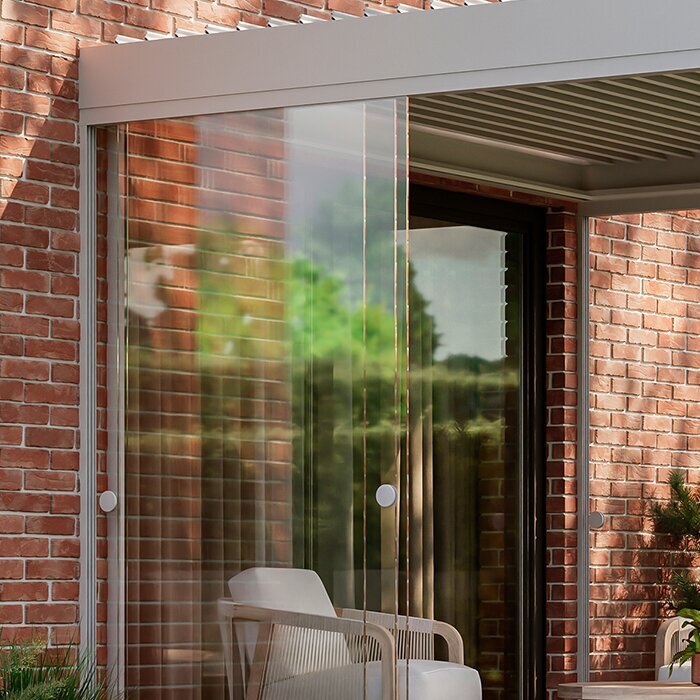
If you are considering side screens, curtains or other add-ons, check that rain and wind information applies to that combination and that the attachments are included in the specification. An added barrier can change how wind acts on the structure, so do not assume an extra layer automatically improves overall protection. Check which sides are open in the tested arrangement and whether the product claim includes spray coming from the direction that matters at your site. For the Bloomcabin wall-mounted pergola listing, confirm which exact arrangement its documentation refers to; the wall-mounted name and product imagery alone do not show how wind-driven rain will behave at your house.
Check snow-load wording for the roof itself
If snow can occur at your site, look for a stated snow-load figure for the pergola roof, not a general statement about the product. Confirm the units and whether the number is for the roof, a ground snow value or one part of the assembly; those are not interchangeable descriptions. Ask whether the stated case is uniform accumulation or also covers uneven deposits and drifting, and which roof position and configuration were assumed. Check whether the figure is a design load or a limit described another way; ask the supplier to define it in writing. A figure without these definitions cannot tell you how the complete structure performs in your conditions, and it should not be converted into an assumed safe depth.
Local topography and nearby buildings can affect where snow collects, so a site with occasional snow still deserves a specific answer if the roof could accumulate it. Ask the manufacturer for the design assumptions and a qualified local building professional whether they relate to the proposed location; do not use a generic map or personal calculation to approve a structure. Also ask whether the specification assumes a particular roof position or requires a defined winter arrangement; do not invent an operating procedure from the wording. Where the supplier says a specific roof state or action is necessary, get written guidance before ordering and consider whether it is realistic for the property. The Bloomcabin pergola listing should be compared only against documents for its exact configuration. If a snow value is not supplied, record it as unknown, not evidence of capacity or incapacity.
04
Confirm the rating matches the exact configuration
Weather figures apply to particular assemblies. Ask whether they cover the size and roof arrangement you are ordering, and whether the stated performance depends on particular post spacing, supports, anchoring or a specified base. A document may set out conditions that are easy to miss in a product summary, so check the complete notes rather than extracting one headline number. The point is not to derive fixing details yourself: it is to learn which assumptions the supplier’s document makes, then have a qualified professional check whether the proposed installation matches them. A rating attached to one configuration should not automatically be carried across to a larger version or a different support arrangement without confirmation.
Compare the product code and options in the technical sheet with the item in the basket. Photographs may show accessories or an arrangement that is not the one being sold, and a screen, canopy or other attachment can alter the conditions covered by a weather claim. Confirm whether accessories are included, optional or outside the tested assembly, and whether the same model name covers more than one configuration. A similar family name or photograph is not enough to identify the tested assembly, so verify the product reference. For the wall-mounted Bloomcabin pergola product page, ask which listed components and installation assumptions its performance documents address; do not infer wall capacity, included fittings or suitability from the title. Put any supplier clarification in writing before ordering.
Compare Black Friday prices against comparable specifications
Use Black Friday as a point to compare like with like, rather than a reason to reduce the checks. For each candidate, write down the exact model and configuration, the source and date of its weather document, the wind figure and basis, the rain claim and drainage assumptions, and any relevant snow information. Mark a field “not stated” when it is missing, and distinguish a genuinely non-applicable hazard from a blank listing. This makes it harder to overlook gaps because a promotion looks urgent and exposes when the price, photograph and specification describe different versions. Keep the comparison on documented limits, not on a general weather label. If price and specification appear on separate pages, match their product references before treating them as a pair.
Compare the item and package attached to each price, then weigh the price only after the weather information has been aligned. The listed Bloomcabin pergola model page can be one product identifier in that comparison; it does not, by itself, establish that the model meets any wind, rain or snow requirement. Check the retailer’s page for the exact item you intend to order and the amount payable, but do not assume a seasonal offer is active or that an advertised saving compensates for missing evidence. When two documents differ, ask which configuration each covers before deciding whether their prices are comparable.

05
Ask specific questions when the listing is unclear
When information is vague, send a short set of questions instead of asking whether the pergola is simply “suitable for New Zealand weather”. Which exact model and configuration does the document cover? Is the wind figure a gust or average, and what method and assembly does it assume? What rain conditions and drainage components are included? Is there a snow-load value for the roof, and what accumulation pattern does it describe? Request the current technical document and written answers for anything it does not cover. If the reply uses only a label such as “all-weather” or “wind resistant”, ask for the supporting limits rather than treating the phrase as an answer. Ask the supplier to point to the relevant part of its document so you can distinguish technical detail from sales wording.
Give the supplier a clear description of the intended site and tell them which roof position, sides and add-ons you plan to use, without asking them to make an engineering judgement from a headline alone. The Bloomcabin pergola product listing can identify the product in your enquiry, but the response should refer to the actual technical documents. If the site has unusual exposure, relevant snow risk or a complex attachment, ask an appropriately qualified local building professional to assess the proposal and any applicable local requirements. Keep this independent assessment distinct from the retailer’s general product description, and do not treat a missing reply as confirmation.
Keep the decision tied to written evidence
Before checkout, save the specification sheet, the product name and variant, and the written replies that explain wind, rain and snow assumptions. Record the document version or date where available, and note which configuration you matched to the price. Also keep the supplier’s clarification about any add-ons, support requirements and excluded conditions; these details define what a figure does and does not cover. This is particularly useful when a listing changes or a seasonal campaign presents a different bundle: you can see exactly which information informed the decision. Keep the product page and supporting documents together rather than relying on a screenshot of a broad marketing claim. Note any unanswered question and resolve it before paying.
Finish by separating confirmed facts from open questions. A written figure with a defined scope is useful; a missing or unclear one is not a pass or fail on its own. If site conditions fall outside the stated assumptions, or the supplier cannot clarify a relevant exposure, pause and get a qualified local assessment before choosing. Where snow is not relevant, note that judgement separately instead of interpreting a blank field as a snow rating. If two candidates both have documentation that applies to your site, price can help you choose between them; where evidence is incomplete, a Black Friday price cannot resolve the weather question.
Frequently asked questions
Can I rely on an advertised wind speed?
Not on its own. Check the unit, whether it describes gusts or average wind, the test or calculation basis, and the exact assembly and roof position covered. A figure for a component or specified setup may not apply to a complete pergola at your site. Ask for the supplier’s current written document and get site-specific questions assessed locally.
Does a rainproof roof keep the whole area dry?
Not necessarily. A roof may shed rain from above while wind blows water through open sides or under the edges. Check the test conditions, roof position, joints, drainage parts and discharge route, then match those details to the protection you expect. Do not read a broad waterproof label as a promise that an open-sided area will stay dry.
What should a snow-load specification include?
Look for a value explicitly described for the pergola roof, with its units, configuration and accumulation assumptions. Clarify whether it is a roof load or another snow value, and whether it covers uneven deposits or drifting. If snowfall is plausible at your site, ask the supplier and a qualified local professional to interpret the document; do not calculate a safe depth from a general figure.
Should I wait until Black Friday to choose a pergola?
Compare the product and configuration with the published weather information first. A Black Friday price is comparable only when you know which version it covers; do not assume an offer is active or that a lower price resolves missing wind, rain or snow data. Once the specifications are clear and relevant, price can help distinguish otherwise suitable options.
What if a product listing has no weather specifications?
Ask for the exact model’s current technical sheet and written clarification of any missing weather claim. Mark unspecified details as unknown, not as proof either way. If relevant site conditions are not covered, pause and ask an appropriately qualified local building professional to assess the proposal before ordering. A general reassurance such as “all-weather” is not a defined specification.
A sound Black Friday pergola comparison starts with weather claims you can interpret, not with a headline price. Match wind, rain and any relevant snow information to the exact configuration and the conditions at your site. If a specification is incomplete, keep that gap visible and get it clarified rather than assuming it means the product will perform as hoped. When the documentation does apply to your site, price can then help you make a more informed choice.
