
Buying a Replacement Pergola: Can You Reuse Existing Foundations?
Pergola buying guide
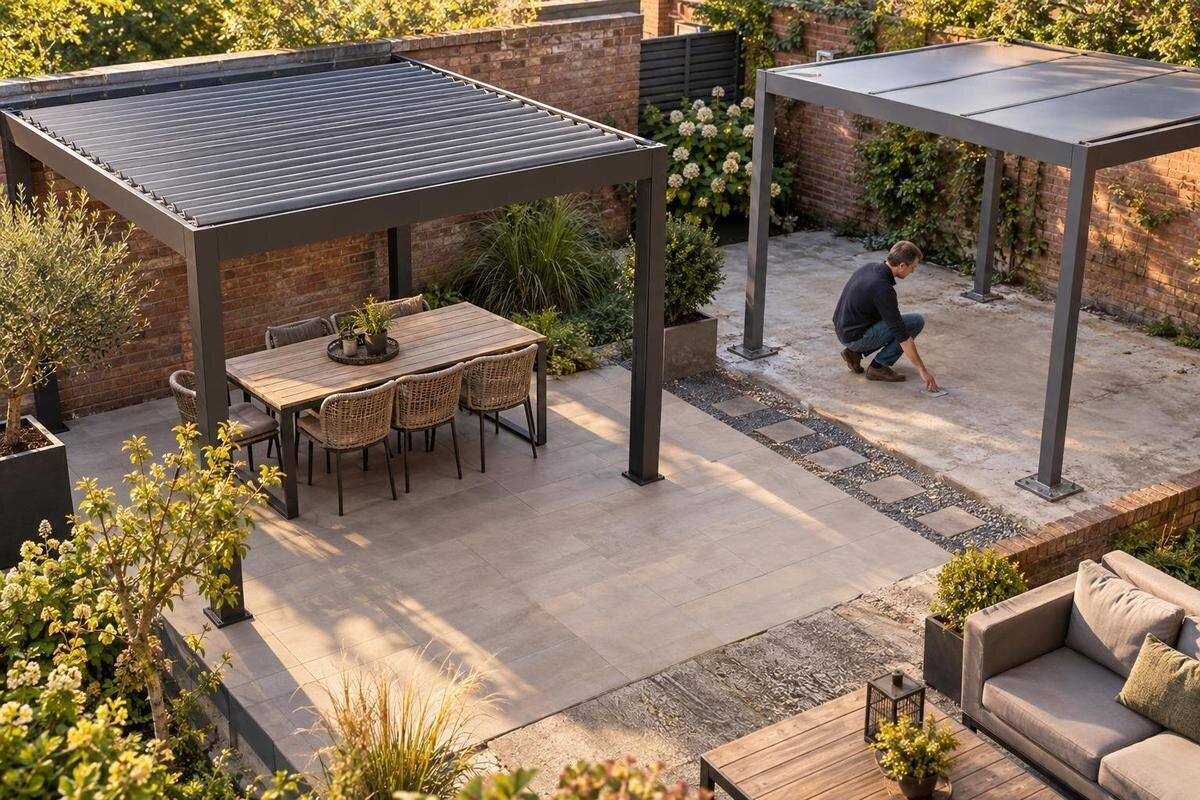
A pergola can come down while its footings stay in place, but that does not mean they are ready for a replacement. Reusing them may avoid some site work; it can also create extra work if the new frame has different post positions, connections or support requirements. The key buying question is not whether the old base looks intact. You need to establish what the existing structure is fixed to, assess its condition and compare its layout with the exact pergola you plan to order. This guide covers the checks to make, the information to request and when to allow for new foundation work.

Can existing pergola foundations be reused?
Sometimes, but reuse is a possibility to verify, not a default. The existing foundations must be in suitable condition, correctly located and compatible with the replacement pergola’s specified support and fixing arrangement. A frame that looks much like the old one may place its posts differently or connect to the base in another way. Matching outside dimensions alone does not prove that fixing points coincide. The original layout may also have been adjusted during installation, so catalogue dimensions for the old pergola might not match what was built. Treat the foundations as a separate part of the purchase decision, rather than a feature already approved for the new frame.
Identify the exact replacement before asking whether the base can stay. A product entry such as the Bloomcabin pergola listing gives you a clear item to refer to, but use the installation guidance for that exact item—not a title or photograph—to confirm its site requirements. Ask for the relevant footprint and fixing information, and whether a site inspection is needed. Keep the product reference and its drawings together so the supplier, installer and building professional are discussing the same pergola. If information is unavailable, include possible foundation work in your comparison rather than ordering on the assumption that the existing base will line up.
Find out what the pergola is fixed to
First establish what the old pergola was fixed to. It may have stood on separate footings, been fixed to a larger paved base, or used another arrangement; the visible posts and paving do not reveal the full construction below ground. Look for installation drawings, original instructions, invoices, build photographs and records of later repairs. These may help identify post positions and the connection used. If a builder or installer put up the structure, ask whether job notes or drawings are available. Treat remembered dimensions and product images as clues only, particularly if the layout changed during installation. Don’t assume that paving beneath a post is the footing itself.
Record what you can see and what remains unknown. Note whether posts appear bolted to a surface or set into the ground, whether there are visible brackets or base plates, whether a slab continues beyond each post, and whether repairs or extensions have altered the area. A visible anchor does not tell you the size or condition of the footing beneath it. If site evidence conflicts with the original plan, flag the difference instead of choosing whichever measurement seems convenient. Label each support on your sketch so it can be matched to the right photograph. Avoid drilling or removing parts to expose the base; ask a qualified person how to investigate it appropriately.
Assess the visible condition of the foundations
Before the old frame is removed, photograph each support and the surrounding surface from a few angles, then note anything unusual. Cracks, crumbling or chipped edges, shifted concrete, gaps, loose-looking fixings, corrosion on exposed metal, or water collecting beside a footing are useful observations to pass on. Record where each sign appears and whether you know it has changed over time. Note any previous patching or resurfacing, too, as it may be relevant to an assessment. These are prompts for further investigation, not a do-it-yourself pass-or-fail test: a surface mark does not by itself prove failure, and a tidy surface does not establish what is happening below ground.
The condition question includes parts you cannot see, such as buried material and the way a footing meets the surrounding ground. A visual check may help an installer understand the site, but it cannot confirm hidden construction or suitability for a different frame. Ask the pergola supplier or installer what information they need, and arrange a site-specific assessment by a suitably qualified building professional if condition, movement or construction is uncertain. Give them the photos, measurements and original documents. Ask them to assess the foundations against the requirements of the exact replacement, rather than giving only a general view of the old pergola. Its continued presence is not proof that the foundations suit a new frame.
Compare the old layout with the replacement
Measure the positions of the existing support points from fixed references, such as a wall or a defined paving edge, rather than from the old frame. Record the overall footprint, the distance between post centres, the direction the pergola faced, and any height differences between the bases. Note how close supports are to walls, doors, steps, drains or other features that matter to the planned layout. A site sketch with labelled measurements and photographs is more useful than a single width-and-length figure. Use the same units throughout, and mark any estimated position as uncertain rather than presenting it as exact.
Compare that record with the drawing for the exact replacement, including where its posts and fixings sit—not only its overall dimensions. A candidate such as a Bloomcabin pergola listing needs its own installation information; don’t infer a footprint from the product name or image. Two pergolas with similar outside measurements can still have different support positions. Check orientation and height as well as spacing, and ask whether any adjustment is allowed if the points do not align. Don’t assume that posts can be shifted or a frame altered to make the old foundations fit; get confirmation about what the product permits before including an adjustment in your plan.

Check the base plates and fixing arrangement
Even where footing positions appear to match, the frame-to-foundation connection still needs checking. Compare the new pergola’s specified base plate or mounting arrangement with the existing brackets and anchors; the relevant details are those in the instructions for the exact item. A bolt that looks similar, or a plate that sits close to the old one, is not enough to establish compatibility. When asking about a candidate, use this Bloomcabin pergola page as the item reference and provide your measurements and photographs. Ask directly whether the existing fixings may be retained, whether their positions match, and what information that answer depends on.
Don’t assume a mismatch can be solved by enlarging holes, adding an adapter or reusing an anchor in a different position. Such changes affect the connection and should not be improvised. Get written advice from the relevant manufacturer, supplier or qualified installer before authorising an alteration. Ask what fixings the new pergola requires, whether they are supplied or need to be sourced separately, and who is responsible for installation. If anchors are buried, damaged or unidentified, that is a point for assessment, not a reason to guess. Consider the frame and the base together, including who will confirm that any proposed connection is acceptable.
Account for a change between freestanding and wall-mounted designs
Replacing a freestanding pergola with a wall-mounted one—or making the opposite change—alters the support arrangement, not just the appearance. A freestanding design relies on its specified posts and ground connections; a wall-mounted arrangement also depends on the wall connection described for that exact product. That does not mean one type automatically needs fewer footings, or that old ground bases become irrelevant. A visible wall finish may not tell you what structure is behind it. Have the wall, attachment points and any ground supports considered as part of the whole installation. If the type is changing, start a fresh support plan instead of assuming one element from the old structure can serve the new design.
If a wall-mounted option is on your list, use the Bloomcabin wall mounted pergola page to identify the item you are considering, then request its specific installation information. The product label does not establish whether your wall or existing foundations are suitable. Ask what supports and attachment points the product requires and have the relevant structure assessed by a qualified person. If you stay with a freestanding arrangement, compare its post locations with the existing foundations. Either way, check the complete arrangement before deciding that any old base can remain.
Request information for the exact pergola
Gather the documents before settling on a replacement. For the old pergola, look for the original plan, footing layout, installation guide and any record of repairs. For the new one, request the exact item’s instructions and drawings, including the stated footprint and fixing arrangement. A listing such as the Bloomcabin listing you are comparing helps identify which item you mean, but a listing name or photograph is not a substitute for technical information. Make sure any drawing or answer relates to the version being quoted, rather than a similar-looking product. Keep the product reference, the site sketch and the relevant documents together for the person assessing the foundations.
Put your questions in writing so any conditions are clear. Ask whether the manufacturer or supplier can confirm the pergola’s requirements, whether they can assess existing foundations on site, or whether those are separate tasks. Share the site sketch, photos and known measurements, then ask what remains unverified and who can resolve it. A general answer about pergola installation may not cover your particular base or ground conditions. If a site-specific structural judgement is needed, engage an appropriately qualified building professional, such as a structural engineer where suitable. Ask for any conditions on the advice to be stated clearly before you order.
Compare the full cost of keeping or replacing foundations
Compare the total project cost in at least two versions: the replacement with existing foundations retained after they are approved, and the replacement with new or altered foundation work. Include removal of the old frame, assessment, preparation, any repair or replacement of foundations, reinstatement of paving, and installation labour where relevant. These are items to price, not costs you can safely estimate from a photograph. Reuse is not automatically the cheaper option if extra adaptation or investigation is needed; new work is not automatically necessary either. Ask for figures based on the actual site and exact product, including what would change if the existing foundations cannot be reused.
Use the Bloomcabin pergola product entry as a reference when asking for a quote, then request separate figures for the pergola and the supporting site work. That makes it easier to see what is included and what remains an assumption. Compare replacement options by the clarity of their installation information, the fit of their support layout and the amount of change required on site, as well as the frame price. If an option fits the existing arrangement only after unconfirmed alterations, show that uncertainty in the comparison rather than treating it as a confirmed saving. Where the quote depends on approval of the old foundations, ask what happens to the scope if they are not accepted.
Coordinate the order with site preparation
Before placing an order, check that the quotation names the exact product and configuration you intend to buy. Ask what is included, which fixings are supplied, what must be prepared or purchased separately, and who is responsible for site preparation and installation. For a candidate listed as a Bloomcabin pergola option, use the exact product reference in correspondence so any written answer applies to the item being quoted. Confirm the foundation question in writing; a general assurance that installation is straightforward does not confirm that your existing base is compatible. Check the terms for delivery, cancellation and returns before committing.
Coordinate the timing with whoever is assessing or installing the pergola. If the old frame has not yet been removed, keep photographs and measurements of its support positions; once it is gone, useful evidence can be harder to recover. Agree when the site will be checked, who will confirm the foundations are ready, and what happens if they are not. Check that the route for bringing the product to the site and a place to keep it are available, without assuming a delivery date or installation service. If the installer expects the base to be ready, establish how that will be confirmed before the installation is scheduled.
Decide whether reuse is confirmed
Make the reuse decision against three confirmed points: the foundations’ condition, the match between their positions and the new product’s support layout, and compatibility of the connection. If any one is unknown, reuse is not yet established. Ask the person responsible for the assessment to state what they checked and any limits on their conclusion. Keep verified facts separate from open questions in your notes, so an estimate is not mistaken for a confirmed measurement. A verbal assurance does not tell you whether the footing below ground, the anchors and the new frame were all considered. The aim is to know what the purchase and installation depend on.
If the evidence points to replacement or modification, include that work in the plan before ordering rather than trying to adapt the frame on site. A different arrangement, such as the candidate identified by the wall-mounted Bloomcabin listing, still needs its own site-specific requirements checked; it is not a shortcut around foundation questions. If the existing foundations are confirmed suitable, record why they match and keep the details with the order. Either outcome can support a sound buying decision when the frame, foundations and site have been considered as one project.
Frequently asked questions
Can I reuse the old concrete footings for a new pergola?
Possibly, but only if their condition, location and fixing arrangement are checked against the exact replacement’s installation requirements. The former pergola’s successful use does not establish that buried footings remain suitable. If the construction or layout is unknown, get a site-specific assessment before ordering.
Will the foundations fit if the new pergola has the same overall dimensions?
Not necessarily. Overall width and length do not show where posts, base plates or anchors sit, and similar-looking frames can have different support layouts. Compare the exact product’s installation drawing with measured foundation positions; don’t rely on a photograph or the old frame alone.
What should I measure before asking for advice?
Record each support position from fixed reference points, the distance between post centres, the overall footprint, any height differences, nearby walls and obstacles, and how the posts connect to the base. Label your sketch and note estimated measurements. Share it alongside the exact replacement’s installation information.
Can I reuse the existing anchors?
Only if the manufacturer or a suitably qualified installer confirms that the anchors are compatible and in suitable condition for the specific pergola. Similar dimensions or a bolt that fits are not enough. Don’t drill, enlarge holes or use an anchor in a different arrangement without approval.
Who can confirm whether the old foundations are suitable?
The supplier can explain the chosen pergola’s requirements. Assessing hidden or site-specific foundation conditions may need a qualified building professional. Ask each person what they have assessed, what remains uncertain and whether their advice applies to the exact product and existing site.
Treat the existing footings as a possible advantage, not an assumed part of the new pergola. The buying decision is settled only when their condition, position and fixing compatibility have been checked against the chosen product. If any detail remains unknown, compare the replacement on a basis that includes appropriate foundation work. That gives you a clear scope for the order and avoids relying on appearance or guesswork.
