
Can a Louvred Pergola Handle Heavy Rain?
Pergola weather performance
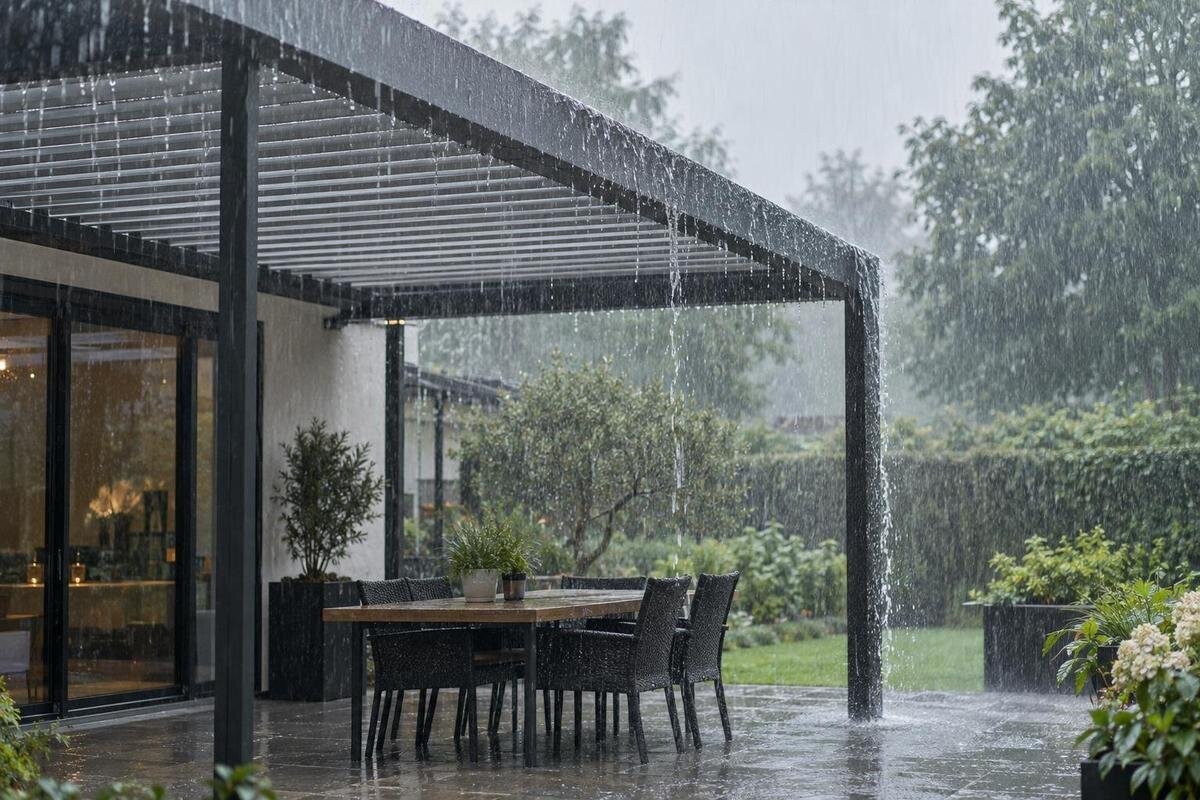
A louvred pergola may shed heavy rain when its roof is fully closed and water can follow the model’s designed drainage route, but ‘louvred’ and ‘watertight’ are not blanket promises. Rain can get through joints or around uncovered sides, and wind can push it beneath roof edges. The useful question is not just how much rain falls: it is what conditions the model has been tested or observed in, how it drains, and whether those conditions match your site. This guide explains what to ask before expecting a dry seating area.

What ‘watertight’ means for an open-sided pergola
‘Watertight’ can mean no rain passing through the roof, no drips landing on the patio, or a completely dry area. Those are different standards. A louvred pergola is usually open around its sides, so a closed roof may shed rain from above without stopping water blown horizontally into the shelter. The product label alone does not establish that every slat joint, roof edge or perimeter is sealed. Ask whether a claim describes the louvres, the drainage route or the whole area underneath the structure. In other words, roof drainage and the weather-tightness of an enclosed room are not interchangeable descriptions.
Set a realistic performance question before comparing claims. Is occasional spray at an open edge acceptable, or do you need the surface below to remain dry throughout a long, windy shower? If you plan to leave furniture uncovered, even a small drip may matter; for ordinary outdoor use, edge spray may be acceptable. Ask how any observation was made, where water appeared and whether the louvres were fully closed. A statement about water being carried away from the roof does not automatically cover furniture, wall junctions or side openings. If ‘watertight’ appears without a defined test condition, treat it as a term to clarify, not a measurable guarantee.
How closed louvres direct rain
When the louvres are fully closed, their shape and meeting points are intended to guide water towards a collection edge or channel; the exact overlap, seals and route depend on the roof design. At a ventilation angle, gaps remain and rain can fall through by design. It may not be obvious from ground level whether the mechanism has reached the specified closed position. Use the operating instructions or roof drawing to identify that position, rather than relying on how the slats look in a photo. Check whether the system is meant to be closed before rain starts, since opening it during a shower can expose the area below.
When comparing the Bloomcabin Pergola product listing with other options, focus on the closed-roof detail rather than the model name or overall appearance. Ask for a drawing that matches the exact model and size, showing how the slats meet and where water passes into the collection channel. Details at the ends of the slats can matter as much as the broad roof surface. Separate the intended drainage path from any joints where dripping was observed during a test. This makes the explanation more useful than a general statement that the roof closes. A gallery image alone cannot show how those interfaces perform in rain.
What counts as heavy rain in a performance claim
Heavy rain is not a single test condition. A short, intense burst and a long spell of steady rain place different demands on the roof and drainage route. Rainfall rate describes how quickly water arrives; duration affects how much has to be carried away over time. Ask for the conditions behind a claim, not just words such as ‘heavy’, ‘all-weather’ or ‘rainproof’. If figures or a test method are provided, check that they refer to the exact roof size and fully closed position you are considering. A result without this context cannot be compared reliably with another model or used as a universal storm limit.
Wind can change the result even when rainfall is similar. Direction and speed determine whether water lands mostly on the roof or is pushed sideways beneath an edge; gusts can also make conditions less consistent than a controlled observation. The Bloomcabin Bioclimatic Pergola listing identifies a model, not a rainfall or wind test. Ask for an observation or test record stating the rainfall method or rate, duration, wind conditions, louvre position and which sides were open. Evidence collected in sheltered conditions does not establish what will happen at a more exposed site. If no numerical threshold is available, ask for a plain-language account of the conditions actually observed.
How drainage channels and outlets carry water
Rain protection depends on more than the slats: water must leave the roof by a route that can handle the flow. Depending on the design, it may pass from the louvres into a channel and onwards through an outlet or downpipe; confirm the actual path rather than assuming it is hidden in a post. If a channel, joint or outlet is obstructed or overwhelmed, water may pool, spill over or emerge somewhere unintended. The relevant question is how the specific model collects and releases water under its documented conditions, not simply whether it has a gutter. A drainage diagram also shows where the water is discharged, which matters when planning the position of seating and access routes.
For the Bloomcabin Bioclimatic Pergola product page, request a matching drainage drawing that includes channels, joints, outlet positions and discharge points. Follow the route from the roof to the final outlet, noting where cleaning access is needed and what signs indicate an obstruction. This is not a request to calculate capacity yourself: the supplier should explain any specified or observed limits, while an installer can confirm that the route can be assembled and discharged as intended at your site. Keep roof collection and final discharge distinct when comparing alternatives. A channel may collect water as intended while the outlet location still requires careful consideration in the patio layout.

Wind-driven rain can enter at the roof edges
The roof perimeter is where a closed top meets open air. Wind-driven rain can come in beneath a roof edge even if the central part of the slats sends water into a channel. A shelter behind a wall or fence may face different exposure from one open on several sides, and the direction of the weather can make one edge more vulnerable than another. Nearby buildings, fences or rooflines can also shelter or channel wind. A central-roof leak test does not necessarily describe how much water reaches the perimeter. For an open-sided structure, edge entry can be the limiting factor in how dry the seating area feels.
Ask whether a test or observation included wind and whether the full perimeter was checked, not just the centre of the roof. Drawings should show any edge lips, seals or collection details, but do not assume visible trim forms a wind seal. Confirm which sides were exposed in the documented setup and compare that with the planned orientation. If protection is only documented for rain falling from above, read the claim narrowly. It gives no basis for promising a dry area when the wind carries rain under or around the roof.
The roof-to-wall junction needs separate detailing
Where the pergola meets a house, water control at the wall is a separate detail from drainage across the roof. Rain may run along cladding, reach the roof-to-wall junction or be affected by nearby eaves and gutters. An existing gutter that discharges above or beside the roof can send water into the junction independently of the pergola’s own drainage. A roof diagram showing channels does not prove that the building-side joint is weather-tight, and a generic mounting image may not cover the construction of your wall. Check whether flashing or another junction treatment is included, what surface it is designed to meet, and how nearby building drainage is handled.
The Bloomcabin Wall-Mounted Pergola listing identifies a wall-mounted model, but it does not establish the connection detail for every cladding or eave arrangement. Ask for the junction drawing for your exact installation and confirm what is supplied versus what must be designed or fitted separately. If the site involves existing gutters, narrow clearances or uncertain wall construction, have a suitable building or installation professional assess the interface before choosing a configuration. That assessment concerns the specific site, not a universal rule for all wall-mounted pergolas.
Installation and maintenance affect drainage
Even a sound design can underperform if its parts are not aligned or assembled as specified. Incorrect louvre closure, a poorly joined drainage channel or an outlet placed differently from the drawing can change where water travels. Follow the product-specific assembly and operating instructions; do not add sealant, alter a channel or improvise a fall as a substitute for a documented detail. Before use, check that the finished roof moves to its intended closed position and that visible outlets are not blocked. If the installation involves structural or building work, have the relevant design and site conditions reviewed by a qualified professional rather than guessing from a generic diagram. At handover, ask the installer to show the drainage route and access points for cleaning.
Maintenance should follow the guidance for the roof actually installed. The Bloomcabin Pergola page lists a model from 9 to 24 m², so keep the documents matching your selected dimensions, mounting type and supplied components rather than a general catalogue description. Retain the drainage diagram and operating guidance with the installation records, including the cleaning access points shown at handover. If water later appears somewhere unexpected, those records help distinguish the intended discharge route from a possible obstruction or assembly issue. They also give the supplier or installer a clear reference when discussing the affected channel, joint or outlet, without relying on a similar-looking roof.
Side screens change the conditions
Adding a side screen, blind or glazed panel may reduce rain reaching the shelter from that direction, but it does not automatically make an open pergola watertight. Water can still enter through gaps, around the top and bottom, or at a meeting edge. A side element can also change how wind and water act around the roof, so the configuration used in a roof-only test may no longer match. Confirm that any enclosure is designed for the pergola and that its permitted combination with the roof is documented; do not treat a generic accessory as a weather-rated wall.
If you are considering the Bloomcabin Wall-Mounted Pergola product page, assess the proposed side treatment as part of the complete arrangement. Ask whether it is compatible with the selected roof and mounting configuration, and whether the performance information includes that combination. For a dining area exposed to rain from one direction, the relevant details are the screened side and its junctions with the roof and wall. A roof-only result does not answer that question. Decide whether you need partial screening or the protection expected from an enclosed room, and use that distinction when considering what furniture or other items you will leave underneath.

What product documents should show
Useful product evidence should describe an identifiable model and configuration, not only a category. Ask for the roof plan and drainage diagram, the exact louvre position during the test or observation, rainfall rate or method, and duration. It should also state any recorded wind speed or direction, whether the sides were open, which edges were exposed, what roof dimensions were used and where water appeared. If the results are qualitative, ask who observed them and what counts as an acceptable outcome. Photographs can help explain the setup, but cannot replace the conditions or a defined result.
Use the Bloomcabin Wall-Mounted Pergola model page to identify the option in your enquiry, then compare the documents supplied for it. The roof drawing, mounting detail and rain observations should describe the same arrangement, including the building-side junction and drainage outlet. A wall-mounted detail should not be borrowed for a freestanding configuration, or vice versa. Read the operating and maintenance guidance alongside the performance information so the approved closed position and cleaning requirements are clear. If a claim refers to a different size, mounting arrangement or set of side panels, ask the seller to explain which parts of the result apply to your proposed setup.
Match the evidence to your site and expectations
Compare the documented setup with the place you intend to use. Note which sides are open, what nearby buildings or landscape shelter them, where wind-driven rain usually approaches and whether the roof will be mounted against a wall. Then check the drainage outlet’s location and where water is released, so the route does not send runoff back towards the seating area or an access path. This is a site-specific review, not a universal rule about orientation: a layout that performs acceptably in one sheltered position may not provide the same comfort in a more exposed one.
The Bloomcabin Pergola catalogue listing states an available area range of 9–24 m², which helps with comparing size but is not a heavy-rain specification. Weigh the rain performance separately from how much patio space the roof covers. An arrangement that provides acceptable shelter for occasional outdoor use may not meet an expectation that furniture stays completely dry through prolonged, wind-driven rain. Consider both the covered centre and the exposed perimeter when judging the usable seating area. Your choice should reflect the protection documented for the whole arrangement and the level of shelter you need, including whether another type of shelter would better suit an expectation of a fully dry space.
Frequently asked questions
Can a louvred pergola keep me dry in a downpour?
It may direct rain away from the area beneath the roof when the louvres are fully closed and the drainage route is working as intended. That does not guarantee a dry space: wind-driven rain can enter around open sides, and performance depends on the exact model and documented conditions.
Does closing the louvres stop wind-driven rain?
Not necessarily. Closing the roof can reduce rain coming through the slats, but wind may push water under the roof edges or into joints. Ask whether the model’s rain observations included wind, and which sides and edges were exposed.
Can the drainage channels overflow?
Water may spill or emerge somewhere unintended if a route is obstructed or the conditions exceed its documented limits. Ask for the drainage diagram, any specified limits and guidance on keeping the channels and outlets clear.
Will side screens make the pergola weatherproof?
Not automatically. Screens may reduce rain entering from one direction, but gaps and junctions can remain, and an added side element changes the arrangement. Check compatibility and whether performance information covers that exact combination.
What should I ask the supplier for?
Request documents for the exact model, size and configuration. Look for the drainage diagram, the specified closed-louvre position, and the conditions behind any rain claim, including rainfall, wind, exposed sides and the observed outcome.
A louvred pergola can carry rainwater off its roof when the slats are shut and the drainage route is working, but that is not the same as a sealed shelter. In a heavy downpour, wind, open edges, wall junctions and the outlet path all affect where water can still reach. Judge the exact roof configuration against the conditions documented for it, then set your expectations accordingly: rain management can offer useful protection without promising a dry room.
