
Can You Install a Ceiling Fan Under a Pergola?
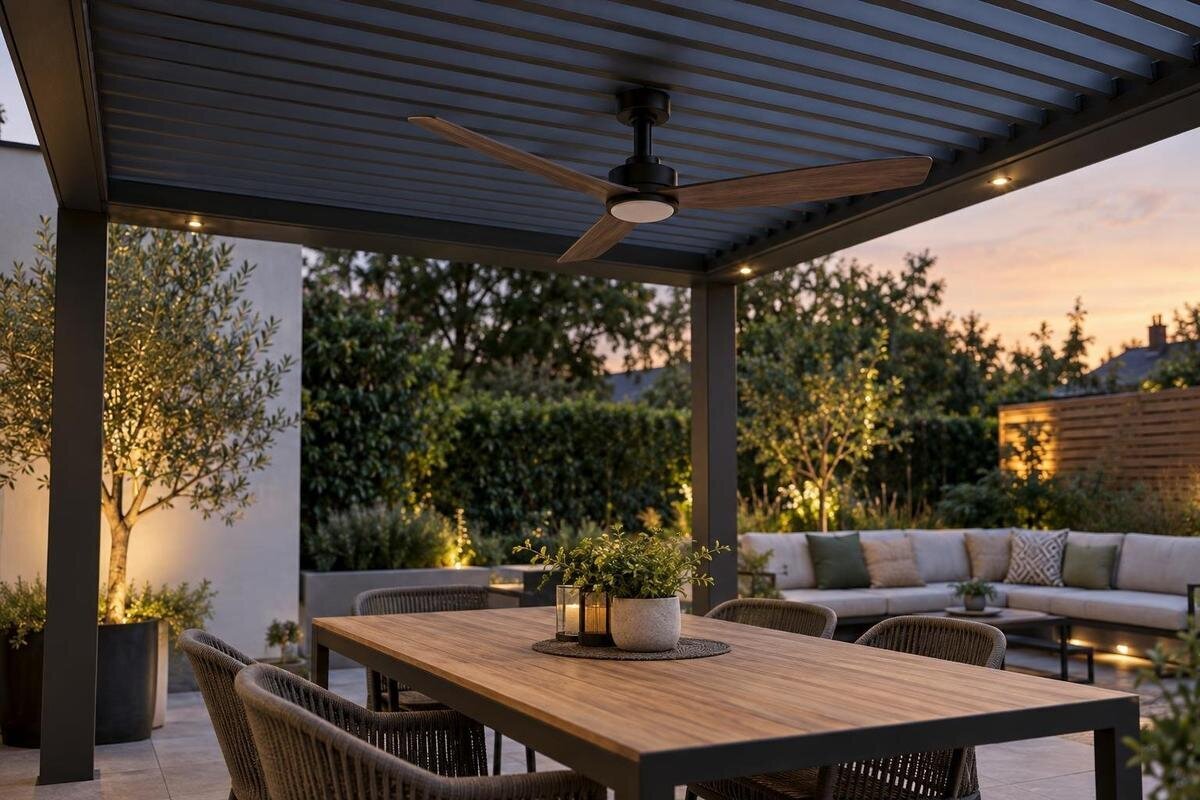
Pergola planning
Adding a ceiling fan beneath a pergola can be possible, but an overhead beam that looks sturdy is not evidence that it can safely support a rotating appliance. A fan brings its own mass and changing forces, needs clear blade space, and must suit the moisture and wind exposure at the site. The frame, mounting bracket, fan model and electrical plan need to be considered together. Treat compatibility as a documented approval question, not a DIY judgement based on appearance. This guide explains what to confirm with the pergola supplier, fan manufacturer and a qualified electrician before buying or modifying anything.

01
The answer depends on documented compatibility
Yes, a ceiling fan can be fitted beneath some pergolas, but not simply because a roof member sits overhead. The decisive question is whether the exact pergola configuration, intended fixing point and selected fan have been assessed together. A freestanding frame, a wall-supported frame and a roof with moving components can present different load paths and clearance constraints. The fan must also suit the exposure at that position and be connected through an appropriate electrical plan. If any of these matters is unknown, treat compatibility as unconfirmed until someone with the relevant information checks it. Judging a beam by its appearance or how firmly it feels fixed, or relying on a neighbour’s installation, is not reliable proof.
Keep product choice and installation approval separate. A product page can identify a model and its available footprint, but it does not by itself show where a fan may be fixed or what moving load a member can carry. The Bloomcabin Pergola listing gives a range from 9 to 24 m²; that area information is not approval for a fan or evidence of a fan-ready fixing point. Ask for documents that match the exact size and configuration you are considering, rather than relying on a general description or a photo of a similar-looking pergola.
Can the pergola frame support a ceiling fan?
A pergola roof may use open members, a light cover, widely spaced beams or components intended to manage weather. The visible surface could be cladding or a roof component rather than a structural member. Drilling into whichever part is easiest can leave the fan attached to something never specified for a hanging, vibrating load. The material, apparent thickness and overall look do not establish what the structure can carry. Even support for a light fitting would not prove that the same point can take a rotating fan. Find the structural drawings and installation instructions for the exact model, and look for an expressly permitted equipment attachment or an assessment of the proposed point.
Frame layout matters as well as the roof surface. A freestanding model and a wall-mounted arrangement have different paths for transferring loads, so neither should be judged by the look of a single beam. The Bloomcabin Wall-Mounted Pergola page identifies a particular configuration, but its title does not document fan attachment points or the capacity of any connected wall. If the design has adjustable or removable roof parts, their arrangement may affect where a fan could go. Treat each configuration as its own question rather than assuming that a general approval applies across a product family.
02
A fan’s moving load is more than its weight
A ceiling fan’s static mass is only one part of the demand on its support. As the motor starts, stops and runs, the rotating assembly produces changing forces; imbalance or a loose component can increase vibration. Air movement and gusts around an open-sided pergola can add another influence, while attachments experience repeated movement over time. A simple weight figure for a beam may not answer the fan question. The approval needs to cover the proposed fan’s operating loads and its particular support arrangement, not just the weight of a light or a person briefly leaning on a member. Repeated movement is a different consideration from a one-off static load.
Give the fan’s manufacturer, model, weight and installation details to the pergola supplier or a suitably qualified structural professional. Ask whether the assessment covers the fan’s operation, vibration, selected bracket and the forces transferred to the frame at that location. Do not estimate an allowance by comparing fan mass with a quoted beam figure, or assume that a thicker-looking section is a safe upgrade. The listed Bloomcabin Pergola size range describes floor area, not a dynamic-load rating; a particular footprint still needs applicable structural information. If the answer cannot be documented, choose another mounting plan.
The fixing point and load path need approval
Approval should name a real support point, not simply say that a fan can go somewhere under the roof. The load path runs from the fan and its specified bracket through the fixing and supporting member, then into the frame and its supports. A bracket or reinforcing piece helps only if its position and connection are part of an approved design; adding a board or more fasteners is not automatically reinforcement. Check whether the proposed support needs a separate member or a manufacturer-supplied accessory, and whether drilling or altering a roof component is permitted. Where a roof also manages rain, ask whether a proposed alteration could affect its intended operation.
For a wall-connected structure, the house-side connection is part of the load path too. The wall-mounted pergola model identifies a layout, not a fan anchor in the building wall; a pergola fixing and a fan fixing are separate questions. A professional should establish which part carries each load and whether the attachment method suits the actual construction behind it. A wall finish alone does not confirm what backing is available. If the fan position relies on a bracket fixed to the house rather than the pergola, have that support checked independently. Do not transfer approval from one point, span or configuration to another without confirmation.

03
Check the full blade sweep and headroom
Measure the space the fan will occupy while running, not just the centre of an open bay. Use the selected fan’s blade diameter and mounting arrangement to map its full sweep against beams, roof edges, posts, lights, heaters, screens and hanging décor. Check vertical headroom from the lowest relevant part of the fan to where people walk, stand and sit. A fan above a dining table could still be close to someone standing up or moving a chair. Include the fan body and any downrod or bracket as well as the blades. Follow the fan manufacturer’s specified minimum clearances rather than inventing a standard gap, and consider everyday access around the space.
Check clearances at the actual roof setting and through any movement that changes the overhead space. A louvre, retractable shade or screen may occupy a different position while opening, closing or being cleaned; the fan should not sit in its path or block access to the moving part. A listed footprint alone cannot tell you usable height or blade clearance. The Bloomcabin Bioclimatic Pergola product identity is not a dimensioned fan-clearance drawing. Request measurements for the exact pergola configuration and compare them with the fan instructions before deciding on a location.
Match the fan to real outdoor exposure
A fan under a pergola may face more than occasional splash. Open sides can let wind-driven rain reach the fitting, and the amount of shelter changes with roof shape, screens, wind and position. Moisture, condensation and dust can affect equipment over time; at some sites, salt in the air is another factor. Do not treat being under cover as equivalent to being indoors, or assume a fan intended for a sheltered porch suits every open pergola. Choose according to the fan maker’s documented conditions for installation, taking the actual exposure at the proposed spot into account.
Check the fan manual and product markings for the conditions the particular model is permitted to face. Ask about the motor, controls, connections and mounting hardware as a complete installation, not only the visible blades. If the instructions limit exposure, the fan’s appearance or a general outdoor label may not answer whether it suits your site. When considering the Bloomcabin Bioclimatic Pergola listing, use the model details to request configuration-specific information about the pergola. Those details do not establish the separate fan’s outdoor rating. If the fan’s permitted conditions are unclear, ask its supplier before purchase.
04
Plan electrical work before fixing the fan
Bring a qualified electrician into the planning before ordering a fan or choosing its position. The electrician needs the exact fan instructions, proposed location, power and control requirements, and details of any other electrical equipment planned under the pergola. They can assess the supply, switching, isolation, protective arrangements and cable route for the site and installation, including exposure to moisture and any moving roof parts. The aim is to agree on a suitable complete installation, not to improvise a connection after the frame is assembled. Electrical work should not be treated as a do-it-yourself extension of the pergola build.
Give the electrician the pergola manual or drawings as well as the fan manual. Ask where the cable and controls can be accommodated without damaging structural members, entering a moving mechanism or becoming difficult to inspect and maintain. If lights, a heater or other appliances are also planned, include them in the conversation so their positions and electrical needs can be reviewed together. Do not assume an existing outdoor socket is an approved supply for a permanently installed ceiling fan, or that a remote control removes the need to plan wiring. The electrician should confirm an appropriate arrangement for this site and equipment.
Allow for moving roofs and other accessories
A fan can fit in a roof bay and still conflict with how the pergola is used. Adjustable roof parts, retractable shades, side screens and lighting tracks may move through the same space, while a fan can obstruct their travel, maintenance or access. The relationship can change when the roof is set to a different position, so one measurement with everything closed may miss a clash. Check the operating positions described in the pergola instructions along with the fan’s full blade sweep. Do not assume that a fan can run whenever a motorised roof is moving, or that two control systems will coordinate automatically.
If the roof is adjustable, ask for a written answer about the combinations of operation that are permitted. For example, check whether a fan can be installed at all, whether it must be off before roof movement, and which positions maintain clearance. The fan’s own instructions may also set limits on nearby structures or moving air; check those rather than relying on a general rule for ceiling fans. When considering this bioclimatic pergola model, request its model-specific operating drawings and instructions before deciding where a fan could sit. Keep the fan and pergola instructions together for anyone who installs or services either system.

05
Decide whether a ceiling fan suits the space
Even when installation is technically possible, an overhead fan may not be the most useful choice. It moves air rather than creating shade or changing the outdoor air temperature, and its effect may be less noticeable in a breezy, open setting than in an enclosed room. Consider when the pergola is occupied, where people sit or stand, whether the blades would be near a dining or circulation area, and whether the space is usually calm enough for the airflow you want. If the fan would hang too low, conflict with an opening roof or operate only under restrictions that undermine your intended use, the plan may not be worthwhile.
Compare the ceiling fan with other ways to provide local air movement, such as equipment designed for a stable floor or wall position. Check those products’ outdoor instructions and electrical arrangements too. A different position may avoid an unapproved overhead attachment, but it does not remove weather exposure or the need to keep equipment and cables clear of everyday movement. Changing the pergola style is not a shortcut: each frame still needs its own documented support and clearance assessment. Choose around the way you use the space, rather than assuming that every covered outdoor area needs a ceiling fan.
Get approval for the exact fan and configuration
Before committing, bring together details that can otherwise be scattered across emails and product pages: the pergola model, size and roof configuration; the proposed fan model and weight; the exact mounting location and bracket; clearance drawings; the fan’s permitted exposure conditions; and the electrician’s proposed connection. The Bloomcabin Pergola product page can identify a model family and listed size range, but the project record should name the exact configuration being assessed. Ask the pergola supplier who can approve an added load and whether a structural professional needs to review it. General reassurance about a strong frame does not answer the specific question.
Keep the written response tied to the chosen components. It should make clear which point and fixing arrangement are approved, which fan specifications were considered, any clearance or roof-position limits, and who is responsible for the electrical work. If the pergola supplier cannot confirm the attachment, ask a qualified structural professional to assess the actual design rather than modifying it on a guess. If approval depends on a different fan, bracket, span or roof setup, treat that as a different proposal and have it checked again. A clear no is useful too: it lets you choose another solution before holes, wiring or purchases lock in the wrong plan.
Frequently asked questions
Can I attach a ceiling fan directly to a pergola beam?
Only if the pergola manufacturer or an appropriately qualified structural professional confirms that the specific member, fixing and frame are suitable for that fan’s operating loads. A beam that appears solid, or a bracket supplied with the fan, is not proof of approval.
Can I use an indoor ceiling fan under a covered pergola?
Only if the fan manufacturer permits installation in the actual conditions at that spot. Wind-driven rain, condensation, dust or salt in the air can reach equipment under an open-sided roof, so check the fan’s documented exposure limits rather than relying on the roof for shelter.
Do I need an electrician to install a pergola fan?
Ask a qualified electrician to assess the fan’s electrical requirements, supply, controls, protective arrangements and cable route for the site. Share the pergola and fan instructions before installation; a nearby outdoor socket does not by itself confirm a suitable fixed connection.
Can a fan run while an adjustable pergola roof is moving?
Only if the instructions for the exact pergola and fan allow it and the required clearances remain adequate throughout movement. If the documentation is unclear, do not assume the systems can operate together; ask the relevant suppliers and professionals.
What if the pergola is not approved for a ceiling fan?
Do not drill into or add a fan to the frame on a guess. Consider another airflow option, such as equipment designed for a stable floor or wall position, and check its outdoor and electrical requirements too. A different pergola style is not automatic approval.
Installing a ceiling fan under a pergola requires coordinated structural, clearance and electrical planning. It is a viable option only when the exact frame and fixing point are approved for the fan’s operating loads, the blade sweep stays clear in relevant roof positions, the fan suits the site’s exposure and an electrician confirms the electrical installation. If any part remains unconfirmed, leave the frame unmodified and choose another airflow option.
