
Choosing a Fixed Glass or Louvred Pergola Roof
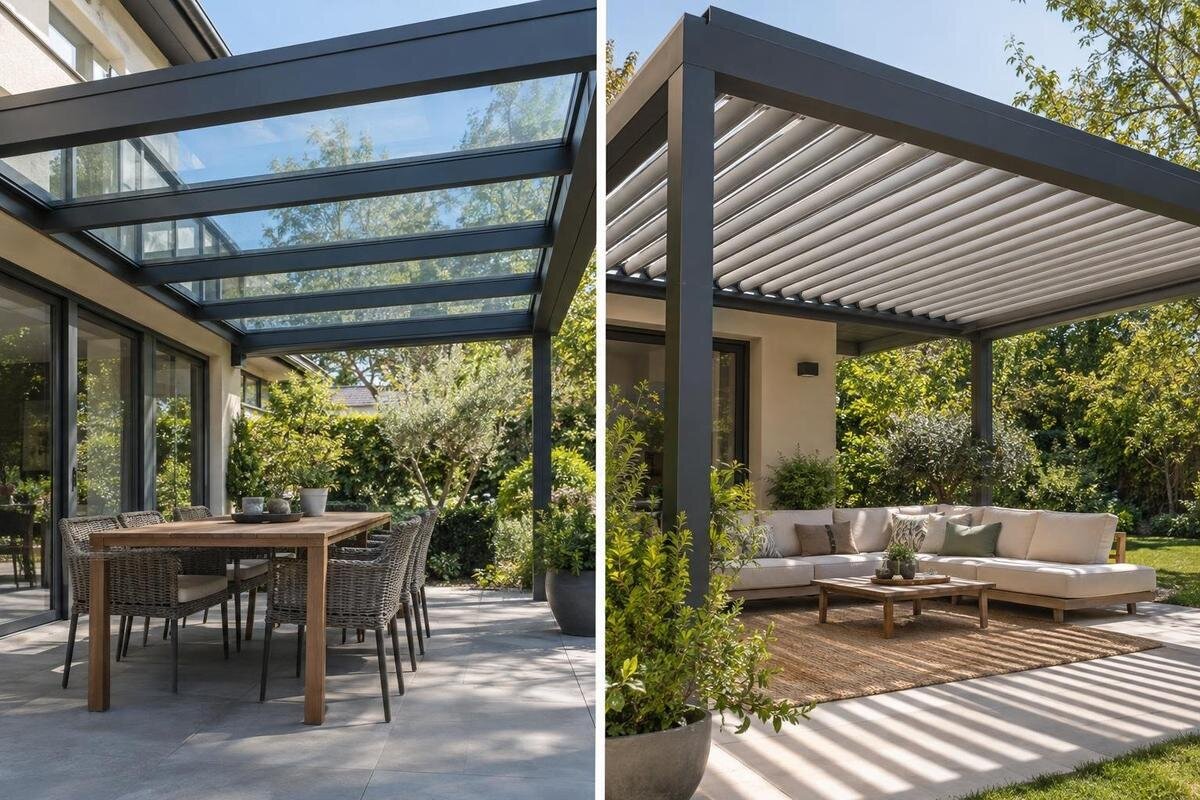
Pergola roof guide
Choosing between a fixed glass roof and a louvred pergola roof means weighing up daylight, shade, airflow and rain protection. Glass is stationary and admits light, but the roof itself cannot open to release rising warm air or adjust shade. Operable louvres let you change the roof opening and the amount of overhead shade, although closed-roof rain performance depends on the model’s design and drainage. Neither option automatically makes an open-sided pergola weatherproof. The useful comparison is how each roof behaves at your site, how water is managed and what details the supplier documents.

01
What fixed glass and louvres change
A fixed glass roof creates a stationary surface above the outdoor area. It can let daylight pass through, but it cannot be opened at roof level to release air or alter shade as conditions change. A louvred roof uses blades over the patio; where those blades are designed to move, their position can change the opening, the pattern of shade and the path rain takes. One adjustment may affect light and airflow together, so a louvred system is not simply a fixed cover with an extra setting. The basic choice is between an overhead surface that stays in place and one you can adjust.
Before comparing models, write down two or three important outcomes: retaining daylight, controlling direct sun, creating an overhead opening for air, or providing rain protection appropriate to your site. Fixed glass may align with some priorities; operable louvres may help with others, but neither gives a blanket answer about weather. The Bloomcabin Pergola product page provides a starting point for your shortlist. Catalogue names, including “bioclimatic” and “wall-mounted”, identify products rather than establishing their roof construction, controls or suitability. Compare the actual roof specifications separately from the supporting structure. This keeps a preference for a particular pergola layout from becoming an assumption about what its roof can do.
Daylight under a glass roof
Glass generally gives a more consistent daylight condition than an opaque roof because light passes through the overhead area. How bright it feels is not determined by the word “glass” alone: tint, coating, surface texture, panel layout and supporting members can all affect the light that reaches the patio. Ask what glazing is specified and whether measured light-transmission information is available if brightness is central to your decision. A photograph may suggest the view, but it cannot show the exact transmission or appearance in your own setting. Consider whether you want a clear view of the sky, softer light or simply a brighter area.
Think about both the outdoor seating and any rooms alongside it. The roof’s position and framing may affect daylight reaching nearby windows, while trees and buildings cast changing shadows. Observe the area at the hours you expect to use it and, if possible, in more than one season. With opaque louvre blades, closing the roof interrupts more direct overhead light; opening them reveals the sky, while intermediate positions produce changing patches of sun. The precise pattern depends on blade size, spacing, position and sun angle. For a useful comparison, distinguish light at the table from light at the house windows: you may want shade over a meal without making the adjoining room feel darker. Ask to see the proposed roof layout in relation to those windows, rather than judging brightness from a close-up of the roof material alone.
02
Direct sun, glare and warmth
Daylight and shade are different outcomes. Clear-looking glass should not be assumed to stop direct sun, prevent glare or keep a patio cool. Those effects vary with the glazing specification, sun angle, surrounding surfaces and how much of the roof is exposed to sunlight. If glare or heat is a concern, ask for the exact glass description and any relevant published light or solar-performance information. Do not infer tint, coatings, UV properties or solar control from a photograph or the general label “glass roof”. Appearance alone is not a reliable measure of how the glazing performs.
Observe the area at the times you actually sit outside, not only at midday. Lower-angle morning or late-afternoon sun can reach beneath a roof from the side, while a higher sun path may strike the surface more directly; the pattern changes through the year. Note where people sit, whether sun reaches a nearby doorway, and whether reflections from paving or walls cause glare. Louvres can adjust shade from above, but their position does not automatically block low-angle light entering around the sides. If considering separate screens or an awning, confirm compatibility and do not assume they are included.
Ventilation through a louvred roof
A fixed glass roof has no adjustable opening overhead. Air can still move through open sides, but the roof itself cannot be changed to create a vent. How airy a covered area feels depends on the breeze, surrounding walls or screens, and the layout of furniture and people. If you specifically want to release warm air through the roof, fixed glass cannot provide that opening. A transparent surface may feel visually open, but that is different from ventilation; keeping the distinction clear helps prevent a daylight preference being mistaken for an airflow solution.
Where louvres are adjustable, opening them creates a route for rising warm air to leave, while open sides can let replacement air move in. That can help the space feel less enclosed when a breeze and the layout support it; it is not a guarantee of cooling or a substitute for an open perimeter. When comparing the Bloomcabin Bioclimatic Pergola listing with other options, establish how far the blades move and how they are operated. Do not assume a motor, remote, sensor or automatic response. Also consider whether the setting you would use for airflow gives you the shade you want at the same time. These are related adjustments, not necessarily separate controls. A useful demonstration would show the roof in several positions, explaining what each position changes rather than presenting “open” and “closed” as the only relevant choices.

03
Rain protection depends on roof details
A fixed glass roof can form a continuous barrier to overhead rain when its glazing, joints and installation are designed to direct water properly. The glass alone does not settle how well the assembly sheds rain: panel joins, edges and the connection with the rest of the structure matter. Open sides also leave the patio exposed to rain blown in from an angle. If keeping a particular table, doorway or seating area dry is important, ask how the complete roof is intended to manage water rather than judging from a photograph of the panels.
Rain can pass through the openings of a louvred roof when its blades are open. Closing them may direct water towards channels or edges, but the result depends on the blade profiles, gaps, seals and drainage built into that exact system. When reviewing the bioclimatic pergola product page, distinguish information about the closed roof from information about an open or partly open setting. Check the conditions in which rain protection is specified. For everyday use, the important question is whether the roof position you prefer for shade and airflow is also the position intended for rain. If those settings differ, you will need to change the roof position as conditions change. Do not assume that the system detects rain or closes itself; establish what action the user is expected to take.
Plan where roof water will go
Both roof types need a clear route for water to leave the covered area. Ask for a drawing or description that traces the flow from the roof to its outlets, including whether channels or gutters are part of the design and where the water discharges. Do not assume that glass and louvred systems use the same arrangement. Think about where an outlet would be relative to a doorway, path, outdoor furniture or planting, so the discharge point does not come as a surprise once the pergola is in use.
Where the roof meets a house, consider the junction as part of the water route, not merely the point where the pergola attaches. A qualified building professional can assess how the proposed connection works with the existing wall and nearby openings. For a layout such as the Bloomcabin Wall-Mounted Pergola, discuss the roof edge beside the house as well as the outlet positions farther away. Ask the supplier to explain these on the same drawing so you can follow the complete route. This is particularly useful when comparing two roof systems whose drainage arrangements differ: an outlet that works neatly for one layout may be inconvenient in another. Keep the discussion focused on where water goes and how the junction is formed, rather than assuming that a wall-mounted roof drains in a particular way.
04
Wind-driven rain and open sides
A roof covers overhead space, not every route rain can take. When the sides remain open, wind can carry rain beneath the roof or through its edges, even when the surface above is shedding water. A closed louvred roof is not automatically a sealed enclosure, and fixed glass does not remove exposure at the perimeter. Consider how nearby buildings, planting and walls shelter or expose the patio, and where rain tends to come from during the weather in which you want to use it.
For a more exposed position, look for documented design conditions for the exact structure and have a qualified professional assess whether they suit the site. If the Bloomcabin Pergola model details are part of your comparison, separate the roof’s rain-handling information from the structure’s stated site limits. Neither tells the whole story about how comfortable an open-sided patio will be. Identify the seating area you most want to shelter and the edge most exposed to driving rain. That gives the discussion a clear purpose: protecting an entire patio and protecting a table near its centre are different expectations. Apply the same expectation to both roof options so one is not judged on overhead cover while the other is expected to keep every edge dry.
Operation and ongoing care
A fixed glass roof does not need to be repositioned, but its surface and any drainage areas still need to be kept clear enough to do their job. Ask how the glass and roof edges are meant to be cleaned, what access is needed, and whether regular upkeep is practical at your property. If the overhead surface is difficult to reach safely, discuss suitable maintenance access with the supplier or a qualified professional rather than improvising. Clarity, debris and the condition of the drainage route can all affect how the roof looks and performs over time.
Louvres add an adjustment mechanism, so find out how the exact model is operated and what care its moving parts require. For the Bloomcabin bioclimatic pergola option, confirm the supplied controls rather than assuming either manual or powered operation. Think about who will use them and whether adjustment would be convenient during a meal or when leaving the patio. Ask whether routine cleaning needs access to blades, pivots or channels, and what maintenance the manufacturer recommends. Compare the work involved, not just whether a roof is described as low-maintenance: cleaning a fixed surface and caring for an adjustable assembly are different tasks. Include access and the stated care routine in your decision, particularly if you want a roof that needs little attention between uses.

05
Fit with the house and outdoor area
Consider the roof in relation to the way you use the whole patio, rather than treating it as an isolated surface. Mark the main table or seating position, the doors leading outside and the routes people take between them. Then consider where each roof edge would fall. A seat near the perimeter has a different relationship to side-entering sun and rain from one farther under the cover, regardless of roof type. Keep this layout separate from your daylight comparison: the brightest arrangement is not necessarily the one that puts shelter where you need it. If you plan to move furniture between dining and relaxing, compare both layouts before deciding which roof behaviour is more useful.
Mounting style and roof type are separate choices. The wall-mounted pergola product page can help you consider an arrangement beside the house, but it should not replace a comparison of the overhead surface itself. First decide whether the proposed position serves your doors, seating and circulation; then assess how fixed glass or adjustable louvres would behave above that space. If comparing a wall-mounted option with another arrangement, note which differences come from location and which come from the roof. Otherwise, a sheltered position beside the house could be mistaken for an advantage of one roof material. Keep the building connection and water-management assessment with a qualified professional, while using your patio layout to clarify what you want the finished space to do.
Match the roof to your everyday use
Fixed glass is more likely to suit a brief centred on steady daylight and an unchanged overhead cover, provided the glazing and rainwater details meet your needs. An operable louvred roof is more adaptable when changing shade or opening the roof for airflow matters more. Neither is a universal winner: a need for strong sun control, overhead ventilation and dependable rain cover may involve competing requirements. Decide which outcome matters most on the days you actually use the patio, and which limitations you are prepared to accept.
Try comparing two ordinary situations, such as a sunny meal and a shower with a breeze. For each, note what you would want the roof to do, where water should go, and whether sun or airflow matters more than a fixed cover. Use those situations to compare the Bloomcabin Pergola catalogue entry with your other shortlisted options, once their roof specifications are clear. Record both the benefit and the compromise: for example, whether the preferred setting gives shade while leaving an opening above, or whether permanent cover matters more than adjustment. A simple comparison in your own words is more useful than a list in which every feature appears equally important. If neither option meets all your priorities, identify the limitation you can comfortably live with rather than expecting one roof to deliver every outcome at once.
Frequently asked questions
Will a fixed glass roof keep the patio dry?
A suitably designed and installed roof can intercept overhead rain, but the result depends on panel joints, edges and drainage. Wind-driven rain can still enter an open-sided pergola. Ask how the exact roof is designed to shed water and what limitations its documentation states.
Can a louvred roof improve airflow?
When the blades open, the roof can provide an overhead path for air. How much movement you feel depends on the opening, the breeze and the sides of the pergola. It is not guaranteed cooling, and a fixed glass roof has no adjustable opening at roof level.
Does a glass pergola roof provide shade?
Not automatically. Glass generally admits daylight, and direct sun and glare depend on the glazing and sun angle. Check the properties of the specified glass rather than assuming it blocks sun. A fixed roof cannot change its shade by opening.
Are closed louvres waterproof?
There is no universal answer. Blade profiles, gaps, seals, roof edges and outlets all affect how a closed louvred roof handles rain. Check the documentation for the exact model and its stated limits; the word “closed” does not prove that the roof is sealed.
Which roof suits New Zealand weather?
There is no single answer for every property. Sun, shelter, wind and driving rain vary by site. Fixed glass provides overhead cover within the limits of its design and drainage; louvres let you change shade and the roof opening, but rain performance is model-specific. Compare the documented conditions with your site and how you use the patio.
Decide which conditions matter most on the days you actually use the patio. Fixed glass keeps the overhead arrangement unchanged and admits daylight; operable louvres give you more control over shade and the opening above. Those differences are more useful than broad claims about being “all-weather”. Match your preference with documented information about water run-off, sun, operation and site exposure, and choose a roof that suits your outdoor routine rather than relying on an attractive product image.
