
Choosing a bioclimatic pergola on Black Friday: key features
Black Friday buying guide
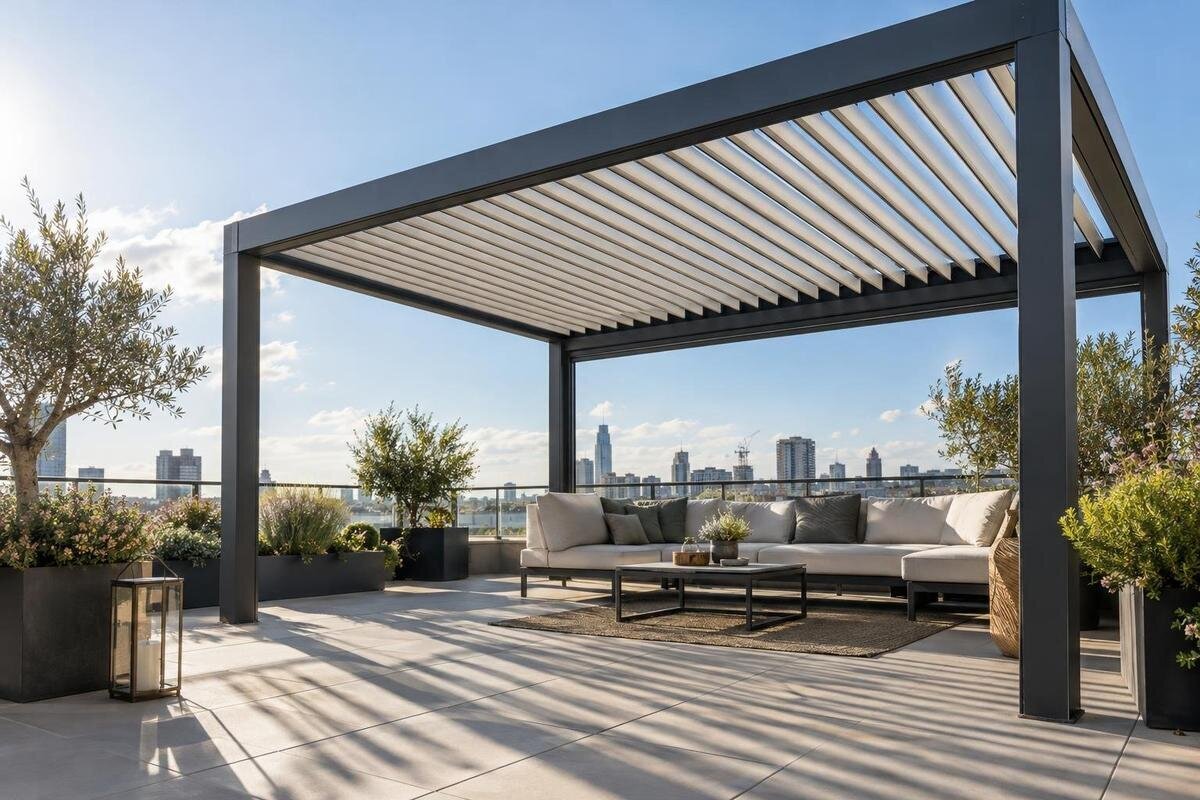
Black Friday can put several pergola listings in front of you at once, but an event label does not tell you whether the louvres, controls or rain management will suit your outdoor area. A bioclimatic pergola is defined by an adjustable louvred roof; the useful buying question is how adjustment works on the particular model and what the rest of the system is designed to do. Compare the written specifications, installation requirements and included components before choosing. No current promotion is confirmed in this guide, so verify any advertised offer and configuration on the live product page before ordering.
What the term bioclimatic means
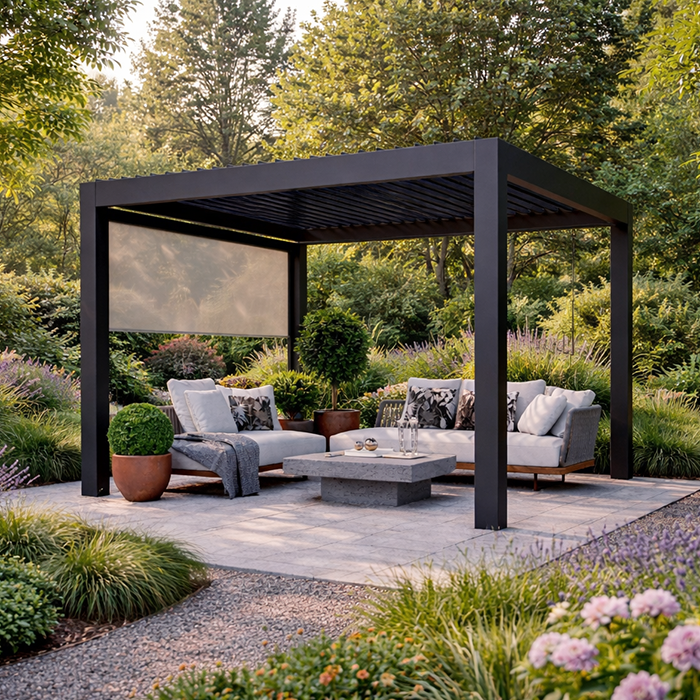
A bioclimatic pergola generally has an adjustable louvred roof rather than a permanently fixed cover. Changing the louvre angle can alter how much direct sun, open sky and airflow reaches the area below. That gives you more ways to adapt the space, but the category name does not state the louvres’ range, how they are operated or how rain is managed. Those details differ between products and configurations. Read “bioclimatic” as a description of the roof concept, not a promise that the structure will shade every angle, keep the area dry or respond automatically to changing weather. For buying purposes, the written specification matters more than a category label.
Before comparing models, decide what you most often want the roof to do: admit more daylight, moderate direct sun, or offer some overhead cover during showers. These aims can compete: a more open setting admits more sky and airflow, while a closed setting changes the light and may still have limits for rain. Look for the maker’s diagrams and written operating or weather notes rather than assuming that “closed” means sealed. The bioclimatic pergola listing is one place to read product-specific details; use what it states, rather than the category label alone, to assess that model. A useful comparison records both what the roof can do and the conditions in which the maker says it should be operated. Note when you expect to use the space, as the same roof position can feel different as daylight changes.
How much louvre adjustment do you need?
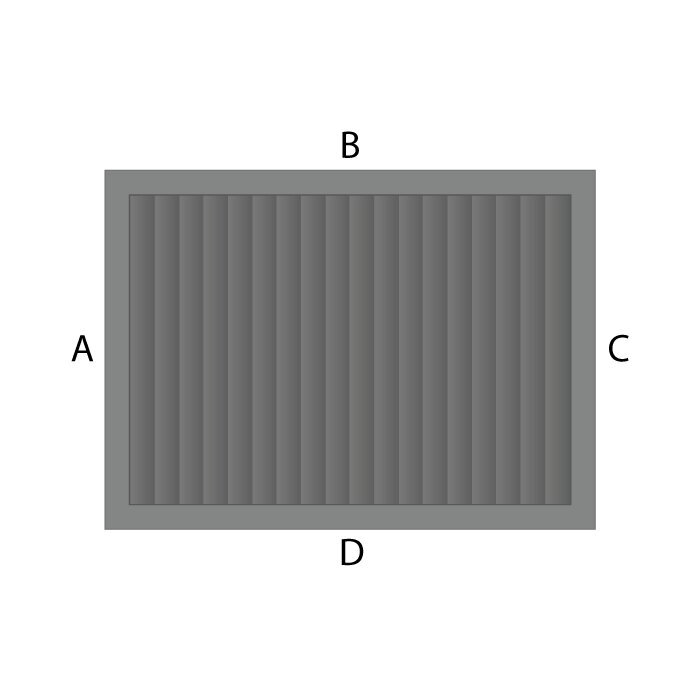
An adjustable system is only useful if its movement matches how you want to manage light. Check whether the documentation shows a range of angles or only broad open and closed positions, whether louvres can stop partway, and whether adjustment is available across the full roof or by section. These are questions, not features to assume: a product image with a partly open roof does not confirm a particular setting or control method. A diagram from above and from the side may clarify the louvre direction relative to your intended layout. If the maker shows only a few positions, consider whether those will suit your needs rather than assuming a continuous range. If drawings are unclear, ask for operating information for the exact configuration.
Also consider how often you expect to make an adjustment. If you want to respond as sunlight shifts, easy access to the mechanism and a useful range of positions may matter more than an extra feature; if you generally leave the roof set, how it holds its position and its stated operating limits may be more relevant. Check whether furniture, a wall or a beam could obstruct the control, and whether everyone using the space can understand its operation. A short video may help show the movement, but confirm it is for the same model and version. For one product’s identity, see the Bloomcabin pergola page, then check its own documentation for these details. Do not assume movement or locking features from the product name.
Manual, motorised and automated controls
Pergolas may use a manual mechanism or a powered one, but the category name does not tell you which. A manual control can keep operation straightforward, while a powered option may suit a layout where you expect frequent adjustments; neither is automatically better. Check the product information for the actual method, how it is operated and what is included in the selected configuration. Consider where you will stand to use it: if the controls are awkward to reach from the usual seating area, the roof may be adjusted less often than you expect. If several people will use the space, look for clear instructions so the operation is familiar to them as well. Include control access in your comparison, not just the mechanism itself.
For powered controls, read details on the power supply, controller and any stated manual override; do not infer them from a motor icon or a staged photo. Confirm whether a remote, wall control or other device is supplied and whether extra components are required. If sensors or app-based control are mentioned, verify compatibility and what they actually automate; an automated response does not make an outdoor area suitable in every weather condition. Electrical work and fitting should be planned with a qualified professional in line with the product instructions. Check the listing for the bioclimatic pergola for its stated options, but do not assume a powered system is included or that a pictured control comes with the selected configuration.
Shade and airflow in your outdoor space
Think about where shade is needed rather than judging coverage from a single photograph. Sun direction changes through the day and year, and nearby houses, fences, trees and eaves affect what reaches a particular seat. Note when you use the space and where you sit, then consider how the louvres might alter overhead light. A roof cannot, by itself, block low-angle sun from every side. If side protection matters, check whether it is specified as part of the product or as a separate compatible item; do not assume screens or blinds are included. Marking where direct sun reaches from the sides can help you decide whether roof adjustment alone is likely to address your main concern.
Air movement and daylight are affected by the surroundings as well as roof position. A closed or partly closed roof changes the sense of openness, while the sides remain exposed unless the design includes additional enclosure; a louvred roof should not be treated as climate control. Ask for product drawings that show roof orientation and louvre travel, and compare them with the layout you intend to use. The general pergola product page is another listing to assess on its own terms: compare its stated details with a bioclimatic option rather than assuming both have the same roof or controls. Drawings can support your comparison, but they cannot predict exactly how shade will fall at your site.

Rain protection and drainage
Rain protection needs more evidence than a roof shown in its closed position. Check whether the product information describes the louvres’ closed fit, any seals or joints, and how water is directed off the roof. Channels, gutters or outlets may be described, but do not assume they are present or that they handle every shower. Wind can drive rain through open sides, so an overhead cover is not the same as a watertight outdoor room. Look for the maker’s stated weather limits and care notes, and ask for clarification if the wording only says “weather resistant” without explaining the conditions. Check whether the description applies to the roof alone or to the whole assembled structure, especially if keeping furniture dry is important.
Work out where roof runoff would land in your actual layout. Water near a doorway, path, table or a surface that drains poorly can be inconvenient even if the roof directs it as designed. Ask how discharge is arranged and whether a downpipe or other parts are included, then check that the proposed location can accommodate the route. A product page does not establish how water behaves at your site, especially where nearby walls or roofs affect flow. For the Bloomcabin pergola listing, read its model-specific rain and drainage notes, if provided; do not transfer claims from one product page to another or treat an image as a performance test. Discuss any unresolved drainage questions with the installer before settling on a location.
Materials, finish and ongoing care
Materials and finishes affect how a pergola looks over time and how much routine care it needs, but a photograph cannot identify either. Look for the stated structural material, surface finish and care instructions, then consider the conditions at your property: airborne salt, wind-blown grit, nearby trees or persistent damp can all influence cleaning needs. These examples are not evidence that a particular product is suitable for your site; check whether the maker specifies exposure limits or a maintenance schedule. If important details are missing, request them before buying rather than guessing from colour or appearance. A useful comparison records the material and finish stated for each product, not just how they appear in a catalogue image.
Pay attention to moving parts and areas where water or debris may collect. Find out how the louvres, pivots and drainage points are meant to be cleaned, whether access is practical after installation, and what the instructions say about routine inspection. Do not use a cleaner, lubricant or repair method unless the product guidance permits it. If replacement parts or servicing matter to you, ask what support is available and how any warranty terms apply; no warranty period or service arrangement should be assumed from a product name. Use the pergola listing only for details it expressly states; appearance alone cannot establish a finish or maintenance requirement. Also consider whether installed supports or nearby features could make routine access difficult.
Installation, supports and site fit
How the structure is supported affects what you need to check before ordering. A freestanding layout and a wall-mounted layout raise different site questions: a wall-mounted pergola relies on the mounting surface and connection details, while a freestanding one needs space for its supports and whatever fixing method its instructions specify. Confirm clearances around doors, windows, roof edges, gutters, outdoor lights and services, and allow access to the louvre controls. Do not assume an existing deck, paved area or wall is suitable because it looks solid. The wall-mounted pergola listing identifies a mounting type; it cannot confirm that your wall or site suits that product. Include room for the installation work and later access when assessing the proposed position.
Before committing, obtain installation instructions for the exact model and check the required support conditions and assembly tasks. A qualified builder or pergola installer can assess the site and whether the structure and fixing method suit it; where powered operation is planned, involve an appropriately qualified electrical professional for the electrical work. Give those professionals the product requirements rather than relying on a retailer photograph or generic diagram. Confirm who will install the structure and assess the site before ordering, so the stated support requirements can be considered in time. Also check there is practical access to bring components to the location and work around existing features. This is a purchase-planning check, not a do-it-yourself fixing guide.
Included features and optional extras
A product image may show a complete-looking outdoor setting, but accessories and optional items can vary. Make a written list of what the selected configuration actually includes: the roof and support components, operating mechanism, controls, mounting hardware and any stated drainage parts. Then list anything described separately, such as lighting, screens or sensors, and check whether it is compatible with the exact model. These are examples of items to verify, not a claim that they are available with a particular pergola. Ask whether each pictured item is included in the package or only part of the setting before counting it as a feature. Check that the list refers to the configuration you have selected, not a different version shown elsewhere.
Compatibility matters if you may add features later. Check whether an accessory can be fitted to the precise louvre system and support arrangement, what additional parts it needs, and whether it affects access to controls or routine maintenance. Avoid relying on a broad product-family name to establish compatibility between two models. For powered equipment, verify the specified control interface and power requirements with the seller and installer before ordering; do not plan on adapting components yourself. If future additions are important, ask whether fitting them could affect servicing or the applicable warranty terms. A comparison table with “included”, “optional”, “not stated” and “not compatible” columns can expose gaps without turning an unknown into a promise.
Comparing Black Friday configurations
Black Friday listings may use event wording, but this guide has no verified offer details and makes no claim that a particular pergola is discounted or available. If you see a promotion, confirm that it applies to the exact product and configuration you want, including louvre operation, controls and included accessories. Do not compare a bare structure with another listing that includes or illustrates add-ons and assume they are equivalent. Read the stated terms on the live page and at checkout; a general event banner is not a substitute for item-specific information. If a page lets you select options, check that the chosen configuration remains clear as you review the offer. The feature comparison is useful even when no promotion applies.
Compare the specification first, then consider any promotion separately. Product type can change key decisions: the wall-mounted pergola page is not interchangeable with a listing for a different mounting arrangement just because both use the word “pergola”. Note the exact product label or model reference, selected options and anything described as extra; keep a copy of the specification details available to you at the time. If the page leaves a key feature unclear, resolve that question before relying on the offer. Open the full product information rather than judging equivalence from an event tile alone. This keeps seasonal urgency from deciding a purchase that does not match your space.
A practical feature shortlist before ordering
Turn your requirements into a short list with three levels: essential, useful and optional. An essential might be a particular louvre adjustment range, a control you can operate conveniently, clear written rain-handling information or a mounting type that suits the site after professional assessment. Useful extras may improve day-to-day use, but they should not distract from a missing essential. For each listing, record what the specification explicitly confirms, what is an optional extra and what remains unanswered. Add a reason beside each essential so the trade-off is clear. If a critical point is still unconfirmed, keep the product off your shortlist until you have an answer.
Before placing the order, check that the selected configuration, installation plan and any advertised offer all refer to the same product. Confirm the details that matter most in the product information, and ask the seller or installer for clarification when a specification is incomplete. If you cannot verify a critical point—such as how the louvres are operated, what rain protection is described, or whether the proposed installation suits the site—pause and resolve it. A well-chosen bioclimatic pergola is one that fits the way you intend to use the space and the conditions documented for that exact model. Keep any outstanding questions together so they do not become assumptions at checkout.
Frequently asked questions
Are bioclimatic pergolas waterproof when the louvres are closed?
Not necessarily. Closed louvres do not by themselves establish that a roof is watertight. Check the manufacturer’s wording on seals, joints, drainage and the conditions covered, including any limits for wind-driven rain. If the documentation does not answer this, ask before buying rather than relying on the product name or a photograph.
What do adjustable louvres change?
Their position can alter the amount of overhead sun, daylight and open sky reaching the area below. The available angles and how they are adjusted vary by product, so check the diagrams and instructions for the exact model. An image showing partly open louvres does not confirm the full range of movement.
Is a motorised louvre system worth choosing?
It depends on how often you expect to adjust the roof and how accessible the controls need to be. Compare the operating method, power requirements, included controller and any stated manual override. Do not assume a motor, remote or sensor is included just because it appears in a product image or description.
Can a bioclimatic pergola go on an existing patio or against a wall?
Do not assume the existing surface or wall is suitable. Check the installation instructions for the exact model and have a qualified builder or pergola installer assess the site and required support conditions. A product described as wall-mounted identifies a mounting type; it does not confirm that your particular wall is suitable.
What should I check in a Black Friday pergola listing?
Compare the exact product and configuration, including louvre operation, controls and included components. If an offer is advertised, verify that it applies to that selection and read its stated terms on the live page and at checkout. No current promotion is confirmed in this guide.
Choose by the way you will use the space, not by the event wording. Check the louvre range, control method, rain-handling details and installation conditions for the exact configuration. If a Black Friday offer is advertised, consider it only after confirming that the product itself fits your needs. Clear product information and site advice are more useful than guessing from a headline.
