
Climbers on Aluminium Pergolas: What to Confirm
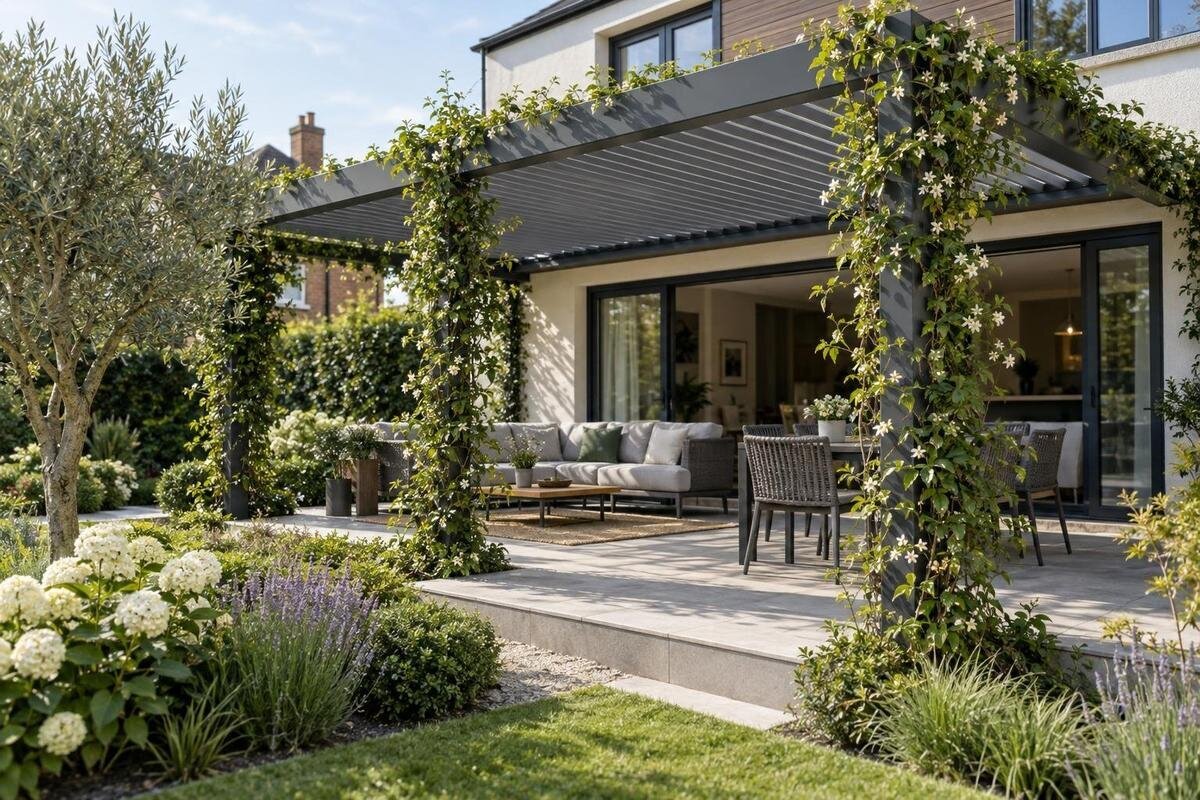
Pergola planting guide
Climbing plants can make an aluminium pergola feel more connected to the garden, but the frame is not automatically a trellis. A vine grows beyond the size it was when planted, carries water in its foliage and can spread into areas that need to stay clear. If the pergola has a moving roof, growth may interfere with its operation or servicing. Before buying or attaching anything, establish who can approve the plant, its support and the proposed attachment points. A written answer tied to the chosen configuration and a dimensioned planting plan is more useful than a general assurance that vines are suitable.

What does approval for a climber need to cover?
Approval is not simply a yes to the idea of greenery. Ask the pergola supplier to confirm in writing whether the proposed plant-support arrangement is permitted on the exact model and configuration you are considering. The response should identify which parts, if any, may receive attachments, which methods are acceptable, and what limits apply to plant mass, coverage or maintenance. A broad statement about aluminium pergolas, a showroom image or a product name does not establish that a particular frame can carry a mature vine. If the roof moves, ask for guidance that expressly covers its moving parts as well as the fixed frame. Advice for another size or configuration may not apply.
There may be separate questions for the supplier, the person designing the plant support and the installer. The supplier can explain the product’s permitted use; a suitably qualified structural professional can assess the proposed arrangement and site-specific loads where needed; and the installer should follow the documented method rather than improvise fixings. If the project includes a connection to a building or other site constraints, ask the relevant professional or authority whether further confirmation is needed. When enquiring about the Bloomcabin Bioclimatic Pergola, include the configuration you are considering and explain where you want the climber to grow. Keep the planting proposal with the supplier’s reply so everyone works from the same assumptions.
How much weight will a mature climber add?
Assess the plant at its intended mature extent, not at the size it is when purchased. Stems thicken and side shoots spread; dense foliage presents more surface area, while rain or retained moisture can make the canopy heavier than it is when dry. A plant trained overhead may place its load differently from one carried by an independent trellis, and weight can concentrate at a few attachment points rather than being shared evenly. The likely outcome depends on species, coverage, watering and care, so a guess based on pot size is not a sound design input.
Leaves and stems also catch wind, and growth rarely stays perfectly even across a frame. Expected spread, foliage density and seasonal changes matter alongside the plant’s name. Ask the supplier what information it needs, and involve a structural professional if the proposed loading requires assessment; do not turn general gardening advice into a frame load rating. If you are considering the Bloomcabin Wall-Mounted Pergola, ask for the proposed plant support to be reviewed separately from the pergola’s connection to the building. Include a likely mature size and pruning approach; if the species is undecided, seek guidance for a defined planting brief before buying. Do not rely on the weight of a dry, recently pruned vine as representative of a full canopy.
Keeping climbers clear of a moving roof
With a roof that opens, tilts or otherwise moves, clearance must be judged through its full travel, not only when it is fully open or closed. A shoot that seems harmless below a closed roof can grow into a blade, hinge, track, seal or other moving area. Leaves, tendrils, ties and fallen plant material can also affect movement or service access. Ask the supplier to mark the complete clearance zone for the exact mechanism, including the space it occupies while opening and closing. Do not estimate the boundary from a photograph or a single roof position. Include access for cleaning and servicing in the same discussion.
Ask how the growth boundary is to be maintained and who will check it. Include thickening stems and flexible new shoots, not just the main trunk; allow for growth that may spread or shift in wind, as well as ties or support rails. The plant must not be relied on to guide, stop or support a moving part. Follow the product instructions if something obstructs the mechanism; do not force it to move. Use the Bloomcabin Pergola listing to identify the product being considered, but ask the supplier whether the chosen configuration has moving components and what clearance applies. Even with a fixed roof, confirm that stems and foliage will not block drainage or routine access.
Where can a vine be attached?
An attractive vine can tempt you to fix a wire to whichever crossbar is easiest to reach. Do not assume that a rail, post or trim piece is a suitable load-bearing point. Drilling, screws, clamps, adhesive products and ties create different contacts and force paths; a method permitted at one location may be unsuitable at another. An unapproved fixing could affect the finish, drainage, joints, moving sections or access. Ask the supplier to identify permitted points and methods, confirm any material-compatibility requirements and state whether attachments are excluded. The same check applies to a hanging planter or decorative wire, even if the vine itself is not tied directly to the frame.
Wait for written instructions before drilling, clamping or tying a trellis, wire or plant to the aluminium. Do not substitute a generic clip or hardware-store bracket for a specified fixing, and do not assume an existing hole is available for another use. If the answer excludes attachments or is unclear, use a separately designed support for the climber rather than testing the frame. When discussing attachments for the bioclimatic pergola, request a drawing showing acceptable fixing locations for the exact configuration and any parts that must remain untouched. Keep the fixing details with that drawing so the designer and installer can follow the same arrangement without having to interpret a general description.

When is a separate support the better choice?
A separate trellis or set of posts is worth considering when the supplier will not approve loading on the pergola, when a moving roof must stay clear, or when the plant’s mature size and pruning needs make shared framing impractical. Independent means the vine support has its own suitable structural design and does not rely on the pergola to stay upright. A trellis set beside a pergola post but tied to it still transfers force; branches, wires, rails or a heavy canopy can also bridge the gap as they grow. Separation is real only if the support system and the plant route remain clear of the pergola.
Have the separate support considered for the mature plant and its site, including how it is held in place; do not assume a nearby wall, fence or pergola post can carry it. A qualified designer or structural professional can coordinate its location with the pergola while keeping the two support systems distinct. Allow room for pruning and access, and plan the vine’s direction so it does not reach the roof or service areas. If a wall-mounted option is on your shortlist, ask about its permitted use separately from approval for a neighbouring trellis. The mounting type does not establish that the wall or pergola is a suitable vine support. Show the separation on the plan so it is not lost during installation.
Mature size and climbing habit
Choose a climber by its mature habit and upkeep, not by the small specimen at the garden centre. Record its expected height and spread, growth rate, whether it is evergreen or deciduous, leaf density and how it climbs: twining stems, tendrils, clinging roots or a trained main stem. Those habits affect whether the plant can be kept within a defined plane and whether it may cling to surfaces that need to remain accessible. Ask a reputable nursery or landscape designer for information suited to your site; the pergola supplier will need a clear plant brief to assess any proposed support.
Include seasonal features that alter care, such as flowers or fruit, leaf fall, sticky residue or thorns, and how frequently the plant is likely to need pruning. Root spread, water demand and the position of the planting bed or container belong on the landscape plan, even though roots do not load the overhead frame directly. A fast-growing plant is not automatically unsuitable, but its growth rate has to match your maintenance capacity and the clearance conditions. An image of a mature vine on a pergola cannot tell you its weight, attachment method or upkeep. Where a plant will cling directly to a surface, ask whether that contact is permitted and how it can be managed. If your choice is open, compare documented mature habits before seeking approval.
Include pruning and checks in the plan
Approval can depend on a maintenance plan. A vine that stays within a marked zone only because it is trained and pruned is different from unmanaged growth spreading over the roof. Ask the supplier or designer to state the maximum area the vine may cover and which areas must remain clear. Agree who will maintain it and how they will reach it without using the pergola as a ladder or support. A plan that assumes frequent pruning may be unrealistic for a vigorous plant, so match the routine to the species and the time you can reliably set aside. Include these assumptions when asking for approval.
During routine garden care, compare actual growth with the approved drawing. Look for loose ties, thickening stems, new shoots entering a clearance zone and leaves collecting near joints or drainage points. If growth has exceeded the agreed boundary, seek guidance rather than adding fasteners or allowing it into a moving area. Use an access method recommended by the supplier and a competent gardening professional; do not reach across a moving roof. Before settling on the Bloomcabin pergola option, discuss the maintenance requirements of your proposed arrangement. Record which tasks are needed to keep the approved areas clear, and update the plan if the plant or its care routine changes.
Plan the route for wall-mounted and freestanding layouts
Wall-mounted and freestanding layouts raise different questions, but neither makes vine support automatic. With a wall-mounted arrangement, distinguish the pergola’s connection to the building from support for the plant; a nearby wall, fascia or gutter should not be treated as a spare fixing point without approval. With a freestanding layout, consider how the vine support sits in relation to the pergola posts and its own base, and whether it might be tied to the frame later. A climber can bridge a gap as it grows, so show its intended route, not just where it is planted.
Draw the building elevation as well as the ground plan. Mark openings, gutters, downpipes, doors and paths alongside the roof’s movement and service zones; these affect where growth can go and how it can be pruned. Ask the supplier and designer to review the route across the full layout, not just a pergola outline. For a proposed wall-mounted pergola, show the relationship between the building, the plant support and the areas that must remain clear. Include nearby fences and existing vegetation that the vine might reach. If it is intended to climb another structure, identify that structure on the drawing and make clear who will assess its suitability and maintain the growth.

What to show on a planting plan
Dimensioned drawings make vague questions concrete. Include a plan and elevations with the selected pergola’s dimensions and configuration, locations of posts and any moving roof areas identified by the supplier, and the proposed trellis or vine route. Show the plant bed or planter, distance to the frame, likely mature spread and height from reliable plant information, nearby walls, and access for cleaning, operation and pruning. Mark the intended growth boundary and the route a gardener can use. A sketch can start the conversation, but use actual product dimensions and the final site position rather than a generic pergola rectangle.
Attach planting information: the exact species or shortlisted alternatives, growth habit, mature size, canopy density and management plan. Add nursery or landscape-designer information and any structural assessment requested; do not supply a guessed weight or invent a load allowance for the frame. Ask reviewers to mark permitted and excluded attachment areas, any independent-support requirement and moving-roof clearance. The Bloomcabin Pergola size options range from 9 to 24 m², but the listed area does not replace the dimensions needed for a site drawing or establish clearance for a vine. Update the drawing if the species, support or proposed route changes, so the planting information and layout remain consistent.
What should written approval say?
Before planting, ask for a written response that names the exact pergola model and configuration and answers practical questions: the approved plant-support method and locations, any attachment or loading limits, moving-roof clearance, and how cleaning and service access are to be kept open. Ask whether the supplier requires a separate support, specialist review or a defined planting limit, and who should confirm site-specific design. If approval is conditional, have the conditions written against the drawing, including the growth boundary and clearances identified by the reviewer rather than numbers you choose yourself.
Keep the response, drawing, plant details and product instructions together. Re-check before changing the species, adding another vine or trellis, attaching a planter, or allowing growth beyond the agreed footprint; those changes may alter load, access or movement. Supplier guidance addresses product use; it may not settle site-specific design or other project requirements, so ask an appropriate professional or authority where relevant. If no approval is available, treat the pergola as separate from plant support and design a genuinely independent trellis. If the approval depends on pruning, record who will maintain the boundary and how that access will work.
Frequently asked questions
Can I attach a wire or trellis to any pergola crossbar?
Only if the supplier confirms the location and method for your exact pergola configuration. Ask about loading, compatible materials, moving parts and access. If the attachment is not clearly approved, use a separately designed support rather than drilling, clamping or tying into an unapproved part.
Does a young vine’s weight matter?
The planting-day weight is only a small part of the picture. Stems, foliage and coverage change as the plant matures, and a wet, dense canopy can be heavier than a recently pruned one. Provide information about the plant’s expected mature size and care when asking for an assessment.
How do I keep a climber clear of a moving roof?
Ask the supplier to identify the clearance required throughout the roof’s full movement, and show that boundary on the planting plan. Include shoots, tendrils, ties and access for maintenance. Agree how growth will be kept clear before planting, rather than relying on the closed or open position alone.
Does a wall-mounted pergola automatically support a climbing plant?
No. The pergola’s connection to a building and the support for a vine are separate questions. Confirm what the supplier permits, and have the proposed plant support assessed where needed. A nearby wall or the pergola’s mounting type is not, by itself, approval to attach a climber.
What information should I send when asking for approval?
Include the exact model and configuration, a dimensioned plan, the plant species or shortlist, its expected mature size and climbing habit, and the intended support and growth route. Add a pruning plan and any documented plant information available. Ask the supplier what further information or professional assessment is required.
The clearest choice is either a climber and attachment method approved for the exact pergola, or a separate support designed to carry it. Decide on the plant at its mature size, show where it will grow and settle any moving-roof clearance before planting. Keep the written guidance with the plan, then revisit it if the plant or support changes. That lets the greenery remain part of the garden without relying on guesswork about the pergola’s intended use.
