
Comparing Fabric-Roof and Aluminium Louvred Pergolas
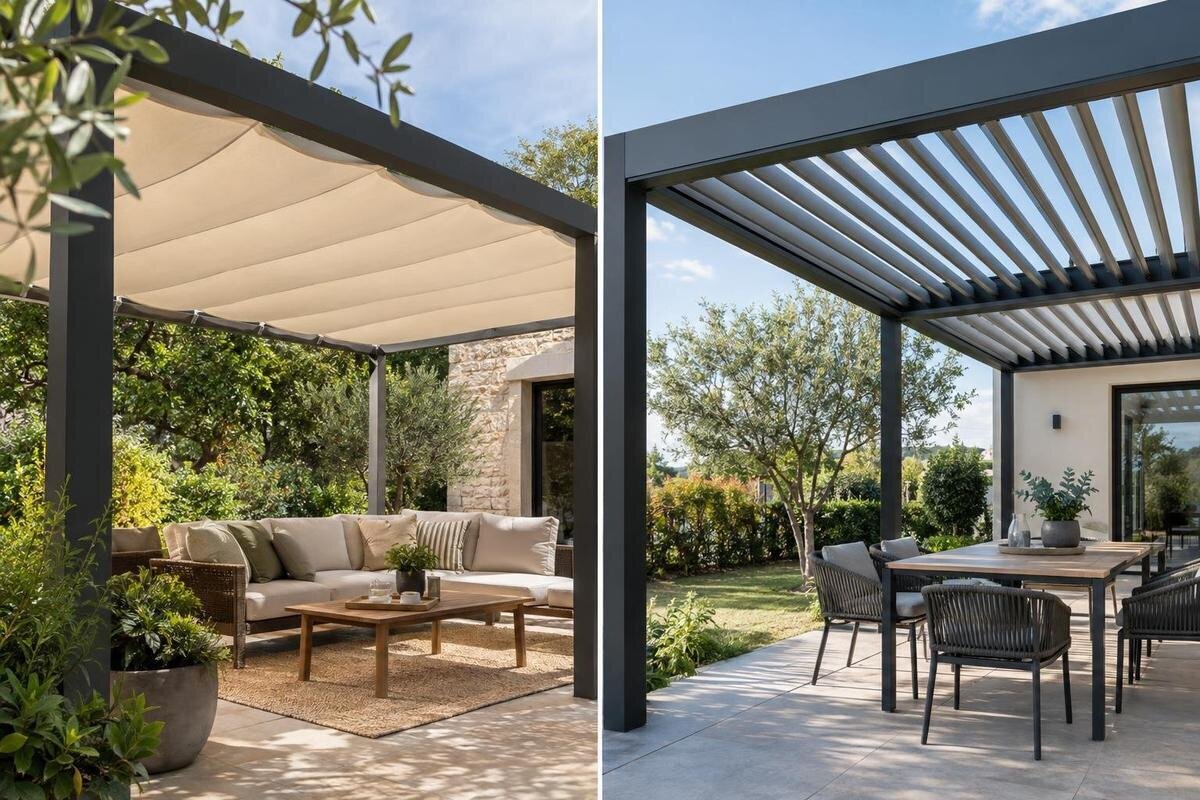
Pergola roof comparison
Choosing between a fabric-roof pergola and an aluminium louvred pergola is mainly a decision about how you want shade and ventilation to change, how the roof operates, and what upkeep you are willing to do. The labels do not tell you whether a fabric cover retracts, whether louvres move, or how either system handles rain and wind. Compare the exact model instructions and configuration rather than judging by roof material alone.

How the two roof systems work
Fabric-roof pergolas are not all built the same way. A model may have a fixed fabric panel, a tensioned canopy or sections that slide or retract; the description and diagram should make clear which. When deployed, fabric spans the roof opening, but how much direct light it filters depends on its opacity and construction. A movable cover can be drawn back to admit more sky, but check where the fabric gathers, how far it travels and what you need to do to operate it. Ask whether the stated coverage refers to the fully extended canopy or just the frame footprint. Do not assume every fabric roof retracts, blocks all sunlight or can stay deployed in every kind of weather.
An aluminium louvred roof uses a series of blades rather than a fabric sheet, but the useful comparison is whether they adjust, what positions are available and how they are controlled. A fixed louvre arrangement cannot be treated like an operable one; nor does the word “aluminium” tell you about seals, drainage, motors or sensors. Use a specific listing as an identifier, not a technical description: Bloomcabin Pergola names a pergola model, but that label alone does not establish whether its roof is fabric, louvred or movable. Check the chosen model’s specification and mechanism diagram for those details, and ask the supplier to explain any unclear drawing. A catalogue title is a starting point for identifying what to compare, not proof of a particular cover or operating method.
Shade and ventilation across the day
Map the shade over the part of the deck or patio you actually use. The area a fixed fabric roof shades depends on its footprint, position, fabric opacity and the sun’s path; it does not change its openings as the sun moves. A retractable version can alter how much sky is covered, if it is designed to do so, but the shaded area changes with the canopy position. If a table, lounge chairs or doors sit near the edge, those areas may be exposed at some times. Check coverage from more than one seat and at different hours, not just from a plan view. Decide whether filtered light is acceptable or whether you want a more complete screen overhead.
Adjustable louvres offer another way to manage overhead shade: changing blade angle can alter the gaps and direction of light, and an open setting may let more air pass through the roof than a continuous cover. The actual adjustment range and effect vary by model, so do not assume you can achieve full sun, full shade or a particular level of ventilation on demand. For the Bloomcabin Bioclimatic Pergola, use a roof diagram and description of available positions rather than inferring operation from the word “bioclimatic”. Check where direct sun lands at the times you usually use the area. A mechanism is only useful if its range suits the patio and the way you spend time there.
Rain protection and drainage
Rain claims need especially careful reading. For fabric, ask whether the cover is described as water-resistant or waterproof, how water is intended to run off, and what the maker says about seams, tension and pooling. Those terms are not interchangeable, and a fabric name on its own does not establish either one. A model with a retractable roof may have specific rules for use in rain; another cover may be intended to stay fixed. Read the full instructions for the chosen configuration, including any limits on use, rather than relying on a photograph or a broad product category. If the documents are silent, ask for a clear written answer.
Louvres can channel rain only as the design allows. Confirm whether the instructions describe a closed position, how water is collected and discharged, and whether gaps or edges remain exposed. A closed roof should not automatically be treated as watertight, and no generic claim can settle what happens in persistent or wind-driven rain. On the bioclimatic product listing, look for a model-specific rain statement and drainage diagram, or ask for those details before comparing it with fabric. Note where discharged water would fall relative to doors, furniture and the main walking route. Also ask whether the documented protection applies to the exact roof position you intend to use.
Wind exposure and operating limits
Wind exposure is another reason not to rank roof systems by material. A fabric canopy may have to be retracted or secured under conditions set by its manufacturer; a louvred system may have its own permitted positions or operating restrictions. Ask for guidance for the exact roof, frame and configuration, including whether any stated limit applies while open, partly open or closed. Do not treat a substantial-looking roof or an aluminium frame as proof that it suits an exposed site. Product images cannot show allowable conditions. Check whether the instructions distinguish limits while the roof is being operated from limits when it is left in position.
Consider the roof together with the site: shelter from nearby buildings or trees, exposure on an open deck, salt air and leaf fall all shape the questions you need answered about use and care. If you are considering the Bloomcabin wall-mounted model, ask how its weather guidance applies to your proposed building connection and roof configuration. Where site exposure, structure or attachment needs judgement, have a qualified installer or relevant building professional assess the arrangement against the manufacturer’s instructions. Do not substitute a generic online figure for model-specific guidance. Establish which roof positions are required in poor weather and whether you can readily put the roof in those positions.

Opening, closing and controls
Convenience depends on what you need to do each time sunlight or weather changes. Some fabric covers are fixed; others slide manually or use a powered mechanism. Ask which applies, how far the cover travels and whether you can operate it from where you normally sit. Find out whether the canopy needs to be fully extended or secured in defined positions, and whether using it involves pulling, winding or storing fabric. If you expect to adjust the roof often, access to the control and the effort involved matter. Compare the complete opening and closing routine, including any securing or storage steps, rather than just the movement of the cover.
With louvres, ask whether the blades are adjustable, how the control works and whether operation is manual or powered. When reviewing the bioclimatic model’s product details, confirm what is included rather than inferring a motor, sensors or automation from the category name. If a motor is offered, establish whether it is standard or optional, what control is supplied and what the manual says about a power cut. Consider operating noise, access to the control and whether a stopping or override method is documented. Leave electrical work to a qualified professional. For powered options, ask what happens if the roof is partway through a movement when power fails; do not assume there is a backup function.
Routine cleaning and upkeep
Fabric care usually starts with the maker’s rules for brushing off loose debris, spot-cleaning marks and allowing the cover to dry. Check which cleaners, brushes or washing methods are allowed; a strong detergent or abrasive tool may damage fibres or a surface treatment. Leaves, pollen and bird mess are easier to deal with before they build up, but the cleaning interval should follow the manual and conditions at your property. If the cover is folded or retracted for storage, ask whether it should be dry first and whether the fabric is removable for cleaning. Do not assume the whole cover can be machine-washed or replaced, or that the same method suits every fabric.
Louvred roofs need access to blade surfaces and, where fitted, places that collect water or debris. Ask how to clean the blades, edges and drainage parts without harming the finish or interfering with the mechanism. A smooth-looking surface does not make a roof maintenance-free: dust, leaves and deposits can still need attention, and moving components should be cared for only as the manual specifies. For the model shown in the wall-mounted pergola listing, request care instructions covering permitted cleaners, service points and access for routine cleaning. Where channels are fitted, find out how they should be cleared. Consider whether the recommended cleaning access is practical in the position you have planned.
Repairs and replacement parts
Ask about replacement and repair before wear becomes urgent. With fabric, useful questions include whether the canopy is separately orderable, whether it is made for one exact model, and whether sliders, fasteners or tensioning elements can be serviced independently. For louvres, ask how replacement blades, seals, drive parts and water-routing components are identified, where those parts are present, and who can service them. Do not infer that a cover can be swapped because it appears detachable, or that one brand’s parts fit another. Get part references and service arrangements in writing, particularly for components hidden inside the roof, and ask how parts are identified if you need to follow up later.
Access to parts can matter as much as the visible roof. A damaged cover may require removal and refitting; a problem in an operable louvre system may involve a moving part or control. These are different repair tasks, so compare the relevant manual and parts information. If the regular pergola product page is on your shortlist, ask which roof components are supplied and how replacements are identified for that configuration. Establish how faults should be reported, what routine maintenance is expected and what the warranty terms cover. Do not assume a warranty includes a particular cause of damage or that components from different models are interchangeable.
Compare the full cost of ownership
Upfront price alone is not a like-for-like comparison, and there is no reliable rule that fabric is always cheaper or louvres always cost more over time. Compare written quotes for the same covered footprint, frame arrangement, finish, delivery and installation scope, and list controls or extras separately. A retractable canopy, a fixed cover and an operable louvre roof are different configurations. Ask whether the quoted total includes roof components, drainage elements and any planned site work, rather than reading a base model price as the complete project cost. Be clear about whether screens or other add-ons are wanted before comparing totals, so an optional feature is not mistaken for a standard inclusion.
Then consider ownership effort over several seasons: expected cleaning, how the roof is stored or positioned when not in use, access to replacement components and servicing for any powered parts. These are questions to price, not assumptions about a material’s lifespan. If one design needs more manual handling but offers the shade pattern you want, that may be a reasonable trade-off; if another has a mechanism, check the cost and service support for it. Use current written quotes and component terms, not generic claims about which roof is better value. Include the time and effort you expect to spend, even where there is no separate invoice, and ask suppliers to distinguish included service from work charged separately.

Fit, footprint and mounting
Measure the usable area and clearances before selecting a roof type. Mark the posts or frame footprint, table and chair positions, door swings and regular walking routes; for a moving fabric cover, also account for where the fabric sits when drawn back. Confirm overall dimensions for the exact configuration, since a listed area does not tell you the roof shape or remaining walkway. The Bloomcabin Wall-Mounted Pergola listing gives an area range from 9 to 24 m²; use that as an initial size reference, then verify the full measurements for the selected model before planning furniture. Check dimensions alongside the intended shade area, not as a substitute for it.
Roof choice and mounting arrangement are separate decisions. A wall-attached design needs to be checked for the specific building connection, while a freestanding layout raises different support and placement questions; neither arrangement proves that its roof suits a particular exposure. Do not assume an existing wall is suitable or decide fixings from a general guide. Have a qualified professional assess the proposed structure and attachment, and use the model instructions for dimensions and clearances. Check how the water route, access for cleaning and any open or retracted parts relate to windows, doors and walking space. Keep these matters distinct from whether the cover is fabric or aluminium louvres.
Comparing shortlisted models
Put shortlisted models side by side on a comparison sheet. Record the exact roof arrangement (fixed, sliding or retractable fabric; fixed or adjustable louvres), the covered area in each position, the controls, rain guidance, wind restrictions and cleaning method. Add what is supplied, what is optional, where water exits and which parts can be serviced or replaced. If a specification is silent, mark the point as unanswered rather than filling the gap with a guess based on material, brand name or appearance. Keep each answer tied to the exact model and configuration so that a general brochure statement is not applied to a different version.
Then weigh the answers against the way you will use the outdoor area. A continuous canopy may suit a preference for steady cover when deployed; adjustable louvres may appeal if you want to vary the roof opening and the selected model actually permits it. A design needing repeated repositioning, careful storage or professional servicing may be a poor match if you want minimal intervention. This is not a universal contest between fabric and aluminium: it is a choice between documented shade, operation, weather limits and routine care. Decide which of those factors matters most to you, and resolve any uncertainty about site or structural suitability separately with a qualified professional.
Frequently asked questions
Do all fabric-roof pergolas retract?
No. Some have fixed fabric, while others use covers that slide or retract. Check the exact model description and diagram, how far the cover moves, where the fabric gathers and whether the maker says it can stay deployed in the weather you expect. A product photograph alone does not establish how the roof operates.
Does a closed louvred roof keep rain out?
Not necessarily. Water performance depends on how the blades meet, any seals or drainage routes, and the conditions described by the manufacturer. Ask what happens at the edges, where water exits and whether the stated protection applies to the position you intend to use. Closed does not automatically mean watertight.
Which roof needs less maintenance?
There is no universal answer. Fabric care may involve cleaning and drying instructions, while louvred systems can have blades, moving parts or drainage areas to maintain where fitted. Compare the manuals for the exact models, including cleaning methods, access and service requirements. Neither aluminium nor fabric should be treated as maintenance-free.
Are aluminium louvres always motorised?
No. Operation varies: a louvred system may be fixed or manually controlled, while another may use powered controls. Confirm whether the blades move, what mechanism is supplied, which controls or sensors are included, and what the instructions say about a power cut. Do not assume a motor comes with the roof.
Which option is best for a windy site?
Neither roof material settles that question. Check the manufacturer’s limits and required roof position for the exact frame and configuration, then have a qualified professional assess the site and proposed structure. Do not use a generic wind figure or infer suitability from how substantial a product looks.
The better roof is the one whose everyday operation suits your outdoor area and whose limits you are comfortable managing. Fabric can provide a fixed or retractable cover, depending on the model; operable louvres can vary the roof opening when the mechanism allows it. Neither material settles questions of rain, wind or upkeep. Make the choice from the exact configuration and its documented guidance.
