
Comparing ZIP Screens and Pergola Curtains
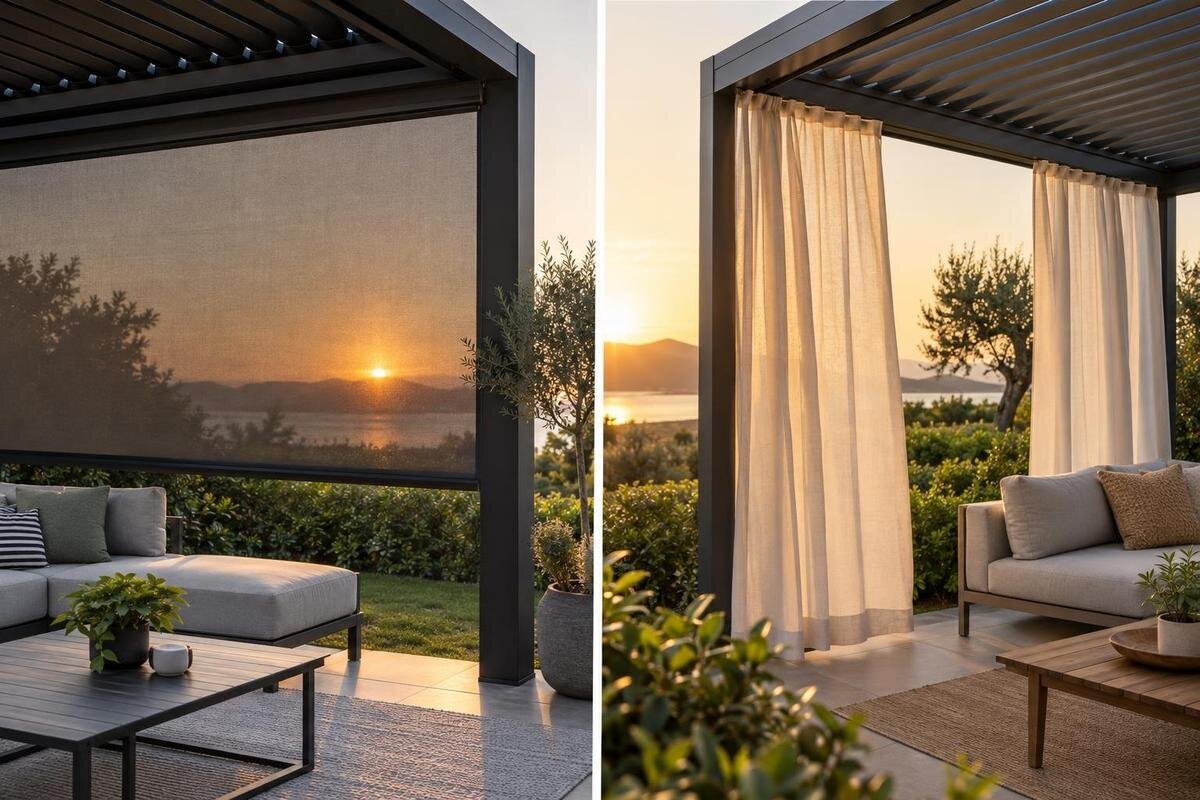
Pergola side options
A pergola side treatment changes more than the view: it affects how an opening works, how much breeze passes and what care the fabric needs. A ZIP screen is typically guided in side channels; an outdoor curtain hangs and gathers. Compare the actual fabric, operation and documented wind guidance for the exact model before deciding.

How ZIP screens differ from outdoor curtains
A ZIP screen and an outdoor curtain can cover the same pergola opening, but they are supported and moved differently. In a common ZIP-screen system, fabric travels vertically in side guides that retain or control its edges; when retracted, it is generally stored above the opening. This gives the deployed panel a more defined path than fabric hanging freely, but it does not turn the side into a rigid wall. The fabric, guide design, width and operating mechanism all vary. The word “ZIP” describes a type of guided screen, not a promise about privacy, airflow, rain or wind performance. Those outcomes depend on the specific system and its instructions. The guides may remain visible when the panel is raised, so include the open-state appearance in your comparison.
An outdoor curtain is usually suspended from a rod or track and drawn across the opening, gathering into folds at an edge or being tied back, depending on its fittings. The gathered fabric uses space at the side, and folds may remain visible even when the opening is clear. It can feel softer and more informal, while a screen often presents a flatter plane when deployed; appearance depends on fabric and frame. Curtains sold for outdoor use can still differ in weight, weave and hardware, so compare the actual panel rather than the label. For a frame enquiry such as Bloomcabin Bioclimatic Pergola, treat the side treatment as a separate question: the pergola name alone does not establish that a curtain or ZIP screen is included or approved.
Opening, closing and storing the fabric
Consider the routine rather than only the fully closed picture. A vertical screen does not need a horizontal run along which the fabric can gather, but it needs space for its upper housing, side guides and operating edge. Check whether those parts project into the entry, interfere with door hardware or sit where a person can reach them. Operation may be manual or powered, so check the offered system rather than assuming. Ask whether it can pause at intermediate positions, how you raise and lower it, and whether the controls are reachable from the seating area you use. If a screen has a lower bar, find out where it rests when fully extended and whether it creates an awkward threshold. The location of a handle or control can matter more than the neatness of the closed panel.
A curtain needs room for the panel to slide and stack, and its gathered width may take up useful space at an edge. Look at the fully open position as well as the closed one: could fabric cover a doorway, brush furniture or narrow a normal walking route? If a wide opening matters, ask whether panels draw to one side or split, and what holds them open; do not assume tie-backs are included. If the side is near a door, include the door’s swing in your plan so the panel does not get in its way. For a query about Bloomcabin Wall-Mounted Pergola, request a side-view drawing of the proposed system in both positions. The model name alone cannot show its clearance or confirm that an accessory will fit.
Privacy depends on fabric, lighting and sightline
Privacy is determined by fabric and sightline, not by the words screen or curtain. An open-weave screen may preserve a view and admit light while still obscuring some detail from certain angles; a denser fabric may block more of the view but also reduce outlook. Curtains range from sheer to opaque, so a curtain label is no better guide. Compare a sample at eye level from the seats and from the outside boundary, and consider standing as well as sitting. Check daytime backlighting: a bright exterior behind the panel can make a view through it different from what you expect. Hold the sample against the background you need to screen, not just a plain wall.
Night-time conditions can reverse expectations. With the pergola lit and the exterior darker, people outside may see through a fabric that felt private in daylight, particularly if it is open weave or translucent. No ordinary screen should be treated as one-way privacy glass without explicit product evidence. If neighbours or a path are the concern, mark the actual sightline and the height and direction of the view, then test the chosen material there. Privacy may require covering only one side or using a more opaque panel, but full coverage can also remove a view and make the space feel enclosed. If outdoor lighting is planned, assess the panel after dark as well as during the day.
Airflow depends on fabric and open sides
Airflow depends on how open the fabric is and how much of the side is covered. Mesh or open-weave screen material can allow some air through, but the weave, panel size and side guides matter; a tighter fabric may feel more sheltered while reducing the breeze. Curtains also vary: a light, porous panel is not equivalent to a dense outdoor fabric, and an open curtain can leave large gaps at its edges. Do not use terms such as “breathable” as a substitute for an airflow figure or a clear description of the material. If ventilation is a priority, ask what product information is available for the actual fabric rather than judging from a photograph.
Think about circulation through the whole pergola, not just the material in one panel. A screen closed on the breeze-facing side may change how air moves even if its fabric is permeable; two or more covered sides can feel different from one. A curtain can be drawn partly open, but its gathered section does not ensure a steady opening if it billows or shifts. If you want shade from low sun and continued breeze, consider the sun’s direction and keep a useful open route through the space. When discussing Bloomcabin Pergola, ask about the actual proposed side accessory rather than inferring airflow from the pergola frame.
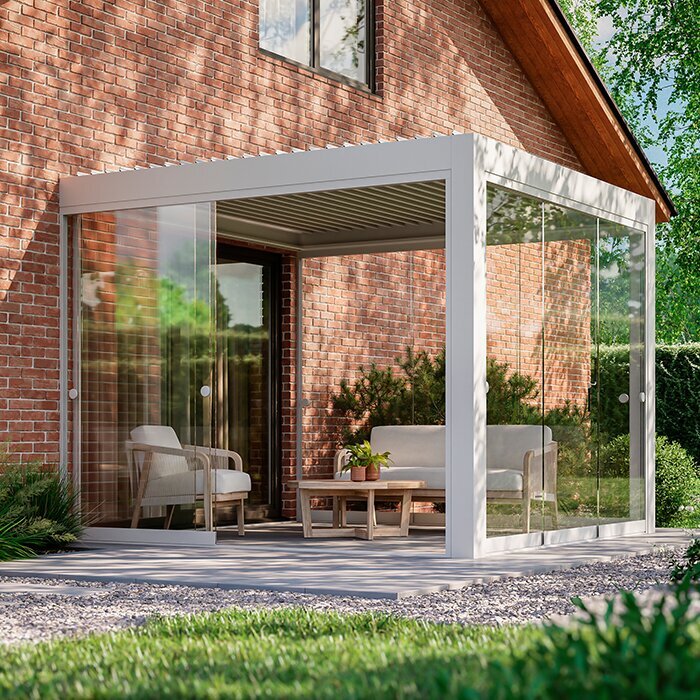
Ask for wind guidance for the exact side treatment
Treat wind suitability as a documented limit for the exact screen or curtain, not a general property of its category. A ZIP edge can be held in guides and still have fabric exposed to wind; a curtain may move in the wind and put strain on its hanging points. Neither fact by itself says how a particular product will perform. The size of the panel and the number of covered sides are also reasons to ask about the specific arrangement. Request the maker’s written wind guidance, including whether it applies while fully deployed, partly lowered or raised, and what operation is required as conditions change. A wind rating for a pergola frame is not automatically the rating of its side covering.
Where a limit is stated, check what it means: how wind speed is measured, what direction or exposure is assumed, and whether the guidance concerns average wind or gusts. Avoid converting a number from a brochure or a different accessory into a safe-use rule for your installation. Ask what the instructions say to do as conditions change, including whether a partly deployed position is covered by the guidance. If the documents do not cover the configuration you are considering, seek clarification before relying on it for an exposed site. When comparing the bioclimatic pergola model, request relevant information for the exact frame and proposed side treatment separately; do not infer accessory limits from the product name or pergola structure.
Compare cleaning and care requirements
Care requirements differ in practical ways. A screen has fabric plus guides or tracks, where dust, leaf fragments and insects can collect; inspect those areas and clean them as the supplier directs so the panel can move as intended. Do not assume a particular cleaner, lubricant or pressure-washing method is suitable for the fabric or hardware. A curtain’s folds and hems can trap dust and may need to be taken down for cleaning, but not every panel is designed to be removed or machine-washed. Check whether routine cleaning requires detaching the fabric or using particular tools. Request written care instructions for the exact material and fittings before choosing on the basis of easy cleaning.
Think about the conditions where the pergola sits. Fine dust, tree debris or salt carried through the air can make regular wiping more relevant, especially around exposed fabric edges and metal tracks; the actual cleaning interval belongs to the manufacturer’s directions. Ask whether care changes after a long period of non-use, and whether the screen must be dry before it is stored, rather than guessing. Check what the instructions say about seams, hems, fastenings and moving parts, as well as the main fabric. For an enquiry about the wall-mounted pergola option, compare maintenance guidance for the offered side accessory, not just the visible frame.
Confirm model compatibility and availability
Compatibility is a separate check from deciding which style you like. A pergola page may identify a frame without listing a screen or curtain as standard equipment. Ask whether the side covering is designed and approved for that exact model, size and opening, and whether it is supplied by the same manufacturer or a third party. Confirm how the guide, track or rail is fixed and whether the selected arrangement matches the frame; do not assume generic dimensions or a visually similar accessory will fit. A product that appears to fit is not, by itself, evidence that the manufacturer supports the arrangement. Discuss any changes to the structure or fixing method with the supplier or an appropriately qualified installer.
Ask for an itemised answer: what comes with the frame, what is optional, what is sold separately, and what can currently be ordered in New Zealand. Availability can differ between a pergola model and its side accessories, so do not treat a listing or gallery image as proof of local stock. Request the exact fabric description, finish, sizes, control method and installation scope that apply to your quote; confirm any expected supply timing rather than assuming it. When enquiring about the Bloomcabin pergola listing, ask the supplier to confirm accessory compatibility and current availability. That gives you concrete details to compare if another option is proposed.
Plan coverage around openings and access
Draw the pergola openings before selecting coverage. Mark posts, house walls, existing fences, doors, steps, furniture and the route people normally use. Then identify which side needs shade or privacy at the times you are outside. A treatment on one exposed edge may address a particular view or low sun; screening every side can reduce outlook and alter ventilation. Include the full travel path of a curtain and any screen housing or guide, rather than drawing only the fabric rectangle. Mark the usual open and closed positions too, so the plan reflects how the pergola will work rather than just how it will look in a closed-up picture.
Access matters as much as the closed view. Leave a useful route through the side you use most, and check that the panel will not block a door, gate, light switch or access to another feature. If a door opens towards the pergola, show its swing on the drawing. Consider whether you need to reach the fabric or track for cleaning and whether furniture will need to move before it opens or closes. When enquiring about Bloomcabin’s bioclimatic pergola, share a sketch with the preferred sides labelled and ask which arrangements are offered for that exact model.
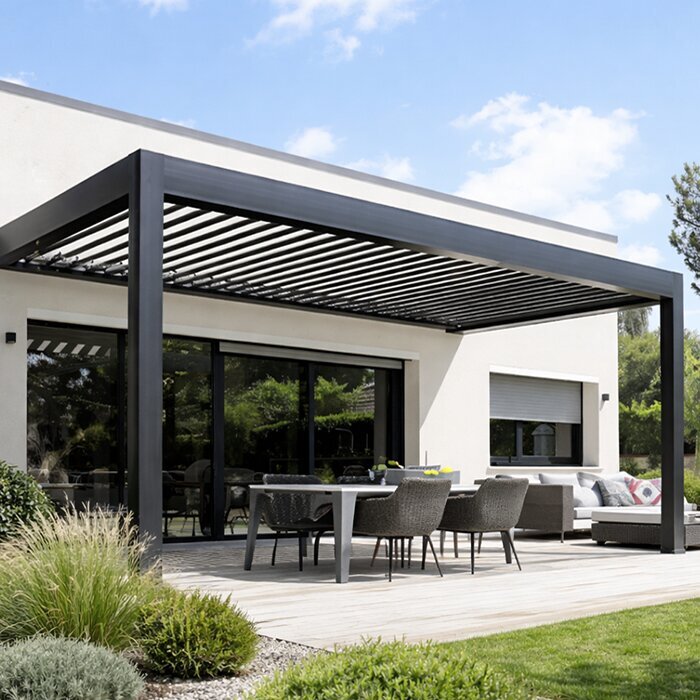
Check shade and views at the time you use the pergola
Look at side shading at the hours you actually use the pergola. Low sun can enter below a roof from the side, but a side treatment only addresses the direction it covers; it cannot replace overhead shade or screen sun coming from another opening. Note whether the problem is glare, direct sun, loss of privacy or simply a view, because each may call for a different fabric opacity and side position. Check the sun’s path during the part of the year that matters to you, not just the conditions on the afternoon you first look at samples. A change in angle may mean the side you need covered changes too.
A swatch can help with colour and texture, but a small piece does not show the full effect of a large panel or a curtain with folds. Ask for a larger sample or a product-specific image, and view the sample from both sides against the real background if possible. When considering the wall-mounted pergola, request a drawing or visualisation of the proposed screening arrangement. Compare the panel open, partly drawn and fully closed at your usual seating position. If you can, assess the sample in both direct sun and shade; that makes it easier to judge how much view and daylight you trade for privacy or shade.
Choose for the way you use the opening
A ZIP screen may suit you if you prefer a vertically guided panel and want the fabric to clear the opening without a gathered curtain stack. The guides and storage position still need to work with the frame and your layout. Check that the actual fabric provides the privacy or shading you need, that the airflow is acceptable, and that the maker’s wind instructions suit your intended use. If you expect to adjust the screen often, consider whether its operating method and controls are convenient from the places you use. Choose on evidence for the whole installed side, not on the assumption that a guided edge is automatically stronger, more private or easier to maintain.
A curtain may suit you better if you like its softer appearance and want the panel to gather or be drawn back across a rail, provided the storage stack, care and wind guidance work for the location. Neither format is the universal lower-maintenance or safer choice: material, fittings, exposure and how often you change the opening all matter. If priorities differ from side to side, compare each side on its own and combine treatments only where the supplier confirms a compatible setup. Think about how the chosen fabric looks and behaves when it is parked as well as when it is deployed. The useful comparison is the opening in its everyday positions, not a single closed-up photo.
Frequently asked questions
Are ZIP screens windproof?
No. ZIP describes a guided screen arrangement, not a universal wind rating. Ask for written guidance for the exact screen, pergola model and deployed position, including what to do as wind conditions change.
Which option gives more privacy?
Neither does so automatically. Privacy depends on the fabric’s opacity or weave, the viewing angle and the light on each side. Check a sample from the seating area and from outside, including after dark with the pergola lights on.
Do outdoor curtains allow more airflow?
Not necessarily. Air movement depends on the fabric, how much of the opening is covered and whether there are clear gaps around the panel. Compare the actual materials and layout rather than relying on the product name.
Can I leave a screen or curtain deployed in wind?
There is no safe-use rule that applies to every product. Follow the maker’s instructions for the exact accessory and configuration, and confirm whether its guidance covers fully deployed, partly open and retracted positions.
Are side screens included with a Bloomcabin pergola?
Do not assume they are included or compatible from the pergola’s name or a gallery image. Ask the supplier to confirm the exact model, approved side options, what is included and what is currently available to order.
A ZIP screen moves vertically in side guides; a curtain gathers along a rail. That difference affects how much of the opening remains clear and where the fabric sits when not in use. Compare each option in its open, partly deployed and closed positions, then weigh the fabric properties, care requirements and model compatibility alongside the wind guidance for your chosen arrangement.
