
Opening Pergola Louvres After Rain: Why Drips Occur
Pergola rainwater guide
Rain has stopped, the louvres begin to turn, and drops fall from the roof. That timing can be unsettling, but movement may simply release water left on a blade or in a roof channel. The useful distinction is whether the drips are a brief result of changing the blade angle or a sign that water is escaping somewhere it should not. The exact drainage path and operating practice depend on the roof design, so observe the pattern before deciding what it means.

Questions to ask before buying 1
Why louvres can drip as they open
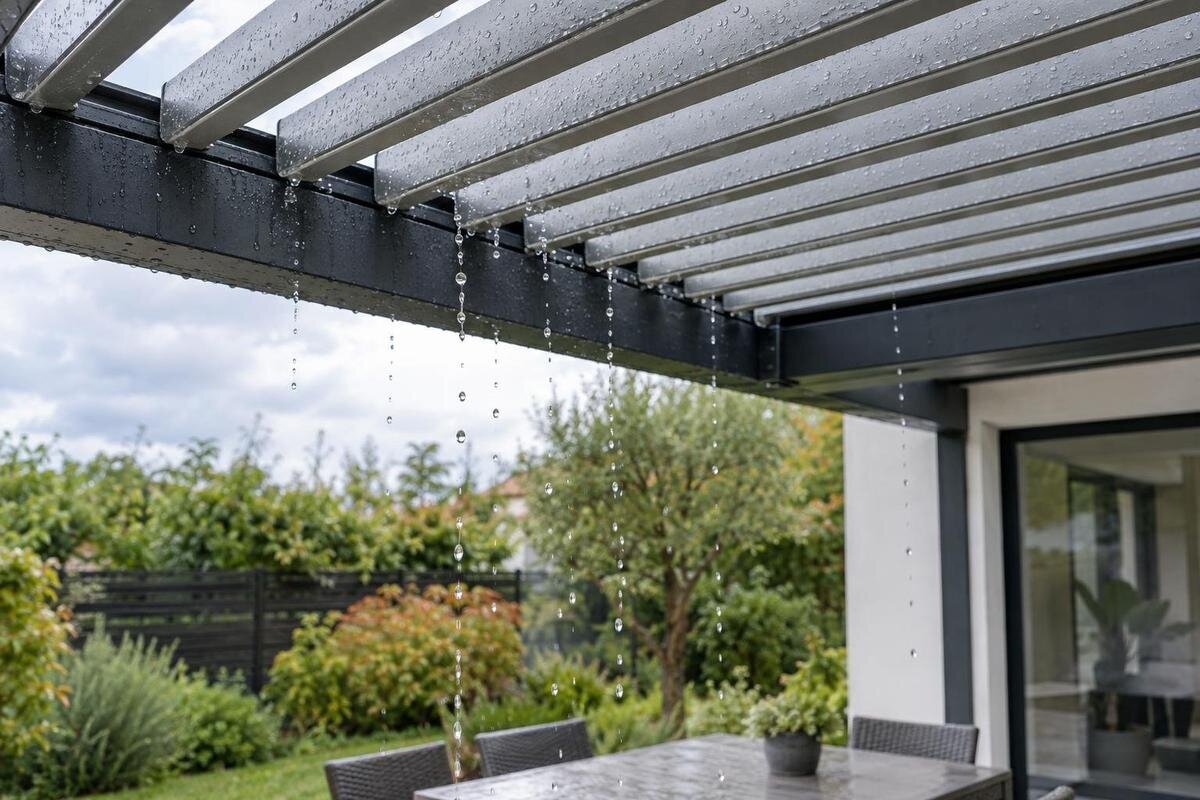
Closed louvres present their upper faces at one angle. After rain, a thin film or separate beads can remain near a blade edge, an overlap or a joint even when the sky has cleared. As the blades rotate, gravity acts on those surfaces differently: water can move towards a new low point, gather at an edge and detach. The first movement can release one set of droplets; continuing to open the roof can expose another wet edge or change the route again. A small bead may cling to a corner until the blade shifts, so the release can seem sudden. The water may have been held there since the earlier rainfall, rather than entering at the instant you opened the roof.
A louvred roof is more than a row of wet blades: depending on its design, water may also travel into a perimeter channel or along an end detail. Opening can uncover, tilt or interrupt that route, so a drip from below does not automatically show that water has passed through a failed seal. Identify the design before judging the water path. For example, the Bloomcabin Bioclimatic Pergola listing identifies a model; the matching operating instructions and drainage drawing, not the product name alone, explain how its roof is meant to move water. A drip can also fall some distance from the place where water first moved.
Where rainwater can remain on a louvred roof
Water may remain on the top face of a blade, its lower edge, the meeting line between adjacent blades or the point where a blade meets the frame. It can cling as a film or collect at a seam before a change of angle sends it onward. These are inspection clues, not a map of every pergola: blade profiles, overlaps and end details differ. A dry-looking underside viewed from the ground cannot show every wet contact point, and the main runoff stopping does not prove each detail has dried. Avoid assuming that a bead means water is trapped inside the roof; it may be sitting on an exposed edge.
Some roofs route runoff from the blades into channels along the perimeter, then towards outlets. A channel can still be wet after the main flow has stopped, and movement may let a final portion run to a point where it drips. Follow the drainage drawing from blade to channel to outlet, using its labels and arrows; do not infer the route just by looking up at one beam. If your product is identified as the Bloomcabin Wall-Mounted Pergola, use that exact name when requesting the relevant diagram. Distinguish places where water may remain from the points where it is intended to leave the structure. Other designs may use different paths, so the same symptom can have different sources.
Questions to ask before buying 2
How blade movement changes the water path
Think of roof movement as changing the slope of each wet surface, not just making a larger opening. A bead can roll towards a blade tip, run along its length or break free as the blade rotates. If two surfaces overlap when closed, the gap between them may be exposed differently as they separate. That can produce a short drip at the beginning of movement, another at a later angle, or a bead that follows the moving edge. Which sequence occurs depends on the roof’s geometry and operating direction. A stationary frame may stay wet while moving blades shed water, so note those locations separately.
Record the stage of movement rather than describing the roof as simply open or shut. Does the first drop appear immediately, halfway through, or only once the blades reach the position you normally use? Does it stop when movement ends? Those details help a supplier compare what you saw with the design. When describing movement on a Bloomcabin Pergola, include the starting and finishing blade positions rather than relying on the model name alone. The sequence matters when interpreting where retained water is released. If the normal instructions permit different positions, avoid cycling repeatedly just to provoke drips: further movement can release more residual water and obscure the first pattern.
Use timing and drip location as clues
Record when rainfall ended, whether it was still drizzling, the roof’s position before movement and whether the blades had already been moved since the rain. If drips begin only when opening starts, residual water released by movement is plausible. If water appears before operation or continues from the same place after the roof stops, the source may lie elsewhere in the drainage path. Timing narrows the question but does not prove a cause. Note the elapsed time, too, without treating it as a universal drying measure: shade, recent rainfall and roof details affect how much water may remain.
Location adds another clue. Drops falling from blade edges suggest a different point to examine than a stream at a beam end or post, but water can travel along a component before falling. The spot on the ground may not be directly below its source. Mark the drip location in relation to a post, beam and blade, then compare it with the model’s drawing. If several points drip briefly as the blades move, note whether they stop together or one continues. A location map and time sequence are more useful than a vague report that the roof leaks.
Questions to ask before buying 3
When a drip may need closer attention
A few drops that appear as the blades first move and then taper off can be consistent with water being released from a wet surface or a partly drained channel. That pattern is a clue, not a pass-or-fail test. Do not judge it by an assumed number of minutes or by how many drops another pergola produces: drainage arrangements and recent weather differ. Follow any model-specific instruction about operating after rainfall, and compare the expected discharge with the exact roof diagram. If guidance is not available, ask the supplier for it rather than adopting a rule from a different design.
Take more notice when the same point produces a continuing flow after movement has stopped, when water appears at an unexpected joint, or when the pattern has changed from what you previously observed. A blocked outlet, altered connection, blade not sitting as intended or another component issue may need assessment; none can be confirmed from the drip alone. For a roof identified as the Bloomcabin bioclimatic model, ask whether the observed release matches its expected water path rather than seeking a general acceptable drip count. Its operating, drainage and weather-performance documents provide the model-specific context for discussing that pattern and the roof’s limits.
Observe the roof without taking it apart
Observe from a safe position at ground level, with people and furniture clear of the area where drops are falling. Do not stand beneath moving blades to watch closely, climb on the structure or remove covers or parts. During ordinary rainfall, if it is safe to do so, note the roof’s starting position; after rain, observe one normal opening according to its instructions. A short video from outside the drip area can show the order of events more clearly than trying to remember whether the first drop came before or during movement. Include a view of the whole roof as well as the relevant area.
Write down the date, approximate rain conditions, time since rainfall stopped, starting and ending blade positions, when the first drip appeared, where it fell and how long it continued. Include whether the blades were moved earlier and whether visible water left the usual outlets. Add a simple sketch or photos with reference points, rather than only a close-up of a wet spot. If the unit is the wall-mounted model, include that exact identity and the installed roof configuration when requesting advice. Accurate details help avoid comparing your observations with a different system.
Questions to ask before buying 4
Follow the instructions for the exact roof
Use the owner’s instructions for the exact roof to decide how to open and close it around rainfall. They may describe a control sequence, permitted blade positions or specific guidance for operation after rain. Do not infer an opening angle or waiting period from another pergola: a different blade profile and channel layout can change the way water runs. If the instructions say nothing about opening after rain, ask the manufacturer, supplier or installer for clarification rather than treating a pause of your choosing as a guarantee that all water has drained.
Use the normal control method and stop if the roof does not move as described or the blades appear out of alignment; do not force a blade or reach into joints while it is moving. If you need to identify your roof when requesting instructions, the Bloomcabin Bioclimatic Pergola listing provides the catalogue name. Also describe the installed roof and controls so the guidance you receive addresses the system you actually operate. The key question is how to use those controls after rainfall, rather than how a different roof is operated. Do not alter seals or drainage components to stop a drip without advice, as that may change the intended water route.
Check the drainage route and visible outlets
Once the roof is stationary, inspect only what you can see safely from the ground: whether water is leaving the outlets shown in the drawing, whether debris is visible at an accessible opening, and whether the drip comes from a blade edge, beam or post. A visible obstruction may justify cleaning, but only if the manufacturer’s care instructions describe how. Do not poke into an internal gutter, remove an end cap or use a ladder to reach a roof channel just to confirm a suspected blockage. Leave inaccessible areas to a suitably qualified person.
Use the drainage drawing to distinguish an intended outlet from a point where water happens to fall. Do not assume that water on the ground indicates a blocked outlet or that every post should discharge water. If a visible channel is not draining as shown, or water escapes at a connection, photograph it and seek advice rather than using a pressure washer or improvising a test. When asking about a product shown in the wall-mounted pergola listing, identify the relevant beam, post or connection in your photo. This gives the supplier a specific location to compare with that model’s drainage details.

Questions to ask before buying 5
Questions to ask when choosing a louvred pergola
If you are comparing pergolas or planning an enclosure, ask to see the model-specific roof layout and drainage drawing, not just a general illustration of louvres. Confirm where water is intended to travel when the blades are closed, what happens as they open and where it leaves the structure. Ask what the operating guidance says after rainfall and whether it describes residual drips at first opening. Those answers are more useful than a broad ‘weatherproof’ claim, because this question concerns water movement as the roof changes position, not an unlimited promise about performance.
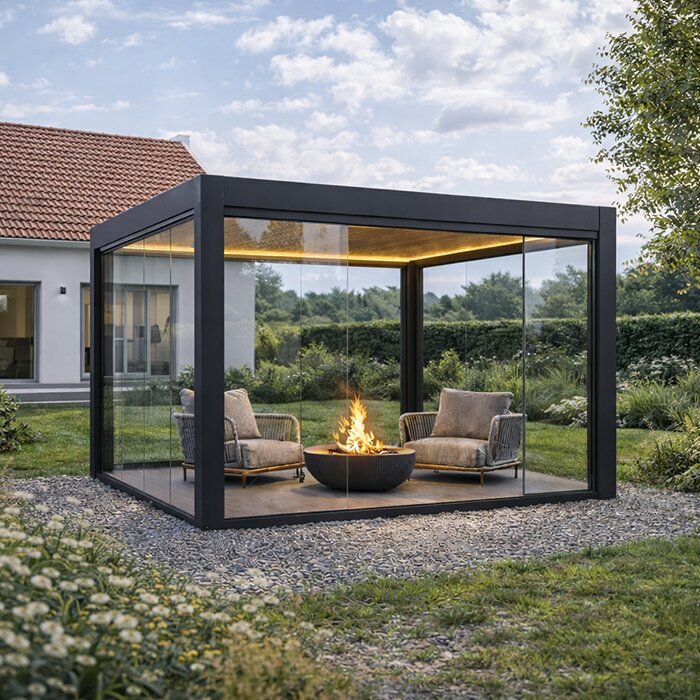
Ask whether any proposed side enclosure or wall changes the intended discharge path or the instructions for operating the roof. Request information for the exact combination, since a drawing for an open-sided unit may not answer questions about an added enclosure. If you are considering the model on the Bloomcabin Pergola catalogue page, include its name and your planned configuration in the enquiry. Ask for the corresponding weather-performance information and a drainage diagram that addresses that configuration, rather than assuming a general product description covers it. Also ask which outlets are accessible for routine inspection and what cleaning the instructions permit.
When to ask the supplier or installer to investigate
Ask the supplier or installer to investigate when dripping continues after the blades stop, comes from an unexpected joint or changes suddenly from the roof’s previous pattern. Seek advice as well if the observed route does not match the drawing, or an outlet appears blocked but cannot be reached safely. These signs do not establish a defect; they identify questions that need the model’s installation details and operating guidance. If the roof was recently installed or adjusted, explain what changed and avoid altering blades, seals or channels before the cause is understood.
Share your notes, photos or video, the precise model and configuration, the roof position, recent rainfall and the point where water appeared. Ask the installer to compare those observations with the drainage drawing and approved operating practice for that exact roof. A clear record helps distinguish a temporary release of retained water during movement from an ongoing drainage or installation concern. Ask whether the observed drip is expected residual discharge or needs an inspection; avoid treating a guess as a diagnosis. Until you receive guidance, use the roof only as its instructions permit and keep vulnerable furnishings out of a known drip zone.
Frequently asked questions
Why does it drip only when I open the louvres?
Water from earlier rain may remain on blade faces, edges or in a roof channel. Changing the blade angle can move it to an edge and release it. The timing is a clue, but the drainage drawing for your roof is needed to judge whether that route is expected.
Is there a set time to wait after rain before opening the roof?
There is no universal waiting time. Surface details and drainage layouts differ, so follow the instructions for your exact roof or ask the supplier for guidance. An arbitrary delay cannot confirm that all retained water has drained.
How can I tell whether the water came from a blade or a channel?
Note whether drops start during movement and where they fall: a moving blade edge, beam, post or outlet. Compare those clues with the roof’s drainage drawing. Water can travel along a component before falling, so the drip location is not proof of its source.
Do a few drops mean the pergola is leaking?
Not necessarily. A brief release as wet louvres move can be residual rainwater. Continuing flow, water escaping from an unexpected point or a changed pattern deserves model-specific assessment, but a few drops alone do not establish a fault.
Can I test the roof with a hose or clear a channel myself?
Only do what the owner’s instructions permit. A hose test or reaching into a roof channel may make the source harder to trace or create a hazard. Ask an installer to assess an inaccessible outlet or uncertain drainage path.
The first opening after rain can reveal where water has remained, because moving louvres change its path. Note when the drops begin, where they fall and whether they continue after movement stops. Then compare those observations with the drainage drawing and operating guidance for the exact roof. That approach helps separate a temporary release of retained rainwater from a pattern that needs closer investigation.
