
Frost and Frozen Pergola Louvres: When Not to Operate
Pergola weather and care
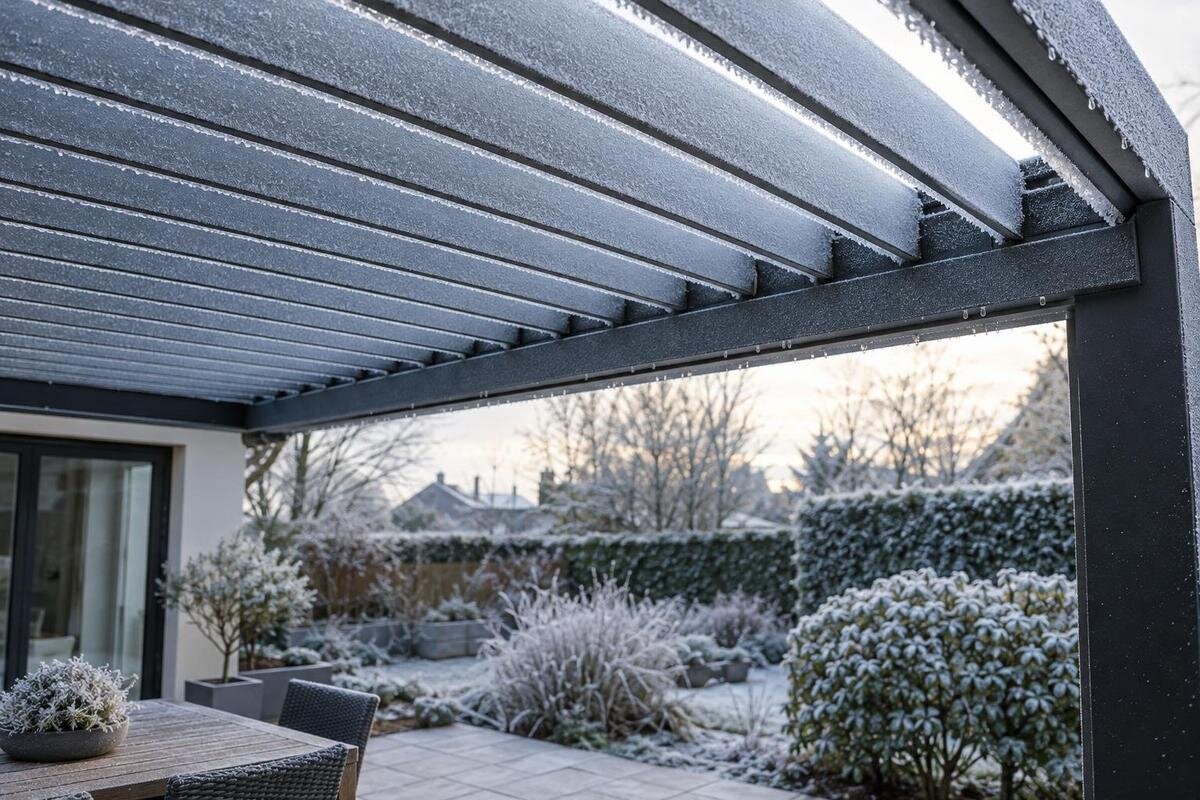
A louvred pergola roof can become difficult to move when frost or ice bridges a gap, pivot, linkage or another moving point. If the roof hesitates, stops part-way, moves unevenly or makes an unfamiliar noise in freezing conditions, stop operating it. Do not force the louvres or try a manual override unless the instructions for that exact model expressly allow it. Ice may remain in a less visible part after the exposed surface looks clear, so a quick glance is not proof that the mechanism is free.

01
How frost can immobilise a louvred roof
Frost is more than a coating on the visible face of a louvre. Water from rain, dew or condensation can remain where adjacent louvres meet, around a pivot, in a drive linkage or in a drainage recess. Once frozen, a small bridge between surfaces may prevent a joint from moving freely. The moving parts differ between roof designs, and the point of resistance may sit above or inside the mechanism rather than on an exposed edge. From below, a slat can look clear while a less visible contact point remains bound.
Thawing and refreezing can leave ice at an edge or joint after open surfaces appear clear. What matters is not just how much frost you can see, but whether ice has formed across a moving part's path. Water that drains slowly or remains after a wet day can become a fresh bond overnight; the relevant location may be underneath a louvre rather than on its top. If your paperwork names the Bloomcabin Bioclimatic Pergola, use that exact model name when requesting instructions. The name alone does not establish an ice limit or the conditions in which its roof may be moved.
Why the forecast cannot confirm the roof is clear
An air-temperature reading or forecast does not measure the temperature of every roof component or reveal whether moisture has frozen inside a sheltered joint. Exposed and shaded surfaces can warm at different rates, and water in a recess may remain frozen after a sunny spell. A sheltered part of the roof may also be colder or wetter than the nearby patio. Visible frost, local conditions and a general forecast therefore cannot provide a reliable clearance test. A manufacturer's stated operating-temperature range, if supplied, must be read on its own terms; it may not explain how to deal with ice binding a moving part.
Do not use a set number of hours, an air temperature above freezing or a smooth-looking upper surface as a universal go-ahead. When comparing your paperwork with the Bloomcabin Wall-Mounted Pergola, check that the instructions cover the installed version and its controls. A catalogue name or area range does not tell you whether the roof can be moved when icy. If the guide gives a temperature limit, check what it applies to and whether it separately explains frost, ice and thawing. Keep these questions separate: whether conditions fall within an operating range, and whether the moving parts are free of ice.
02
Stop as soon as movement is abnormal
Stop at the first sign that movement is not normal. That includes louvres that hesitate, start and stop, travel unevenly, remain part-open, make an unfamiliar sound or fail to respond after a command in freezing conditions. On a motorised roof, a hum or brief movement without normal travel is not a reason to press the control again. Even if only part of the roof appears affected, you cannot assume the other louvres or connected parts are free to move.
Do not try the opposite direction to free a stuck louvre, complete a cycle or make several short test movements. Repeated commands can add strain to the drive and connected parts without removing the ice. If the controls include a timer or app, use only the manual's stated method to pause automatic operation; do not reset, reprogramme or alter a control sequence by guesswork. Note what happened, including whether the roof moved at all, and leave it stationary. Describe the sequence clearly when reporting it: the command you gave, the movement you saw and the point where it stopped. If you have already pressed the control more than once, include that information rather than trying again to reproduce the symptom. The purpose of this record is to explain the interruption, not to test how much resistance the mechanism can overcome.
Why forcing or improvised thawing is risky
Do not push or pull individual louvres, lever a slat with a pole or tool, or climb onto the roof to loosen ice. Use a manual release or override, if the system has one, only when the instructions for that exact model say it is suitable for this situation. An emergency release intended for a power interruption is not automatically an ice-clearing method. The Bloomcabin Pergola model name on its own cannot establish whether an override is fitted or how it may be used.
Do not try to speed thawing with hot water, a heat gun, a portable heater, a sharp scraper, salt, chemical de-icer or an unapproved lubricant. These methods can affect finishes or seals, send water into a recess where it may refreeze, or damage components; the risks depend on the materials and design. Do not assume a household remedy is safe because it has worked on a gate or car. Use a thawing or cleaning method only if the manufacturer approves it for the model and explains how to apply it.

03
Find the instructions for the exact installed model
Useful advice starts with matching the roof to the right documentation. Check the order confirmation, invoice, handover papers or a safely accessible product label for the full model name and any model, serial or product code supplied. Record the installation date, installer and controls fitted. Do not remove a cover or climb to read a label. If you are checking the catalogue name, the Bloomcabin bioclimatic pergola listing can help you compare the model wording with your paperwork; it cannot confirm whether the installed version has different options or controls.
Ask the manufacturer, seller or installer for the current operating and maintenance instructions for that exact version. Useful questions include whether operation is prohibited when frost or ice is present; whether any roof position is recommended before a freeze; what the approved response is if movement stops; whether a manual release is permitted in that circumstance; and what thaw or restart procedure applies. Ask for a written answer tied to the installed model and controller. Separate instructions for preparing a freely moving roof before cold weather from instructions for a roof that is already stuck. A recommended position before frost is not, by itself, permission to move frozen louvres into that position. If a reply simply says to wait until the roof has thawed, ask what conditions or checks the manufacturer requires before restarting. A guide for a similar-looking roof is not a safe substitute.
A cold-weather limit is not an ice-clearance rule
Separate the roof's movement instructions from other weather information. A temperature limit for a motor or controller does not by itself confirm that a joint is ice-free. A stated wind, rain-drainage or snow-load limit, where the manufacturer provides one, answers a different question; it does not automatically authorise movement through ice. Equally, do not infer a universal storm, watertightness or snow guarantee from the fact that a roof is louvred. Follow only the conditions and limits documented for the model.
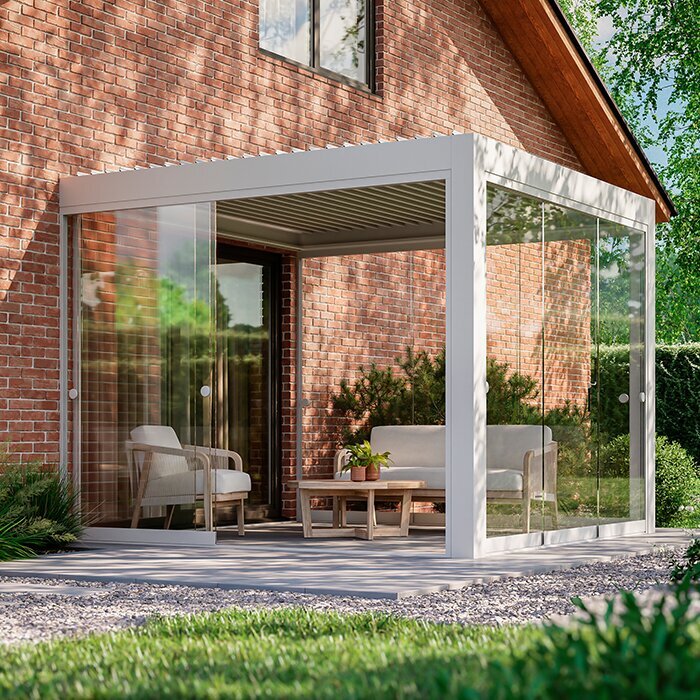
For a roof identified as the Bloomcabin wall-mounted model, request the matching weather and operating documents and confirm that the advice applies to the installed roof and enclosure arrangement. State whether your enquiry concerns the existing installation or an enclosure you are considering, so the reply addresses the right configuration. Ask specifically whether the manual says to leave the louvres in a particular position ahead of frost, or whether it gives no such instruction. Do not choose open or closed by applying generic advice from another model; a storm position and a frost response are not necessarily the same instruction. Keep the relevant limits with the operating instructions rather than treating one weather rating as an answer to every winter condition.
04
When a stalled roof may have another fault
A roof that does not move is not automatically frozen. A control, power or mechanical fault can produce similar symptoms, while ice may be present even when the controls show no warning. From the symptoms alone, you cannot reliably separate these causes. When reporting a problem with a roof identified as the Bloomcabin Pergola, include the product name shown in your paperwork and state which controls are actually installed. Describe what you observed without presenting a suspected cause as a diagnosis. For example, distinguish a roof that did not respond at all from one that began moving and then stopped. If there was no displayed error, say so; do not assume that this rules out a fault or confirms that the mechanism is clear. The catalogue name helps identify the roof, but does not identify every control option.
Do not open electrical covers, disconnect wiring, bypass a sensor or repeatedly reset a controller to test whether the roof will move. If the model instructions provide a simple user check, follow it only when the roof is safe and the directions clearly apply; otherwise ask the installer or a suitably qualified service professional to assess it. Give them the weather conditions, any displayed error, the last normal operation and the point at which movement stopped. This helps distinguish a possible icing event from a fault without further loading the mechanism.
Keep people clear while you assess the roof
Assess the roof only from a safe position on the ground. Do not stand on the pergola, lean a ladder against it, reach between louvres or work below loose ice. From a distance, note whether the louvres appear misaligned, whether ice or water is visible, and whether any part looks bent, loose or displaced. Do not tap a slat, wipe a joint or lift a cover to confirm what is frozen; those actions bring you close to moving or overhead parts without proving that the roof is safe to operate.
If the frame or a roof component appears sagged, displaced or damaged, keep people away from the area and arrange an assessment rather than trying to reposition it. Ice can fall as it thaws, so avoid sitting or walking directly beneath a roof with loose ice. Take photos or a short video only from a safe distance, and note the time, weather and what the controls did. If a detail cannot be seen safely, report it as unknown rather than moving closer to inspect it. A useful record distinguishes visible ice, unusual louvre alignment and an observed interruption in movement; these are observations, not confirmed causes. Do not operate the roof to make a demonstration video. Existing images and a clear description may help a service provider, but they are not a structural safety check or permission to operate.
05
When to resume operation after thawing
Wait for the model's stated thaw criteria, not an arbitrary number of hours. A roof can remain bound at a pivot or linkage after the surface appears dry; moving it is not a suitable way to discover whether hidden ice remains. If the instructions specify conditions, an inspection or a service visit before restart, follow them. If no frost procedure is available, keep the roof still and ask the supplier or installer what the manufacturer approves rather than making a test movement.
Once the instructions say operation may resume, use the normal controls and sequence exactly as described, while keeping people clear. Stop immediately if the roof hesitates, travels unevenly or makes an unfamiliar noise; do not try another cycle. When seeking restart advice for Bloomcabin's Wall-Mounted Pergola, give the precise model name and confirm that the reply matches your installed controls. Explain whether the original symptom has changed during thawing, using observations made without moving the roof. Keep any response about restarting separate from general maintenance advice, so it is clear which instruction applies to this interruption. If the problem returns during the permitted restart, report where movement stopped and what was different, rather than treating a brief successful movement as proof that the whole mechanism is free.
Prepare a frost plan before the next cold spell
Before winter, put the manual where it can be found and ask the installer or manufacturer what to do if ice forms. Clarify any operating-temperature limits, whether the maker specifies a position before freezing, how a jam should be reported, what thaw and restart steps are approved, and whether automatic controls need a documented user action. These answers are most useful before the roof is stuck, when you can check the model and control details without approaching an icy structure. Make sure everyone who normally operates the roof knows where the instructions are and understands that another button press is not a way to free it. Keep the supplier or installer's contact details with the model information so a problem can be reported without searching for paperwork outside. If several people use the controls, agree how to tell one another that operation has stopped. Request missing instructions rather than relying on a generic winter checklist.
If you are buying or configuring a louvred pergola, include frost operation in your pre-purchase questions: ask for model-specific weather documents, what those limits cover and how they apply to any planned enclosure. The Bioclimatic Pergola product page identifies a catalogue model, and its listed range of 9 to 24 m² is an area range, not evidence of an ice rating. Compare the roof and control documentation for the exact option you intend to order. Give each supplier the same questions so you can distinguish a stated cold-weather operating limit from an explanation of how to respond to ice. Where an answer covers only normal operation, ask separately about a roof that has stopped moving. This makes the comparison useful for day-to-day ownership rather than relying on a category name to predict cold-weather behaviour.
Frequently asked questions
Can I operate the roof if there is only a light frost on top?
Do not use the amount of visible frost as a clearance test. Ice can bind a hidden pivot or joint even when the louvre faces look clear. Follow the instructions for your exact model, and stop if the roof hesitates or resists movement.
Can I use a manual override if the roof is stuck?
Only use an override if the instructions for that model specifically allow it in icy conditions. A release intended for a power interruption is not automatically suitable for freeing ice. Do not force the mechanism.
Can I pour warm water over the louvres?
Do not do this unless the manufacturer explicitly approves that method for your model. Water can reach a joint or component and refreeze, while heat or chemicals may affect finishes and seals.
How long should I wait before trying again?
There is no reliable wait time for every roof and site; ice can remain in sheltered moving parts after exposed surfaces have thawed. Use the model's stated thaw and restart procedure. If there is none, keep the roof still and ask the supplier or installer for guidance.
What information should I give the installer?
Provide the exact model name and any product code, the controls fitted, the weather conditions, what happened after the last command and any displayed error. Photos taken from a safe distance may help. Do not climb up or remove covers to gather information.
A frosted roof should remain still if ice is binding its moving parts or the model's instructions prohibit operation. Treat resistance as a reason to stop, not a challenge for the motor or a cue to reach for a lever. Leave the mechanism undisturbed, keep people clear where ice may fall, and follow the guidance for the exact installed model before restarting. A clear-looking surface alone is not enough to decide that a frozen roof can move again.
