
Growing garlic in a greenhouse
The greenhouse garlic almanac · New Zealand
Growing garlic in a greenhouse
A garlic clove is not a switch for warmth, but a store of time. In a greenhouse, a good crop follows a calm sequence of cool conditions, rooting, leaf growth, longer days, dry ripening and patient curing.
Treat the greenhouse as weather protection, not a machine for endless summer. It keeps heavy rain off the bed, improves control of soil moisture and ventilation, and makes harvest easier. It must not, however, remove the cultivar-specific chilling that supports later clove formation.
01 · The principle
Garlic succeeds under cover when the house protects its natural seasonal rhythm without erasing the winter cool that cues bulb development.
Garlic seems straightforward: a healthy clove should produce a new bulb. Yet its growth follows a precise sequence. First the clove makes roots, then enough leaf area. For many cultivars, an extended cool period is part of the biological signal. Only the combined history of temperature, rising warmth and longer days triggers division of the bulb into individual cloves.
That is why a heated greenhouse is often the wrong first response. Constant warmth can produce strong, attractive foliage while the necessary chill is missing, leaving small or undivided round bulbs. An unheated or only frost-protected house is often more suitable. It offers an accessible dry bed, controlled watering, less wind and purposeful ventilation without completely cancelling the natural season.
Start with the cultivar, then set up the growing space around it. Hardneck garlic often suits cooler districts, produces a firm edible flower stem and usually has fewer but larger cloves. Softneck garlic commonly has more, smaller cloves, can be braided and generally stores longer. These groups are not a complete site recommendation: the specific cultivar and advice from a reputable New Zealand or regional supplier remain decisive.
If you are planning the whole house for cool autumn and spring crops, include the right model early. Explore the Classic aluminium greenhouse alongside your crop plan. Garlic benefits from a deep in-ground or raised bed, a clear route for care and harvest, and easy-to-reach vents. Position rows so tomatoes or cucumbers grown later do not shade garlic foliage too early in spring.
Before plantingChoose planting stock
Cool seasonChill and root
SpringBuild leaves
Longer daysForm bulbs
Early summerHarvest and cure
Think of this sequence as a crop clock, not a fixed monthly timetable. Begin with large, healthy planting cloves. Cool soil and moderate moisture encourage rooting; a cultivar-appropriate chill period supports later bulb development. In brighter spring, a robust leaf canopy provides energy for clove division. Finally, reduce watering and growth so bulbs ripen dry and can be harvested cleanly.
Growing guidance consistently stresses that chilling, the temperature pattern, day length and cultivar characteristics work together. The Royal Horticultural Society suggests roughly one to two months at 0 to 10 °C for most varieties. Use this as guidance, not as a universal refrigerator prescription. Exact needs depend on cultivar, origin and previous storage of planting stock; supplier advice takes priority.
Cool inland districts
Plant suitable garlic in April or May in a deep, well-drained greenhouse bed. Do not keep the house permanently closed through winter: the crop should still experience natural cool conditions. Roofing and glazing protect it from persistent rain and sharp weather shifts. After extended frosts, still check moisture, as a covered bed can be drier than outdoor temperatures suggest.
Mild urban districts
Choose the coolest available spot, rather than a position beside a sun-warmed house wall. Ask for cultivars suited to mild New Zealand conditions. Controlled pre-chilling is appropriate only where the supplier expressly recommends it. Cooling for too long or at the wrong time can initiate bulb formation before enough leaf area has developed.
Warm, sunny houses
Ventilate early. Even when outdoor air is cool, strong winter or spring sun can raise temperatures rapidly under glass. Avoid overheated, humid, stagnant air. A clear central path, openings on more than one side and adequate planting distances help release heat and condensation.
Anatomy of a planting clove
Wrapper
Point facing up
Root base facing down
Wrapper. Keep the papery skin as intact as possible. It protects the planting clove from unnecessary drying, bruising and minor injuries.
Shoot tip. Place the narrow pointed end upwards, so the new shoot can grow directly towards the soil surface.
Root plate. The flat base faces down and makes direct contact with evenly moist, loose soil.
03 · Planting stock
Choose the bulb before choosing the bed.
Planting stock is your first important decision for plant health. Buy certified or clearly sold seed garlic from a reputable specialist rather than random supermarket bulbs. Kitchen garlic may come from another climate, have been treated to suppress sprouting, or carry unnoticed disease into the greenhouse. Use only firm, plump bulbs with dry wrappers. Reject soft, mouldy, damaged, unusually light or dried-out bulbs at the base.
Hardneck
Hardneck garlic is often a good choice for cooler New Zealand areas. It develops a firm central flower stem and usually a ring of relatively large cloves. Cut the young scapes when they form a clear curl if large bulbs are the priority. The tender scapes are edible, and you may allow extra plants for the kitchen.
Softneck
Depending on the cultivar, softneck garlic can suit milder areas. It normally produces no firm scape, often has more and smaller cloves, and can be braided after curing. It usually stores better. Save especially vigorous, healthy outer cloves for the next planting.
Not elephant garlic
Elephant garlic is botanically closer to leek and is not true garlic. It is interesting in the kitchen, but its size and growing habits are not a suitable basis for planning an ordinary garlic crop.
Split bulbs only one to two days before planting. Separate each clove carefully, retain its dry wrapper and do not damage the flat root plate. This avoids drying and needless entry points for disease. A crushed or badly torn clove is better used in the kitchen than planted into a damp winter bed.
04 · The planting row
Give every clove room for winter, roots and the future bulb.
Garlic needs deep, loose soil, not merely a thin layer of rich compost over compacted ground. A permanent in-ground bed is usually best in a greenhouse. If containers are necessary, use broad frost-resistant pots with at least 25 to 30 cm of growing medium and free drainage holes. Remember that temperature and moisture change faster in pots than in a deep bed.
Too shallow
Correct
Too deep
Too shallow: An exposed point can dry out, be lifted by temperature changes or lose stable anchorage.
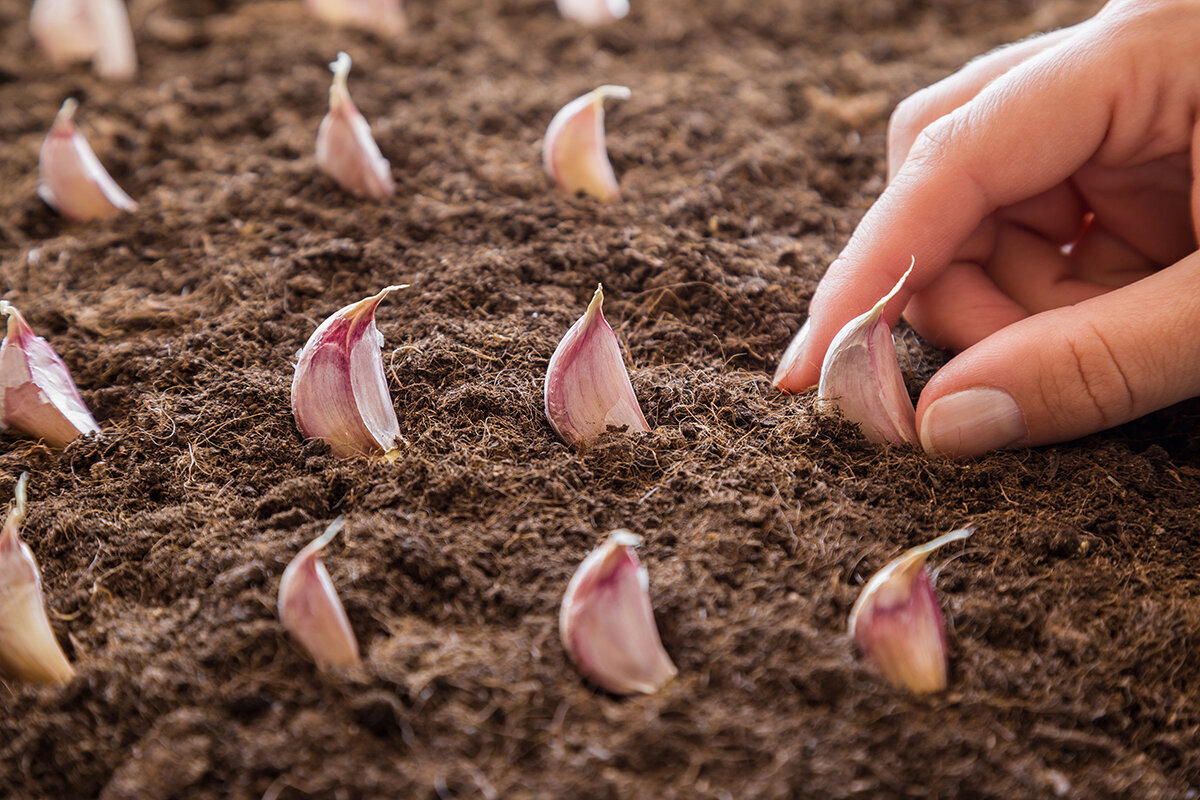
Correct depth: Set the point upwards and cover the clove with about 5 cm of loose soil in a typical greenhouse bed.
Too deep: Excessive depth delays emergence and makes growing harder in cold, heavy or continually wet greenhouse soil.
Bed geometry with air
Allow around 12 to 15 cm between cloves and 20 to 25 cm between rows for mature bulbs. A clearly arranged double-row bed uses space well, provided a wide access path remains beside it. Never tread on the root area. Raised beds help where ground dries slowly, but should not be filled solely with loose material that settles heavily by spring.
Work in some mature compost before planting and, in heavy soil, improve drainage with suitable mineral material, coarse sand or a raised bed. Soil should retain moisture without becoming waterlogged. Fresh manure and excessive nitrogen are not shortcuts: they encourage soft leaf growth and can reduce ripening and storage quality.
Planting checklist
- Use the largest healthy outer cloves; small inner cloves go to the kitchen.
- Point up, flat root plate down.
- Water thoroughly once to settle soil around the cloves, but do not keep the row saturated.
- Use only loose, clean mulch and keep young shoots clear.
- Label every cultivar and record its planting date and greenhouse position.
05 · The moisture pattern
Water the root zone, not the greenhouse air.
Garlic does not need constantly wet soil. Aim for an evenly supplied, oxygen-rich soil profile where roots can remain active from autumn planting until the bulb fills.
Establishment
Water sufficiently after planting for soil to settle around the cloves. Then check several centimetres below the surface. A cool covered greenhouse bed often dries slowly in winter, even when the upper soil layer already looks pale and dry.
Leaf growth and bulb filling
As leaf number, light and temperature increase, so does water demand. Water deeply and evenly without following a rigid weekly schedule. In a greenhouse, rain contributes nothing, while ventilation, sun position, soil volume and substrate structure greatly change evaporation. Check moisture at root depth. Drip irrigation or slow morning watering directly onto soil is better than wetting foliage. The surface may dry slightly, but the root zone should not repeatedly dry out completely during active growth.
Before harvest
Gradually reduce watering before the planned harvest and, where possible, stop it in the final stage. Aim for moderately dry soil that allows clean lifting and shortens curing time, not premature drought stress while bulbs are filling.
Ventilation is the necessary companion to watering. Open roof and side vents early on bright days so warmth and dew do not remain among the leaves. A Classic aluminium greenhouse is particularly helpful in late spring, when stronger light quickly raises temperatures under glass. Plan air movement, clear paths and responsive watering as one system. Find further model information in the Classic aluminium greenhouse.
06 · Reading the leaves
Bulb problems usually begin earlier.
Do not reach immediately for fertiliser or treatments; first place every symptom in the context of the season. Garlic is a long crop: the bulb records decisions and stresses that often occurred months before harvest.
Lots of leaves, little bulb
Insufficient chilling or the wrong development timing is common. An unsuitable cultivar, very late planting, excessive warmth and too much nitrogen can also contribute. Check cultivar suitability and the temperature pattern first. Extra greenhouse heat cannot replace a missing winter phase.
Early yellowing
Check soil moisture first. Waterlogged roots, poor nutrition, disease, pests or normal ripening can look alike. Expose one test plant before assuming a nutrient deficiency. Remove clearly diseased plants with their bulbs and do not put suspicious material in compost.
Small bulbs
Small planting cloves, close spacing, weed competition, interrupted watering, limited leaf area or bulbs forming too early can restrict size. A greenhouse mainly helps prevent several stresses occurring together: heavy rain, dry spells and temperature peaks can be balanced more deliberately.
Split wrappers
Cracked outer wrappers often indicate late harvest. Once cloves push through their protective layers, keeping quality declines. Use these bulbs first. Save only firm, closed and unblemished bulbs for the next planting.
07 · Lift at the right moment
The harvest window is narrow and easy to read.
Garlic is not ready while every leaf remains deep green, nor should it collapse completely. Exact timing depends on cultivar, location and the growing season. Yellowing or drying lower leaves, while upper leaves are still partly green, are a useful guide. When about one-third to one-half of the foliage has aged, carefully expose a test bulb. Individual cloves should show clearly beneath tight, closed wrappers, without the bulb splitting open.
In New Zealand, a conventional autumn-planted crop is usually harvested in summer. Under cover, it may begin earlier or later depending on the region, cultivar and temperature history. Let the condition of leaves, neck, bulb and wrappers decide rather than a printed month. Plan lifting for a dry weather and bed period where possible.
1
Reduce watering
Reduce watering gradually before harvest and allow the bed to become moderately dry. Do not force drought during active bulb filling; this change belongs only to the final stage.
2
Lift, never pull
Loosen soil well below the bulb with a garden fork or narrow hand trowel. Then lift the whole plant out with leaves and roots. Pulling by the stem causes bruises or tears at the neck, precisely the damage that shortens later storage life.
3
Do not remove wrappers
Gently shake off only large, loose clumps of soil. Anything adhering firmly may dry first. Do not wash storage garlic or strip away outer layers in harvest enthusiasm. Dry wrappers are the cloves’ natural protection.
4
Separate kitchen garlic and planting reserve
After complete curing, reserve the largest, most even and healthiest bulbs for next season. This simple selection often improves the next crop more sustainably than extra equipment or heavier fertilising.
The airy curing place
Shade
No direct sun.
No direct sun.
Airflow
Leave space.
Leave space.
Time
Usually two to four weeks.
Usually two to four weeks.
08 · The curing space
Cure for keeping, not display.
Freshly harvested garlic is edible, but careful curing turns it into a storage crop. Hang whole plants in small, loose bundles or lay them in one layer on an airy mesh rack or slatted shelf. The place should be shaded, dry, rain-protected and well ventilated. A greenhouse is suitable only if it can be reliably shaded and ventilated. Beneath closed glazing, direct sun, trapped heat and condensation can make wrappers brittle or reduce quality.
Allow usually two to four weeks. Bulbs are ready when outer wrappers feel papery, roots are dry and the neck rustles when handled. Only then brush off loose soil and trim roots and stems. Softneck garlic can be braided while dry stems remain flexible. Sort again: use soft, damaged or visibly blotched bulbs first and do not store them among sound bulbs.
Store fully cured garlic in a dark, dry, airy place, such as nets, open crates or loose hanging bunches. Closed plastic containers are unsuitable. The refrigerator is also usually not an ideal long-term home for whole storage bulbs, because humidity and unfavourable temperature changes can encourage sprouting. Actual storage life depends on cultivar, curing quality and room conditions; softneck types usually keep longer than hardneck garlic. Check stores regularly and remove soft bulbs.
For a greenhouse with a clear purpose throughout the gardening year, the Classic aluminium greenhouse provides a bright, organised setting for a carefully planned garlic bed during the cool season. After summer harvest and thorough bed care, the cleared space can serve suitable warm-season follow-on crops or preparation for the next rotation.
09 · Practical questions
Garlic in a greenhouse: common questions
Clear answers to choices that strongly affect bulb quality, harvest and storage life.
Can garlic grow in a heated greenhouse?
It can produce leaves in a heated greenhouse. Constant warmth does not, however, replace the chilling that many cultivars need for reliably divided bulbs. Use a warm house only for special crops or controlled methods when you know the cultivar’s requirements precisely. For storage bulbs in a home garden, an unheated, lightly frost-protected or partly cool greenhouse is usually the more dependable option.
Should I pre-chill garlic cloves in the refrigerator before planting?
Not automatically. With autumn planting in an unheated greenhouse, winter provides the required cool conditions naturally in many parts of New Zealand. In exceptionally mild areas, controlled pre-chilling may suit particular cultivars. The response is cultivar-dependent, however; incorrect or overly long chilling can encourage premature bulb formation. Ask the planting-stock supplier for a specific recommendation beforehand.
Can I plant garlic in greenhouse containers?
Yes. The container should be wide, frost-resistant and at least 25 to 30 cm deep, with clear drainage holes. The crop must also receive the necessary winter cool. A deep in-ground bed is more forgiving because it buffers moisture and temperature more evenly. Check containers more often, avoid waterlogging and leave about 12 to 15 cm between cloves for large bulbs.
Should I remove hardneck scapes?
If your aim is the largest possible bulbs, cut young scapes once they make a distinct curl and are still tender. This leaves more energy for the bulb. Scapes are edible and work well in pesto or vegetable dishes. You may leave some for observation, but expect slightly smaller bulbs on those plants.
Why do my greenhouse bulbs stay round instead of forming separate cloves?
An undivided round bulb often points to insufficient winter chill, a cultivar unsuited to the site, late planting or too short a leaf-building phase. An excessively warm greenhouse can also be involved. The bulbs are edible. Record the cultivar, planting date and temperature pattern, then deliberately change only one factor next season.
What crop can follow garlic?
After harvest and careful bed maintenance, the space can be used for warm-season summer crops, leafy vegetables or a rest and rebuilding phase, depending on timing. Do not immediately plant another allium, such as garlic, onion, leek or chives, in the same soil. A multi-year crop rotation and complete removal of plant debris help limit recurring problems. The Classic aluminium greenhouse offers inspiration for spatial planning.
Sources and further reading
Growing knowledge behind the crop.
More from Bloomcabin: Setting up a greenhouse: layout, plants and care · Water-wise greenhouse gardening · Greenhouse curtains and shading
- LWG Bayern — Garlic: the wonder clove Fundamentals of planting, care, harvesting, use and special features of garlic growing.
- LWG Bayern — Vegetables in climate change: garlic German practical experience of cultivation, climate conditions and crop development.
- Royal Horticultural Society — How to grow garlic Advice on chilling needs, planting time, position, care, harvest and storage.
- University of Minnesota Extension — Growing garlic in home gardens Growing information on cultivar choice, autumn planting, spacing, watering and healthy seed garlic.
- Oregon State University Extension — Garlic (Fall) Practical guidance on autumn planting, crop management, maturity signs and harvest.
- Oregon State University Extension — Preserving garlic Recommendations for safe processing, curing and storing garlic.
- LWG Bayern — Garlic: the wonder clove Further overview of location, planting, care, harvest and use.
