
Growing Strawberries Under Glass in a Greenhouse
Bloomcabin Growing Portfolio / New Zealand
Growing strawberries
under glassin the greenhouse
A greenhouse strawberry is more than an early berry. It reveals how precisely light, air, water and harvest timing work together.
01The greenhouse advantage
Precision is the most valuable ingredient here.
Strawberries reward attentive care in especially visible ways. A crown set only slightly too deep can rot; one missed day of ventilation can turn a crop full of white flowers into a grey mould risk; a dried-out pot reduces fruit size before leaves visibly wilt. Outdoors, weather sometimes disguises these small errors. Under glass, they become clear – and can be corrected with calm daily care.
The benefit is not simply an earlier harvest. Under cover, flowers and fruit are protected from persistent rain, water can be directed deliberately to roots, and plants can be arranged at a comfortable picking height. Damaged berries are removed more quickly, leaf undersides are easier to inspect, and small problems are noticed sooner. Strawberries remain a seasonal crop, not a winter houseplant. As daylight increases, however, a well-managed greenhouse creates a generous transition into spring and a gentle finish through autumn.
Treat the strawberry area first as its own microclimate. It needs bright light, a clear path, water within reach and enough open space for air to move through foliage. Do not place every pot tight against the glazing: temperatures fluctuate more at the edge, and root balls dry faster. Before benches, irrigation and containers are given permanent positions, consult the Bloomcabin guide to classic aluminium greenhousesfor useful orientation.
For a dedicated picking area, the clear proportions and planned ventilation options of aclassic aluminium greenhouseleave enough freedom to reserve a sunny side for fruit while keeping workspace for propagation, repotting and other seasonal crops.
02Varieties with purpose
Choose the harvest rhythm before choosing a variety name.
Greenhouse space is valuable. Match growth and cropping habits to the way you want to harvest rather than collecting varieties at random. Start with healthy, clearly labelled plants from a reliable nursery. Sound young plants are already an important part of preventive plant health and make later monitoring much easier.
Variety names matter, but only after the variety group. Flavour, firmness and response to warm days vary with site and greenhouse conditions. Trial two varieties in small numbers before planting a whole bench. Keep labels and make brief notes on harvest time, flavour and care needs. Plants that taste excellent and remain healthy in your greenhouse deserve space again next year.
For most home greenhouses, everbearing or day-neutral plants are the steady choice for a long season. Once-bearing varieties complement them when a concentrated bowl in early summer is the aim.
A short season
Once-bearing
Once-bearing strawberries form flower buds in the previous year and give a generous, concentrated main crop in late spring or early summer. They suit jam making, freezing and a special harvest weekend. Harvest is followed by a clear care phase. Runners are more integral to this group and are particularly easy to manage in a ground or raised bed with a narrow row that can later be renewed.
They can grow beautifully under glass, but their single harvest peak uses protected space differently from a long container crop. Choose them if you want a deliberately timed harvest and have room for runners, renewal and an open row.
The greenhouse favourite
Day-neutral
Day-neutral strawberries respond less strongly to day length and can produce flowers and fruit for a long time in suitable conditions. They are often sold alongside everbearing varieties. Choose first for flavour, then test how plants respond to light, warmth, ventilation and your harvesting interval. A small home-garden trial is more revealing than any variety promise.
Remove runners so the plant directs energy towards flowers and fruit. This is especially practical in a home greenhouse: a few ripe berries every few days are easier to enjoy, inspect and chill promptly than a brief harvest glut. A shallow, evenly moist root zone and dependable pollination matter more than trying to force rapid growth.
Two flushes
Everbearing
Everbearing strawberries produce flowers and fruit repeatedly, often with a peak in early summer and another phase into autumn. They work well in containers but require a consistent routine for watering, harvesting and hygiene. If you already know and value a particular variety, it makes a lovely addition. Where space is limited, a small, clearly managed selection usually gives more pleasure than a dense mix of varieties.
03Calendar for protected crops
Light, frost and plant development set the pace.
Timing varies widely between warmer coastal districts, inland areas and cooler southern regions of New Zealand. Follow light, temperature and your plants’ condition – especially in an unheated house. This is not a rigid monthly programme but a care rhythm: prepare, plant, let plants flower, keep foliage dry, harvest and renew.
Late winterPrepareCheck pots and ventilation
Early springPlantSet crowns level
Late springFlowerVentilate and pollinate
SummerHarvestWater evenly, feed moderately
AutumnRenewSelect and clean
In late winter, clean containers, check glazing, drains, doors and vents, and remove old foliage. Plant in early spring during bright, relatively cool weather; in unheated houses, pot roots need protection during severe frost. During flowering, open early, keep foliage dry and allow insect access. Through summer, harvest frequently, water evenly and remove unwanted runners from fruiting plants. In autumn, decide which healthy plants to retain; weak, diseased or overcrowded plants make way for fresh material before the strawberry area is cleaned for winter.
04Crown, roots, restraint
The crown belongs exactly at the substrate surface.
The crown is the thickened living centre from which leaves, flower stems, runners and roots emerge. It is not a bulb and must not disappear beneath compost or growing medium. The essential rule is simple: cover roots completely, leave the growing point visible, and position the crown level with the surface.
Planting depth in section
Too deep
Correct
Too high
Too deep: the crown remains wet and becomes prone to rot. Correct: the crown sits level with the surface while roots lie beneath it. Too high: exposed roots dry quickly and the plant has less anchorage.
Before planting bare-root stock, you may briefly moisten the roots in clean water. Prepare planting holes wide enough for roots to sit loosely downwards; they must not bend upwards or be folded into a knot. Firm the medium only lightly, water thoroughly once, then check the depth again. After planting, it often becomes clear whether the crown needs lifting slightly.
Allow about 25 to 30 cm between crowns in pots and troughs. This is not an abstract number: it lets you water each root ball accurately, reach fruit without crushing foliage, and allows damp leaves to dry promptly after a cool night. Keep rows in long planters narrow enough to inspect from both sides.
- Use a high-quality, airy, structurally stable medium rather than heavy garden soil in pots.✦
- Fruit must not rest on wet substrate, standing water or plant debris.✦
- Label variety and planting date; memory is easily misleading in midsummer.✦
- Correct exposed roots or sunken crowns immediately after watering.✦
05The root-zone area
Moist, airy and never thoughtlessly wet.
Strawberry roots work close beneath the surface. A plant can therefore still look leafy and vigorous while its fruit stays small: the upper root zone may have dried repeatedly and then been overwatered. In a greenhouse, containers warm and dry faster than outdoor beds, especially beside glazing and on raised growing benches.
Use a quality peat-free or reduced-peat medium that holds moisture while draining well. A compact pot can work, but deeper boxes or sufficiently large pots create a much steadier water reserve. Choose containers with clear drainage holes. Saucers where the root ball sits permanently in runoff are not a watering solution. Excess water must also drain safely from raised beds.
Drip irrigation is elegant because it directs water to the roots and keeps foliage and fruit dry. A finger test several centimetres down, pot weight and temperature together give a better decision than a fixed timetable. Water slowly enough for the whole root ball to absorb moisture, and stop once a little water drains through – not when the container is permanently saturated.
| Observe | Interpret | Adjust |
|---|---|---|
| Surface dry, pot very light | Water before wilting | Water slowly until a little drains; never leave roots standing in runoff. |
| Root ball wet for days, leaves limp | Drainage or frequency problematic | Check drip duration, drainage holes and medium structure carefully. |
| Large leaves, few flowers | Often excess nitrogen or low light | Dose fertiliser to the manufacturer’s directions; do not force growth with extras. |
| Fruit becomes small in heat | Root stress or hot air | Water and ventilate earlier; shade only at the midday peak. |
Feeding principle:Let the quality of the growing medium and the manufacturer’s instructions for a suitable berry fertiliser guide you. Everbearing plants crop over a long period and therefore need reliable but moderate feeding. More nitrogen is not a route to better berries. It often produces soft, dark-green, dense foliage that dries poorly and is more likely to encourage problems. Use compost and additional nutrients especially sparingly in beds.
For planning questions about irrigation, drainage and easy-to-reach planting areas, thealuminium greenhouse FAQcan help before pipes or benches are installed permanently.
06The green flower space
A well-shaped berry begins with a fully pollinated flower.
Ventilate first for flavour, then make pollination visible.
Strawberries are self-fertile; a second variety is not needed for pollen compatibility. Yet every flower carries many individual stigmas that need pollen for evenly developed fruit. Open doors and roof vents in suitable weather, especially during flowering. This gives insects access while keeping air moving and dry around the crop.
If insect access is restricted for a longer period by cold, persistent rain or fine mesh, assist carefully on dry mornings. Brush softly over several open flowers with a soft paintbrush, or gently tap the flower stems. The aim is light pollen transfer, not rough handling. Tapered or unevenly developed fruit often indicates incomplete pollination; heat stress and flower damage can also play a part.
Ventilation is equally important. The crop grows more slowly in cold and excessive heat, and a sunny spring greenhouse often becomes much warmer than the forecast suggests. Open early instead of reacting only after heat builds up, and avoid a dense, damp canopy. When planning glazing and air exchange, the Bloomcabin article on made-to-measure aluminium greenhousesoffers useful pointers for a productive picking area.
07Runner sequence
Decide: new plants or competition?
Runners, botanically stolons, carry young daughter plants away from the mother crown. In a once-bearing bed, they can extend the planting and selected daughter plants can renew it. In an everbearing greenhouse crop, they usually compete with flowers and fruit. Remove them early before they claim water, light, space and energy.
To propagate a healthy favourite plant, let a well-placed daughter plant root into a small pot of fresh medium while still attached to its mother. Separate the runner only after good rooting, then grow it on separately. Do not use runners from weak or diseased plants: they can pass on pests and pathogens as reliably as desirable variety traits.
From mother to renewal
Mother
crown
crown
Runner
Stolon
Stolon
Remove
for fruit
for fruit
Root daughter
for renewal
for renewal
Everbearing crop: remove runners promptly. Healthy once-bearing mother plants: root only the strongest daughter plants, then separate them cleanly and keep them clearly labelled.
08Every berry needs its place
Plan for clean fruit and a calm morning round.
The best strawberry layout is one you can water, inspect and harvest without reaching into a dense thicket of foliage. Raised containers offer excellent access and airflow but dry more quickly. Ground beds have a steadier moisture buffer and look abundant, but need a wider path and careful hygiene. A combination is often especially versatile: pots or troughs for everbearing plants on a bench, plus a small bed for once-bearing strawberries.
Leave enough aisle width for a watering can or harvest bowl without brushing foliage. Frequently harvested plants are ideally closer to the door. Keep the floor clear of fallen leaves and fruit. For further planning ideas, consult the Bloomcabin classic aluminium greenhousepage for sizes, glazing and ventilation options that can shape the planting area.
Pots on bench
Flexible and clean
Raised bed
Steady root zone
Trough or planter
Ergonomic picking
Ground bed
Good for runners
Pots on a bench make variety changes easier and suit drip irrigation well. Raised beds provide generous medium volume but need well-planned drainage. Troughs and long planters create a comfortable picking height, but need secure supports and close moisture checks. Ground beds suit once-bearing strawberries and runner management, provided rows remain narrow, airy and easy to renew.
09The calm diagnostic sheet
Read symptoms early, while responses can stay gentle.
Grey fuzz on fruit
Fine pale speckling
Curled leaves, pale coating
Uneven or knobbly fruit
Grey fuzz on fruit Typical of grey mould, which often starts on flower remains or near the calyx and moves onto ripening fruit. Remove affected berries and dead flower parts immediately, improve air movement and avoid splashing water. Cool, damp conditions, dense foliage and plant debris encourage the fungus.
Fine pale speckling Check leaf undersides for spider mites, especially in warm, dry periods. Speckling, feeding marks and bronzing are typical warning signs. Isolate heavily affected plants and respond early with the gentlest suitable option.
Curled leaves, pale coating Powdery mildew can curl leaf edges upwards and cause a pale, floury coating, often on leaf undersides. It can develop in humid air even where leaf surfaces do not look wet. Thin dense foliage, remove badly affected parts and ventilate consistently.
Uneven or knobbly fruit Check pollination first. Improve insect access or hand-pollinate open flowers gently. Then check for heat stress, uneven watering and pest damage to flowers.
10The harvest moment
Pick when the berry is red to the shoulder, cool and unmistakably fragrant.
Strawberries do not become sweeter after picking. Leave fruit on the plant until colour reaches the shoulder and a clear aroma is noticeable. The best picking time is a cool morning, when berries are dry and firm. They may darken a little after harvest, but gain no meaningful sugar once off the plant.
Support the berry in your hand and snip or twist the stem above the calyx instead of pulling the fruit. During peak season, harvest every one to two days, and daily in hot weather. Frequent picking removes overripe fruit and also becomes a regular check of leaves, flowers and irrigation.
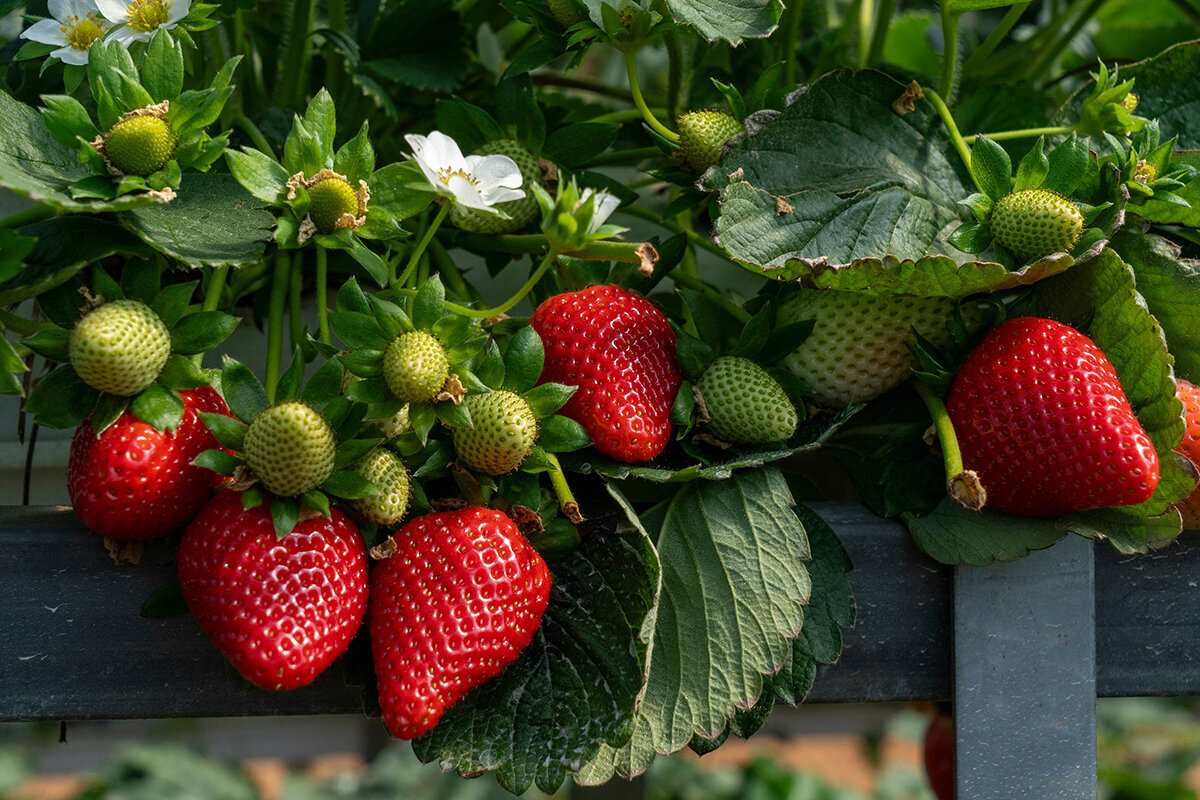
Not yetWhite shoulder
At its peakFull colour and fragrance
Past its peakSoft or dull
White shoulder: wait, because sweetness improves little after harvest. Even colour and fragrance: pick now, while the fruit is firm enough for the walk to the kitchen. Use soft, leaking or dull berries immediately – or remove and discard them if they collapse or become mouldy.
The short storage rail
Chill quickly, wash late.
Lay berries loosely, ideally in a single layer, in a shallow dish; bruises retain moisture and shorten storage life. After a brief rest in the shade, refrigerate them unwashed. Wash only immediately before eating. Greenhouse berries picked at their aromatic peak are finest enjoyed the same day, even though they may keep for several days when well chilled.
Yield expectations:A fixed kilogram figure per plant would be misleading. Variety, plant age, light, pollination, root volume, warmth, water management and harvest frequency all change the result. A small group of healthy everbearing plants usually rewards you not with an annual number, but with recurring fragrant handfuls.
11Calm answers
Greenhouse strawberry FAQ
Can strawberries grow in an unheated greenhouse?
Yes. An unheated greenhouse protects from rain and mainly extends the shoulder seasons in spring and autumn. It does not replace winter: watch night temperatures, protect pot roots in severe frost and water sparingly so the root ball does not dry out. Warm overwintering in weak light is usually less suitable than a cool resting phase.
How many strawberry plants fit in a home greenhouse?
Plan access, paths and air movement before maximum plant numbers. In pots or troughs, plants need about 25 to 30 cm spacing, plus room to water and pick. Ten accessible plants with air around them and reliable watering are generally more productive and healthier than twenty tightly packed, continually damp plants.
Should I remove the first flowers?
For newly planted everbearing strawberries, it can make sense to remove the first flowers for several weeks so crowns and roots establish securely. Once-bearing plants are often managed more cautiously while establishing because a strong crown is crucial for the later crop. With already vigorous flowering plants, however, their vitality matters more than a rigid rule.
Why are greenhouse strawberries small but sweet?
Small fruit may be typical of the variety, but can also point to incomplete pollination, a dry root zone, heat, insufficient light, crowding or a very heavy fruit load on a young plant. Check pollination first, then the consistency of watering and ventilation. Do not respond too quickly with more fertiliser.
How long do greenhouse strawberry plants remain productive?
When yield, fruit size or plant health noticeably decline, a fresh planting is sensible. In a protected home garden, regular renewal with healthy planting material is often easier and safer than keeping exhausted plants going for too long. Replace sooner if crowns weaken, disease recurs or the planting becomes so dense that hygiene and checking are no longer easy.
12Sources and further notes
Notes from advice, practice and plant health.
The German horticultural and plant-protection sources below informed this article’s growing guidance. For New Zealand-specific questions, current advice from relevant local authorities takes priority.
- Chamber of Agriculture: Strawberry-growing guidance
Fundamentals of cultivation, planting and harvesting in home gardens. - LfL Bavaria: Strawberries in the home garden
Variety groups, care, pollination and practical growing guidance. - LfL Bavaria: Plant protection in small gardens
Prevention, diagnosis and responsible plant-protection practice. - Chamber of Agriculture: Grey mould on strawberries
Botrytis, humidity, hygiene and preventive measures. - Berlin Plant Protection Office: Garden bulletin
Current guidance for recreational gardeners. - Chamber of Agriculture: Fertilising strawberries
Nutrient supply and restrained fertilising strategies. - Chamber of Agriculture: Strawberry growing compact
Additional information on healthy plantings and cultivation.
A Bloomcabin picking space
Reserve a sunny strawberry bench.
Give the season’s eagerly anticipated fruit a dedicated, orderly place: a bench of fragrant everbearing plants, a clean central path, a narrow irrigation line and roof vents ready before the first flowers open. The result is a space between kitchen garden and daily greenhouse ritual – for flowers, ripe berries and the short walk to the bowl.
Explore the classic aluminium greenhouseFor an overview of planning, equipment and material questions, also visit thealuminium greenhouse FAQ.
