
LED strips or spotlights under a pergola?
Pergola lighting
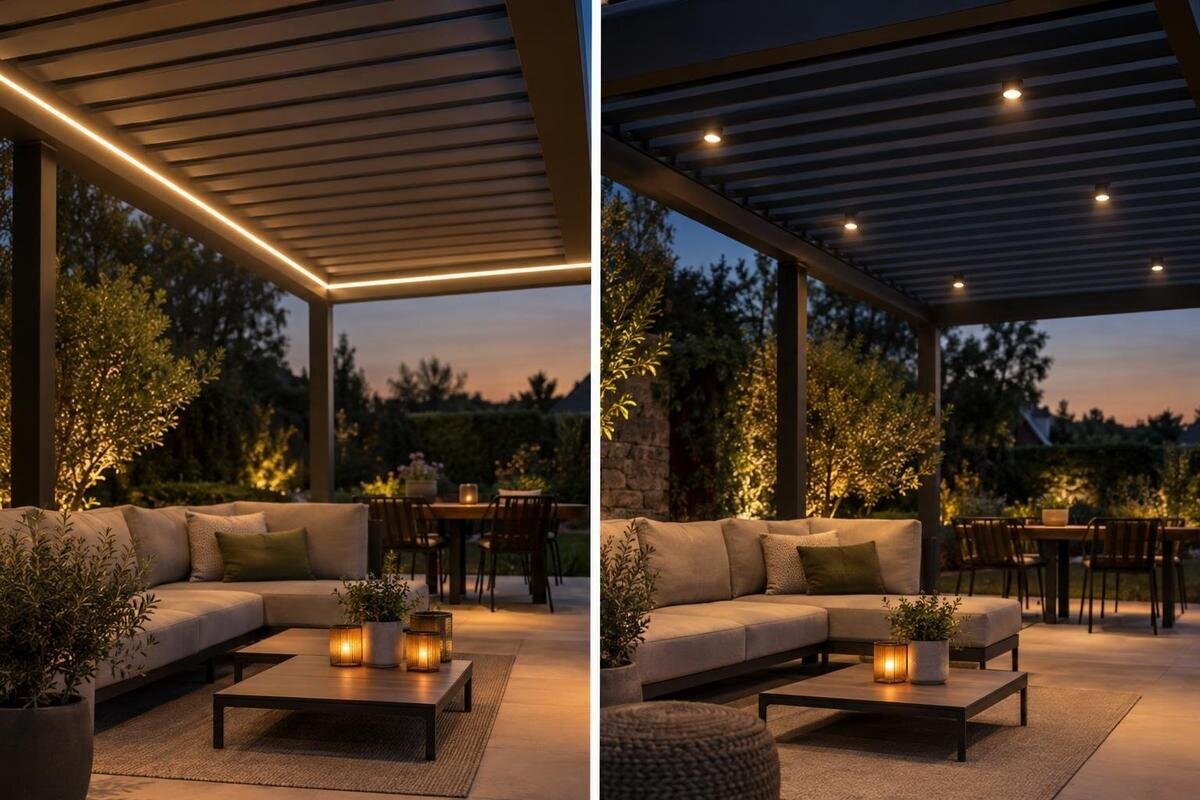
LED strips and spotlights can both work under a pergola, but they do not put light into a space in the same way. A strip gives a linear source along its fitting run; spotlights give separate beams that form individual pools. That affects coverage across a table or walkway, how visible the source is from a seat and how a fitting could be accessed for replacement. Compare documented layouts for the particular pergola, rather than deciding from the words ‘strip’ and ‘spotlight’ alone.

What to check before choosing 1
What changes when you choose a strip or a spotlight?
The core difference is the shape of the light, not the fact that both sources use LEDs. A strip forms a luminous line along its length. In a suitable, documented position, it can create a more continuous-looking band along an edge or beam, but useful light may travel down, sideways or onto the surrounding structure depending on its orientation, diffuser and optics. A spotlight is a separate source with a directed beam; several spots create individual pools that may overlap. Beam shape and spacing matter as much as the number of fittings. Neither type guarantees even coverage, a particular brightness or freedom from glare. Even a strip can produce a concentrated effect, while spotlights come in different distributions, so the exact fitting matters.
On a lighting plan, show a strip as a line and a spotlight by the area its specified beam covers. If the spotlight can be aimed, show its proposed direction as well. This is a starting distinction rather than a performance rule: gaps, structure and furniture alter the result. A continuous run is possible only where the approved mounting route allows it, and a row of spots may leave dark spaces or create overlap. When considering lighting for the Bloomcabin Pergola, first establish which fixture positions are supported for your chosen configuration. Those positions define the layouts you can meaningfully compare. A strip drawn along an unavailable mounting route is not a useful alternative to spotlights in supported locations.
Compare how the light spreads across the space
To compare coverage, draw each proposed light pattern over the same simple plan. A strip can follow a supported edge or beam, making the light follow that line; it does not necessarily spread evenly across the whole area below it. Orientation, lens or diffuser, distance from the surface and nearby structure affect how much output reaches a table or floor. A bright-looking line can still leave the centre of a seating area dim if its light is directed elsewhere. Conversely, a well-positioned strip may cover a long worktop or circulation edge without separate pools. These are possibilities to test against the fixture details, not guarantees attached to the strip format.
Spotlights concentrate light into separate beams, so check their specified spread and how adjacent beams relate. If they are narrow or spaced far apart, distinct bright patches and darker gaps may be more noticeable; wider distributions or closer spacing may overlap, depending on the exact fitting and position. For the Bloomcabin Bioclimatic Pergola, compare a strip layout and a spotlight layout using the positions available for that configuration. Ask for the expected coverage to be shown on the same drawing, with the table and walking route marked. This makes gaps and overlaps easier to discuss than a comparison based only on the number of lights or the apparent length of a strip.
What to check before choosing 2
Map the fittings against furniture and movement
Compare the places where you want light to land with the fitting positions documented for the pergola. Mark the usual table location, chairs when pulled out, the main path through the area and any nearby doorway or gate. Then draw the proposed strip run or specified spotlight beams over that layout. This can reveal a mismatch: a fitting might sit neatly on a frame member yet direct useful light away from the table, or illuminate seats while leaving the route between them dark. If the furniture moves or the area has more than one use, show both arrangements rather than designing around an empty footprint. A light that looks centred over paving can seem off-centre once the table is in place.
Pair an overhead sketch with an eye-level view. The first shows where light may fall; the second helps show whether the source sits in a seated person’s view. If you are considering the Bloomcabin Wall-Mounted Pergola, include the doorway and seats nearest the house in both views. Note where people enter and which direction they face when seated, without assuming the adjacent wall is an approved mounting surface. Keep the furniture positions consistent between the two views so you can relate coverage on the plan to the view from each chair. If the table has an alternative position, show that separately rather than combining two arrangements into one confusing drawing.
Check what the light source looks like from a seat
Glare depends partly on what people can see from normal seating and standing positions, not simply on whether the fitting is a strip or a spotlight. A strip may appear as a bright line if it is in direct view; a spotlight may appear as a bright point. A diffuser, reflector or other optical design can change the appearance, so avoid assuming that a recessed-looking position or a particular fitting type will solve the problem by itself. The viewing angle matters too: a source that is unobtrusive from one chair may be prominent from another.
Check the proposed arrangement from the places people actually use, including a seat facing the house and one facing outwards. Notice whether a fitting is directly visible or reflected in nearby glass or a shiny table surface. When comparing strip and spotlight layouts for the regular pergola, use the same seating positions for both options. Where possible, compare the exact fitting at its intended position and operating setting rather than relying only on a product photo. Record which seats have an uncomfortable view and whether the visible source is a whole strip, part of a strip or an individual spotlight. That gives the supplier or qualified professional a specific issue to address when revising the fitting or position.
What to check before choosing 3
When it makes sense to combine strips and spotlights
A mixed layout may suit a space where one light pattern does not cover all the areas you use. For example, a supported strip run might provide a line of light along an edge, while spotlights could direct light towards a particular zone, if the chosen fixtures and positions allow it. But adding a second type also adds more sources and positions to assess. If one well-planned arrangement already covers the table and the route to it, extra fittings may make the layout busier without solving a real problem. Compare the combined plan with each single-type option over the same furniture layout.
Availability and compatibility come first: do not assume the manufacturer supports both types on the same pergola or supplies them as a package. When considering lighting options for the bioclimatic pergola, ask which combinations are supported for the chosen configuration. Then explain the purpose of each part of the proposed layout: which area would the strip cover, and what would the spotlights add? If both serve the same area, compare their combined effect with either type used alone. If a combination is not supported, do not plan an improvised second row. Where moving roof parts or service access are relevant, check the arrangement against the exact instructions.
Check how the fittings will be controlled
The choice of fitting does not tell you how it will be switched or whether different types can operate separately. A strip and a row of spotlights might be controlled together, or a system might offer separate controls; neither arrangement should be assumed without checking the exact options. Decide what you want the lights to do in everyday use. For instance, would you use the strip without the spots, or would you always want both on together? The answer can affect whether a mixed layout is useful, not just how the fixtures look on a plan.
Ask whether the specific fittings support the controls you want, including any dimming or separate operation being considered. Confirm compatibility with the pergola’s documented system rather than assuming a light can connect to a motor, app or control already associated with the structure. Record the expected behaviour in plain terms and have a qualified electrical professional check the proposed system and manuals. This is a compatibility check, not an instruction to modify wiring. It helps avoid selecting a layout whose separate light patterns cannot be used in the way you expect.
What to check before choosing 4
Plan access for cleaning and replacement
A continuous-looking strip is not necessarily one continuous, replaceable part. Its construction and replacement method depend on the exact product: a section might be replaceable on its own, or the service approach may involve a longer run. A spotlight is a separate-looking fitting, but that does not guarantee its light source or other parts can be replaced individually. Before choosing, ask what replacement parts are available for the exact fitting and whether the manual describes access to them. Avoid basing a maintenance decision on appearance alone.
Consider how a person would reach each position for inspection, cleaning or approved replacement, and whether access would involve disturbing another part of the pergola. When comparing fitting access on the Bloomcabin Pergola, ask about the strip run and each spotlight position separately. A single answer about maintenance may not explain the access requirements of both layouts. Note any fitting near a moving component or difficult to reach from the ground, and ask what work the manufacturer’s instructions allow and who should carry it out. Include access to associated components in the discussion, not just the visible light source, so the comparison covers the proposed system rather than its appearance alone.
Check the outdoor rating for the exact location
A fitting being placed under a pergola does not automatically mean it is protected from the conditions at that position. Exposure can vary across the structure and with the way the space is used. Check the exact fixture’s documented outdoor rating and mounting instructions for the proposed location instead of relying on the broad description ‘outdoor light’. The fixture, its associated components and its specified installation conditions all matter; do not assume that a rating for one product or position applies to another.
Bring the actual fixture details and the pergola’s relevant instructions into the same conversation. A qualified electrical professional can assess whether the documented rating and mounting conditions suit the exposure at the intended position. If an exact rating, manual or mounting approval is missing, do not fill that gap by guessing from the appearance of the product. Outdoor suitability is a property of the specified fitting and installation context, not a general feature of LED strips or spotlights.

What to check before choosing 5
Confirm the pergola supports the proposed mounting positions
Choose from fixture positions documented for the exact pergola configuration; do not assume that any convenient beam, edge or roof section can take a light. The supported positions may depend on the model and its instructions. A proposed fitting must also be checked against any moving parts, service access or water paths identified in the relevant documentation. That is why it is better to confirm the structure first than to pick a fitting and then assume it can be attached wherever it looks suitable.
For mounting lights on the wall-mounted pergola, distinguish between proposed locations on the pergola and any nearby wall. The model listing is not approval to use either surface. Ask for documented mounting approval for the chosen position and exact fitting, and have a qualified professional check the proposed installation against the manuals. The drawing should identify the mounting location clearly enough that everyone is discussing the same arrangement. If the structure has moving roof elements, confirm that the location does not interfere with their operation. Do not infer support from images, another model’s options or the fact that a fitting is sold for outdoor use.
Compare both options on the same lighting plan
A like-for-like comparison makes the choice clearer. Use the same seating plan and mark only the fixture positions documented for the pergola. Draw the strip’s proposed run and the specified spotlight beams over the places where people sit, eat and walk. Compare where useful light falls, how the sources appear from seated positions and whether either plan leaves a noticeable gap. Then consider the number of fittings, the intended controls and how each would be accessed for maintenance. This is more informative than comparing a strip with a spotlight in isolation, because the position and optics shape the result.
For a final comparison of strip and spotlight options for the Bloomcabin Bioclimatic Pergola, keep the exact fittings and positions identified on each plan. Summarise the differences in coverage, the view from the seats, control behaviour and replacement access. Separate preferences from requirements: you may prefer the appearance of a line of light, but that preference does not resolve a gap over the table or an unsuitable mounting position. If both layouts meet your requirements, their appearance and everyday operation can guide the choice. If one leaves an important question unanswered, resolve that point rather than assuming strips are always softer or spotlights always more precise.
Frequently asked questions
Do LED strips give more even light than spotlights?
Not automatically. A strip can create a continuous-looking line, but its direction, optics, mounting position and interruptions affect where useful light falls. Spotlights can overlap or leave gaps depending on their beam spread and spacing. Compare the exact proposed layouts rather than relying on the fitting type.
Are LED strips less likely to cause glare?
No fitting type is automatically glare-free. A strip may be visible as a bright line, while a spotlight may appear as a bright point. Check the actual fitting from the places where people will sit or stand, and consider how its diffuser or optics affect the view.
Can I use LED strips and spotlights together?
Possibly, but only if the exact fittings and mounting positions are supported for the pergola. A mixed layout is useful when each type addresses a different coverage need; it is not automatically better. Confirm compatible controls and the proposed installation with the relevant manuals and a qualified professional.
Are spotlights easier to replace than LED strips?
There is no universal answer. A spotlight may be a separate replaceable unit, or its light source and other components may be integrated. A strip may be replaceable in sections or require a different approach. Ask about the exact replacement parts, access and service requirements before choosing.
Can any outdoor LED fitting go under a pergola?
No. A pergola does not necessarily protect a fitting from the conditions at its proposed location. Check the exact product’s documented outdoor rating and mounting instructions, and have a qualified professional confirm suitability for the exposure and approved position.
The better choice depends on where the supported fittings can go, how their light falls across the furniture and whether the sources are comfortable to see from the places people use. Strips can create a line of light; spotlights can create separate pools, but neither format guarantees the result on its own. Compare exact fixtures and positions, then confirm outdoor suitability, mounting approval, controls and replacement access. That gives you a choice based on the pergola’s documented options and the way the space is actually used.
