
Pergola Seal Replacement: Matching the Correct Profile
Pergola repairs and spare parts
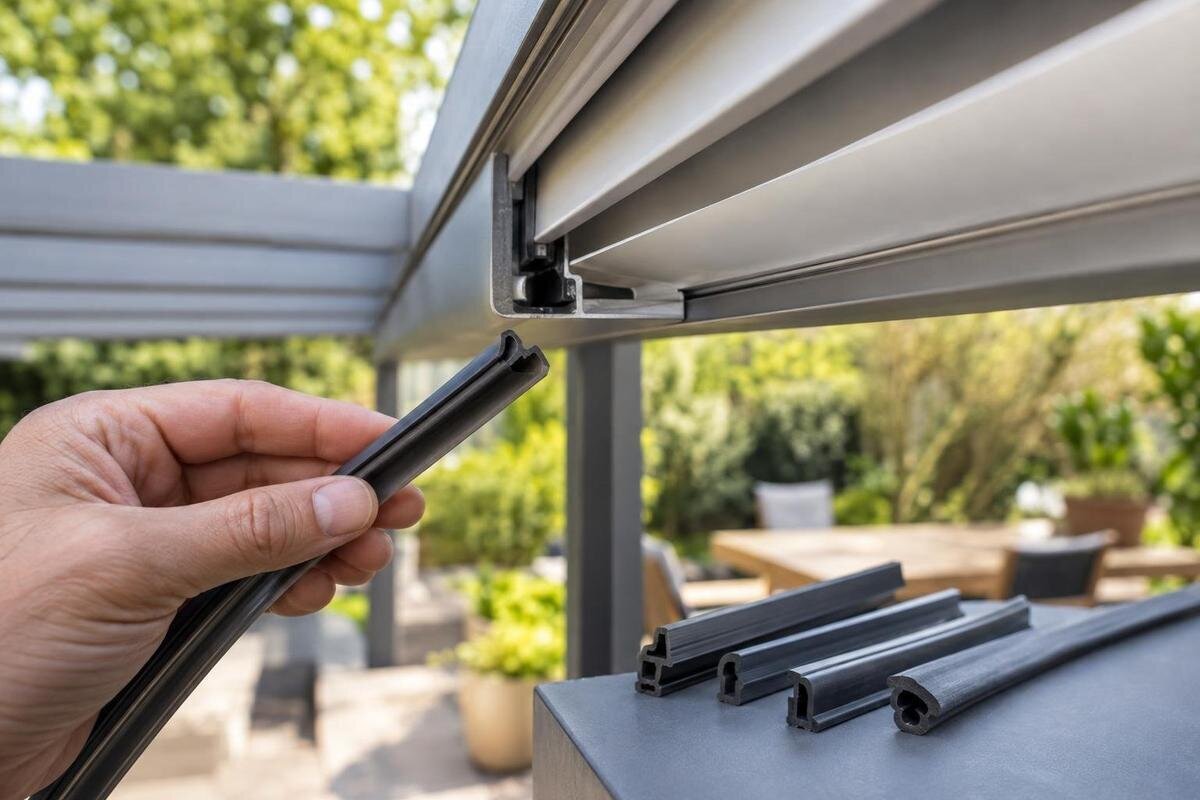
A replacement pergola seal can look deceptively simple: a flexible strip cut to length. But the crucial detail is its profile—the cross-section that sits in a particular channel and meets adjoining components. A strip with a similar appearance may sit loosely, fail to stay in place, interfere with a moving part or leave the original problem unchanged. The reliable way to identify a replacement is to record the pergola’s exact model, locate the seal precisely, compare its profile with the correct documentation and ask the supplier to confirm compatibility before ordering. This guide explains what to record, which photos help and why an arbitrary cut strip is a poor substitute.

Identify the pergola model and version
Begin with the manufacturer, full model name and any variant or configuration shown on the original order, invoice, product label or manual. Add the approximate purchase or installation date and any serial, order or product reference you have. These identifiers help a parts specialist distinguish a component intended for one system or revision from a strip that merely looks similar. The structure’s colour or overall size is not a substitute for its model identity. A description such as “the roof seal” or “the strip by the post” does not identify a part. If your records name the Bloomcabin Wall-Mounted Pergola, repeat that exact name rather than shortening it to “attached pergola”.
Keep identity details separate from observations about the seal. The model tells support which pergola you own; it does not, by itself, establish the seal profile, its location or the part number. Note whether the structure has been repaired or altered and whether the seal appears original, but do not guess why it has changed. If the invoice, product label and manual use different wording, copy each version and say where it came from rather than silently choosing one. If you cannot find a serial or product reference, say so. A legible photo of an accessible label can prevent transcription errors. A clear record of each identifier’s source is more useful than a confident but unverified model name.
Record exactly where the seal sits
Describe where the seal sits before discussing its shape. Use fixed landmarks: the side or end of the structure, the adjoining frame or panel, and whether the strip runs along a straight section, a corner or a joint. Depending on the pergola design, a sealing component may be associated with an edge, a meeting surface or a moving interface; do not assume a strip at one location is interchangeable with one elsewhere. People may use the same casual label for parts in different positions. The Bloomcabin Pergola product listing identifies a product name, but a parts enquiry still needs a precise location on your actual structure.
Make a location note that another person could understand without standing beside the pergola. For example, describe the side facing the house or garden, then identify the nearest post, beam, panel edge or other visible landmark. If the seal turns a corner, changes direction, ends against a cap or meets another strip, record that transition. Note whether it is on an inside or outside face if this is clear. Number locations on a simple sketch or in photo captions, without marking the structure. A single pergola can use more than one profile, and similar-looking sections may serve different joints. Never assume a seal running along one side continues around the whole perimeter in the same shape or length.
Describe the profile, not just the length
Profile means the seal’s cross-section: the shape you would see if the piece were viewed from its cut end. Describe what is visible, such as a flat or rounded face, a hollow or solid-looking section, a projecting lip, groove, channel or barbed edge. Record the channel opening and the seal’s width and depth only if they can be observed safely and measured without stretching or compressing it. Use millimetres and label what each measurement refers to; a number without an axis is hard to interpret. If only part of the profile is visible, mark that description as uncertain rather than filling in the missing shape. These observations help compare a drawing, but do not prove a match on their own.
Some features are difficult to see while a seal is installed, and wear can distort its apparent shape. A flattened lip, torn edge or stretched fragment may no longer show the original section, so avoid treating a damaged piece as a precise template. A measurement taken from a compressed seal may also differ from the dimension shown in a drawing. For a structure identified as the Bloomcabin Bioclimatic Pergola, ask for a profile drawing that applies to its version and the seal’s location. Compare the visible retaining edge and contact face with that drawing, noting any features you cannot see clearly. Length, colour and overall appearance can support the enquiry; none substitutes for the shape that retains the seal and meets adjoining parts.
Find the matching manual or drawing
Check the paperwork that came with the pergola before ordering. Look for the model name, parts list, assembly manual, technical drawing or service document, then note any drawing number, part code and revision or date shown. A parts diagram can help distinguish components that are hard to name from a photograph; use its labels and location together rather than picking the nearest-looking illustration. Search by the exact model wording and any product reference you have. Do not assume a general manual or a document for a current range applies to an older version. If the correct document is unavailable, ask the supplier or manufacturer for the relevant documentation instead of matching against an unrelated model.
If a product page helps confirm the wording in your records, the Wall-Mounted Pergola product listing is a naming reference only; it is not a spare-parts diagram or proof that a seal fits. In an enquiry, state which document you consulted and where the suspected component appears in it. Include the file title and page number so support can find the same reference. If the diagram shows several similar strips, ask for the precise item number and whether it applies to your model version. If no part code is printed, do not infer one from an illustration alone. A drawing from a different series can look convincing while describing a different channel.

Take photos that show the channel
Send a sequence of photographs rather than one tight crop. Start with a wide view that shows the pergola and the relevant side or bay, follow with a mid-range image showing the seal in its surroundings, then take a sharp close-up of the seal meeting its channel or adjacent component. Include both ends or a corner if the profile changes there. Photograph in even light and keep the camera square to the relevant surface where possible; an angled view can hide a lip or make a channel seem narrower. Check that the lens is clean and the detail is in focus before sending. If glare obscures the groove, take a supplementary view from another angle.
Place a metric ruler beside the component, in the same plane where possible, without pressing it into the seal. Include one image that gives scale and another close-up where the shape remains clear. Label files or captions by location—such as “house-side corner beside the post”—rather than “photo 1”. Keep the original image as well as any cropped copy, and do not draw over the profile in the only version you send. Group the photographs with your model details so they remain identifiable if forwarded separately from the enquiry. For the Bloomcabin Pergola, include that full name and any available order or product reference in the accompanying note.
Keep samples intact and measurements clear
Do not pull out an intact strip simply to obtain a sample. Removal may damage the seal, obscure its original position or require access you should not attempt. If a piece has already come free and can be handled safely, keep it whole and untrimmed; note exactly where it came from and which face or end was oriented towards the channel. Store it so it is not stretched, folded or mixed with another fragment. Keep separate pieces labelled by location, and do not scrape or cut one to make a neater sample. A loose piece without location information can be less useful than a clear photo of the strip still in place.
When measuring, state what you measured: exposed width, visible depth, channel opening or the length of the affected run. Place a ruler or suitable measuring tool beside the seal without pulling on it, and record the units. For a length, show the direction of measurement; an angled reading across a corner can mislead. A cut fragment’s length says little about its profile, and a rough measurement cannot confirm retention or compression. Label your measurement sketch with the model recorded in your paperwork, such as the Bioclimatic Pergola model, and the location shown in your photographs. Keep measurements from separate locations distinct rather than combining them into one set of dimensions.
Describe the problem without diagnosing it
Report what happens and where, rather than naming a failed part before it has been checked. Note any visible gap, displaced section, water appearing at a particular point, or difficulty closing or moving an adjoining component. Say whether the issue is constant or appeared after a particular event, if known, and whether it occurs at one location or several. If a maintenance visit or impact happened around the same time, include that fact without claiming it caused the problem. A leak or gap near a seal does not by itself show that the seal is the cause; drainage, alignment or a neighbouring joint may need assessment too.
Keep the description neutral: “water appears at the rear corner after rain” is more useful than “the corner seal is faulty” if no one has confirmed that. Avoid adding sealant, adhesive or a generic strip while the part is being identified; a change can conceal the original condition and complicate diagnosis. If more than one area is affected, number each location and use the same number in its photo caption. Keep the symptom notes with the product details—for example, the Wall-Mounted Pergola model—and distinguish what you observed from what you suspect. Photos taken before any work help support staff compare the reported problem with the seal’s position and visible condition.
Information to include in a seal enquiry
Make the parts enquiry easy to verify. Include the full model name and variant, any serial or order reference, approximate purchase date, location note, brief symptom description, and labelled wide and close-up photographs. Add the relevant manual or drawing number and your measurements, clearly marked as observations rather than confirmed part dimensions. If you have an intact loose sample, say where it came from and offer a photo before sending it. Keep the message concise, but label each attachment so support can connect it to the right location. You do not need to speculate about material, hardness or the manufacturer’s terminology; let the parts specialist identify the item against the evidence.
Ask for specific confirmation before ordering: the replacement’s part number or drawing reference, the profile it is intended to match, and confirmation that it fits your exact model, version and location. If only a generic description is available, ask for a cross-section drawing or for the supplier to compare your photos with the specified channel. Confirm whether the component is supplied to a stated length, whether a joining piece is separate and what installation method is recommended. Ask whether identification changes for a particular model revision if you are unsure. For the Bloomcabin Pergola model, state that exact name rather than relying on “standard pergola”.

Check the proposed replacement before ordering
Review the proposed part against the answer you received, not just its appearance. Check that the item reference belongs to the requested model and the seal’s stated position, and that the drawing depicts the same cross-section and retaining features you reported. If the supplier gives a length, confirm what it measures and whether it describes one run or a different quantity. Ask whether corners, end sections or connectors are separate parts where the drawing suggests a change in profile. A matching colour or similar-looking material is not evidence that the section will engage correctly. If the reply confirms only a broad style, send one clear follow-up question.
Be cautious of a generic strip described only by width, thickness, colour or an approximate trade name. Those details may narrow a search, but they do not show how a seal sits in its channel, where it contacts the adjacent part or whether it allows the assembly to operate as intended. If compatibility cannot be tied to your model and location, pause and request clearer documentation rather than trimming an arbitrary strip to fit. Do not treat a marketplace description or search result as confirmation. Keep the supplier’s written part reference with the pergola records so a later enquiry starts with an identifiable component, not a guess.
When seal inspection needs a professional
Some seals can be reached from ground level; others may sit where access involves a roof surface, working at height, panel removal or a moving mechanism. Do not climb onto a canopy or remove a component just to expose its cross-section. If identifying the part requires a ladder, dismantling, supporting a panel or working near powered components, leave that work to a qualified service professional familiar with the product. Follow the manufacturer’s service instructions, and do not attempt electrical work or adjust a mechanism as part of a seal enquiry. A professional can record the needed details using an appropriate method for the structure.
Stop the repair discussion and request an assessment if the frame or an adjoining part has shifted, a panel is cracked, fasteners appear loose, or the seal repeatedly comes out of its channel. A replacement strip will not correct movement or an issue in another component, and forcing one into place may create further damage. Share photographs from a safe position and describe what changed; do not test the structure by pushing, climbing or repeatedly operating it. If stability is uncertain, keep people clear of the area until it has been assessed. A professional can decide whether the seal alone is involved and how to identify it safely.
Frequently asked questions
Can I match a replacement by length alone?
No. Length tells you how much strip may be needed for a run, but not whether the cross-section fits the channel or meets the adjoining component correctly. Two seals can have similar visible widths and lengths yet differ in a retaining lip, depth or contact face. Record length as one measurement, then seek confirmation against the pergola model, location and profile.
Will a universal pergola seal fit?
Only if the supplier confirms that the exact profile is compatible with your channel and the seal’s position. A generic label or similar appearance is not proof of fit. Send the model details, location note, clear photographs and any drawing reference, and ask for a specific match before ordering.
Should I cut off a sample to send?
Do not cut an intact seal simply to make a sample. If a fragment has already come away and is safe to handle, keep it whole, untrimmed and labelled with its original location and orientation. An unlabelled piece may not identify the channel it came from; photos of the seal in place are often more informative.
What photographs help identify the seal?
Send a wide view showing which side or bay is involved, a closer view that locates the joint, and a sharp image of the profile meeting its channel. Include a metric ruler beside the seal for scale, without compressing it. Label the images by location and keep an original uncropped version.
Can I replace the seal myself?
That depends on its position and the manufacturer’s service method. If access requires climbing, removing a panel, supporting a component or working near a powered mechanism, use a qualified service professional. Do not dismantle parts or work on wiring to expose the seal. Ask for the approved procedure with the compatible part.
Correct identification is a matching exercise: the pergola model narrows the search, while the seal’s location, channel and cross-section establish what needs to be confirmed. A labelled photo set, an intact fragment if one is already loose, and a drawing or part reference give support useful evidence without altering the installation. Wait for confirmation tied to the exact model and position before ordering; if access or dismantling is involved, leave inspection to a qualified service professional. That is more reliable than cutting a convenient strip and hoping it fits.
