
Planning Pergola Installation at a Trading Business
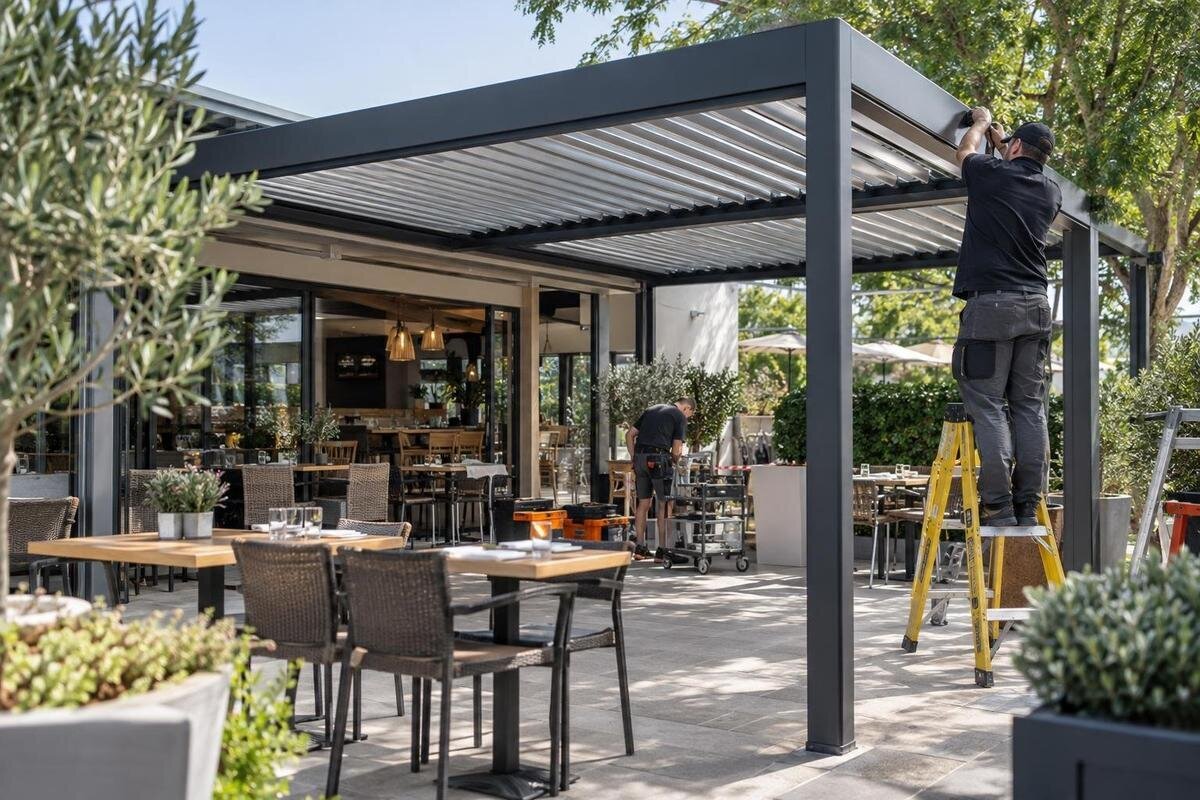
Commercial site planning
Keeping a trading business open through pergola installation requires more than choosing a start date. Contractor access, customer movement, stock deliveries, noisy work and any service interruption can affect different parts of the day. The useful planning document is a shared, dated programme that sets out the work zone, the business functions that must continue, who controls each interface and what happens if the sequence changes. It should be based on actual site plans and the operator’s requirements, not a generic assumption that an outdoor job will leave trading untouched.

Set trading requirements before booking dates
Begin with a short operating brief from the people who run the site, not with a calendar entry from the contractor. List the functions that must continue: customer entry and service, staff access, deliveries, stock movements, booked activities and any area that cannot simply be moved. Mark when each is most sensitive—opening, a regular delivery slot, shift change, scheduled meeting or peak service. This is a description of your business, not a guess about what counts as a quiet period. Ask each team lead to identify constraints the site manager might miss, such as a shared entrance or an internal route used to move stock.
Convert that brief into phases with dates or agreed time windows, a named lead and clear dependencies. For each phase, state what area contractors need, what the business expects to remain available, which route or service may change, and what must be completed before the next phase begins. Build in check-ins so the operator and contractor can compare the programme with conditions on the day. Installation day is too broad if delivery, preparation, assembly, checks and clean-up happen at different times. Use planning windows as assumptions, not guarantees, and ask what could alter them. Keep one controlled version, give it a version date and state who may approve changes. Share revisions with the people who make daily decisions rather than relying on a noticeboard or verbal update.
Map access routes on the current site plan
Use a current floor plan as a working document, then walk the site with the operator and contractor. Mark the proposed pergola footprint, business entrances, staff-only access, delivery gates, customer routes, shared areas and any existing path that needs to remain clear. Compare the drawing with conditions during a normal trading period: temporary seating, stored stock, queues or movable furniture can change the usable route. Note who manages each shared area and who can approve a temporary change. If you are considering the Bloomcabin Wall-Mounted Pergola, record that model alongside the proposed location so the operator and contractor are discussing the same option. Keep the product reference and the site layout together as the proposal develops.
Give every route a purpose and an owner. Separate the proposed paths for customers, staff, contractors and deliveries where the site allows; where routes need to cross, record how that interaction will be managed and who may change the arrangement. Note any temporary detour, its start and finish, signage or staff briefing, and how customers who need an accessible path will be directed. Fire and access arrangements depend on the actual site and applicable review, so ask the relevant qualified people to check the plan rather than assume a marked line is adequate. A route that works before opening may fail once queues form. Save a dated copy for daily briefings.
Define and manage the work zone
Draw the work-zone boundary on the site plan and describe what it means in practice: which areas contractors may enter, where tools or materials may be placed, and which business spaces are out of bounds. Ask the contractor to propose how separation will be maintained during each phase; an outline on paper is not a physical control. Mark the places that the operator expects to remain available, including customer entrances and any access or exit routes identified in the site review. Have the relevant site leads review these arrangements. Where the work zone meets a shared area, make clear who controls access on each side of the boundary. Review crossing points and gate access, not just the perimeter. The controls must reflect the actual site and work.
Include the boundary in the daily set-up and close-down routine. Name the person who checks it before customers arrive or a route reopens, and who can approve a change if the work area moves. Decide how separation is restored after breaks or shift changes. For a proposal involving the Bloomcabin Pergola, keep the selected product record with the work-zone drawing, while showing the contractor’s working area separately from the finished pergola footprint. Agree a response if a barrier moves, a delivery arrives early or a customer enters the wrong area: who stops the affected activity, controls access and informs the operator? Customers should not have to interpret an informal boundary.
Plan deliveries and storage around business access
Treat each delivery as a scheduled task, not an arrival the business will absorb. Confirm the vehicle approach, gate or access point, receiving contact, arrival window, unloading arrangement and route from drop-off to the agreed storage or work area. The contractor and operator should identify any point where a vehicle, pallet or carried component could affect customers, staff, neighbouring tenants or routine deliveries. Choose a slot that fits actual site patterns and confirm it with the people who control access. Check whether it overlaps with waste collection or another supplier’s access. Agree how the driver is contacted if the entrance is unavailable or the booking changes; a booked time is not permission to block a customer route.
Mark where materials, tools, packaging and waste may be held, and how that space will stay separate from the business’s own goods. Ask the contractor what area and handling arrangements the agreed scope requires. If your order is for the Bloomcabin Bioclimatic Pergola, use the current order and contractor documents to confirm package dimensions and delivery arrangements before allocating storage space. Decide who checks a delivery if that is part of the contract, who records a discrepancy and who arranges waste removal. Do not use a customer area for temporary storage simply because it appears vacant on arrival. A late or incomplete delivery needs an agreed resequencing or rebooking plan, not an improvised obstruction.

Schedule disruptive tasks and housekeeping
Ask the contractor to flag tasks likely to create noise, dust, vibration, odours or repeated movement through occupied areas, if any are expected in the agreed scope. Their timing matters as much as duration: a short activity during a key service period may be harder to manage than a longer task outside it. Compare the work sequence with the business calendar and mark meetings, customer peaks, deliveries and staff handovers that should be protected. Where suitable, sequence lower-impact preparation away from the busiest period. Agree in writing which tasks can move, what notice is needed and who may approve a change. Do not assume all outdoor work is unobtrusive or that one quiet window suits every business.
Schedule housekeeping rather than leaving it to the final day. Agree how often the work area and any shared route will be checked and tidied, where packaging and waste go, and how dirt or debris will be kept from being tracked into customer-facing areas. Give staff a clear way to report a spill, noise issue or blocked route, with a named person to respond; customer-facing staff should not have to negotiate technical changes with installers. When discussing a wall-mounted pergola option, ask the contractor to identify the site activities that could affect trading and include them in the programme. Let the operator approve any change to their timing, alongside the housekeeping arrangements needed before normal business use resumes.
Coordinate any interruption to site services
Ask for a service-impact list before dates are locked. The proposed work may not affect business services, or it may interact with lighting, power, water, communications, access controls or other site systems; the actual drawings and scope must establish which. Have the operator identify the services the business relies on and the relevant service specialist confirm any affected point. Record each anticipated interruption, its location and time window, who is responsible for the work, and who can authorise the change and restoration. Include shared systems used by another tenant or part of the site. Do not infer service requirements from a pergola model name or an outdated sketch.
Schedule any confirmed interruption as its own programme event, with preparation, notification, work, checks and an agreed return to service. Ask whether the business can operate during that window, whether a backup is workable and who decides if the work overruns. That matters if operations depend on payment systems, communications, refrigeration or controlled entry, but the operator should identify real dependencies rather than assume every example applies. Record whether suppliers or customers need notice. If you are considering the regular pergola model, include any confirmed service work in the project scope rather than leaving it outside the installation timetable. Only appropriately qualified people should determine or carry out service work, with the responsible site contact confirming the business is ready for the agreed change.
Give staff and contractors one clear communication route
Set a clear chain of communication before the first site activity. Name one operator contact and one contractor lead for daily coordination, with a backup for absence; give each person reliable contact details, authority limits and an agreed escalation route for a trading or safety concern. Decide who confirms the day’s work, who may approve a route change and who records a revised finish time. A brief at the start of each working day and a close-out update can keep changes visible. Contractors should not receive different directions from several staff members, while the operator should not have to chase separate trades to learn whether an area will reopen. Share the current programme and site plan, not mixed drafts.
Brief staff before work starts and whenever an agreed change affects their tasks or customer information. Keep the message practical: dates, affected entrance or area, permitted route, delivery change, service interruption, contact person and what to do if the arrangement is not in place. Let reception, service, facilities and delivery teams know what they need, and make sure each relevant shift receives the update. Keep the selected product, such as the bioclimatic pergola model, in the project record so staff handling contractor enquiries can identify it. Public notices should prioritise clear routes and timing rather than catalogue language. Avoid promising unchanged opening or service arrangements unless the operator has confirmed them. Give staff a way to report confusion from customers.
Complete site-specific reviews before work proceeds
Before confirming the programme, identify which project reviews or approvals are relevant to this site. Depending on its location, ownership and proposed work, input may be needed on planning, building, fire, access, structural, utility, landlord or shared-property matters; do not assume any applies or is unnecessary without checking. Use actual floor plans and a complete project description, and ask appropriately qualified local professionals or relevant authorities to assess matters within their remit. A product listing cannot establish whether a particular installation is suitable at a particular business. Confirm who is responsible for obtaining each response and when it is needed. Add a check date for any external response rather than relying on an unconfirmed assumption.
Put review milestones in the programme instead of leaving them as an informal pre-start conversation. Record who supplies drawings and site information, who reviews each interface, what decision or document is needed, and who confirms it has been received before the affected work proceeds. If the proposal includes a wall-mounted model, identify it in the project description alongside the actual location and scope to be assessed. Revisit the review if the location, supporting surface, access route or work method changes; a decision on an earlier drawing should not be treated as a decision on a different arrangement. List unresolved items as hold points with a named owner, and make clear which activities depend on their resolution.

Agree contingencies and change control
Build contingencies around plausible programme changes, not a vague note saying weather permitting. Ask the contractor what could delay or alter this specific work: an unavailable delivery, route conflict, unexpected site condition, outstanding service review or a task that cannot be completed in its planned window. Not every project will face each issue. For every relevant trigger, record who decides whether work pauses, whether another activity can move forward, how the business is protected and when the operator must be told. Agree a stop-and-review point for any change that affects an occupied route, work boundary or trading service, rather than waiting for an informal complaint.
Define acceptable alternatives before they are needed: shift a task to another time, keep an area closed longer, use a different agreed route or postpone the next phase. These options work only if the operator, contractor and relevant site reviewers confirm they are workable. Set a point at which an extension requires new staff or customer notices, and specify who updates the schedule and any affected third parties. Keep the confirmed scope for your Bloomcabin pergola project separate from options still under consideration, so a suggested alternative is not mistaken for an agreed change. If no option preserves the agreed controls, postpone the affected task. Document approved changes, including their time and cost implications, before proceeding.
Reopen the area through an agreed handover
Do not treat the contractor’s last installation task as an automatic reopening signal. Agree a close-out check that covers the work area, shared routes, entrances, waste and any services the work affected. The contractor should complete the items assigned in the scope; the operator or another named site lead can then verify that business-facing arrangements are back as agreed. If a route, barrier, surface or service needs further attention, keep the affected area under the agreed control and record who will resolve it. Name the person who can approve reopening in the programme, rather than deciding in a last-minute conversation.
Collect the handover information the contract actually includes: current drawings or changes, relevant product and installation records, maintenance responsibilities, outstanding items and a follow-up contact. Confirm which documents are supplied and by whom rather than assuming a standard pack. Update internal site plans and staff instructions so temporary works directions and obsolete instructions no longer remain in circulation. Close the programme with a brief record of what changed, what remains outstanding and who accepted each item. Record who has acknowledged the handover and where the latest programme is stored. Keep that record with the site’s operating information so the next manager or contractor can see the decisions rather than rely on memory.
Frequently asked questions
Can the business stay open during installation?
Possibly, but do not promise uninterrupted trading until the operator and contractor have checked the actual work area, customer and staff routes, deliveries and service impacts. If suitable separation or an agreed alternate route cannot be maintained, plan a partial closure or a different phase. Record what conditions would require work to pause.
What should the contractor programme include?
Include dates or time windows, daily activities, work-zone limits, access routes, delivery arrangements, disruptive tasks where relevant, service interruptions, named contacts, review points, contingencies and close-out responsibilities. Show dependencies and who can approve changes. Ask for a revised, dated version whenever the agreed sequence changes, so staff are not working from conflicting copies.
Who can approve a change to customer routes?
The operator should name the person authorised to approve changes to the live business arrangement, while the contractor manages its agreed work activities. Where fire, access or another specialist review applies, involve the relevant qualified people. Staff should not move barriers or create a new route on their own.
When should staff and customers be told?
Tell affected people before a route, entrance, delivery window or business service changes, using the timing agreed in the programme. Give staff enough detail to respond consistently. Keep customer notices direct: what is changing, when, where to go and how updates will be shared. Refresh notices promptly if the programme shifts.
What if work runs past the agreed window?
Contact the named operator and contractor leads, use the agreed contingency and update anyone affected. Keep an impacted route or service under its planned controls until the authorised person confirms a change. Do not ask staff to improvise a detour or reopen an area simply because trading pressure has increased.
An installation beside a trading business is easier to coordinate when each day’s work and the site’s operating needs are planned together. Keep the live site plan, agreed route controls, delivery windows, service notices, named contacts and change decisions in one current record. When conditions differ from that record, the operator and contractor can review the affected phase before the change reaches customers or staff. The close-out record then shows what was completed, what remains open and who owns the next action.
