
Choosing Pergola Louvres: Manual or Motorised?
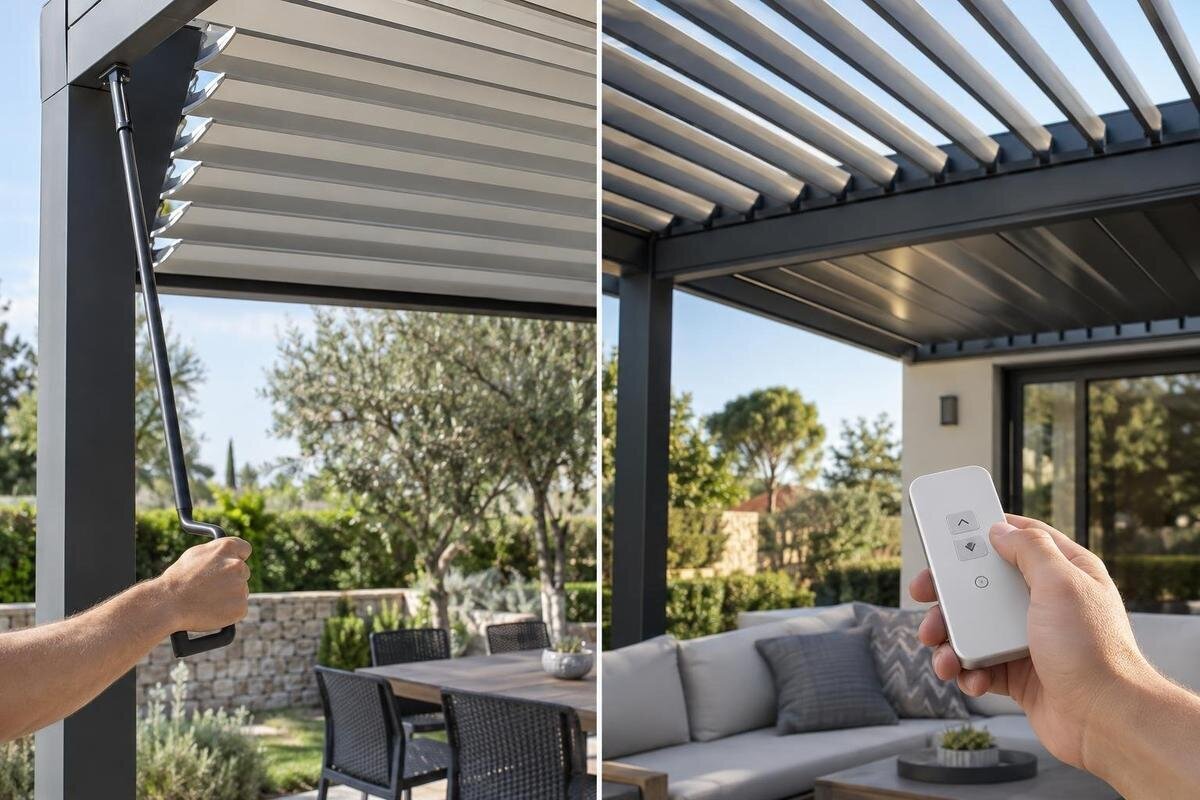
Pergola operating options
Choosing between manual and motorised pergola louvres is less about which sounds more advanced than about whether the control fits the way you use the space. A hand-operated mechanism asks you to reach and move the louvres; a motorised drive reduces that physical action but depends on the configuration’s power and controls. Think about how often you expect to adjust the roof, where the control will be and who needs to operate it. Then confirm the actual mechanism and included equipment for the model: a pergola’s name or appearance does not settle those details.

Manual or motorised: what the choice means
Manual and motorised describe how the louvres move, rather than defining every feature of the roof. With a manual arrangement, you operate a hand mechanism; with a motorised one, a powered drive moves the mechanism when a user activates a control. Either may let you change the mix of shade and open sky, subject to the design and its instructions. A motor does not, by itself, mean that a sensor, schedule, phone app or self-closing function is included. Likewise, choosing manual control says nothing about the roof’s permitted weather positions. Treat operation, roof performance and added controls as separate questions, each requiring its own product information.
The available catalogue identifies a regular pergola, a bioclimatic pergola and a wall-mounted pergola. These product names do not establish whether a particular configuration is hand-operated or motorised, or what controller is supplied. The Bloomcabin Pergola model page is one place to identify the regular product, but confirm its operating arrangement in the relevant specification, manual or written supplier response. If that detail is not stated clearly, do not infer it from a picture, the product category or the word “bioclimatic”. Compare only configurations for which you can establish what will actually be supplied.
When manual louvre control is practical
Manual operation is easiest to judge by picturing the actual action, not simply noting that there is no motor. You may need to stand at a particular point, reach a handle or crank, and make a series of movements to change the louvre angle. The effort, direction of movement and clearance required depend on the mechanism and the roof layout; not every hand control feels the same. Ask for a demonstration or operating instructions so you can check the grip, turning space and movement path. Consider whether a wall, post, planter or outdoor furniture could obstruct the control once the space is set up. A roof-only photograph will not answer those practical questions.
Manual control can suit a household that adjusts the roof occasionally and can approach the mechanism comfortably. It avoids using electrical power for that movement, although separate lighting or accessories may need power. Do not assume a hand-operated system is automatically cheaper, more durable or maintenance-free; those details depend on the actual design and terms. When comparing the Bloomcabin Bioclimatic Pergola product page with other options, ask specifically about the operating action rather than relying on the model name. Find out whether a hand control is included and where it sits. During a demonstration, consider the whole adjustment, from approaching the control to leaving the louvres in the position you want.
What motorised louvre control changes
A motorised system is worth considering if you expect to change the louvres often, or if walking to a hand control each time would interrupt how you use the outdoor area. Using a control instead of repeatedly moving the mechanism by hand can make small adjustments easier to fit around a meal, changing sunlight or a shift from one activity to another. That is a convenience comparison, not a promise that a particular motor is faster, quieter or more precise; such details vary and need a demonstration or product documentation. Try the actual control, if possible, from the positions where you plan to sit or stand. Also check whether the user has to remain at the switch while the roof moves.
Motorised does not mean automatic. A powered system may still need someone to use a switch, remote or other controller whenever the louvres are adjusted, and the control type must be specified. Sensors, app control, timers and responses to wind or rain are separate functions unless listed for the exact configuration. Ask whether the motor and controller are included, whether any extra parts are needed, and how the user starts and stops movement. If unattended operation matters, get a clear explanation of the trigger, what the system does and any stated limits. That separates a useful powered adjustment from a claim of full automation.
How often will you adjust the roof?
Think about a normal week, not an ideal day: how often would you genuinely alter the roof position? Someone who sets it once and leaves it there may find manual operation acceptable, provided the mechanism is easy to reach. Someone who responds to changing sun, shade or airflow several times during an afternoon may appreciate a powered control. The number of adjustments is only part of the decision: even an occasional change can be inconvenient if the control is awkward, while regular use may be fine if the action is simple and accessible. Picture actual occasions—morning coffee, lunch or evening dining—and whether you would be likely to make the effort to adjust the roof.
Consider who will use the pergola as well as how often. If one person opens it and someone else closes it, both need to know how to use the control and be able to reach it. A motorised control helps only if its location and operation suit those users; a manual mechanism needs to be usable by the people expected to move it. When comparing the regular pergola listing with other models, describe your household’s likely use: who makes adjustments, from where and at what times. If guests also use the space, consider whether a first-time user can understand the control without guesswork. This gives you a practical basis for comparing operating arrangements rather than assuming every household will use a powered roof more often.

Check reach and control placement
Map where you are likely to operate the louvres: at the outdoor table, beside a doorway, from a seat or while moving between indoors and outside. A manual handle may be fixed at one point, so check the route to it and the space needed to work it. For a motorised system, find out where the switch or included controller will be placed. If a remote is offered, check its stated range rather than assuming it will work from every seat or through every wall. Make allowance for chairs, screens, planting and doors that may block access. An arrangement that looks straightforward on a plan can become awkward once the patio is furnished.
Wall-mounted and freestanding layouts can result in different control locations, but the mounting label does not tell you where a handle, switch or cable will end up. Review an installation drawing or ask the supplier to mark the operating point on your layout before furniture positions are fixed. If a wall or opening constrains the route, confirm access from the side you will actually use; do not assume the control is reachable from indoors. When discussing the Bloomcabin Wall-Mounted Pergola product page, use a sketch showing the doorway, seating and intended operating point. This lets you discuss the proposed arrangement in relation to your space, rather than trying to judge access from a product photograph.
Plan for power and outages
Power access needs to be considered before choosing a motorised louvre system. Find out what supply the specified motor and controller require, where the connection point needs to be, and which electrical parts are included in the configuration. Those details should come from the manufacturer’s documentation, not a general description of motorised pergolas. Ask a suitably qualified electrician to assess the proposed connection and route for your site; do not infer wiring requirements from another model or a photograph. Have the conversation while the outdoor layout is still being planned, so the preferred control point and electrical route can be considered together. If a suitable power arrangement is not practical, compare a confirmed manual configuration rather than assuming a motor can be added later.
Ask what happens if power is interrupted, and get an answer for the exact mechanism. A system may have a manual override or another means of moving the louvres, but do not assume that it is included; another design may simply stay where it was. If an override is provided, ask where it is, how it is used and whether you can reach it in the proposed layout. Keep this question separate from normal powered operation: an accessible switch does not establish access to an override. For the model shown in the wall-mounted pergola product details, record the outage procedure alongside the power requirements. Understanding what you can and cannot do without power helps you compare the operating arrangements on equal terms.
Controls are not the same as automation
List the controls you would actually use, then verify each one against the product information. A wall switch, handheld remote, app or smart-home connection may be available on some systems, but none follows automatically from having a motor. Check what is included, whether extra equipment is required, how many people can operate the system and whether different roof sections need separate controls. If more than one control type is offered, ask for a demonstration and notice what happens when the user presses, holds or releases it; behaviour can differ by design. Avoid choosing on the word “remote” alone: range, pairing and compatibility are product-specific and should be confirmed.
Keep automated features separate from ordinary motor operation. A sensor reacting to sunlight, wind or rain, a timer or an app-based routine is part of the offer only if documentation names it for the exact configuration. Confirm what the sensor detects, what action it can trigger, whether it depends on a separate controller or connection, and how a person can override it. Do not assume the roof will close itself when conditions change. The bioclimatic pergola product listing should be read for what it actually specifies, not taken as evidence that sensors or smart controls are included. A written list of included and optional controls prevents a basic powered system being mistaken for a fully automated one.
Weather performance is a separate question
How the louvres are operated is not a measure of the roof’s weather performance. A powered drive does not make a roof more weatherproof, and manual operation does not establish that it is less capable; either claim needs evidence for the specific product. Check the documentation for the available louvre positions, the conditions in which the manufacturer says to operate or leave them, and any stated limits. Also separate the roof’s ability to provide shade or manage rain from the control that moves it: one feature does not establish the other. If drainage or protection from a particular exposure matters to you, ask about those performance details directly rather than treating the operating method as an answer.
Ask how the instructions expect you to respond when conditions change and you are away. If the manufacturer specifies a louvre position for particular conditions, understand how the chosen control lets you reach it and whether the guidance assumes someone is present. With manual operation, the user makes any adjustment the instructions call for; a motor helps only if it can be operated and has power, unless documented automation provides the relevant response. Avoid leaving the roof in a position based on generic advice for another pergola. Follow the instructions for the exact model and ask the supplier about situations they do not address, especially if the roof’s permitted positions are not clear.

Compare exact configurations
Compare complete, named configurations so you can tell whether differences concern the roof itself, its operating mechanism or optional controls. Ask the supplier to state plainly whether the louvres in the version you are considering are moved by hand or by a motor, what component moves them and what control is supplied. Use the Bloomcabin Pergola overview to identify the regular model, then record the version being quoted beside its operating details. If two options differ in more than their controls, note those differences separately. Otherwise, a comparison presented as manual versus motorised may actually involve different equipment or roof arrangements, making it difficult to judge what accounts for the difference in the offers.
A comparison sheet can include the mechanism, controller, power requirement, control location, optional sensors or automation, user instructions and support. Mark each point as included, optional, not offered or not yet confirmed; silence on a product page is not a specification. Ask for the same information in the same format for each model. Request the manual before purchase if ordinary operation or weather instructions are unclear, and check that it matches the configuration you want rather than a similar-looking roof. If a product image shows a controller or a feature described elsewhere, confirm that it is supplied with your version. A precise written answer keeps the choice tied to what you will receive, not a broad product description.
Include support and upkeep
Include support and upkeep in the comparison without assuming either mechanism is maintenance-free. A manual system still has moving parts, while a motorised one adds powered components; care, service access and replacement-part arrangements depend on the design. Ask what maintenance the operating manual assigns to the owner, whether the motor or controller has separate service guidance, and who can help if the louvres stop responding. Get the applicable warranty and support terms for the exact product in writing; do not infer them from another model or from the presence of a motor. Compare the responsibilities involved in keeping each system usable, not just the convenience of moving the roof by hand or with a powered control.
Make the support enquiry specific to the operating parts you are considering. For the Bloomcabin Bioclimatic Pergola model page, ask which mechanism and controls the support information covers, and whether enquiries go through the supplier, installer or another service provider. Find out what information you would need to identify the configuration when requesting help. Also check whether the proposed layout leaves the access required for the maintenance described in the instructions; furniture and screens should be considered in that discussion. Keep the operating instructions, configuration details and support contact together so another household member can find them. This adds a practical ownership comparison to the initial choice between manual effort and powered convenience.
Frequently asked questions
Are motorised pergola louvres automatic?
Not necessarily. Motorised means a powered drive moves the louvres; you may still need to operate a switch, remote or other control. Sensors, timers and app-based control are separate features, so check whether they are included with the exact configuration.
Do manual louvre controls need electricity?
The hand-operated movement itself does not need electrical power. Other items, such as lighting or accessories, may still need a supply, so check the details for the whole pergola configuration.
Can I adjust louvres in the rain or wind?
There is no universal answer for every pergola. Check the operating instructions for the exact model, including any stated positions or conditions for using or leaving the louvres.
Can a motor be added to a manual pergola later?
Do not assume it can. Ask the supplier whether the mechanism and exact configuration support a motor, what power arrangement is required, and whether the work needs a qualified professional.
Does a wall-mounted pergola have motorised louvres?
The mounting arrangement does not tell you how the louvres are operated. Confirm whether the version you are considering is manual or motorised and which controls are included.
The right choice is the one that feels practical in your everyday setting. If you make few adjustments and can comfortably reach the mechanism, manual operation may be enough. If you expect frequent changes, a motorised system may be more convenient—but only when its power, controls and support arrangements work for your site. Let the documented configuration, not the model label, settle the comparison.
