
Pergola Louvres in Strong Winds: Open or Closed?
Pergola weather guide
Whether pergola louvres should be open or closed in strong wind is a model-specific operating question, not a general rule. The roof’s design, installation and any side screens or panels can affect what the manufacturer allows. A position that is appropriate for one pergola may not be right for another, and changing the roof once gusts have picked up may have its own limits. Use the instructions for the exact model and configuration, then check what the wind evidence actually covers.
Documents to request before buying 1
There is no universal open-or-closed rule
“Strong wind” describes the weather; it is not a standard operating threshold for every louvred roof. One manual may give an operating limit or required roof position, while another may set conditions without specifying one simple number. The term can also be used loosely, without saying whether it refers to gusts, sustained wind or a particular exposure. A forecast warning cannot tell you by itself whether a specific roof is safe to adjust or which angle to choose. The relevant answer is what the model’s instructions say for the conditions and configuration you actually have. If the manual defines a measure, use its definition rather than translating it into a general weather alert.
A visual guess does not settle it either. A roof that looks more open may seem to present less surface to the wind, while a closed roof may look more secure, but appearance cannot show which state the designer allows. Louvre geometry, joints, support arrangements and mechanisms differ. Partial positions can have their own instructions rather than sitting halfway between two approved settings. The manual may describe positions in words, diagrams or angle ranges, so match its description to the actual roof. Treat open and closed as model-defined settings, not universal safety choices, and do not copy advice from a pergola that merely looks similar.
How louvre position affects wind exposure
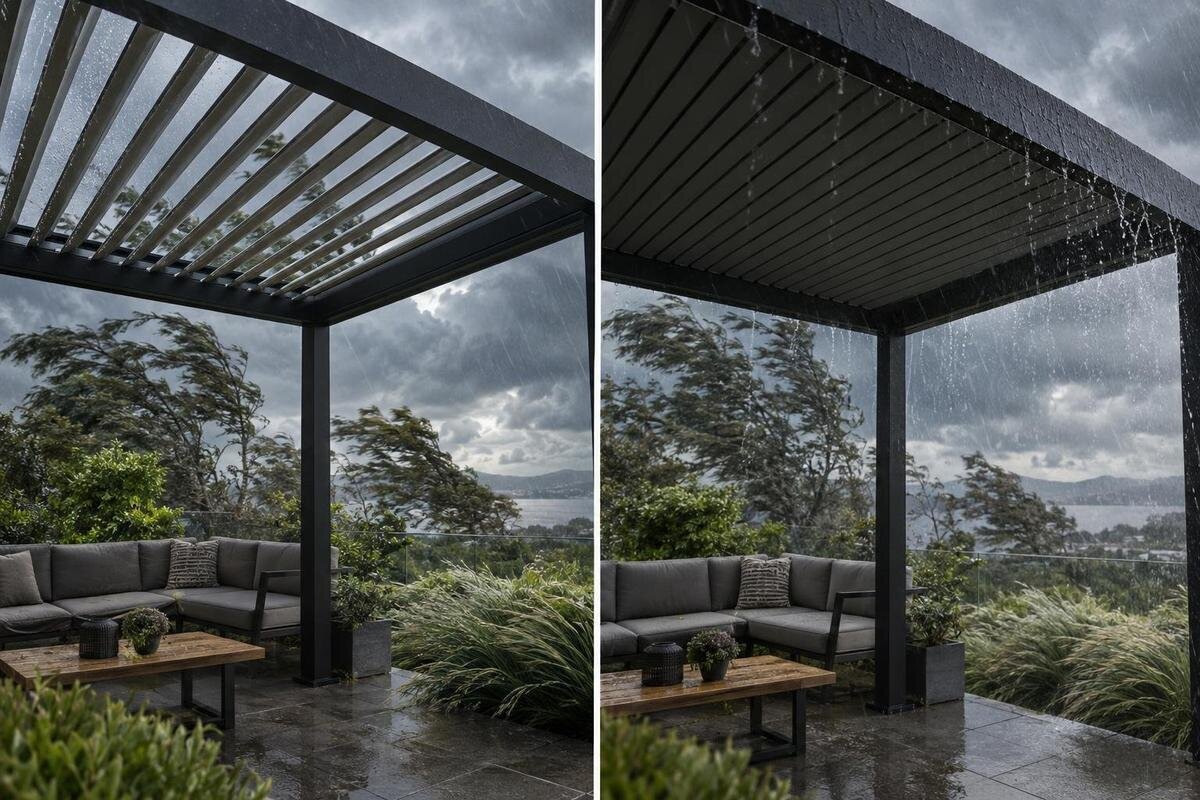
Wind interacts with a louvred roof through its shape and gaps. As the blades rotate, the area presented to the air and the paths between blades change. A closed position does not mean the roof is free of wind force, and an open position does not automatically mean it is unloaded. Depending on the design, a partly turned blade can be a distinct configuration, with different effects on the roof and its mechanism. Moving parts may also have limits separate from the way the roof behaves when stationary. These general principles explain why a manufacturer may specify a position; they are not enough for an owner to calculate one by eye.
Direction and turbulence matter too. Air reaching a pergola may be altered by nearby buildings, a boundary wall, trees or the wider site, and gusts can change quickly. The angle at which wind meets the blades matters, not just a broad description such as exposed. A controlled observation therefore cannot simply be carried across to a different installation. A catalogue entry such as Bloomcabin Bioclimatic Pergola product page helps identify a listing, but its name alone does not answer the wind question. If instructions do not cover louvres already part-way open, ask for clarification rather than assuming that a new angle is safer.
Documents to request before buying 2
A wind rating may not be an operating limit
Look for the exact meaning of any wind figure. A document may describe a structural design or resistance condition, while the operating instructions set a separate limit for moving the roof or specify a position as wind rises. Those answer different questions. A structural rating does not automatically mean the roof mechanism can be operated at that wind level, and a figure without its scope cannot be applied to every louvre angle, enclosure or site. Ask the supplier or manufacturer to identify the document behind the figure and explain what it covers before treating it as practical operating advice.
Check the units and conditions attached to the statement, but do not turn a number into a do-it-yourself trigger unless the manual explicitly tells you how to use it. Look for whether it refers to gusts or another defined measure, what test or installation set-up it covers, and whether it concerns operation or the assembled structure. A page such as the Bloomcabin Pergola listing can help you name the product when asking, but it is not a substitute for wind documentation. A wind statement does not by itself establish that the roof is watertight or suitable for snow.
Read the operating instructions before moving the roof
Use the operating manual matched to the exact model and version, not a general leaflet for a product family. Find the sections on wind, adverse weather, roof positions and operating limits. They should explain, where applicable, which position is required before high winds, whether movement is permitted once a stated condition is reached, and what to do if the wind increases while the roof is partly open. Check the manual’s revision as well as its title. If you have only a quick-start sheet, ask for the full instructions; if the wording is vague, put the unanswered questions to the supplier or installer.
Read any instructions about controls or automatic responses without assuming that a feature is fitted. If the manual refers to a sensor, operating mode or other control, confirm that the system supplied with your pergola includes it and understand what the instructions say it does. Do not try to work around a warning by forcing the mechanism or repeatedly operating a control. When enquiring about the bioclimatic pergola catalogue entry, ask for the full operating guide that matches the version being supplied. Distinguish instructions for an automatic response from actions the owner must take, and ask about any wording that leaves that responsibility unclear.

Documents to request before buying 3
Match the advice to the installed configuration
A manual or wind statement applies only within the scope it describes. Confirm the exact model and size, whether the arrangement is wall-mounted or freestanding, and any other configuration details in the documents. How a pergola is fixed and the surfaces around it can affect the way wind reaches it; this is not something to resolve by comparing pictures or copying a neighbour’s roof position. A wall-mounted arrangement also depends on the specified mounting details. Do not transfer a rating or operating instruction from a different base, attachment type or installation without checking that it applies.
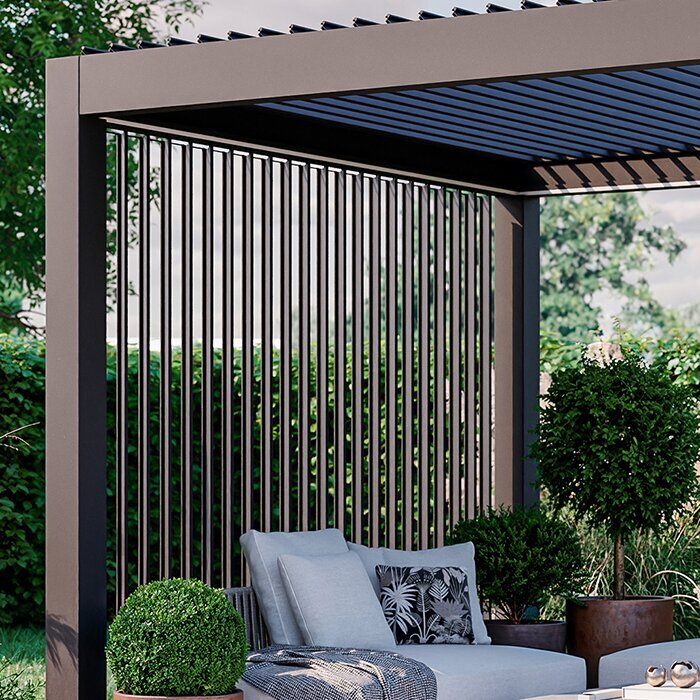
Record any side elements as well. Screens, curtains, sliding panels or glazing can change wind exposure, and advice for a roof without those elements may not cover the same arrangement. Do not assume that closing the sides makes the roof safer, or that removing them does. Confirm which combination the documents address. The Bloomcabin Wall-Mounted Pergola page can help identify a listing, but its name does not prove that a particular wall, fixing, enclosure or wind limit is suitable. Get the intended configuration confirmed for the pergola being installed, with site-specific questions referred to a qualified installer or other appropriate professional.
What controlled wind observations can tell you
Controlled observations are useful when they describe the conditions, rather than offering a bare verdict such as stable in wind. Look for the roof position, wind direction and recorded conditions, the installation arrangement, and any screens or other elements included. Find out what was actually observed: movement of the louvres, operation of the mechanism, water behaviour or another outcome. Ask who produced the record and which model it concerns. An observation about one set-up is not automatically a rating or a guarantee for a different installation, position or combination of accessories.
Check what the evidence was intended to establish. A report about structural behaviour does not necessarily tell you whether an operator may move the louvres in those conditions; a demonstration of movement does not establish performance in every wind direction. If you are looking at the regular pergola listing, ask for evidence that identifies the relevant model and configuration. Read the reported outcome alongside the conditions under which it was observed, rather than treating a successful demonstration as an instruction to operate the roof. A useful report states its scope and limitations, so you can distinguish its findings from questions it leaves unanswered.
Documents to request before buying 4
Keep drainage and wind advice separate
Strong wind can arrive with rain, but a drainage drawing answers a different question from a wind operating instruction. Use the model’s diagram to understand the intended route from the roof through its channels and outlets, and check which roof position the drawing refers to. It can help you see where water is meant to go; it cannot tell you which angle is approved in strong wind, how the roof will behave in that wind, or whether rain will stay out at the sides. Check that the diagram matches the model you are considering.
Ask how the weather guidance applies when wind and rain coincide. A position recommended for one condition should not be assumed to meet the other, and a drainage route is not a promise of a watertight enclosure. If screens or panels are part of the planned set-up, confirm whether the relevant documents address them. Read any rain-related roof-position advice alongside the wind instructions, and ask which instruction applies if the two appear to conflict. Keep any separate snow advice distinct as well. The practical question is how to follow the guidance for combined conditions, not how to infer a wind setting from a water-flow diagram.
Documents to request before buying
Ask for a document pack tied to the exact product identifier and intended configuration. A practical checklist includes the current operating manual, with wind warnings and permitted roof positions; wind-performance information that separates operating limits from structural information and explains its scope; and an installation or configuration drawing showing the arrangement to which the advice applies. Ask for document titles or revision details as well, so you can check that the instructions supplied with the pergola match the ones you reviewed. If a key document is not available, ask when and how the operating guidance will be provided.
Also request any controlled observation or test record supporting the wind guidance, with its conditions and limitations, and a drainage diagram if rain performance matters to your decision. Ask whether the documents cover the exact louvre position, wall-mounted or freestanding arrangement, and side elements you intend to use. If the product you are considering is the wall-mounted pergola listing, use its name to identify the model in your enquiry, then request the corresponding instructions. Keep the replies with your quote and handover paperwork; a product title alone does not confirm the installation or wind advice.

Documents to request before buying 5
If strong wind arrives before the setting is clear
If the wind is already rising and you cannot find a clear instruction, do not guess, force the blades or try a manual override. Moving the roof may itself be restricted once conditions pass the model’s operating limit, so a late adjustment is not automatically the safer choice. Do not climb on the structure or brace it with improvised supports. If it is not safe to reach or operate the controls, stay clear and wait until conditions allow you to seek model-specific advice. Having the manual accessible before unsettled weather is a more useful plan than searching for a setting during a gust.
If the manual clearly gives an action for the current conditions, follow it only if the instructions permit operation and you can do so without entering an unsafe area. If the roof moves unexpectedly or is visibly damaged, keep people clear and contact the installer or manufacturer when conditions allow. When seeking support for a product shown on the Bloomcabin Pergola catalogue page, give the installed model, its configuration and the roof’s current position. Explain whether your question concerns leaving it stationary or moving it, so the response addresses the actual uncertainty. Avoid relying on a neighbour’s setting or an online anecdote.
Wind guidance when buying and at handover
Compare the clarity and scope of the documents, not a single impressive-sounding wind figure or a photo of louvres at one angle. A useful answer identifies permitted positions, the conditions for moving between them, and the configurations covered. If those points are missing or contradictory, ask for clarification before choosing. Where the answer depends on a site detail, have an appropriately qualified professional confirm the intended arrangement. You are choosing both a roof and the instructions for using it, so you should be able to understand the wind guidance before the pergola is installed.
At handover, keep the manual, weather-performance documents, configuration record and drainage drawing together. Make sure anyone who may operate the pergola knows where the wind instructions are, and record the installed model and accessories rather than relying only on a broad product label. If the listing you are comparing is Bloomcabin’s bioclimatic model listing, request documents that identify the exact version being supplied. Use the handover to resolve any differences between the configuration you discussed when buying and the one recorded for the installation. This gives everyone using the controls the same model-matched instructions for roof position and movement in windy weather.
Frequently asked questions
Should pergola louvres be open or closed in strong winds?
There is no universal setting. Follow the operating instructions for the exact model and configuration, including which position is permitted and whether you may move the roof once wind has risen. If the guidance is missing or unclear, do not guess.
Is a closed roof always safer than an open one?
No. Wind acts differently depending on the louvre design, position, installation and site conditions. A closed or open roof is not automatically the safer choice; use the position specified in the model’s instructions.
Can I move the louvres after the wind has picked up?
Only if the operating instructions allow movement in those conditions. If the limit or procedure is unclear, or it is unsafe to reach the controls, do not force or override the mechanism. Wait until conditions allow you to get model-specific advice.
Does a wind-resistance figure mean the pergola is waterproof?
No. Wind resistance, limits for operating the roof, drainage and protection from rain or snow are separate matters. Check what each document actually covers rather than applying one rating to other conditions.
What documents should I ask for before buying?
Ask for the exact model’s operating manual, wind-performance information with its scope and test conditions, and installation or configuration details. Request any relevant observation or test record and a drainage diagram if rain performance is part of your decision.
Do not choose open or closed by rule of thumb. The right position, and whether it may be changed once the wind has picked up, comes from the operating instructions for the exact pergola and its configuration. Confirm what any stated wind limit means, whether the evidence covers the installed arrangement, and how rain guidance relates to roof position. If the documents do not answer those questions, seek model-specific clarification rather than improvising a setting.
