
Pergola Louvres That Rotate or Retract: Key Differences
Pergola roof systems
Pergola roofs described as louvred can move in two quite different ways. Rotating blades pivot to change their angle while staying over the same roof area; retractable elements move aside to uncover more of the opening above. That distinction affects the amount of open sky, the shade pattern and what you need to confirm about rain, controls and upkeep. A product label or photo alone does not establish how a particular model operates. This guide separates the mechanisms and explains how to read model-specific drawings without assuming that Bloomcabin offers both types.
How rotation and retraction differ
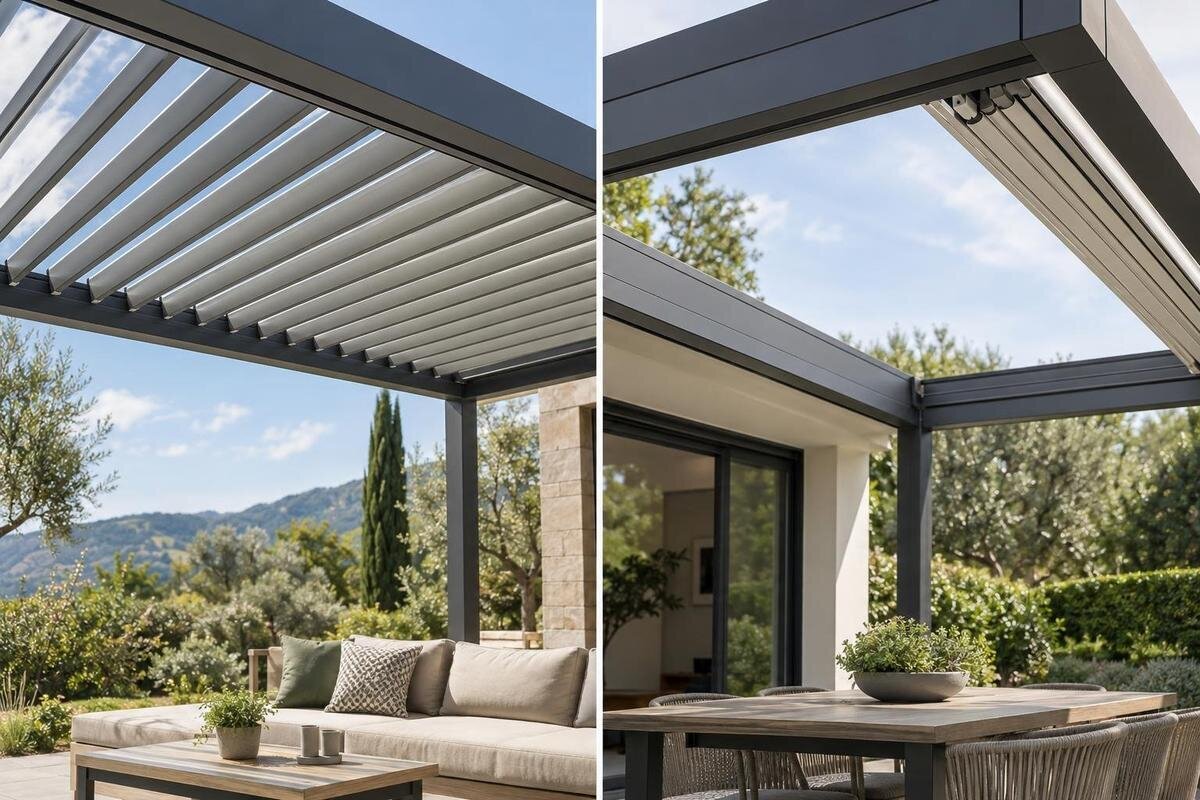
Rotating describes a change in blade angle. In a common louvred arrangement, each blade pivots around an axis running along its length while staying broadly in place above the pergola. Turning the blades changes the gaps between them and the angle at which the roof intercepts sunlight or rain. Even at its most open setting, the blades remain overhead, so the view upwards is still interrupted. The precise shape and spacing vary by design, but the key point stays the same: rotation adjusts the slats rather than removing them from the roof area. The footprint can remain unchanged even as the amount of light passing through it varies.
Retractable describes a change in position: roof elements move away from the area they cover and gather or park elsewhere, revealing an opening. That movement may be partial; parked elements, support beams and tracks still take up space, so a completely clear aperture is not guaranteed. Some systems combine actions, while product wording can use ‘louvred roof’ for different arrangements. A photo taken at an angle can make gaps look larger than they are from below. If the label is vague, use a model-specific diagram or operating manual and look for arrows, open and closed views, and the elements’ path. In product descriptions, ‘open’ might mean tilted blades or a moved roof section; those are not interchangeable.
How rotating louvres change the roof
With rotating louvres, the roof surface is divided into blades that pivot, often together through a linked mechanism. Their angle alters the gaps and how much direct light passes between them. In a partly open setting, the blades may continue to cast shade while admitting more sky and air; the balance changes with the sun’s position and the blade setting. The frame and blades themselves stay in place. That is why an open-looking louvred roof still gives a different view overhead from a roof whose elements move aside. A photo may show only one angle, so do not assume it represents the full operating range.
Check how far the blades turn, whether intermediate positions can be held, and whether one control moves the whole roof or separate sections. A wider range may matter if you want to fine-tune the gaps, while a single fixed open setting offers less choice; details vary by model. The Bloomcabin Bioclimatic Pergola listing identifies a model, but its name alone does not establish which movement it uses. For a useful comparison, note the available blade positions and which sections move together, using the mechanism diagram or operating manual for your chosen configuration. Confirm that any image matches the size you are considering, too.
How retractable louvres expose the opening
With a retractable arrangement, roof elements travel from above the seating area into a designated parking zone. When retracted, they expose more of the roof opening rather than simply changing their angle. Elements may slide along guides or move as a grouped assembly; the arrangement is model-specific. Some systems uncover only part of the roof, while others open a larger section. In any case, the roof’s nominal footprint is not the same as its clear opening: supporting beams and the parked assembly still occupy space. Depending on the design, the parking zone may sit at one edge or in a different position, so the opening is not necessarily centred.
Check where the elements park, how far they travel and what the open and closed limits are. A wall, post, light or other fitting near that path may affect clearance, so use drawings rather than judging from a roof plan alone. Ask for a side or underside view if the parking zone is not obvious. When comparing the Bloomcabin Wall-Mounted Pergola page with other options, keep mounting type separate from roof movement. Establish whether the roof rotates, retracts or combines both actions before considering how its moving parts would sit beside the house. Exposed sky in a photograph does not establish retractability.
How much sky is visible when the roof is open?
At the widest angle, rotating louvres still occupy the roof plane. The pergola can look more open because the gaps align with the view or admit more daylight, but it does not create the same open-to-sky aperture as elements that move aside. This distinction matters if you want an unobstructed view upwards, direct sun over a particular part of the deck or a continuous layer of blades above furniture. The outcome also depends on blade width, spacing, direction and the sun’s position; the word ‘open’ does not supply those details. Consider whether you want a view through slats or a broader gap above the table.
Retracting the roof can give a larger patch of open sky, but the actual opening may be reduced by the parked blades, tracks, perimeter beams or a section that remains fixed. Compare a drawing of the fully retracted roof with the area you want to expose, including where the structure itself still casts shade. The Bloomcabin Pergola listing gives a model size range from 9 to 24 m²; those figures describe listed pergola sizes, not the clear-sky aperture. Ask for opening dimensions if the distinction affects furniture placement, shade or the view from a seat.
Check rain performance in the model information
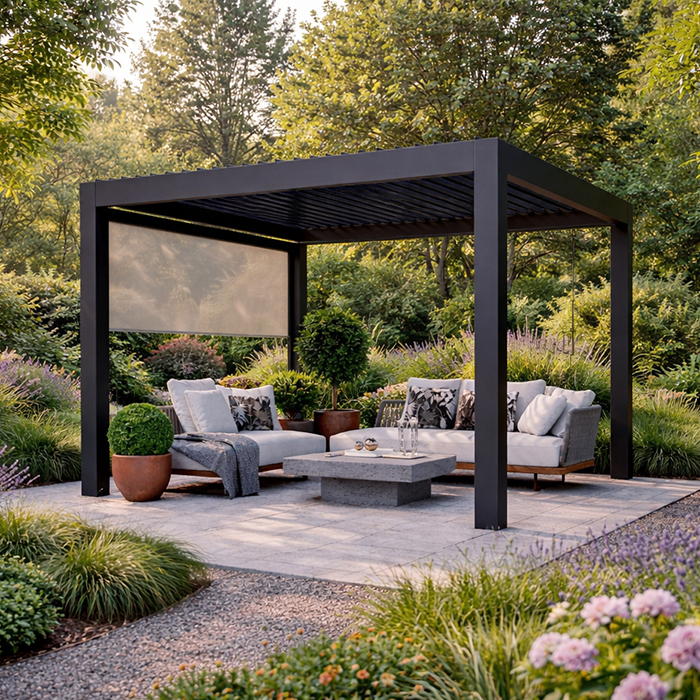
Rain performance is a separate specification from movement. A rotating roof may have a position intended to close the gaps and direct water towards a drainage route, but the word ‘closed’ does not prove that the roof is watertight. Blade overlaps, seals, joints, the frame and the specified installation all affect the result. Check whether the manufacturer describes rain protection, which position is required, and how water is collected and discharged. Ask whether the stated use applies to the whole roof or only when all moving parts are fully closed. A photo of closed blades is not a substitute for that information.
With a retractable roof, the area left uncovered receives rain directly. The covered position may have its own stated conditions, and partly open positions may not be intended for wet weather. Rain can also blow in from the sides, even when there is overhead cover, so a pergola should not be treated as an enclosed room. If the model on the Bloomcabin Bioclimatic Pergola page is on your shortlist, include its stated rain-use conditions in your comparison. Record the required roof position, how water is collected and where it exits, rather than treating the mechanism name as a rain-performance statement.
Light and airflow depend on more than the roof
Rotating blades let you adjust overhead shade without shifting the whole roof assembly. A more open angle may admit more direct light, while a more closed one can shade a larger area; the result changes as the sun moves. A slatted roof will not produce identical light throughout the day, and no single blade setting suits every time or position. If you use the deck at particular hours, consider where the sun reaches the table or seating and how trees, neighbouring buildings and the house affect it. The mechanism can alter the roof’s response, but it cannot change fixed shade around the site.
With louvres open, the gaps are above; with a retractable roof, a wider opening can be overhead. Neither arrangement by itself guarantees a breeze through the seating area. Air movement also depends on how open the sides are and on walls, fences and other nearby features. A broad opening can make the space feel more exposed to the sky, but it does not turn a pergola into a temperature-controlled room. Compare the positions you will actually use—partly open for filtered light, retracted for more sky or closed for stated overhead cover—with your routine and the conditions around the site.
Operating method is separate from roof movement
Whether louvres rotate or retract does not tell you whether they are hand-operated or motorised. Either movement can be paired with different operating arrangements, and an image showing motion does not prove that a motor, remote, sensor or app is included. Confirm what comes with the particular model, how the movement is controlled and whether you can stop at intermediate positions. For powered equipment, ask what supply and installation requirements apply and have electrical work assessed by a suitably qualified professional. Do not assume a motor or weather sensor is part of the standard specification; check whether any such feature applies to the chosen configuration.
Consider frequency and reach as well as convenience. If a handle or operating point sits out of easy reach, a manual arrangement may not fit the way you use the area. For a powered system, ask where the control is positioned and what the instructions say about a power interruption or manual override. For a retractable system, check its travel distance, operating time or manual effort if that information is supplied, and keep the travel path clear. Use the Bloomcabin Pergola product page to identify the model you are comparing, then assess its operating arrangement separately from its roof movement. Neither rotating nor retractable means motorised.
Maintenance points differ by mechanism
Both mechanisms have moving parts, but the areas needing attention differ. A rotating roof relies on blade pivots and whatever links the blades; a retractable arrangement also has a travel path and may use tracks, carriers or a grouped assembly. These are general points to check in diagrams, not proof that one system is automatically more durable or harder to maintain. In a leafy setting, debris may collect around moving parts or in water channels. The manufacturer’s instructions should explain which areas need cleaning and what checks are recommended for that specific design.
Ask what routine care is required, how the relevant parts are accessed safely and whether service or replacement parts are available for the exact model. Check whether cleaning needs to be done in a particular roof position, and which parts are safe to reach. Do not assume that a visible mechanism can be lubricated or adjusted by the owner: use only instructions intended for that system, and refer powered or structural issues to a qualified service professional. If you are considering the Bloomcabin Bioclimatic Pergola model page, compare the maintenance guidance with your routine, including access for cleaning and any tasks that require a service professional.
What to look for in a pergola roof diagram
Product names such as ‘louvred’, ‘bioclimatic’ and ‘retractable’ are not enough to establish the movement in every model. Find a diagram showing the roof closed and fully open, with arrows or notes that reveal whether the blades pivot, move out of the roof plane or do both. If the drawing shows only a plan view, ask for a side or underside view, since a stack can be hidden behind the frame. An operating manual may also identify permitted positions and the sequence of movement. Match each drawing to the model, size and configuration you are considering rather than treating a gallery image as a technical document.
Then compare the moving area with the roof footprint, the position of posts and any route used by the elements. Identify which part remains permanently covered, where the elements park and what clear opening is available. For the product named in the Wall-Mounted Pergola model details, the wall-mounted description alone does not reveal roof travel. If the page lacks movement arrows or opening dimensions, request a drawing matched to the chosen size before finalising a layout. Use the overall dimensions to understand the structure’s footprint and the clear-opening dimensions to understand the uncovered area; those measurements answer different questions.
Choose according to how you use the space
Rotating louvres suit a priority of changing the angle of overhead shade and light while keeping blades over the same roof area. Retractable movement suits a priority of opening more of that area to the sky. These are broad preferences, not guarantees about performance: the design, available positions and surrounding site determine the result. If you want both filtered light and an occasional open sky, ask whether the exact model combines the two actions and how much of the roof it can uncover. Adjustable louvres do not automatically retract, and a retractable roof does not necessarily have adjustable blade angles.
Before comparing models, write down the roof positions you will use most often: a particular blade angle, a fully uncovered section or a closed position for any stated rain use. Then compare the movement path, clear opening, operating method, water handling and maintenance requirements for the model and size you are considering. If the product on the Bloomcabin Wall-Mounted Pergola listing is on your shortlist, include how its movement zone would meet the wall and nearby fittings. Give greatest weight to the positions that serve your everyday use, rather than an opening you would rarely choose. The most useful mechanism is the one whose documented movement fits those priorities.
Frequently asked questions
Can pergola louvres rotate and retract?
Some systems may combine both actions, but the words ‘louvred’ and ‘retractable’ alone do not tell you whether a particular model does. Check its diagram for both the blade pivot and the path that moves elements away from the roof opening.
Which mechanism gives you more open sky?
Retracting usually exposes a larger area than rotating, because the elements move out of their covering position. The actual clear opening depends on what remains fixed and where the roof elements park, so check a drawing of the fully open position.
Are rotating louvres waterproof when closed?
Not necessarily. A closed position may be designed to manage rain, but that depends on the roof’s joints, drainage and specified conditions. Check the model information for rain use and whether the roof must be fully shut; neither the word ‘closed’ nor a picture is a guarantee.
Does a retractable roof open completely?
Not always. The moving elements may park over part of the roof, and beams, tracks or fixed sections can remain overhead. Ask for the clear-opening dimensions and a diagram of the fully retracted position rather than assuming the whole roof footprint is uncovered.
Does the movement tell you if the roof is motorised?
No. Rotation and retraction describe how the roof moves, not how it is operated. Check whether the specific model is manual or motorised and what controls, sensors or other features are actually included.
The useful distinction is simple: rotating adjusts the angle of a roof that remains overhead; retracting moves elements aside to reveal a larger opening. Choose based on which roof state you will actually use, then make sure the chosen model’s diagrams and written instructions show that state clearly. The mechanism name should describe a movement you can verify, not a performance assumption.
