
Squeaking Pergola Mechanism: When Does It Need Maintenance?
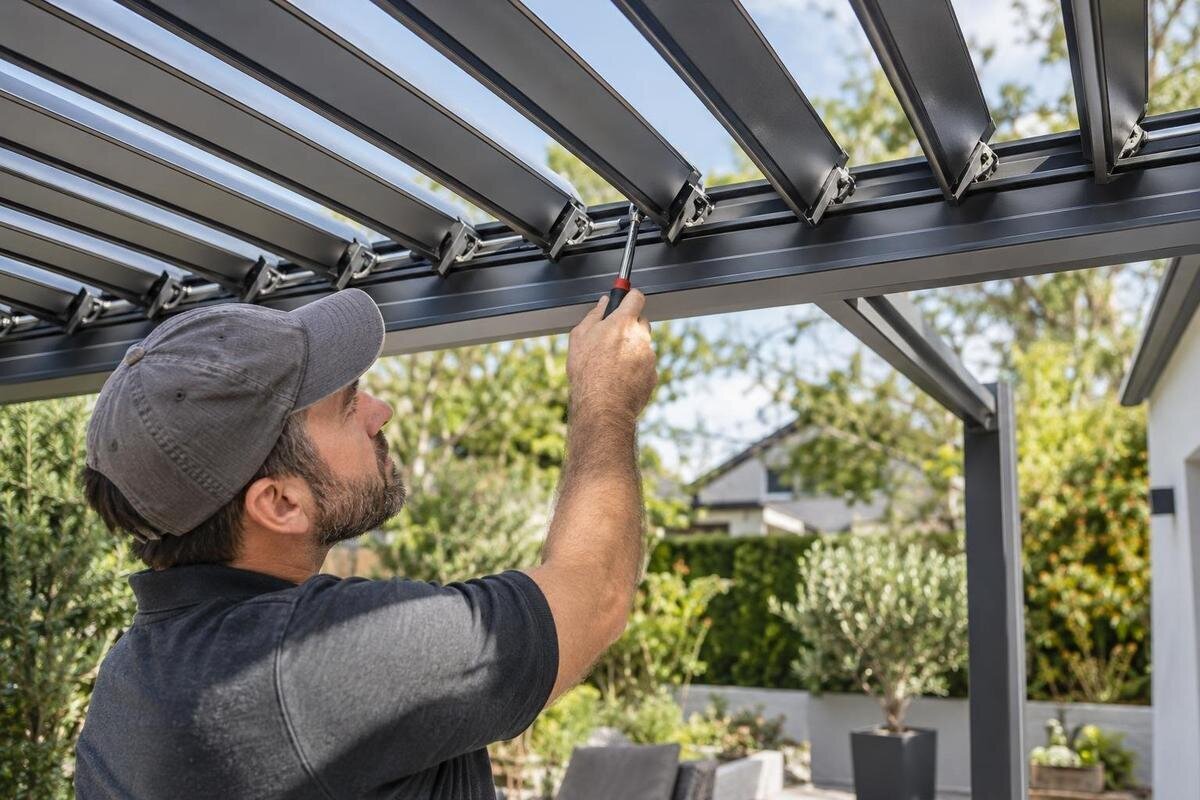
Pergola care and maintenance
A squeak can be an early sign that a pergola needs attention, but sound alone cannot identify its source or prove that lubrication is needed. The useful clues are when it happens, whether it is becoming more frequent or louder, and whether movement has changed. Record what you hear and the conditions around it, then compare those notes with the instructions for your exact model. Avoid generic sprays or adjustments by guesswork: they can mask a symptom without addressing its cause.

Before arranging maintenance 1
What a squeaking mechanism can tell you
A squeak does not identify which joint, drive part, seal or contact point is responsible. Possible sources include moving surfaces in contact, debris, rubbing against a nearby object, or sound carried along the frame from somewhere else. These are possibilities rather than a diagnosis: the loudest point may not be where the sound starts, and a phone recording cannot establish which part is involved. Describe what you hear instead of calling it a dry hinge or loose fitting unless a technician has confirmed the cause. The right maintenance step depends on the installed mechanism and its instructions.
The useful first question is whether the noise has changed. Compare it with what you remember, or with previous service notes if you have them: is it new, more frequent, louder, sharper or happening through a different part of the movement? Has operation become harder or less even? Note each observation separately rather than jumping to a cause. A quiet, stable sound does not automatically mean an urgent fault, but it is not proof that no attention is needed either. If the squeak recurs during ordinary use, record it and seek advice for the exact pergola rather than trying to silence it.
When a recurring squeak needs attention
A maintenance check is sensible if the squeak returns during ordinary use, becomes louder or sharper, or begins at a different point in the movement. A repeated sound at the same point is worth reporting, particularly if that pattern is new; it may help a technician understand the symptom. Persistent noise deserves model-specific advice even when the pergola still moves normally. There is no universal number of squeaks or operating cycles that sets a service interval, so use the schedule and conditions in the manufacturer’s instructions. If you are confirming the product name for an enquiry, compare the Bloomcabin Pergola product page with the wording in your purchase records.
Treat the sound as more urgent if it comes with a change in travel, resistance, juddering, uneven movement, visible rubbing, a loose-looking part or fresh damage. Stop using the moving mechanism if it suddenly grinds, bangs or behaves differently; do not run it through more cycles to see whether it clears. A persistent squeak without those changes still merits a planned check rather than an improvised fix. When you speak with the supplier or service agent, describe what you can observe and how long it has been happening, without stating that a particular component has failed. That distinction can help them decide what information or inspection is needed.
Before arranging maintenance 2
Note which movement triggers the sound
Record whether the sound occurs only as the mechanism moves, while it pauses, or when it is at rest. If your pergola has adjustable louvres, note whether it happens as they open or close, at the beginning or end of travel, or at the same apparent position each time. Do not repeatedly operate the pergola for a test. If it is behaving normally and there are no warning signs, observe the sound during ordinary use, following the usual controls and keeping clear of moving parts. If anything changes, stop rather than trying to complete a diagnostic cycle.
Use plain descriptions such as a brief squeak on closing, a repeated sound halfway through movement, or a noise that continues after movement stops. Avoid assuming that the control, motor or louvre is the cause simply because the sound happens at the same time. If your paperwork names a Bloomcabin Bioclimatic Pergola, retain that exact wording in your notes so the recipient knows which product you are asking about. Record whether the sound seems to occur in one direction or both, if you know from ordinary use. If you have not noticed a consistent pattern, say that rather than running extra tests to find one.
Describe where and how you hear it
Try to locate the sound broadly without touching the pergola: for example, near one side, a corner, a post, the centre of the moving area or the wall side. Use landmarks you can identify from a safe position, not names for hidden parts. If another person is present, one can listen from a clear position while the other uses the normal controls, provided operation is safe and the manual permits it. No one should reach under or between moving components. If the noise happens when the mechanism is still, note that separately; a sound at rest may have a different explanation from one tied to movement.
Describe the character as well as the apparent location: a single squeak, several short squeaks, a scrape, a click or a harsher grinding sound. These descriptions are more useful than calling it faulty or naming a part. Sound can travel through connected sections, so note where you heard it and whether it seems to come from one point or across the frame. A phone recording can help convey timing, but microphones can alter distance and pitch; a recording is supporting evidence, not a way to identify a component. Capture it from a safe position, and do not put a phone close to a moving part.

Before arranging maintenance 3
Check for weather or nearby contact
Outdoor conditions can change what you hear without proving what caused it. Note whether the squeak was first noticed after rain, wind, a change in temperature or a period when the pergola was not used, and whether it is present when conditions are calm. Loose foliage or another item touching the frame may also make noise. For an enquiry about a Bloomcabin Wall-Mounted Pergola, distinguish the wall side from the outer edge when describing the apparent location. Treat timing and location as clues only, not evidence that weather or a particular fitting is to blame. Include occasions when the noise was absent if you remember them.
From a safe place, look around the outer frame for anything visibly rubbing against it, such as a branch or an item stored nearby. Do not pull at an object caught near moving parts, and do not dismiss a recurring sound as wind just because it happened on a breezy day. A note that it occurred only in gusts, only while moving, or also when stationary is more useful than a guessed cause. If you cannot tell whether the noise comes from the pergola or an adjacent structure, say so. That uncertainty is useful information for whoever assesses the next check.
Limit checks to safe visual observations
Keep an initial inspection visual and non-invasive. From ground level, note visible leaves, grit, obvious contact marks or a new scrape on an accessible surface; do not reach into a joint, guide, drive area or gap between louvres. Do not climb on the pergola, lean over it, remove a cover or put fingers near a mechanism, even if the sound seems to come from within easy reach. Avoid moving an item or cleaning a moving surface until the manual tells you how. If checking would require a ladder or handling a component, leave it to an installer or service professional.
For a pergola identified in your records as a bioclimatic model, use the catalogue page for the Bioclimatic Pergola to keep the product name consistent with your enquiry. Make your visual notes specific: describe which side a mark is on, whether it is near a corner or the centre, and whether you know it is new. A whole-structure photo can establish the viewpoint, while a separate image can show the visible mark. Keep both observations and photographs limited to what is safely accessible. If you cannot see the suspected area clearly, record that limitation rather than scraping away residue, pushing a surface or dismantling anything.
Before arranging maintenance 4
Use the manual for products and methods
Use the maintenance instructions for the exact model and version, not a generic pergola-care guide or a routine borrowed from another unit. Check whether the manufacturer specifies lubrication at all; if it does, look for the approved product, location, amount, timing and method. The instructions may also specify cleaning steps or materials to avoid. If you cannot find the right information, ask the supplier or manufacturer using the name and identifying details in your paperwork. A catalogue entry for Bloomcabin Pergola can help with product naming, but it is not a substitute for the manual for the pergola you own.
Do not assume that household oil, grease, silicone spray, penetrating spray or a general-purpose lubricant is suitable just because it quiets the sound temporarily. A product may not be right for the component or nearby materials, and a coating can mask the original symptom or leave residue. Apply nothing to an unidentified opening or joint. If the approved procedure requires a product you do not have, or you cannot tell which point the instructions mean, pause and ask for clarification rather than experimenting. This preserves the original symptom for assessment and avoids introducing an unapproved treatment.
Stop operating it if movement changes
Stop operating the pergola and arrange advice if a squeak changes into grinding or repeated banging, if the movement becomes jerky or uneven, if the mechanism binds, or if you see a bent, displaced or damaged part. Do not try to force it through resistance, hold a moving component in place or repeat cycles to locate the sound. Keep people clear of the moving area. If the sound is persistent but movement seems unchanged, you can request a planned maintenance assessment. Whether to continue normal use should follow the manufacturer’s instructions or service advice, not a guess based on the sound alone.
When requesting service for a Bloomcabin Wall-Mounted Pergola, describe any visible concern at the wall side separately from the noise in the moving mechanism. Do not remove covers, loosen fasteners or adjust a drive part to investigate either area. If the mechanism is motorised, leave the motor, electrical enclosure and wiring closed, and have inspection or repair carried out by an appropriately qualified service person. Tell the service team whether you stopped operation because of the sound, changed movement or visible damage. This explains why you are seeking advice without presenting an unconfirmed cause as a fault diagnosis.

Before arranging maintenance 5
Prepare clear notes for a service request
Send a concise symptom record rather than a long list of guesses. Include the product name and any version or serial details you can read safely from paperwork or an accessible label; do not open a panel to find them. Note when the sound began, how often it occurs, whether it is tied to opening or closing, where it seems loudest, and whether operation or appearance has changed. If your records use the name Bloomcabin Bioclimatic Pergola, the corresponding catalogue entry provides a product reference for the enquiry. Keep any version or serial details separate from that name so the service team can distinguish the catalogue model from your particular unit.
Attach a short recording only if you can make one from a safe position during ordinary operation; do not stage repeated cycles for a better clip. Add a clear photo of the whole pergola and a separate image of any visible mark or contact point, without removing anything. Mention conditions such as wind or rain only if they were present, and say when you last followed the documented maintenance schedule, if known. This gives the service team useful context while making clear which details are observations, which are uncertain, and which checks have not been done.
Review the result before considering replacement
After approved maintenance, note whether the noise has stopped, changed location or returned under the same conditions. Keep the date and details of the work with your original symptom notes so you can explain what changed afterwards. Do not keep applying a product or repeating an adjustment because the sound comes back; report the result and follow the next instruction from the service provider. A temporary reduction in noise is worth mentioning, but describe it as an outcome rather than confirmation of the cause. If you have not used the pergola since the work, make that clear when asked whether the maintenance resolved the squeak.
If the squeak persists after a service check, ask whether the cause has been confirmed and whether further inspection, an approved part, an upgrade or replacement is being considered. For a proposed component, request its exact identification and confirmation that it suits your model and configuration. If you are discussing a complete replacement, the Bloomcabin Pergola listing can provide a reference for the product under consideration. Keep that choice separate from the assessment of your existing structure: a catalogue name does not establish compatibility with its parts or controls. Clarify which option is being proposed and what it is intended to resolve before deciding.
Frequently asked questions
Does every squeak mean the pergola mechanism is damaged?
No. A sound can have several possible sources, and listening alone cannot confirm that a part is damaged or needs lubrication. A new, recurring or worsening squeak is worth recording and checking against the maintenance instructions for your exact model.
How long can I wait before arranging maintenance?
There is no universal waiting period or number of operating cycles that applies to every pergola. Seek model-specific advice if the sound keeps returning or changes. Stop using the moving mechanism if it grinds, binds, moves unevenly or shows visible damage.
Can I spray lubricant on the louvres?
Only if the instructions for your exact model approve the product and method. Do not assume that a household oil or general-purpose spray is suitable. If the manual is missing or unclear, ask the supplier or manufacturer before applying anything.
What should I send with a service request?
Include the model details from your paperwork, when the sound began, when it occurs, where it seems loudest and whether movement has changed. Safe photos or a short recording of ordinary operation may help. Make clear which details are observations and which are uncertain.
Can I inspect the mechanism myself?
Keep checks visual and limited to what you can see safely from the ground. Do not reach between moving parts, remove covers or loosen fittings to find the source. Leave internal or motor-related inspection and repairs to appropriately qualified service personnel.
A squeak is most useful as a change to record, not a reason to guess at a repair. If it recurs, note its timing, location and any change in movement, then follow the maintenance instructions for the exact pergola. Visible signs or rough, uneven operation raise the priority for service; a harsh sound or binding is a reason to stop using the mechanism. Manufacturer-approved care and a clear description of the symptom help establish whether further inspection or a compatible part is needed.
