
Pergola Privacy Panels: Sliding Versus Fixed
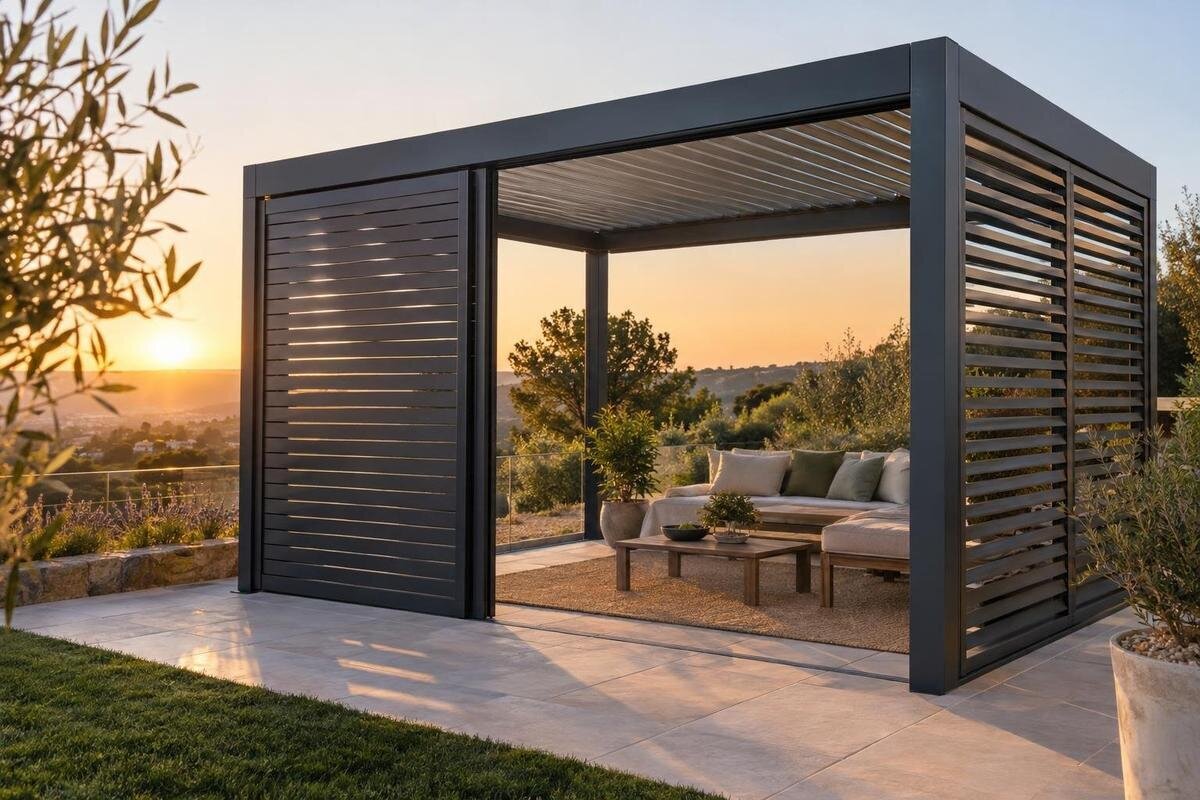
Pergola planning guide
An opaque screen can make one edge of a pergola feel more private, but its value depends on where the unwanted view comes from and what that edge needs to do. A fixed panel keeps the same span covered; a sliding panel can shift coverage along its designed path. The choice is not simply more privacy or less: access, outlook, daylight and airflow may change as well. Plan each side around its use, then confirm that the proposed panel is compatible with the selected pergola model. This guide is about opaque side screening, not the separate question of choosing fixed or sliding glass walls.

Before you choose 1
Which pergola side needs privacy?
Begin with the side that creates the privacy problem, rather than choosing a panel style for the whole pergola. Is a direct view into the dining area unwelcome every day, or mainly when people are seated? Does the edge need to stay open for a route to the garden, or would you like to uncover the outlook after a meal? A fixed screen suits a boundary that should stay covered; a sliding panel is useful when you need to change which part is covered. Treat an opaque panel as a visual barrier, not glazing or a sealed outdoor room: it can block a view through its covered area without making every angle private.
On a simple footprint, mark the house, fence or boundary, neighbouring outdoor areas, main seats, table, doors and everyday route. Label each side with what matters there: privacy, a view, access, shade or a breeze, and note when the issue occurs. If the pergola is attached to the house, a wall-mounted pergola model is one frame option to discuss, but its listing does not confirm that a particular side panel is included or approved. Add approximate panel spans to the sketch. This shows whether one side needs permanent coverage while another should remain open or change position.
How fixed and sliding panels differ
With a fixed screen, the chosen span stays covered. You do not move it to reveal a view or shift privacy towards a different seat, so its effect remains consistent as people use the pergola. A sliding panel can be repositioned along its intended path, letting you cover part of an edge or leave it more open. The extent depends on the panel’s reach and the system layout; a slider cannot cover a span it does not pass. Include the parked position in the comparison, because the panel still occupies space when moved aside. It offers adjustment, not a way to make the whole side disappear.
Fixed and sliding describe movement, not how completely a panel screens a view. Ask whether its face is genuinely opaque, then inspect joins, margins and any open pattern; a view may pass around or through gaps. This differs from choosing between fixed and sliding glass walls, where retaining a view through the wall is central. Here, the question is whether opaque coverage sits across the sightline at the right time, not how much transparency is available. When discussing side options for the Bloomcabin Pergola listing, distinguish the panel’s movement from its screening design. Ask how much of the side each proposed option covers and what remains visible around it.
Before you choose 2
Sketch the sightlines around the pergola
Use a plan view to mark the pergola edges, the seat or table to protect, and the direction of the unwanted view. Then check from places where people actually sit and stand, not only from the centre. A panel across one bay may block a seated view but leave a diagonal view at the end; the reverse may be true from another seat. Walk around the patio and look back towards the space. This often shows whether the full side needs screening or a shorter fixed span would address the main line of sight.
Draw the proposed panel span and, for a sliding system, each position it can occupy and where it parks. If you are considering the Bioclimatic Pergola model, use this sketch to explain the coverage you want, rather than asking for privacy panels without specifying their position. Ask the supplier to show the proposed screen on the exact frame layout so you can compare it with your sightlines. Place the main furniture in its usual position while testing the view. A line that matters when standing may be irrelevant at the table, while moving a chair each time can make an otherwise attractive layout inconvenient.
When a fixed screen is the better fit
A fixed screen can suit a side where the same direct view is unwelcome whenever the pergola is in use and there is no regular need to pass through that span. Its position does not depend on anyone remembering to close or reposition it. That suits a stable arrangement: for example, a seat that stays beside one screened edge, with the entrance and open outlook placed elsewhere. The fixed choice makes sense when its permanent effect is useful through ordinary routines, rather than only during an occasional gathering. Keep it to the section that answers the sightline unless other edges have a separate reason to be covered.
That permanence is also its main trade-off. An opaque panel continues to interrupt the view and daylight through that part of the side, including when privacy is not needed. If the panel is solid, it also obstructs direct airflow through its span; an open or slatted design may behave differently, so check the actual construction. Consider what the screen hides from both inside and outside the pergola, and whether a view across the garden matters at other times. A single fixed section can leave the remaining edges open; extending it simply for a matching outline may close off more than you want.

Before you choose 3
When sliding panels are useful
A sliding panel is useful when the same edge has more than one job. You may want privacy beside a dining setting during a gathering, then prefer an open outlook or passage when the area is quiet. Repositioning can suit those changing preferences without leaving the whole side permanently covered, provided the panel reaches the required point. If the planned use is always the same, movement may add complexity without solving a real problem. Think about how often you would move it, who will use it and whether adjusting it is more convenient than leaving a fixed section in place.
Allow for where the panel goes when it is open. Depending on the design, a section of the side may remain occupied, a travel path may need to stay clear, or the panel may park at one end. Check that this position does not block a gate, door, favourite view or walkway. When discussing a sliding panel for the Bloomcabin Wall-Mounted Pergola, ask for its open and closed positions to be shown on the proposed layout. Compare both with the nearby house doors and the route onto the terrace. Include the parked panel in your plan, not just the fully closed view.
Keep the entrance and walking route clear
Draw the route people take from the house to the garden, outdoor table, storage or any other regularly used spot. Mark door swings and furniture as well as the proposed screen. A fixed panel can work where access is provided elsewhere, but it will not create an opening if you need to cross that span. A sliding panel can provide a route only where its design clears enough space and its parked position leaves the approach unobstructed. Compare both states—screen in use and moved aside—rather than judging from a picture of an open pergola.
Ask about any guides, tracks, thresholds and grip points in the particular system, as well as the parked panel. Their positions can affect cleaning and everyday movement, and an opening shown on a drawing is not necessarily a comfortable route on site. Walk the proposed line with temporary markers and consider the furniture in its usual position. Check the approach as well as the gap itself: reaching the opening should not require moving chairs each time. If carrying items through or keeping a particular route clear matters, explain that to the supplier and ask for the clear opening and operating details for the specific system.
Before you choose 4
Check daylight, views and airflow
Opaque screening changes more than privacy. A fixed panel can shade or obscure the area behind it when sun comes from that side, while an open span leaves more daylight and view through the edge. The pattern changes with the sun and season, so note when you actually use the pergola and the direction from which bright or low sun reaches the seating area. A simple sun-path sketch for breakfast, lunchtime and late afternoon can show whether permanent cover is helpful at a particular seat or would make the space feel closed at other times.
Sliding panels let you adjust an edge only within the positions the system permits; they do not change roof shade or the sun’s direction. If a panel is solid, expect less direct breeze through the covered section than through an open span; gaps and open designs may behave differently. Keep this assessment separate from claims about shelter or wind performance. When comparing side layouts for the regular pergola model, mark the edges you want to leave open alongside those you want screened. This makes the daylight, outlook and airflow trade-offs part of the same discussion. Do not assume an opaque screen is a weather barrier.
Different sides can use different panels
Privacy needs rarely line up on every edge. One side might face a boundary that calls for a permanent opaque screen; another might look out over the garden and work better as an opening; a third may need to provide the main route. Mixing fixed and sliding panels—or leaving an edge without a panel—can preserve those differences. It is often more useful to plan each side for its own task than to choose matching panels simply for symmetry. Consider the view from both the pergola and the garden, and how the arrangement will look when a sliding panel is parked.
Before combining types, confirm that the exact arrangement is supported by the pergola maker. A change to one side can affect how exposed the other edges feel and how air passes through the structure, so do not infer wind performance from appearance. If you are considering the bioclimatic pergola listing, ask the supplier to identify compatible accessories for the complete mixed layout, including any sides left open. Specify the fixed and sliding sections together rather than treating them as separate purchases. A screen made for another frame is not necessarily a drop-in fit, and a product image does not establish what is included.

Before you choose 5
Check opacity, gaps and care requirements
Check what opaque means in the actual panel, not only in the product description. A solid surface may block a direct view through its face, while slats, perforations, joins and edge gaps can leave sightlines. Look from the seating point towards the area you want to screen, and check more than one angle. If possible, examine a sample or compare a full-size drawing with the boundary on site; small gaps can matter where neighbouring spaces are close together. Consider the panel in daylight and at night, with outdoor lights on, to notice any views remaining around its edges.
Fixed versus sliding also changes what to ask about care. A stationary panel still needs cleaning and inspection appropriate to its material, while a moving system has parts that need to remain clear and operable. That does not mean every sliding panel is high-maintenance; requirements depend on its construction and setting. Request the manufacturer’s maintenance instructions, ask how accessible any tracks or guides are, and clarify whether a damaged panel or component can be serviced. For a proposed screen on the wall-mounted option, use the side-layout drawing to discuss access for cleaning, including the panel’s parked position, rather than relying on the frame page alone.
Confirm compatibility with the pergola model
Before ordering, ask for a model-specific answer rather than a general assurance that panels can be added to a pergola. Give the supplier your sketch and ask them to mark which side receives fixed screening, which side slides, where each panel travels and where it parks. Confirm the clear entry route with the panel in both positions. Ask whether the exact accessory is approved for the selected frame and what installation or site details need review by a qualified professional. Do not rely on a generic panel image to establish that a particular arrangement will work.
Keep a record of the final layout: panel type and location, any opening left uncovered, and the clearance needed for movement and access. Check what the quote includes rather than assuming a side panel shown in a photograph comes with the pergola. Use the Bloomcabin Pergola page to identify the model, then have the selected side panels and their arrangement clearly identified in the quote. This keeps the frame choice separate from the accessory order. The finished layout should address the real sightline problem while leaving the pergola practical to enter and use.
Frequently asked questions
Which option gives more privacy?
Neither is automatically more private. Privacy depends on whether an opaque panel covers the relevant sightline, how far it extends and whether views remain around its edges. A fixed screen keeps its coverage in one place; a sliding panel lets you reposition it only within its designed travel.
Can a sliding panel create an entrance?
Only if the particular system is designed to clear the route you need. Check the opening with the panel both in use and parked, and ask about any guides or tracks that affect the approach. Do not assume every sliding panel opens the full side.
Can fixed and sliding screens be combined?
A mixed layout can suit sides with different jobs, but the exact combination must be confirmed for the pergola model. Ask which accessories are approved for that frame and whether the proposed arrangement is suitable for your site.
Are opaque privacy panels like sliding glass walls?
They solve a different problem. An opaque panel is intended to block a direct view through its covered area. Glass walls retain a view through the wall, so comparisons about fixed and sliding glazing do not tell you whether an opaque screen is in the right place.
Will a fixed opaque panel block a breeze?
A solid panel obstructs direct airflow through the span it covers, while gaps or an open pattern may behave differently. The effect also depends on the other open sides. Check the actual panel design and do not assume it is a weather barrier.
Choose fixed screening where the same view needs to be blocked consistently and access can be provided elsewhere. A sliding panel is worthwhile when you expect to change the coverage and can accommodate its travel and parked position. In either case, a sightline sketch helps distinguish unwanted views from the outlook you want to retain. Check the actual opacity and gaps, keep routes usable, and confirm the proposed side arrangement for the exact pergola model before treating it as part of the plan.
