
Porcelain, Timber or Natural Stone Beneath a Pergola?
Pergola flooring guide
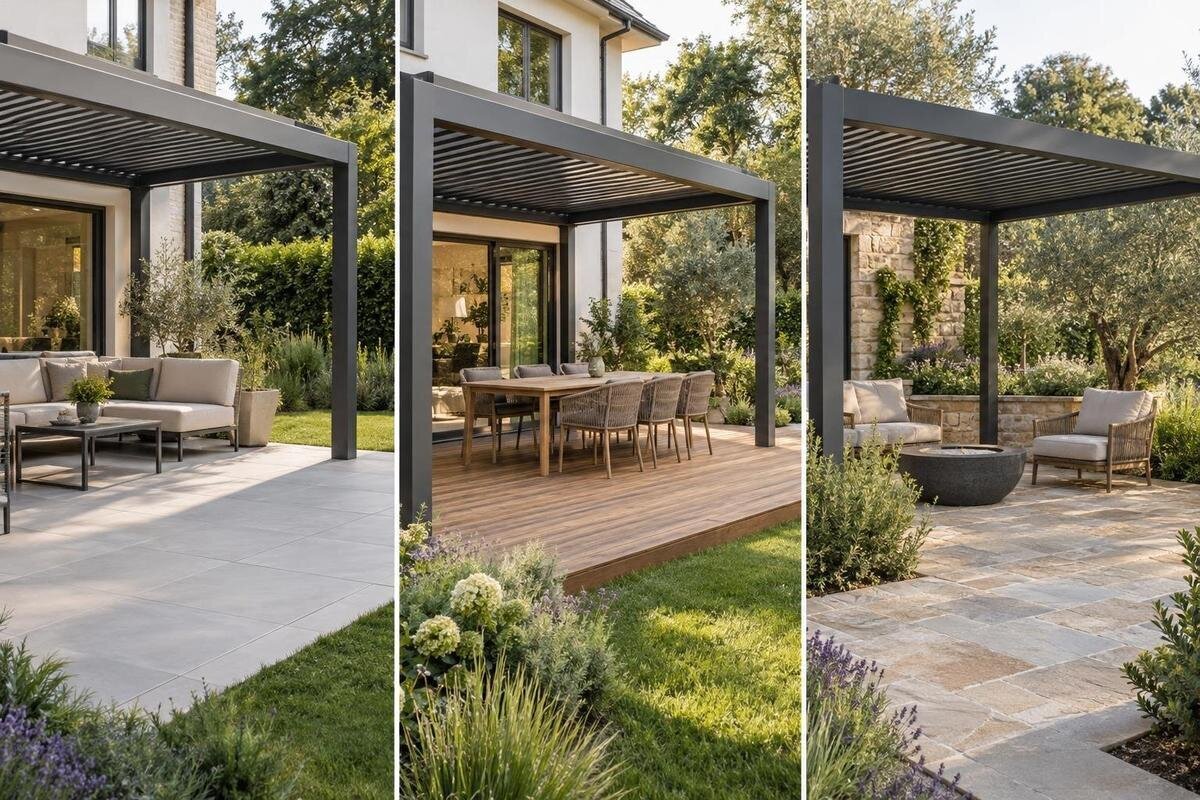
Porcelain paving, timber decking and natural stone each create a different feel beneath a pergola, but appearance alone is a poor guide. Sun and moving shade affect surface temperature; wet weather, grit and food spills shape cleaning; and each material brings a different pattern and care routine. Compare actual products in the conditions where you plan to use them. Settle the walking area and its edges alongside the pergola layout, then weigh comfort, maintenance and the look of the whole outdoor space.
Plan the paved area around everyday use
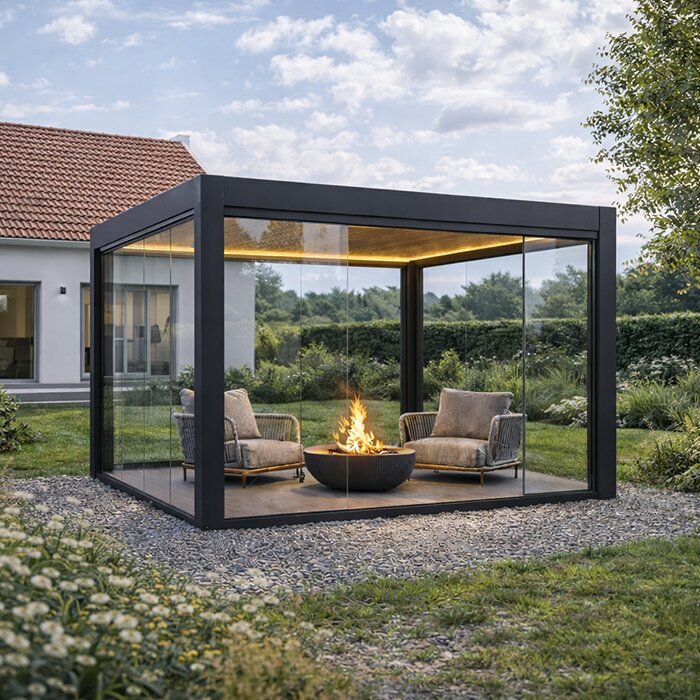
Begin with how the area will be used, rather than with a colour swatch. Mark the dining table and the space needed to pull chairs out, the route between the house and seating, and places where people often stand, such as beside a serving bench or barbecue. Include the way you move through the area when furniture is in use, not only when the terrace is empty. If barefoot use is important, or if you regularly carry food and drink outside, put those routines on the comparison list. Notice whether the route from the house crosses a planned change of surface.
Draw the pergola outline, existing patio and proposed paving on one dimensioned plan. The Bloomcabin Pergola listing identifies a 9–24 m² range; that is a model range, not a recommendation for the area to pave. Mark the actual selected arrangement, then add the circulation and furniture space you want. Decide whether the finish should stop at the pergola line or continue to a path, lawn or dining spot beyond it. A dimensioned landscape drawing makes the edges, planting requirements and routes easier to review before the material is ordered.
Porcelain paving: check the exact finish
Porcelain paving has a manufactured finish, with ranges that may look plain, patterned or like another material. The precise colour, surface and format vary between products, so compare actual samples rather than judging the category as a whole. Look at several tiles together: a repeat pattern, the colour of the joints and the scale of the design can read differently across a terrace than on a hand-sized sample. Check it beside the pergola, outdoor furniture and house exterior. Ask the supplier for the exact product’s care instructions and information about its intended outdoor use; the word porcelain is not the complete specification.
Texture deserves its own check. A smoother face may be easier to wipe, while a more pronounced texture can feel different underfoot and may take more work to brush clean; neither description alone tells you how a specific tile performs when wet. Ask for documented information about the exact finish’s suitability for wet outdoor use, plus guidance on cleaning and joints. On a terrace beside the house, plot doors, the proposed frame line and tile grid together. If you are considering the Bloomcabin Wall-Mounted Pergola, compare the tile layout with the proposed structure and house frontage. Look at where the pattern ends beside doorways and along the outer paving edge, rather than assessing the tile in isolation.
Timber decking: look, feel and upkeep
Timber decking brings a board pattern and visible grain, which can make the transition from the house to the garden feel more continuous. Species, board width, colour and finish all change the look, so compare actual samples next to the exterior, furniture and nearby planting. Some people prefer the feel of boards under bare feet to a hard paving surface, but comfort and warmth in direct sun depend on the exact product and conditions. If that matters, assess a sample where the deck will sit rather than relying on a product photograph or a small indoor display.
Upkeep is part of the choice, not an afterthought. Timber’s appearance can change with weather and exposure; appropriate cleaning and any protective treatment depend on the species and supplied finish. Ask what routine applies to the exact boards, whether a treatment is recommended, and how it may affect the colour or sheen. The direction of the boards also shapes the outdoor room: it can lead the eye along the house, across a dining zone or towards the garden. Show the direction on the same plan as doors and walking routes so the pattern does not end awkwardly at a narrow path.
Natural stone: variation and care
Natural stone offers variation in tone, markings and texture that a manufactured finish may not reproduce in the same way. That variation can make a broad terrace feel less uniform, but it should be a quality you welcome across the whole paved area. Ask to see several pieces from the selected range and compare them in the intended laying pattern; a single hand-sized piece may not show how markings will appear across multiple rows. View the stone beside the house and pergola in natural light, and ask whether display pieces are representative of the variation you can expect.
Care instructions are specific to the stone and finish, so do not assume that all natural stone needs the same treatment. Ask the supplier whether sealing is advised for the exact product, which cleaners are compatible and how to deal with everyday spills. A textured or more open surface can change how dirt is removed, so check the actual finish as well as the stone name. Natural variation can also make a later replacement look different from older pieces. Keep the product and treatment details, and ask whether suitable spare pieces can be obtained if future repairs matter to you.
How pergola shade affects surface temperature
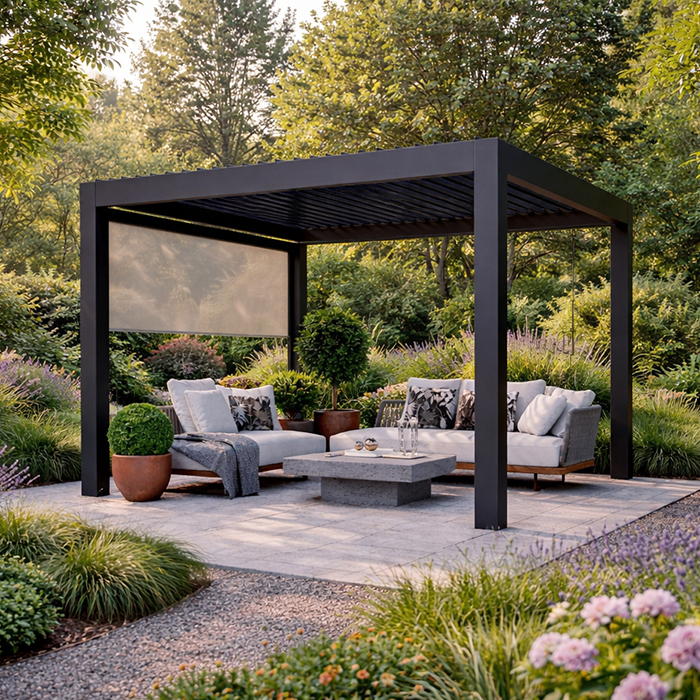
Surface temperature is not a fixed ranking in which one of these three materials is always coolest. Direct sun, changing shade, colour, finish and time of day all affect how a surface feels. A darker finish in full sun may become uncomfortable sooner than a paler one, but shade and surface texture can change the experience; colour alone cannot predict the result at your site. Compare actual samples where they will be laid, at more than one time if practical. Notice which parts stay in direct sun, which are shaded and whether the hottest route is where you walk barefoot.
A pergola can cast partial or moving shade, and the area it covers depends on the selected arrangement and sun at the site. Do not assume the entire paved zone will stay shaded or dry. If the Bloomcabin Bioclimatic Pergola is on your shortlist, use a dimensioned drawing of the intended arrangement to discuss shade over the floor. Mark the seating area and the routes used most often, including any paving beyond the structure. This keeps the comparison focused on where people will actually sit or walk. View your shortlisted finishes under the light conditions in which you expect to use the area, rather than relying on catalogue photography.
Cleaning each surface
Think about cleaning in terms of the mess the area actually gets: leaves from nearby planting, grit tracked in from the garden, and food or drink around a dining table. All three surfaces benefit from having loose debris cleared away, but the details differ. Porcelain may be straightforward to wipe if its finish and approved cleaner allow it, while grout or joints still need attention. Timber decking may need debris removed from gaps where those are part of the design; stone care depends on the type and finish. Ask for product-specific cleaning instructions rather than assuming a familiar household cleaner suits every material.
Plan access around furniture and the outer edge, not just the centre of the pergola zone. Chairs should be easy to move for sweeping, and narrow corners or decorative borders should not create awkward places where leaves collect. When laying out the Bloomcabin Pergola model, show the surrounding path as well as the area beneath it: garden debris reaches beyond the structure’s outline. Ask the installer how water moves across the finished surface and what care is recommended after wet weather. Many joints or hard-to-reach edges can make a layout more demanding to clean than a sample suggests.
Maintenance and future repairs
Compare the ongoing care each option requires before deciding on appearance alone. For each shortlisted product, separate ordinary cleaning from occasional treatments and note what the supplier says should prompt attention. This makes it easier to distinguish a surface that needs frequent routine care from one with less frequent but more involved tasks. Record the recommended products and whether any treatment changes the colour or sheen you liked in the sample. There is no useful universal maintenance interval without knowing the material, product and exposure. If regular recoating or sealing would not fit your routine, rule out options whose instructions require more care than you want to provide.
Keep the instructions and exact product identification with the landscape plan. If you are considering the wall-mounted Bloomcabin model, include the house-side paving edge in the maintenance review as well as the open perimeter; consider whether it can be reached for cleaning. Ask the installer how the chosen finish meets existing paving and thresholds, and how small repairs would be handled. Timber boards, stone pieces and porcelain tiles may be replaced in different ways, and an older, weathered surface may not match new material exactly. Ask about suitable replacements and whether setting aside spare pieces makes sense for the product.
Texture, wet conditions and comfort
Footing needs a separate check from heat and appearance. Outdoor surfaces can be wet, dusty or covered with leaves, and the grip you experience depends on the exact texture and surface condition. A glossy or strongly textured look is not, by itself, proof that a finish is suitable for outdoor walking. Ask the supplier for documented information about the selected product in wet outdoor use, and ask the installer how the finished edges and joins between pieces will be handled. Make sure the sample has the same finish and texture as the product you are considering.
Handle samples and compare their edges, texture and ease of brushing clean; if practical, inspect them where they will be used in dry conditions and when damp. If the bioclimatic pergola option is part of your plan, mark the walking routes that remain exposed in the proposed arrangement. Include the route from the house to the table and any transition from paving to decking or lawn. Consider those routes separately from the seating area, as people will use them while moving through the garden or carrying food outside. Where a level change or a specific access need matters, ask a qualified designer or installer to review the finished route and transitions.
Plan edges, thresholds and transitions
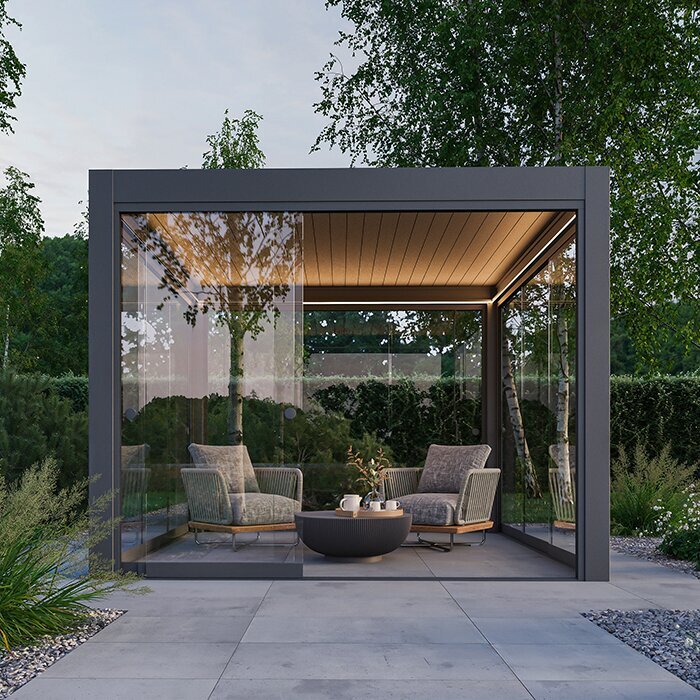
Edges decide whether a finish looks deliberate. Set out the paved area against the house, doorways, garden beds and existing patio lines, then check where tile joints or decking boards will finish. Mark the pergola posts and walking area on the same drawing so cuts and board direction can be coordinated with the structure. Do not make the pergola’s shaded footprint the automatic paving boundary: the surface may need to continue to a path, lawn or dining area beyond it. If you want a contrasting border, check its position against furniture and everyday routes before settling on a material.
At the house, pay attention to thresholds and the movement of rainwater. When considering a wall-mounted pergola listing, include the junction between the paving and your house in the layout review. Show doorways and the existing patio edge so the proposed finish can be considered alongside them. Ask the installer to review finished levels, water flow and the join with existing paving before work starts, especially where doors open directly onto the area. The same review can clarify how the surface edge should meet lawn or planting without leaving an awkward strip. Resolve these site-specific installation questions alongside the choice of material, rather than leaving them until the paving is ordered.
Compare samples before choosing
Use a comparison sheet rather than trying to remember how samples looked. For each exact product, note its appearance across several pieces, documented suitability for wet outdoor use, cleaning instructions, any recurring treatment and how it feels in sun and shade. Compare it with the house exterior, outdoor furniture and nearby planting. If you are considering the Bloomcabin Pergola listing, keep the selected model dimensions on the same drawing as your surface options. Record the proposed paving boundary, tile pattern or board direction beside each choice. That gives you a clear basis for comparing the complete layout, rather than choosing a favourite sample that may not suit the finished space.
Choose the material whose compromises suit your routine. Porcelain calls for careful checking of the exact tile finish and joints; timber means accepting its appearance changes and product-specific upkeep; natural stone means working with variation and following the care guidance for that stone. If no option meets every preference, decide which priority matters most beneath the pergola: barefoot feel, a particular look, easier cleaning or the way the surface relates to the wider garden. A design consultation is most useful when its dimensioned landscape drawing shows the structure, paving, paths and documented planting requirements, helping settle boundaries before materials are ordered.
Frequently asked questions
Which surface stays coolest beneath a pergola?
There is no universal winner. Colour, direct sun, surface finish and the pergola’s changing shade all affect how a floor feels underfoot. The same material can feel different in an exposed area and a shaded strip. Compare actual samples where they will be used, at different times of day if practical, rather than relying on a general ranking.
Is porcelain paving suitable for a wet outdoor area?
That depends on the exact tile and finish, not just the word porcelain. Ask the supplier for documented information about outdoor use in wet conditions, along with cleaning advice and guidance on joints. A textured appearance alone does not prove that a particular product is suitable for your project.
How much maintenance does timber decking need?
There is no single schedule. Species, treatment, finish, exposure and product instructions all matter. Ask what routine cleaning is needed, whether a protective treatment is recommended and how often the surface should be reviewed. Follow the guidance for the specific boards rather than applying a familiar oil or wash by default.
Does natural stone need sealing?
Some stone and finishes may call for a specified sealer; others have different care instructions. Ask about the exact product, any treatment already applied, compatible cleaners and recommended refresh intervals. Do not assume that every type of natural stone follows the same sealing rule.
Should the paving stop at the pergola edge?
Not necessarily. A continuous finish can connect seating to a path or wider patio, while a border can define the outdoor room. Set the edge according to circulation, furniture, garden transitions, cleaning access and the area’s exposure to sun and rain. A drawing of the whole space helps avoid awkward leftover strips.
The best choice is the one that still works when the space is in use, partly shaded and due for a clean. Compare exact finishes where they will sit, and use care instructions—not broad material labels—to judge the work they involve. Once the surface boundaries are shown beside the pergola, house and garden, the decision is about matching real priorities rather than finding a universal winner.
