
After a Storm: Ground-Level Pergola Checks
Pergola care
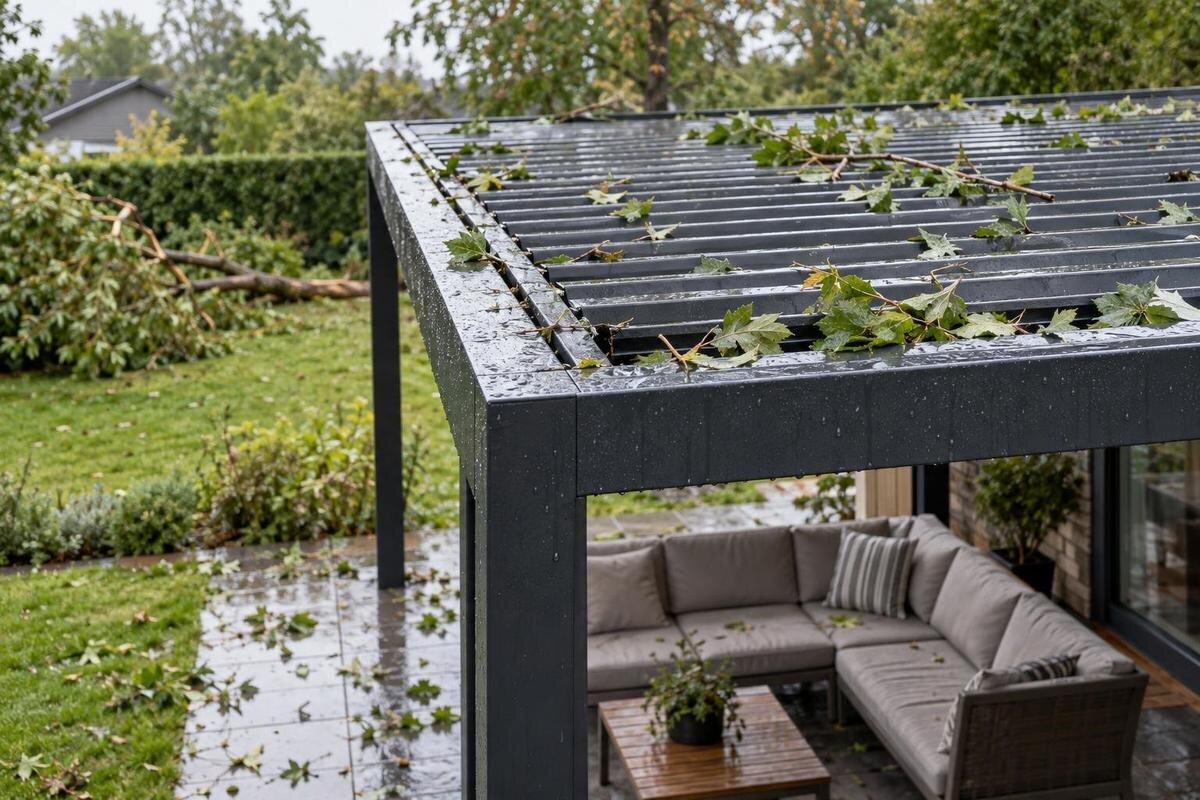
After a storm, the first question is whether the site is safe to approach—not whether a loose-looking part can be pushed back into place. Once wind, rain and nearby hazards have settled, inspect the pergola from ground level. Look for visible movement, displaced roof components, water pooling or ground washout, and record changes without touching or operating anything. A shift in a post, beam or wall connection, or any doubt about stability, needs assessment by a qualified pergola installer or suitable building professional.

Wait until the site is safe to approach
Wait until the wind has eased, rain has cleared enough for a good view and the ground is stable underfoot. Do not approach through floodwater, across slippery paving, beneath unstable branches or beside a damaged wall or fence that could fall. Choose a route that does not pass underneath any roof section that looks displaced. Keep children, pets and visitors away; even a small-looking shift can make a component unsafe to approach. If a power line is down, or a line or electrical equipment is in water, stay well back and contact the appropriate emergency service or electricity network operator.
Use ground-level viewpoints only. Do not use a ladder or step stool, climb onto a roof, reach above your head or lean on the frame. Avoid standing under a bowed beam, hanging panel or visibly shifted section. Do not shake a post, push a part back into place, pull out a trapped branch or handle broken material to see how loose it is. If a feature cannot be seen safely, note that and wait for a qualified person; getting a closer photo is not worth entering an unsafe area. Keep people out until obvious hazards have been assessed.
Record visible changes before clearing anything
Before moving furniture or clearing debris, take a wide photograph from a safe distance showing the pergola in relation to the house, paving and nearby trees. Then photograph visible changes from a few ground-level angles, using zoom rather than stepping beneath a damaged section. Keep the original files and note the date, approximate time, weather you observed and which side of the structure each image shows. A pre-storm photograph taken from a similar position is a useful comparison; do not rely on memory alone to decide whether a post, beam or gap has changed. If you did not see the storm, say so rather than guessing when the change occurred.
Describe what you see without diagnosing the cause. ‘The gap beside the rear post looks wider than in the earlier photo’ is more useful than ‘the footing has failed’ if you cannot verify it. Name the affected post, beam, roof area or wall junction and a nearby landmark that helps locate it; note any visible water or debris as well. Add the product name and any model or order reference from your paperwork. If your records identify a Bloomcabin Bioclimatic Pergola, copy that wording accurately so the recipient knows which product your enquiry concerns. If someone else witnessed the storm, keep their account separate from your own observations.
Check posts, beams and wall connections for movement
Look along each post and beam for a visible change from how it looked before: a post that now appears to lean, a beam that seems bent, a corner that has dropped or a new gap where beams meet. Compare the view with dated photos and fixed nearby features, such as the edge of a wall or paving; memory and perspective can be misleading. Where visible, note a shifted base plate, a fitting that appears to be missing, a fresh split or a newly exposed gap. These are observations, not a diagnosis. Do not touch or tighten fixings, climb to take measurements or assume a frame is sound because no obvious part is missing. Check from another safe angle if it helps show whether the change is limited to one side.
On an attached pergola, look from ground level along the visible junction between the frame and the building. Record fresh separation, cracking or displaced wall finish, and note whether the change is on one side or along a longer section. For an installation identified in your records as a Bloomcabin Wall-Mounted Pergola, include that name when describing the affected connection. Record what is visible without assuming how concealed fixings are arranged. If you see movement at a support or wall connection, keep clear and do not use the pergola until a qualified installer or building professional has assessed it. A single photo may not distinguish a new mark from an older one, so label any uncertainty honestly.
Inspect roof elements without operating them
Where the design has louvres, a canopy, panels or another roof element, check from a safe position for a missing piece, a visibly bent edge, a section sitting out of line, a new gap or something hanging down. Note whether it affects one area or several, but do not climb to inspect the upper surface or clear debris. If leaves or other material obscure part of the roof, record what you cannot see rather than reaching up to remove it. A ground-level look is limited, so do not infer that every connection is sound because the visible face appears aligned. Avoid standing under anything that looks bowed, detached or unstable.
Do not open, close, rotate or push a moving roof part to test it after a storm. If the pergola has a motor, lighting or another electrical accessory, look only for visible damage such as a loose fitting, exposed cable or water nearby. Do not touch controls, wiring or wet equipment, restore power, reset a mechanism or test it. Ask a qualified electrician or service technician for advice if electrical damage or water entry is suspected. Only assess features actually fitted to your pergola. If your records name a Bloomcabin Pergola, include that exact name and any model reference when seeking advice, and describe which roof element or accessory is affected.

Trace rainwater and runoff around the pergola
Follow water paths visually, without walking across a slippery deck or probing the ground. Look for pooling around posts, runoff crossing paving, soil or gravel washed away, fresh channels, water entering a nearby building, or an overflowing outlet or downpipe where one is fitted. A wet patch alone does not prove that a footing has shifted. Record where the water gathered, whether the pattern differs from what you normally see, and whether the ground, paving or garden edge has visibly moved. If surface water is still present, make a safe note now and photograph again after it has receded. Trace a runoff route only when it is visible; do not guess where water came from.
Keep clear of soft, sunken or eroded ground beside a support. Do not dig, lift a paver, pour more water onto an area or try to clear a blocked outlet if access would put you near a damaged structure. When reporting the water path, include the product name recorded in your paperwork, such as the Bioclimatic Pergola, alongside photos showing where water collected on your site. Distinguish water around a post from water at an outlet or along the edge of the paving. Repeated pooling, washout, a new gap around a base or water entering the home needs follow-up. Describe the evidence rather than attributing it to a foundation defect.
Check accessories and surrounding structures
Look around, not just at the frame. From a safe route, note fresh impact marks on posts, beams, the nearby fence or wall, and any fallen branch or outdoor item that may have struck the pergola. Record damage to paving, decking, garden edges or nearby fittings separately so an assessor can tell what belongs to the structure and what is adjacent. Do not lift a heavy branch, handle sharp fragments or shift a leaning object before photographing it if that would bring you close to a hazard. If something needs moving to prevent immediate harm, prioritise people’s safety and seek help rather than inspecting beneath it.
Where a screen, side panel or fitted accessory is present, look for a tear, skewed edge, hanging section or visible separation; do not pull it to test whether it is secure or try to reattach it. Note which side it is on and whether the frame next to it also appears changed. If your records identify a Bloomcabin wall-mounted model, label photos to show whether the affected accessory is beside the house or beside a freestanding post. This helps the assessor locate it in relation to the building junction and other supports. A nearby gutter, fence or plant may also be damaged, but do not assume it caused a pergola change simply because it is close.
Prepare photographs for a professional assessment
Make a small, consistent set of images rather than dozens of near-identical shots: one wide view, one mid-distance view of the affected area and a closer image only if it can be taken from safe ground. Include enough surrounding context to show which part you mean; a tight crop can hide whether a gap is at a post, beam or wall. Take a second view from another safe angle if it clarifies the relationship between parts. Keep an untouched original alongside any annotated copy. Do not enter an unsafe area to include a ruler, person or close-up for scale; add a written description instead.
When you send the record to an installer, supplier or other qualified assessor, label each image with its date and location, and attach an earlier comparison if you have one. Include what changed, what you could not safely inspect, and any model, order or manual reference from your files. If your invoice identifies the product shown on the Bloomcabin Pergola product page, include that name with your installation photos. Use catalogue images only to help identify the product, not to illustrate its current condition or establish a replacement-part match. Keep a copy of the information and images you sent so you can refer to the same record during follow-up.
Know which damage needs professional assessment
Stop using the pergola and keep people out if a post or beam has moved, a support or wall connection appears separated, a roof component is hanging or displaced, or there is a new visible crack or gap alongside movement. Do the same if ground has washed away at a support, a base appears to have shifted, or you are unsure whether the structure is stable. Do not wait for the damage to worsen, put weight on the frame or secure a suspect part with a makeshift tie. If the area poses an immediate hazard, keep well clear and get appropriate help rather than approaching for another inspection.
Ask a qualified pergola installer or building professional to assess structural movement, support connections and the installation context; use a qualified electrician or service technician for suspected damage to electrical parts. A photograph can help explain the concern, but it cannot establish the condition of concealed connections or prove a structure is safe. When requesting an assessment, include the product details from your records—for example, the Bloomcabin Bioclimatic Pergola model name—together with site-specific photos and a description of the movement. State whether the concern involves the frame, its supports or an electrical feature. Do not attempt a repair while the condition remains uncertain.

Confirm replacement-part compatibility before ordering
If the damage appears limited to a replaceable component, do not order by visual resemblance alone or remove it to find a label or take a measurement. Similar-looking items may not suit the same model or configuration, and a photograph of a catalogue part does not prove a match. Gather the installation manual and order details you already have, plus a clear photo of the visible component and where it sits, taken from a safe position. Ask the supplier or installer to confirm the exact part and compatibility before arranging replacement. Do not improvise a repair with adhesive, substitute fixings or a part from another pergola.
For an enquiry, provide the pergola’s product name, any model or order reference, and the date of purchase or installation if known. State which component looks damaged, what changed after the storm and whether the frame itself appears to have moved. If your paperwork names the product shown in the Wall-Mounted Pergola listing, use that name to identify the product family, not to confirm that a particular spare part fits. Include the relevant manual page if available, but do not dismantle a damaged section to obtain more evidence. If the model or compatibility is uncertain, ask for a product-specific check before buying or fitting anything.
Keep a follow-up record after the storm
When conditions are still safe, compare the same ground-level views again after surface water has drained and the site is easier to see. Record whether pooling has cleared, whether a gap or lean looks different and whether debris has moved; do not approach to check a suspected shift more closely. A second dated image can show whether a visible condition changed, but an unchanged appearance cannot rule out concealed damage. If you notice new movement, cracking, erosion or electrical concerns, keep the area clear and escalate rather than waiting for another storm.
Keep the before-and-after photos, incident notes, model information and any professional findings together with the pergola’s records. Note which areas were visible from ground level and which remained unchecked; this prevents a limited visual inspection from being mistaken for a full assessment. Follow the qualified person’s advice about further review or return to use, and keep relevant service or parts records with the original images. The useful outcome is a clear account of observed changes and questions still requiring assessment, not an improvised repair or a claim that the structure has been certified.
Frequently asked questions
How soon after a storm can I inspect my pergola?
Wait until the wind and rain have eased, visibility is good and the route and ground are safe. Floodwater, unstable branches, electrical hazards or a visibly unstable section mean you should stay back. There is no need to inspect immediately; make a note from a safe place and arrange help if needed.
Should I operate the louvres or switch the pergola on to test it?
No. Do not open, close or rotate moving roof parts, or operate electrical features, if storm damage or water entry is possible. A mechanism that moves is not proof that the structure is sound. Keep clear of damaged wiring or equipment and ask a qualified service technician or electrician for advice.
What should I do if a post or beam looks as though it has moved?
Keep people away and do not use the pergola, push the part back or try to secure it yourself. Photograph the change from a safe distance and contact a qualified pergola installer or building professional for an assessment. If there is an immediate hazard, stay well clear and seek appropriate help.
What information should I send with damage photos?
Include dated wide and close views taken from safe ground, a description of where the change is, and earlier comparison photos if available. Add the product name and any model or order reference from your records. State what you could not inspect safely, and distinguish what you observed from what you suspect.
Does water pooling near a post mean its footing has failed?
Not by itself. Record where water collected, whether the ground or paving visibly changed, and whether there is washout or a new gap around the base. Do not dig or probe the area to test it. A qualified professional can assess persistent pooling, erosion or movement in context.
After a storm, a useful inspection creates a clear record of visible changes without putting anyone beneath a potentially damaged structure. Stay at ground level, keep people away from hazards and separate what you observed from what you suspect. Movement, damaged connections, ground washout or possible electrical damage call for professional review before the pergola is used again.
