
A Cost-Recovery Worksheet for a Restaurant Pergola
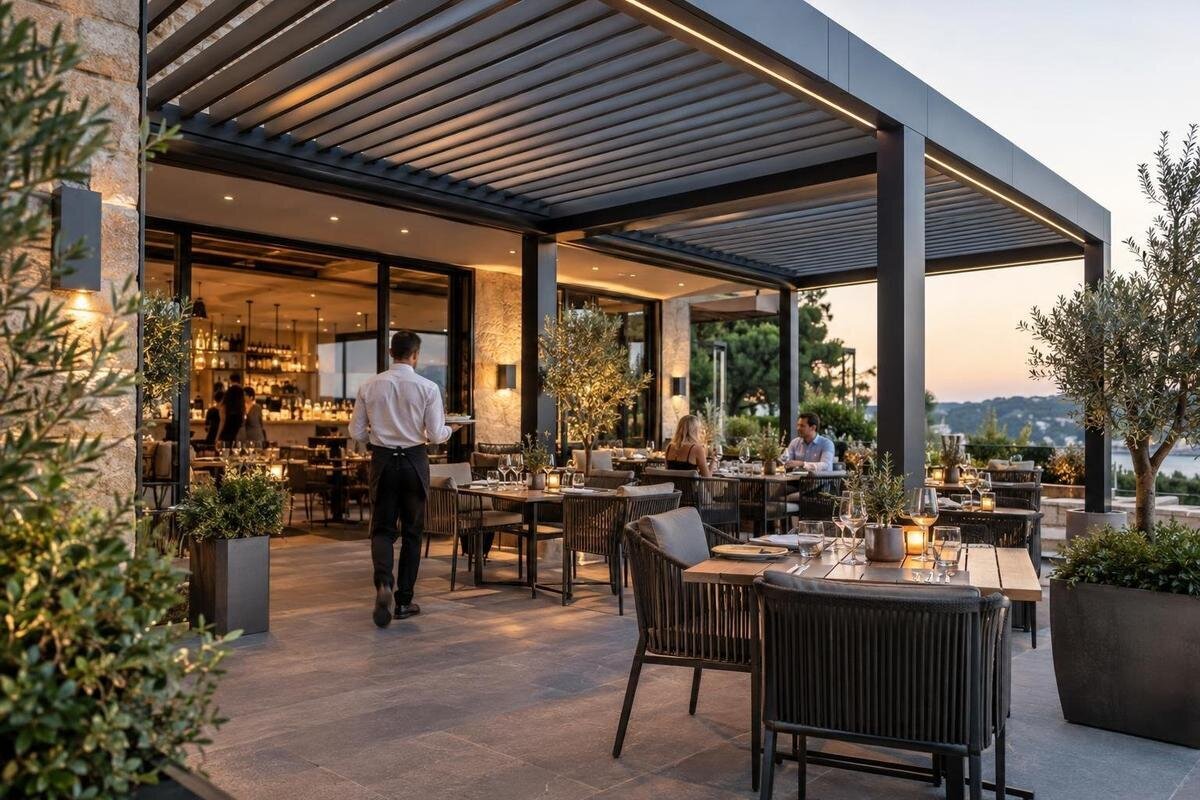
Restaurant pergola cost planning
Before committing to a restaurant pergola, test whether the proposed outdoor dining arrangement could recover its cost under your own trading pattern. This worksheet separates usable service sessions, genuinely additional covers, contribution per cover, full project cost and ongoing expense. It uses your records and scoped quotes rather than assuming more bookings or promising a payback. Keep the inputs visible so managers and project professionals can question the same assumptions.

What the worksheet can tell you
The worksheet tests a narrow financial question: under stated assumptions, could the extra operating contribution attributable to the proposed outdoor dining arrangement recover a defined project cost within a period the restaurant chooses? It is a screening tool, not a sales forecast, a guarantee of bookings or a valuation of wider benefits such as guest experience. A pergola may change where service can take place; that does not by itself mean the restaurant will sell more meals. Demand, staff availability, kitchen throughput and site requirements still shape the outcome. Choose the recovery period and financial measure before entering figures, rather than changing them after seeing the result.
Keep revenue, contribution and cash recovery separate. Revenue is the sales from covers; contribution is what remains after the variable cost of serving them; recovery compares that contribution with project and ongoing costs. Build a without-project baseline and a with-project case for the same periods. Existing customers shifted from indoors to the pergola area are not additional covers, even if the setting changes. If retaining service or improving the outdoor dining experience matters, record it as a separate operational benefit unless it can be measured as a real cash effect. Label each figure as observed, quoted or assumed, and date its source so a reviewer can challenge it.
Build a realistic baseline from restaurant records
Use the restaurant’s own history, not a generic assumption about local weather. Create one row per lunch, dinner or other service, with the date, scheduled hours, whether outdoor tables were offered, outdoor and indoor covers, and any bookings declined or cancelled. Record whether the terrace was closed or reduced and the known reason, such as weather, a private booking, staffing, maintenance or a management decision. Note requests for outdoor seating that could not be accommodated, if staff record them. Point-of-sale reports, booking records, rosters and a dated manager’s diary can be combined; retain the raw counts beside any later estimates.
Choose a period that captures the months when outdoor dining normally trades, and separate lunch from dinner if demand or conditions differ. Flag special events, menu changes, promotions, reduced hours, building work and unusual closures; these can distort a year-on-year comparison. If records miss a season, identify the gap and use a clearly labelled range rather than an industry average presented as fact. Compare similar weekdays and service types where possible, and note changes in indoor capacity. Otherwise, a rise in total covers could be wrongly assigned to the pergola. Keep observed baseline results separate from the proposed-case forecast.
Estimate additional usable service sessions
Write an operational definition of a usable session before counting any. It might mean the restaurant can offer specified outdoor seats for some or all of a service while meeting its own operating requirements; it does not mean merely that the structure is present. List relevant conditions, such as rain, sun, wind, temperature, lighting or furniture storage, only where they matter to the operation. Confirm assumptions about the proposed configuration against its documentation and appropriate professional advice. If a session is only partly usable, record it separately or assign a fraction based on service time; do not quietly count it as a full session.
Compare the definition with baseline sessions and forecast the proposed case by season or service period. Do not assume every poor-weather day becomes serviceable. The Wall-Mounted Pergola listing identifies a model with catalogue sizes stated from 9 to 24 m², but does not establish weather limits or usable sessions at your site. Ask the project team to check the design against the operator’s criteria and the site conditions. Calculate additional sessions as those in the with-project case minus sessions already usable without it, and exclude days when the restaurant is closed. Mark uncertain sessions clearly instead of turning each one into a firm trading day.
Estimate genuinely additional covers
Usable space creates an opportunity only if there is room and demand for covers that would otherwise be lost. Use a scaled floor plan to position tables, seats, service space and circulation; total square metres are not a seating plan. Count the seats remaining after those operational needs are mapped, then consider whether covers could be served at lunch, dinner or both. The Bloomcabin Pergola listing gives a catalogue size range from 9 to 24 m², but that range cannot establish a restaurant’s seat count, clear routes or approved layout. Test the actual proposed arrangement against the site plan.
For each service, estimate covers with the project and covers without it, using bookings, walk-in history and unmet demand rather than the theoretical seat maximum. Incremental covers are the difference after excluding diners who would have moved from the indoor dining room, another outdoor area or an existing table. Check kitchen capacity, staff levels, table turnover, party size and opening hours; model any of these that limit service. If the venue is often quiet, additional seats may remain empty. If it is often full, additional demand still needs evidence. Record low, central and high estimates by season, with the reason for each.

Calculate contribution per additional cover
Convert covers to contribution, not gross takings. Estimate net sales per additional cover from the actual mix of meals, drinks and service periods, then subtract the variable costs of producing and serving those orders. You can use one average contribution per cover or separate figures for different services; separate figures are more useful when lunch and dinner have different sales mixes or margins. Use transaction and recipe-cost records where possible. Apply a consistent GST basis to sales and costs, and check the accounting treatment with your accountant before combining figures from different reports.
Include food and beverage inputs, payment charges, consumables and any labour that varies with each cover. If an extra service needs a new shift or additional opening or close-down hours, calculate those costs by session rather than hiding them in a food-cost percentage. Avoid using gross sales, average spend or a generic margin as if it were cash available to recover the project cost. When assessing a candidate identified through the Bioclimatic Pergola listing, keep its project costs separate from this input: contribution per cover comes from the restaurant’s own menu mix and cost records. If contribution per cover is zero or negative, extra covers cannot repay capital in the simple model.
Include the full one-off project cost
Make a line for every one-off cost needed to deliver the proposed project, not just the structure. Start with a current written supply and installation quote, then add applicable design or survey work, site preparation, mounting or foundation work, freight, labour, professional reviews, changes to services and any furniture or lighting included in the plan. Include only items genuinely required for the proposed design, but do not omit work because another supplier will invoice it. If installation may interrupt trading, estimate that lost contribution separately and explain how you calculated it.
The Wall-Mounted Pergola product page can identify a catalogue option, but it is not evidence of the site’s installed project cost. Ask for a scope showing inclusions, exclusions, provisional amounts, GST treatment and work left to the restaurant. Keep unresolved site conditions in a separate allowance rather than quietly folding a guess into the quote. Record the quote date, who prepared it and which plan it covers. If the design changes, revise the cost lines before recalculating; an earlier price for a different footprint or scope is not a like-for-like comparison.
Allow for ongoing and service-related costs
Costs continue after installation and can change the result. Ask which inspections, cleaning, servicing or maintenance are recommended for the selected system and who will do the work; enter tasks and intervals only when confirmed for the actual design. Add consumables or replacement components when supported by a schedule or allowance, and check any insurance premium change with the insurer. If the project includes powered equipment, heating or lighting, include energy and service costs only when those items are in scope and expected use can be supported. Do not infer these costs from a model name.
Separate annual fixed costs from expenses triggered by a session or cover. Staff time to open, close, clean or manage the area may recur each service; a maintenance contract may recur yearly; food inputs vary with covers. Multiply a per-session expense by forecast sessions and place it in the annual total, but do not count the same labour in both that total and per-cover costs. The Bloomcabin Pergola product page is a product reference, not a site-specific maintenance budget. Obtain relevant estimates from suppliers, the operator and insurer, and test a higher cost where an allowance remains uncertain.
Compare project options on a like-for-like basis
Compare alternatives only after giving each the same commercial brief. For every option, list the proposed footprint, service conditions sought, seating layout, included accessories, site works, installation, professional checks, disruption and recurring costs. One quote may exclude furniture or preparation that another includes; label the gap and price it or leave it unresolved rather than comparing headline totals. Product names and broad categories are not equivalent specifications. The Bioclimatic Pergola product page can identify a named candidate in your register, but its model name does not show whether its project scope matches another proposal.
Use the same baseline, session assumptions, cover limits, contribution calculation and recovery period for each option. Keep a quote comparison sheet alongside the operating worksheet, with each cost marked as a confirmed quote, an allowance or not yet known. If a quotation depends on a site visit or design decision, mark it provisional and show how an increase would affect the result. Do not make one option appear cheaper by leaving its unpriced items out. A cautious estimate with complete costs is more useful than a precise-looking total built from quotes with different exclusions.

Calculate the break-even threshold and payback
Use a simple annual calculation before applying a more detailed finance method. Let C be the full one-off project cost, Q the genuinely incremental covers per year, M the contribution per cover, and O the additional annual operating cost. Annual contribution available for recovery is Q × M − O. Simple payback in years is C ÷ (Q × M − O), but only when the denominator is positive. If it is zero or negative, the project does not recover C under those assumptions. This calculation assumes a steady annual pattern and does not allow for interest, inflation, tax, replacement spending or residual value; state those limits beside the result.
To test a chosen horizon H without discounting, calculate the annual cover threshold as (C ÷ H + O) ÷ M, provided M is positive. This is the number of additional covers needed each year to recover the project within H under that simplified method, not a prediction that those covers will appear. For an option identified through the Wall-Mounted Pergola catalogue entry, use the actual scoped project cost for C; the catalogue reference identifies the product rather than providing a project quote. Run low, central and high cases by varying sessions, covers, contribution and costs. If financing or changing yearly cash flows matter, ask an accountant to assess them over the chosen horizon.
Validate site assumptions and review actual results
Before treating the result as decision-ready, check that the commercial and site assumptions can be delivered. Take the actual floor plan, proposed use, operating requirements and project scope to the relevant designers and qualified specialists. Confirm what review applies to access, fire safety, planning, site ownership and any building or service work; the worksheet cannot replace those project-specific reviews. Check how guest routes, staff movement, exits, neighbouring uses and service access interact with the proposed footprint. A layout drawn for the calculation is not automatically acceptable or suitable.
Make unresolved items visible, including design decisions, access or planning questions, quote exclusions, service criteria and responsibility for maintenance. The Bloomcabin Pergola catalogue entry can identify a model under consideration, but cannot confirm project suitability or satisfy a site review. For a commercial project enquiry, provide the actual plan, operating requirements and cost scope so the proposal can be assessed against the project rather than an assumed layout. Once the new dining area is in use, compare usable sessions, covers genuinely added, staff time and recurring costs with the original assumptions. Note changes in weather, hours, menu, staffing or indoor capacity before attributing a difference to the pergola.
Frequently asked questions
What counts as an additional usable service session?
Count a lunch, dinner or other service only when the proposed arrangement could let the restaurant offer outdoor service that it could not reasonably offer under the baseline, and the restaurant is open and staffed. A session that was already usable is not additional. Record partial sessions separately rather than counting them as full sessions, and do not treat every poor-weather day as an extra trading opportunity.
Should I multiply the pergola seating capacity by a turnover rate?
Not without evidence. Estimate covers for each service using the actual floor plan, past bookings, unmet demand, party size, staff and kitchen capacity. Subtract customers who would have sat elsewhere in the restaurant. If records are limited, show a cautious range and label it as an assumption rather than presenting a theoretical seat count as forecast covers.
Should the calculation use revenue or contribution per cover?
Use contribution: sales from an additional cover less the variable costs of producing and serving it. Keep annual fixed costs and costs triggered by each service in separate lines so they are not counted twice. Apply a consistent GST basis to sales and costs, and confirm the accounting approach with your accountant.
What if the annual result is zero or negative?
If extra annual contribution after operating costs is zero or negative, the simple payback formula has no positive recovery period under those assumptions. Review the project scope, cost inputs and evidence for genuinely additional covers, but do not raise the demand estimate just to produce a favourable result. The pergola may have other operational value; record that separately.
Does a product listing confirm the project's cost or suitability?
No. A product name or listed size range does not confirm an installed cost, additional service days, a seating plan or suitability for a particular site. Use the listing to identify a candidate, then obtain a scoped project quote and have the actual plan and applicable access, fire and planning matters reviewed by the relevant qualified professionals.
Use the worksheet to see whether the project still makes sense when the service assumptions are cautious and the cost lines are complete. A result that holds up under a conservative case and site review is more useful than an optimistic headline payback. If it does not, the model has done its job by showing which assumption, cost or part of the project needs reconsideration.
