
What Can Solar-Powered Pergola Lights Realistically Provide?
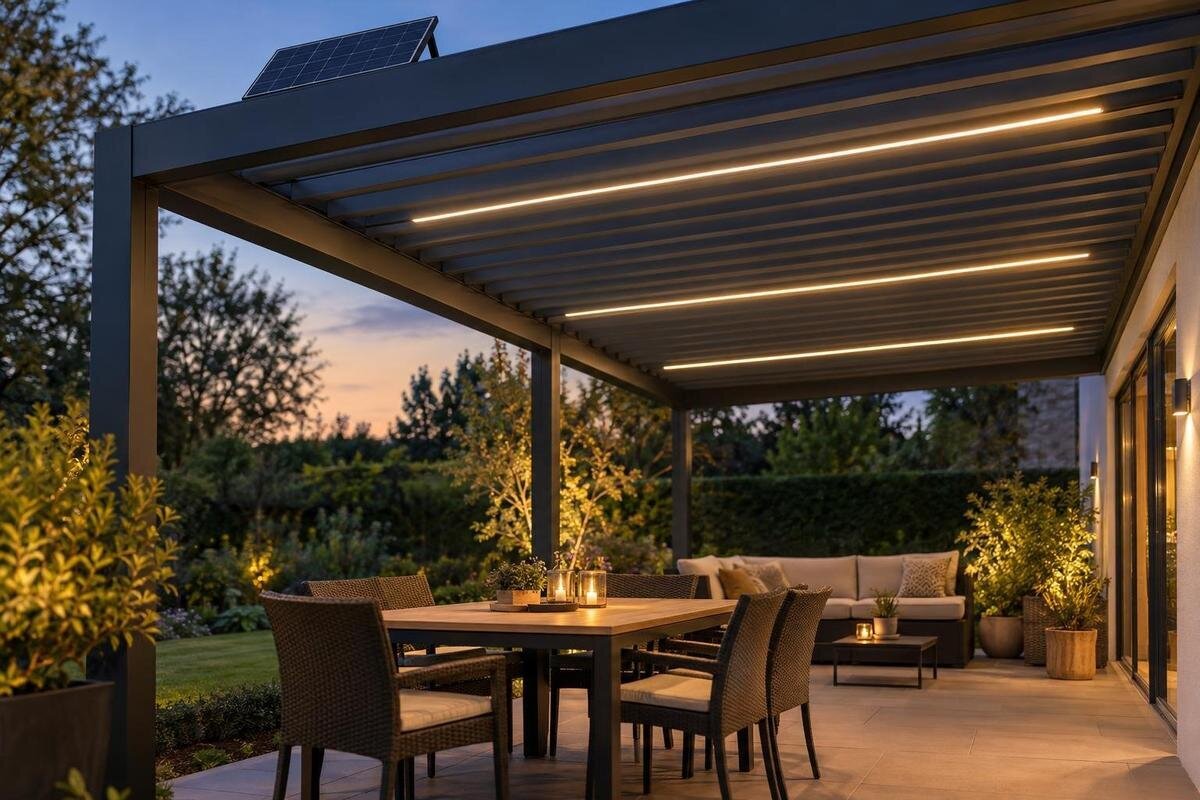
PERGOLA LIGHTING
Solar-powered pergola lights can add a gentle glow or mark a route, but the word solar does not tell you how bright a fitting will be or how long it will last after dark. The practical question is whether the panel can gather enough energy at your site, in the season you use the pergola, for the task and hours you actually need. This guide explains how to compare charging, light output and runtime without treating a sunny-day claim as a promise for every evening.

Defining the lighting task
Before comparing fittings, write down what the light must help you do. A soft glow around seating is different from making a step edge visible; lighting a dining table for a meal is different again from reading or preparing food. One brightness figure cannot show whether a beam reaches the right place. Name the task, the area to cover and the hours the light needs to stay on. If you have several uses in mind, record them separately rather than expecting a small fitting to meet every requirement at once. The specification needs to help you judge where the light will fall, not simply whether the fitting turns on.
Set a practical test for success. For a route, note the threshold, steps and the line people follow; for dining, mark the table surface and seats; for ambience, decide which corners or features should have a soft pool of light. Ask whether you need steady light or whether sensor activation is acceptable, and decide how long an ordinary evening lasts for your household. View the result from where people will sit and walk, not only from directly beneath the fitting. This separates pleasant glow from useful task light and helps you spot a mismatch before buying. It also clarifies whether one zone or several must be covered.
How solar pergola lights store and use energy
A solar fitting is a small power system. In daylight, its panel converts light into electricity; a controller manages charging, a battery stores energy, and an LED uses that stored energy after dark. Some products combine the panel and lamp, while others use a separate panel. That distinction matters under a pergola: the best place for the light may be shaded, while a panel needs a clearer view of the sky. Check the exact product’s design and instructions before assuming its panel can be relocated, or that an integrated panel will charge well beneath a roof. The layout and charging design belong in the same assessment.
Keep the system’s different ratings separate. A panel’s rated wattage describes its electrical output under stated test conditions; it does not promise the daily energy it will collect at your site. LED lumens describe light emitted, but beam shape and mounting position affect how much reaches a table or route. A lux figure measured at a stated distance or surface can be more useful for assessing a particular task, if the manufacturer provides one. Battery capacity and the selected operating mode then influence usable runtime. When planning lighting for a Bloomcabin Bioclimatic Pergola, compare the chosen light’s panel, battery and output specifications separately from the structure’s details. Panel wattage and LED wattage describe different parts of the system and should not be treated as interchangeable.
Panel exposure at the pergola
Panel exposure can matter more than an impressive runtime headline. A pergola roof, beam, wall, tree, privacy screen or nearby building may shade a panel for some or much of the charging period. A panel tucked out of sight beneath the roof may look tidy but receive less direct sun than one in the open. If a product has a separate-panel option, that gives you another possible position, not a guarantee of better charging. Check the manufacturer’s charging guidance against the place where the panel would actually sit; bright shade is not automatically equivalent to direct daylight. Leaves, seasonal growth and stored outdoor items can also change exposure.
Look at the proposed panel position through the day and across the seasons, rather than relying on one sunny snapshot. Notice moving shadows and, where roof sections or slats can change position, consider how their usual setting affects exposure. If you are planning around the Bloomcabin Wall-Mounted Pergola, assess the actual wall-side and roof-side positions instead of inferring panel access from the model name. A separate panel only helps if its permitted location, cable arrangement and exposure suit the product. Treat panel placement as part of site planning, and check it against the exact fitting’s instructions. A note of the changing shade is more useful than an assumption about the site.
Why winter charging is less predictable
Winter is when a sunny-day demonstration becomes a poor guide to regular use. In New Zealand, winter has shorter daylight hours than summer, and low sun, cloud and shade can further limit what a panel collects. The result varies with the site and the weather; one clear afternoon cannot establish how much energy will be available through a run of dull days. A battery can carry stored energy into the evening, but it can only store what has been collected. Do not assume summer performance will repeat unchanged when days are shorter and lights are needed for longer. Cloudy spells matter because they may arrive in sequence, not as isolated evenings.
Describe your pattern of use before judging a runtime claim: every evening or occasionally, one short meal or a longer gathering, and summer-only or year-round use. Compare it with any charging-time or multi-day information the maker provides for conditions close to your site. If that information is missing, treat winter runtime as uncertain rather than estimating it from a best-case number. When planning winter lighting for Bloomcabin Pergola, assess how much daylight reaches the selected panel position during the season that matters to you. Allow some margin rather than planning to use every advertised hour. A system that meets your needs for occasional summer meals may not meet the same needs on successive winter evenings.

What a runtime claim does and does not tell you
Runtime is not a fixed property of a light. It starts with the battery’s charge at dusk, then changes with brightness setting, control mode and the time the LED is actually on. A claim may describe a fully charged battery at a lower output, while your dining plan may require a brighter setting for several hours. Motion activation or a timer can reduce on-time, but may not suit a meal or conversation. Find out which setting, operating pattern and charging conditions sit behind the stated runtime; without them, the number is not a reliable match for your evening. Battery age and operating temperature may also matter, so check the manual for its stated limits.
Compare products using the same conditions: the task, required output, start time and finish time. Do not treat a long run at dim output as equivalent to a shorter run at a brighter setting, or compare figures based on different control modes. Ask whether runtime is measured from a full charge and what charging conditions are assumed; do not translate panel wattage directly into guaranteed hours. For lighting planned around the Bloomcabin Bioclimatic Pergola model, keep separate runtime requirements for a meal, a longer gathering and any brief route lighting. A partly charged battery at dusk may mean less light or a shorter evening. If the maker does not state the test setting, ask for clarification rather than assuming the longest advertised runtime applies at the brightness you need.
Match light output to ambience, routes and dining
Match output to the job. For ambience, a soft pool or accent may be enough if you want atmosphere rather than a brightly lit whole area. For a route or threshold, the beam needs to reach the line people follow rather than simply shine above it. For dining, check the light on the tabletop and at the seats; a fitting that looks bright when viewed directly can still leave the working surface dim. Reading, food preparation or handling small items calls for more dependable task illumination than occasional outdoor dining. Use the maker’s output and beam information, and judge against your own use rather than a broad label such as outdoor lighting.
Covered floor area is not the same as illuminated task area. A narrow beam can make a bright spot and leave nearby seats dark, while a wider spread may be less intense at the table; the exact result depends on the fitting and position. The Wall-Mounted Pergola range is listed from 9 to 24 m², but a structure’s stated area does not tell you how many solar lights are needed. Sketch the table, seating, entry and route, then compare their positions with the stated beam or illuminance data. A floor-area figure describes the pergola footprint, not the light’s distribution. Avoid assuming a single fitting covers every corner because it is described for outdoor use.
Check mounting against the exact pergola
Mounting changes how light spreads and what the panel sees. A higher position may spread light over a larger area but reduce its intensity at a particular surface; a lower position may concentrate it. Use the chosen fitting’s placement guidance rather than guessing from its lumen figure. Check whether the proposed point is shaded by roof members and whether opening or moving the roof would affect the panel or light. Avoid a panel position that the usual roof setting will routinely shade. If a remote panel is permitted, confirm that the specified arrangement reaches a suitable exposed position. The exact fixture manual should cover its approved mounting method; a generic photo of another pergola is not evidence of compatibility.
When considering lights for the Bloomcabin Pergola model, assess the proposed attachment point as well as the position of the beam and panel. The light’s documentation needs to establish its approved mounting method and compatibility with the intended pergola configuration. A bracket, cable route or moving roof section could affect the fit, so information for a generic product family may not answer the question. Keep these details together in the proposed layout: a position that gives good illumination is not necessarily an acceptable attachment point. Any structural attachment or fixed electrical supply needs its own assessment by an appropriately qualified professional.
Outdoor suitability and battery care
Outdoor suitability is a property of the exact light and its parts, not a label you can infer from the pergola’s shelter. Check the stated outdoor rating and the manufacturer’s limits for the LED fitting, panel, battery housing, connectors and any supplied lead. A roof may reduce direct rain yet still leave parts exposed to wind-driven rain, damp and temperature changes. Do not read a general word such as weather-resistant as permission for every location. The manual needs to match the exposure and intended mounting position; where the rating is unclear, ask the supplier or maker for clarification before purchase. A rating for one component may not cover an accessory or a different mounting position.
Maintenance can change what you get over time. Consider the panel’s care requirements, including whether it can be inspected and cleaned without awkward or unsafe access, and check how the light signals a low battery or charging fault. Ask whether the battery is replaceable, what service information the maker provides and whether cold or heat affects the stated operation. When choosing lights for a Bloomcabin Bioclimatic Pergola, include access to the panel and battery housing in your layout, rather than considering only how the fittings look from below. A panel that is difficult to reach may be harder to keep clear. Check these maintenance needs before settling on a discreet but inaccessible position.

When solar lighting may fall short
Solar alone may not meet the brief if the site has little useful sun, if the panel is shaded for much of the day, or if you need consistent, bright light over a long winter evening. It may also fall short when a modest glow is not enough and dimming would make the task difficult. That is a question of matching the system to the use, not a verdict on every solar product. Mark which requirement is essential: a visible route, usable table lighting, a particular number of hours or dependable output after several overcast days. A late meal followed by hours of steady light asks something different of a system than a brief accent use.
If a light cannot meet that brief, compare a product designed to place its panel elsewhere or a system with a different power source, but do not assume either will suit the structure. A mains-powered option needs appropriate outdoor equipment and professional electrical planning; the exact fitting, controls and mounting still need checking. Discuss the intended task, site exposure, seasonal use and approved mounting with a qualified electrician alongside the relevant supplier before choosing a fixed system. The useful comparison is not solar versus mains in general; it is whether each proposed system can meet your task and runtime requirements at this particular pergola.
Compare each option against the same evening
Use a short comparison record for every candidate. Note the activity, area and hours; whether the light must be steady; the output setting and beam information; the panel location and shade; the battery and runtime claim conditions; and the specific outdoor exposure. Add the season you care about most and your pattern of use. This keeps easy-to-overlook details, such as a runtime quoted at low brightness or a panel intended for full sun, beside the headline claim. Write down what you need to see clearly and at what time; broad terms such as bright or long-lasting are too vague for comparison. Mark unpublished details as unknown rather than filling the gap with a guess.
Apply the same requirements to each option. Ask for an answer at the setting you need: full or reduced output, continuous or sensor-controlled use, and the stated conditions behind charging and runtime. If you are considering the Bloomcabin Wall-Mounted Pergola model, mark the proposed panel and light locations on the layout used for your comparison. Keep the structure’s dimensions separate from the fitting’s lighting coverage. Where information is missing, identify which decision it affects: brightness at the table, charging in winter or hours of operation. Choose an option that covers your essential requirements, or be explicit about any compromise, such as shorter evenings or lower output. This makes the comparison more useful than asking whether a light is generally suitable for a pergola.
Frequently asked questions
How many solar lights do I need under a pergola?
There is no reliable number based on floor area alone. Mark the surfaces and routes you want to light, then compare the fittings’ beam coverage, output and mounting guidance with that layout. A broad area can still contain several distinct tasks.
Will solar pergola lights work through a New Zealand winter?
They can work in winter if the system collects enough energy at its site, but shorter days, shade and cloudy spells reduce the charging margin. Check seasonal charging and runtime information for the exact product; a summer test is not proof of winter performance.
Does the advertised runtime tell me how long a light will run each night?
Not on its own. Find out whether the figure assumes a full battery, which brightness setting it uses, and whether the light runs continuously or through a sensor or timer. Your actual runtime also depends on how much charge the panel collects.
Can I put a solar panel under the pergola roof?
Only if the product instructions say that position provides suitable charging. Roof members can create shade even when the area feels bright. If the design offers a separate panel, check its permitted location, connection arrangement and exposure against the exact product manual.
Can a solar light replace mains lighting for dining?
A suitable solar fitting may cover a modest dining task, but do not assume it will match mains-powered output or run for every evening. Check the light reaching the table at the brightness you need, and its runtime under the charging conditions expected at your site.
The realistic promise of solar pergola lighting is not one fixed number of hours or a substitute for mains power in every setting. It is a light that performs a defined task, for the chosen duration, when the panel can recharge it under real seasonal conditions. Set the task first, check the output where you need it, and read runtime alongside its brightness and charging assumptions. If winter dependability or strong task lighting is essential, make sure the evidence supports that brief before choosing solar alone.
