
What Rain Sensors on a Pergola Can—and Can’t Detect
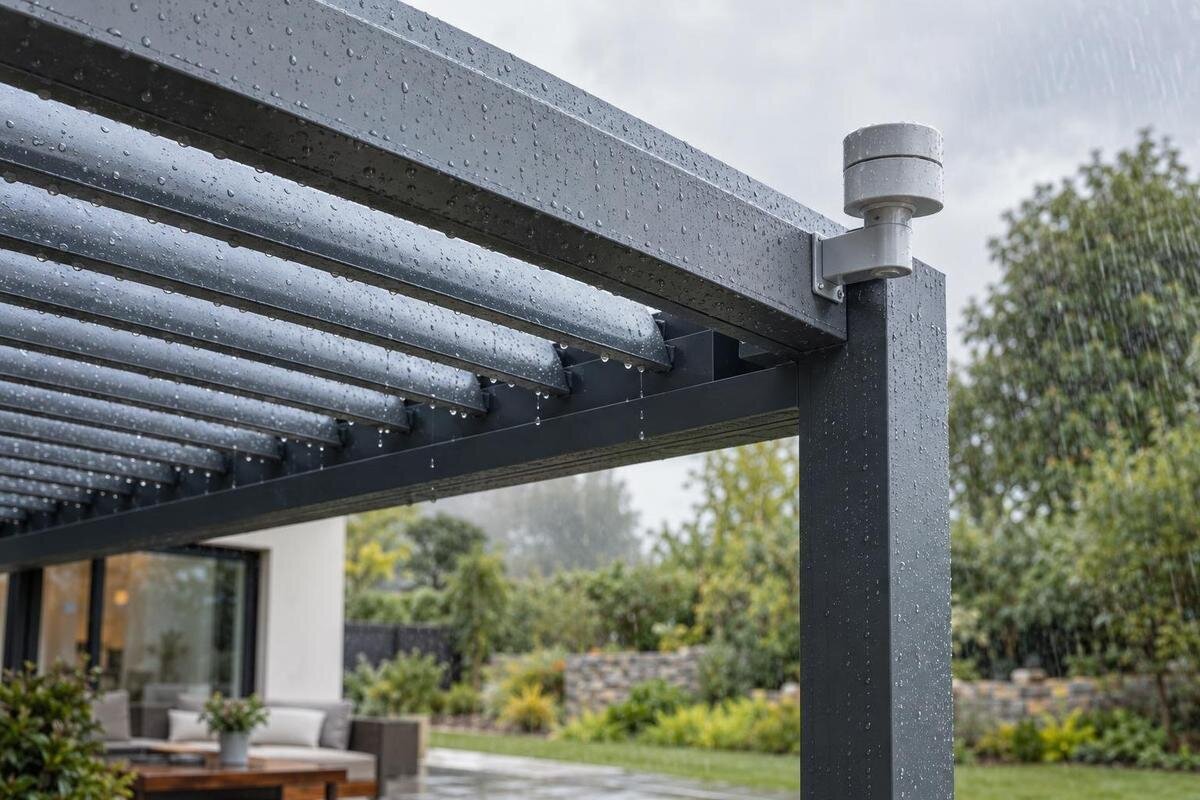
Pergola controls
Rain sensors can help a pergola respond to a defined wetness signal, but they do not assess the weather as a whole or guarantee that the area beneath a roof stays dry. The useful question is not simply whether a system has a sensor. It is what the device detects, how the controller interprets that signal, and which roof movement follows. Trigger thresholds, delays, reset rules and behaviour during a fault vary by system. This guide explains what to look for in model-specific documentation, and where a rain sensor’s job ends.

What a pergola rain sensor measures
The term rain sensor covers different sensing methods. A surface-wetness device registers water at its own exposed element; a gauge-style device may register a defined amount or rate. These produce different signals: a controller might receive a simple wet/dry state, a threshold event or a measured value. None automatically describes rainfall across your whole deck or patio. Read the manual for the sensing principle, the units if there are any, and the precise condition that counts as rain. If a sales description gives only a feature name, ask the supplier to identify the sensor and share the relevant specification.
Keep product identity separate from control evidence. The Bloomcabin Bioclimatic Pergola product listing identifies a model, but its name alone does not confirm a rain sensor, motor, controller or automatic roof response. For any option you are considering, establish whether detection is included, an optional accessory or a third-party addition. The specification should identify what the detector sends to the controller, rather than simply show a rain icon in an app. For example, a wet/dry signal answers a different question from a measured rainfall value: one reports a state, while the other supplies a quantity that a control rule may use. Knowing which signal is available helps you understand the settings described later, without treating every feature labelled rain detection as the same thing.
How a sensor signal triggers roof movement
Detection is only the first step. Where the roof is motorised, the sensor must send a signal the controller can accept; the controller applies a rule; then the mechanism attempts the command. A wet sensor does not necessarily mean immediate movement: a programmed delay, minimum wet period or operating mode may intervene. Depending on roof design and control logic, a response might move adjustable louvres, deploy or retract a cover, or send an alert without moving anything. The exact action and direction must come from that system’s documentation; the phrase rain response does not say what will happen.
Ask the supplier to describe the sequence in order: what condition starts the trigger, whether a timer applies, what command follows, and what happens when the sensor dries. When discussing the Bloomcabin Pergola product page, keep that sequence tied to the exact configuration being offered. A useful explanation separates detection from the command and the resulting movement. If the stated response is to close the roof, for instance, ask whether the command begins as soon as the trigger is met or only after a delay. If the response is an alert, establish what you must do yourself. This also makes demonstrations easier to interpret: seeing the sensor register water is only the first part of the sequence, not a demonstration of the complete roof response. Each step should have a clear meaning rather than being covered by the single word automatic.
Thresholds, delays and reset settings
A trigger threshold could mean that a sensing surface has become wet, that it has stayed wet for a set period, or that a measured amount or rate has crossed a limit. A sensitivity control may change when the system reacts, but a label such as high or low is not a comparable measurement on its own. Ask what the setting actually changes and whether the supplier can give the trigger condition in plain language. Without the relevant manual, there is no universal rainfall value or sensitivity level that can be applied to every pergola sensor.
The reset rule matters as much as the trigger. Some controls may wait for the sensor to dry or for a clearing delay to finish; others may use a separate clear threshold or require a manual reset. Find out whether the roof stays in its new position, returns to a previous one or waits for another command once the rain signal clears. For a configuration discussed through the Wall-Mounted Pergola listing, ask how these settings affect normal use after a shower. A cleared rain signal and a reopened roof are not necessarily the same event. If you prefer to restore shade or ventilation yourself, the relevant question is whether manual control is available at that point. If you expect the system to return automatically, establish which position it returns to and what starts that action. This avoids confusing the end of detection with the next roof command.
Why sensor readings may differ from conditions on your deck
A sensor reports what happens at its own mounting point, not across the whole outdoor area. A sheltered position beneath an overhang may remain dry while rain reaches the deck; a more exposed position may get spray or splashes. Wind can also change where rain falls. The sensor’s position relative to the roof, nearby walls and any shelter can therefore affect when it registers water. Ask the supplier or installer where the sensor is intended to sit and whether that location follows the manufacturer’s instructions for the exact model.
A wet surface does not always tell you why it is wet. Depending on the sensing method, dew, mist, irrigation or water from cleaning may affect a surface detector, while a short shower may not meet a programmed duration or threshold. Do not assume every sensor can distinguish those conditions. Ask whether the system registers simple wetness or measures rainfall, and how its stated trigger relates to the conditions around your deck. This distinction also helps explain an apparently unexpected response. Movement after irrigation does not, by itself, show that a wetness detector has misread its input; it may have registered water exactly as designed. Likewise, no movement during a brief shower does not by itself identify a fault. The location, sensing method and trigger rule all matter when interpreting what you observe.

What rain detection cannot confirm
Rain detection is not a weather forecast. It cannot tell you when a shower will start, how long it will last or what will happen at another part of the property. Nor does a wet signal establish that water is being kept out at every roof edge, that the drainage path is clear or that there is no leak. Those are separate questions about the roof design, installation and water management. A sensor does not change the physical coverage of the pergola or make an exposed side weatherproof.
A signal to move is also not proof that the roof reached the requested position. Unless the control system reports position or a fault, the sensor may tell the controller that rain was detected without confirming the outcome of the command. When reviewing the bioclimatic pergola model page, distinguish any stated rain detection from roof-position feedback. An indicator labelled rain detected answers whether the input has registered rain; an indication of the requested roof position answers a different question. Ask what each status message actually represents, especially if you plan to check the system without standing beneath it. Roof coverage and drainage remain separate considerations too. Even a confirmed roof position would not, on its own, tell you whether water is entering at an exposed edge or whether the drainage path is clear.
Rain detection does not replace wind sensing
Rain and wind are different conditions. A rain sensor does not measure wind speed or direction, so it cannot decide whether a gust is approaching or assess wind-driven rain. It may register rain on its sensing element while wind pushes water beneath a roof edge; it may also remain dry when wind carries rain onto a sheltered part of the deck. The presence of rain detection alone therefore says nothing about how the pergola responds to wind or whether a particular roof position is appropriate for changing conditions.
If a system offers a separate wind input or other weather control, confirm exactly what is included and how it interacts with the rain rule. Ask which signal has priority if rain and wind are detected at the same time, whether the controls apply to the same roof zone, and what limits the manufacturer documents. Do not assume that one sensor covers several weather conditions or that a rain-triggered movement is also a wind response. These functions need their own specifications.
Check compatibility with the roof and controller
A sensor has to suit both the control system and the roof mechanism. The controller must be able to receive the sensor’s signal, and any roof movement must be supported by the mechanism and its controls. A system may use a particular input, accessory or interface; a sensor that detects rain is not automatically compatible with every pergola controller. Where there are separate roof zones, also ask whether the trigger affects all zones together or only a specified one. Do not infer compatibility from a roof type or the word motorised.
Use the regular pergola model listing to identify the model, then confirm the exact roof, controller and sensor combination being offered. Ask for the sensor’s part number or model, the controller it works with, and whether it is included or an additional component. Keep these details together when comparing quotations: two offers using the same pergola name may describe different control configurations, so the name alone is not a useful compatibility check. If a third-party retrofit is proposed, have a qualified installer confirm the interface and installation requirements for the exact system. The practical question is not merely whether the added device detects rain, but whether its signal can produce the intended response through your controller. A generic product image or app symbol cannot explain that connection.
Ask what happens when power or communication fails
The sensor, controller and any powered roof mechanism may depend on different parts of the system, so ask what happens if power is lost at each relevant point. A wired sensor, a wireless connection and a feature that uses Wi-Fi do not necessarily have the same failure behaviour. Find out whether the roof remains in place, stops, or follows another documented response, and whether the system reports that the sensor or connection is unavailable. No default position should be assumed without the manual for the exact setup.
Clarify how manual control works and whether it remains available during a network outage. For the configuration associated with the Bloomcabin Wall-Mounted Pergola page, distinguish loss of a network feature from loss of the sensor signal or power to the mechanism. Ask what happens when each connection or supply returns: does the controller act on a current wet reading, resume a previous setting or wait for a new command? Recovery behaviour matters because the condition at restart may differ from the condition when the interruption began. A shower could have ended, or the sensor could still be wet. The explanation should make clear which input or setting governs the next action. Keep these questions focused on the rain response rather than assuming that every interruption has the same effect.

Test the response and follow the maintenance instructions
During commissioning, ask the installer to demonstrate the manufacturer’s approved test procedure. You should be able to see how the sensor changes state, whether the controller receives that signal, what delay applies and what movement or alert follows. Ask for the reset to be demonstrated as well, so you know what happens when the wet condition clears. Do not improvise by spraying a sensor or its electrical components unless the manufacturer explicitly says that is an approved test method. A simulated app command may not prove that the live sensor is communicating.
Maintenance requirements depend on the sensor and its installation. Ask how to inspect it, what cleaning is permitted and how the manual says to identify a fault; do not assume that a particular cleaning product or schedule is suitable. Keep the care instructions for the sensor separate from general care information associated with the product page for the bioclimatic model. If detection becomes inconsistent, note what you observed: whether the sensing area appeared wet, whether the controller showed a rain signal, and whether the expected action followed. These observations help distinguish an unclear reading from an unclear response without requiring you to diagnose or alter the equipment. If a sensor is dirty, damaged or reporting inconsistently, treat automatic rain response as unverified until the supplier or installer has checked it.
What to confirm before choosing a rain sensor
Before choosing a system, decide which part of the rain response matters most to your use of the pergola. If you want movement without a manual command, an alert-only arrangement would not meet that expectation. If you want to know whether the roof actually moved, detection alone would leave that question unanswered. If you use separate roof zones differently, the scope of the rain command becomes important. Compare offers against those priorities rather than counting weather-control features. A written operating sequence is useful because it lets you compare the same stages in each offer: detection, command, outcome and recovery. It should also make clear which actions remain yours, so you can judge whether the proposed level of automation suits your routine.
Check whether the sensor and any control components are included in the quoted configuration or must be added. When considering the Bloomcabin Pergola listing, keep the quoted configuration alongside the matching operating information so that the feature you are evaluating is the feature you would receive. A useful comparison separates confirmed functions from questions still awaiting an answer; it need not assume that the option with more settings is the better choice. A clearly explained wetness trigger with a response you understand may be more relevant to your needs than a broad automation label. Equally, if position feedback or a particular reset behaviour is essential to you, do not treat basic rain detection as an equivalent. Choose on the basis of the complete response, including its limits, rather than the presence of a sensor alone.
Frequently asked questions
Does a pergola rain sensor automatically close the roof?
Only if the sensor is compatible with a controller that is set to move that particular roof. Some systems may send an alert instead, and the direction or timing of movement depends on the documented setup. Check the exact roof response rather than assuming rain means it will close.
Can a rain sensor tell light rain from heavy rain?
That depends on what it measures. A surface-wetness sensor may report that its sensing area is wet, while a device measuring rainfall may use a defined amount or rate. Check whether the system has separate thresholds; do not assume a sensitivity setting distinguishes drizzle from heavy rain.
Will a pergola rain sensor keep my outdoor furniture dry?
It cannot guarantee that. The sensor reports a condition at its own location; it does not confirm that rain is kept out at every edge or that the roof has moved successfully. Wind-driven rain, the roof design and drainage can also affect whether the area beneath stays dry.
Can a rain sensor detect wind or forecast a storm?
No. A rain sensor detects the condition its own sensing method is designed to register. Wind speed, wind direction and forecasts require separate information or equipment. If a system offers other weather controls, confirm that they are included and how they interact with the rain response.
What happens if the power or connection fails?
There is no universal default. The roof may remain where it is, stop, or behave in another documented way, and a networked feature may have different requirements from a local sensor. Ask what happens during each type of failure and how manual control works.
The practical way to judge a pergola rain sensor is to trace the full chain: what it detects, what triggers the controller, what the roof is commanded to do and how the system responds when something fails. The sensor is only one part of that arrangement, not a forecast or a guarantee of shelter. When those details are clear for the exact model, you can decide whether automatic rain response suits the way you use your outdoor space.
