
Which greenhouse colour suits your home and garden?
Greenhouse planning and garden design
Which greenhouse colour connects your home, garden and personal style?
A greenhouse frame colour does not determine its usefulness, but it strongly shapes its presence in the garden. Considering the façade, paths, patio, planting and light helps create a choice that continues to feel right over time.
A greenhouse is usually visible throughout the year. Its colour therefore deserves the same consideration as its location, shape and glazing. The frame can blend quietly into the existing design, provide a clear contrast, or form a restrained line between plants and architecture. What matters is not a general trend, but how everything works together at your particular site.
View the colour in different light: in the morning, at midday, under overcast skies and from the most important viewpoint. The setting also changes its effect. A dense hedge makes a frame look different from a pale rendered wall, an open lawn or a stone-paved patio. Samples, photographs and views from inside the house all help with the decision.
The best greenhouse colour is the one that supports the role you want it to play. If the building should become a deliberate garden feature, the frame may show its outline. If it should recede visually, calm links to window frames, roof details or plants are valuable. Colour cannot replace careful planning, but it can make a suitable concept visible and cohesive.
01 · Understanding colour effects
The frame defines the architecture
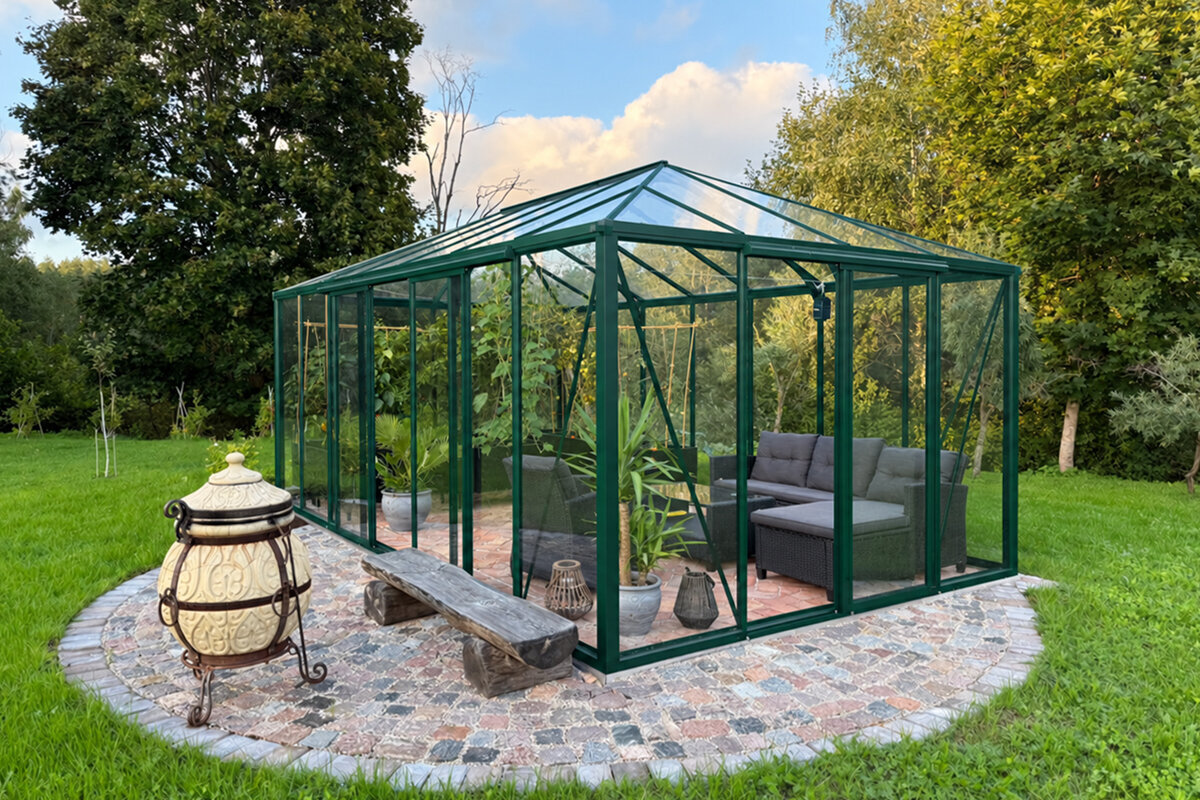
A greenhouse is made of transparent surfaces and slender lines. That is why frame colour has more impact than you may initially expect. Dark profiles outline the glass like a drawing, while pale profiles tend to dissolve visually. Green frames create a middle ground between technical construction and the living garden. No effect is inherently better; it must suit the intended presence.
Consider viewing distance. Close up, the profile colour, fittings and junctions are clearly visible. From the house or the far end of the garden, the silhouette matters most. A strong frame can give a freestanding structure definition. In a small garden already rich in detail, however, the same colour can create extra visual noise. Colour should make the proportions readable, not compete with them. Also consider the profiles at edges and intersections, where the construction becomes visually denser. A frame colour may look finer than expected when it orders the lines clearly, or more prominent when it contrasts strongly with the background.
- Dark frames emphasise contours and make the greenhouse’s geometric form easier to recognise from further away.
- Pale or green frames reduce visual weight and let plants, glazing and surroundings have greater impact.
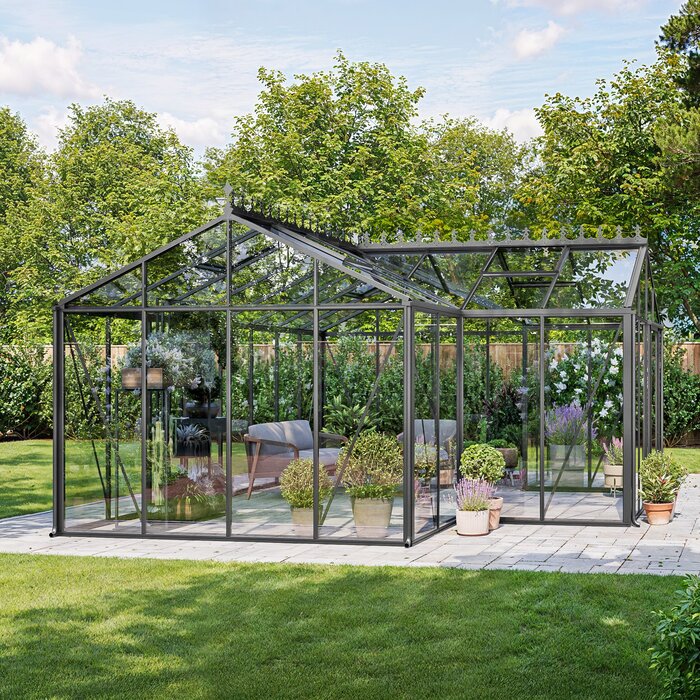
For a clearly outlined freestanding option, consider a standard Classic greenhouse with a defined frame line that gives the garden architecture visible structure.
02 · Black frames
Black for contrast and precision
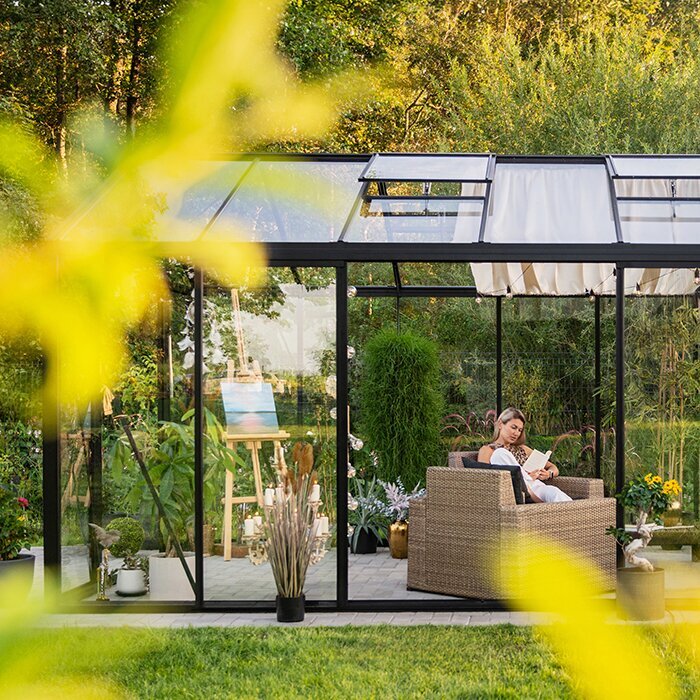
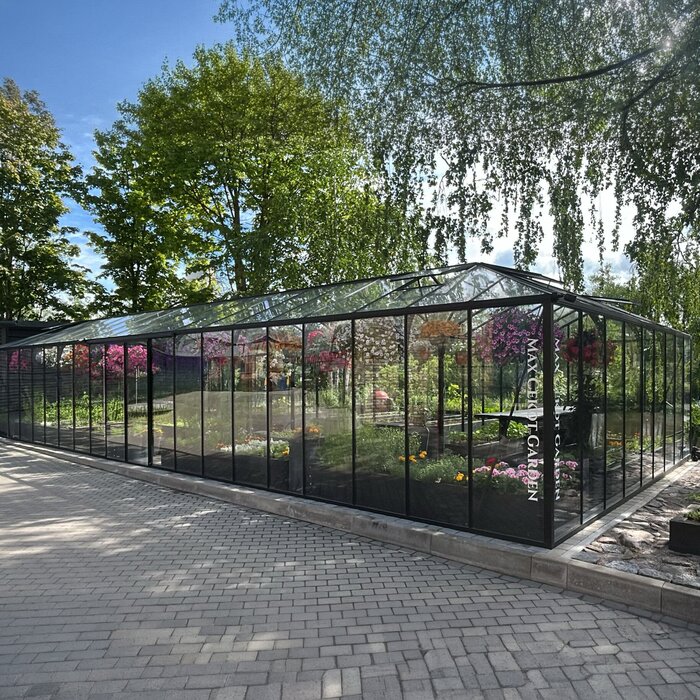
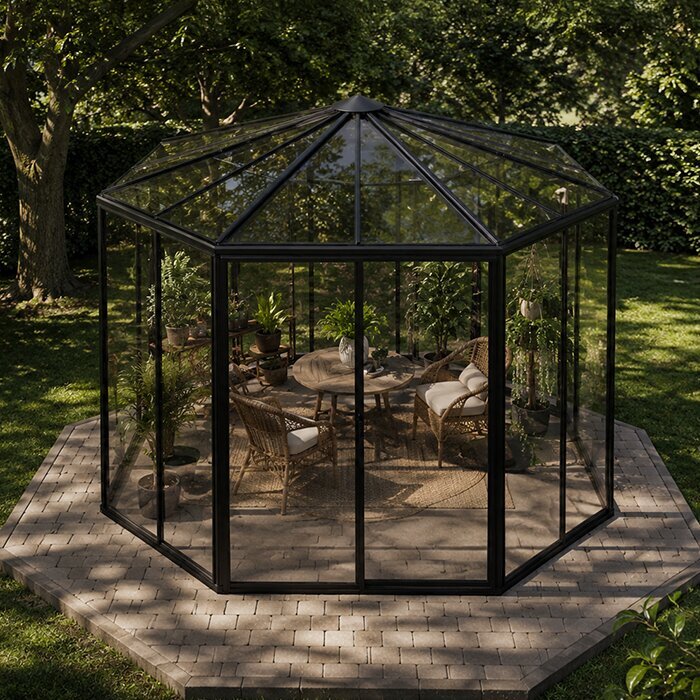
A black greenhouse often feels architectural and deliberately placed. The contrast against glass highlights glazing bars, roof lines and door frames. It can work beautifully with charcoal windows, dark roof details, black lights or steel furniture. Beside pale render, gravel and restrained planting, it also creates a clear contemporary composition. Black is therefore less a neutral choice than a design statement.
Black can also work in lushly planted gardens when you want to create structure. Against deep green foliage, the profiles stand out clearly, while pale flowers and terracotta provide lively contrast. Consider nearby dark fences, sheds or façades, though: when too many visually heavy surfaces meet, the area can feel compact. Open sightlines, light ground materials or airy planting around the site can help. Black feels especially coherent when its clear linework finds an echo nearby, without every detail needing the same colour. Just a few repeated accents can be enough to make the greenhouse feel like an intentional part of the overall design.
- Repeat dark accents sparingly in lights, furniture frames or planters so the frame does not appear isolated.
- Check the view under overcast skies; black often appears more prominent there than in sunny garden photographs.
Beside a dark or clearly structured façade, a full-size standard black lean-to greenhouse can continue the existing lines with calm precision.
03 · Green frames
Green lets the greenhouse grow into the garden
Green is the natural choice when a greenhouse should feel embedded in the garden rather than staged within it. The shade relates to hedges, lawns, shrubs and perennials without needing to match them exactly. In rural, romantic or long-established gardens, this can feel pleasantly effortless. The structure remains visible, yet is usually less dominant than the seasonal change of plants.
The surroundings determine success with green as well. A frame beside evergreen hedges looks different from one against silvery foliage, red brick or a natural-stone wall. Focus on the prevailing shades of green, not simply the idea of a “garden colour”. Very cool or very dark planting can make a frame stand out more than expected. A little space from dense hedges preserves light, maintenance access and a readable outline. With green frames, consider the distance between greenhouse and planting. Some separation keeps the silhouette clear, while dense greenery integrates the frame more strongly. This lets you decide whether structure or planting should be noticed first.
- Green is especially suitable where beds and shrubs frame the site and the greenhouse should look visually integrated.
- Pair the frame with natural materials such as timber, brick or gravel without needing to match every element by colour.
In an established planted garden, a standard Classic greenhouse with a green frame can show its shape while still feeling pleasantly integrated.
04 · Natural aluminium
Aluminium feels light and understated
Natural aluminium brings a practical, light note to the garden. It is neither as graphic as black nor as plant-related as green, making it a good choice for restrained overall schemes. It often creates a harmonious connection with pale façades, concrete, natural stone, galvanised metal elements or crisp patio surfaces. The greenhouse feels light while glass reflections and changing planting bring the scene to life.
Neutral does not mean invisible. Aluminium can appear brighter in direct sun and intentionally cool beside warm timber cladding. View neighbouring surfaces together: gutters, window sills, balustrades, planters and fittings all affect the result. Several metal tones on a house do not need to match exactly. More important is that the frame reads as a deliberate part of the material palette rather than an unrelated addition. Adjacent metal surfaces particularly influence natural aluminium. Silver downpipes, fittings or railings can create a quiet connection. Where very different metal tones meet, a clear, deliberately chosen palette usually looks more convincing than an attempt at an exact match.
- Natural aluminium supports light, minimalist or material-focused garden schemes with stone, concrete and glass.
- Allow for reflections: depending on daylight, the structure may appear brighter or more restrained than a colour sample suggests.
Along a light, straight-lined house wall, a full-size standard aluminium lean-to greenhouse can feel like a light extension of the existing material palette.
05 · Home and patio
Use the façade as a colour guide
The façade often provides the most reliable starting point for choosing a colour. Look beyond the render or cladding shade to repeated details: window frames, the front door, roof edge, downpipes, railings and sun protection. A black frame can echo dark profiles; aluminium can relate to silvery metal accents; green can soften the transition from house to garden. One or two connecting elements are enough.
The patio is the second important reference because the greenhouse is often seen from there. Timber decks, ceramic pavers, brick and furniture fabrics each create a different colour mood. Strong contrast can frame a seating area and give it depth. If the patio already combines many materials and colours, a quieter frame choice may work better. Place samples beside the actual paving rather than judging them only on a screen. Also assess the colour from indoors. Window frames and the garden outlook create a fixed composition. A frame that seems restrained outdoors may register as a much stronger graphic line from the living area.
- Look for recurring accents around the home rather than an exact colour match with large façade surfaces.
- Assess views from living spaces and the patio, as these determine how the greenhouse is experienced every day.
For a freestanding structure at the transition to the patio, a standard Classic greenhouse for the garden offers a clearly legible and flexibly positioned option.
06 · Garden style and seasons
Plants change every colour decision
No garden remains colour-consistent. Spring brings fresh pale greens and flowers, summer dense foliage, autumn warm shades and winter structure. A green frame can look especially integrated in summer, while black creates a strong outline against bare trees. Aluminium responds visibly to light and weather. Think not only about your favourite month, but about the seasons in which you use and see the garden.
Garden style also provides direction. A formal garden often accommodates precise contrasts and clear repetition. A naturalistic garden benefits more from materials and colours that do not demand attention. In a cottage garden, green and black can both work, depending on brickwork, paths and edging. The key is hierarchy: should the greenhouse be a backdrop, a focal point or a connecting element? Seasonal effect depends not only on frame colour, but also on flowers, foliage and ground surfaces around the site. Plan this surrounding area as a changing frame so the greenhouse retains a meaningful role in every season.
- Photograph the proposed site over several seasons if the decision does not have to be made immediately.
- Plan planting around the greenhouse as part of the colour composition, while keeping access and maintenance areas clear.
For a flowing transition between living space and seasonal planting, a full-size standard lean-to greenhouse at the house offers an intuitive starting point for the design.
07 · Proportion and location
Colour can alter perceived size
The same colour looks different on a compact greenhouse and on a generous structure. Dark frames can divide a large glazed surface and give it definition. On smaller forms, they make the construction particularly visible. Pale profiles can make surfaces feel visually lighter, while green may appear restrained at a densely planted boundary. Always assess colour and dimensions together rather than as separate decisions.
The background also affects perceived size. Against a light wall, a black frame is sharply outlined; against a dark hedge, aluminium can appear brighter. On an open lawn, the silhouette is visible from several sides, while a corner between house and screening can be designed more deliberately. Mark out the footprint on site and view it from normal walking routes. This reveals sightlines and unwanted dominance early. Viewing height also changes colour perception. From an elevated patio or upper window, roof lines are more noticeable than from a garden path. Especially with dark frames, check how clearly the structure appears from different heights.
- A contrasting frame strengthens visible articulation; a restrained frame can make glass surfaces appear lighter.
- Include background, distance and viewing direction before choosing colour solely from the building frontage.
As a clear focal point on an open site, a standard Classic greenhouse in a striking colour can visibly and deliberately support garden structure.
08 · Decide with confidence
Check colours in context before buying
A good colour decision comes from comparison, not a quick impulse. Gather photographs of your home in different light and place them beside material or colour samples. Look at the frame area, not just a small section. Discuss the choice with everyone who uses the garden regularly. This clarifies whether you want quiet integration or a distinct architectural statement.
Practical considerations matter too. A greenhouse is cleaned, planted and viewed from several sides. Consider how visible dust, pollen or water marks may be at the site without relying on blanket maintenance claims. Before ordering, check the current product images and available finishes. If attachment to the house, proximity to a boundary or building rules may matter, ask the council whether building consent, resource consent or other site controls apply. If you are choosing between two colours, describe the effect you want in a few words: striking, integrated, or light and practical. This simple priority helps you weigh individual factors instead of choosing from a small sample alone.
- Create a small materials board with a façade photograph, ground sample, furniture colour and plant images for a realistic comparison.
- Clarify design requirements and possible local conditions early with the relevant council, authority or property management.
For a colour-coordinated extension of a house wall, you can choose a full-size standard lean-to greenhouse and compare its effect within the overall setting beforehand.
Comparison
Black, green or aluminium: a direct comparison
The three frame colours serve different design purposes. This overview provides an initial guide, but does not replace looking at your site, existing materials and local light conditions.
| Colour | Effect | Often suits |
|---|---|---|
| Black | Graphic, precise and intentionally prominent | Dark profiles, clear architecture and contrast |
| Green | Plant-related, calm and integrated | Hedges, perennials, brick and established gardens |
| Natural aluminium | Light, neutral and material-focused | Pale façades, stone, concrete and silver accents |
| Black against a light background | Clearly defined and striking | Open spaces and deliberately framed views |
| Natural aluminium in dense greenery | Light, with restrained reflection | Bright garden areas with glass and clear materials |
Five steps to a harmonious colour
Work systematically so the frame colour is not chosen in isolation. A few specific observations can narrow the selection to options that genuinely suit your home and garden.
01
Identify viewpoints
Note views from the kitchen, living space, patio, garden path and driveway. Prioritise the perspectives you experience most often in daily life.
02
Gather materials
Compare façade colour, window frames, paving, roof details and furniture. Look for recurring tones rather than complete uniformity.
03
Observe the light
View the site in sunshine and under overcast skies. Glass and metal respond to light, so the impression changes throughout the day.
04
Define the garden role
Decide whether the greenhouse should be a focal point, quiet backdrop or connecting element. This role gives black, green or aluminium a clear direction.
05
Test the choice
Compare your preferred colour with photographs and current product information. Consider form, location and neighbouring planting together.
Checklist for choosing your colour
Take these points with you when inspecting the site or comparing colour samples. The clearer your answers, the more confident your design decision will be.
01. I know the key sightlines from the home, patio and garden, and have viewed them in different light.
02. I have included windows, roof edges, downpipes and other visible metal accents on the house in my choice.
03. I know whether the greenhouse should stand out deliberately or blend quietly into the planting.
04. I have checked the background at the site: pale wall, hedge, fence, open lawn or mixed materials.
05. I assess colour together with glass reflections, the base, paths and patio paving, rather than from a screen image alone.
06. I include summer foliage, autumn colours and the open garden structure of winter in my decision.
07. I keep sufficient access around the greenhouse for cleaning, planting and maintenance as part of the design.
08. I check current versions and clarify local requirements in good time before placing the final order.
Frequently asked questions about greenhouse colour
Is black always modern for a greenhouse?
Black is often associated with modern architecture, but can also work convincingly beside brick, natural stone or classic garden structures. Repeated elements nearby and the intended level of presence are decisive. If dark reference points are entirely absent, the frame can be used more deliberately as contrast, or it may feel too dominant.
Does a green greenhouse only suit a naturalistic garden?
No. Green can work in ordered settings too, for example where hedges, clipped forms or planted screening shape the design. In highly minimalist gardens, green usually feels softer than black or aluminium. Decide whether the structure should be part of the planting backdrop or an independent architectural feature.
Is natural aluminium always neutral?
Natural aluminium is restrained in design terms, but it is not invisible. Its pale metallic effect can contrast strongly with warm timber or dark façades. It often feels especially cohesive beside concrete, pale render and silver details. Always check the colour beside the actual materials in your outdoor area.
Should the frame colour match the window frames?
An exact match is not necessary. It is often enough for the frame to pick up an existing accent or complement the home’s material palette sensibly. Where a house has many different colours, a consciously neutral choice may create more calm than trying to match every nuance precisely.
Which colour works with lots of planting?
Green can be particularly understated in dense planting, while black makes the construction clearly visible. Aluminium adds brightness between foliage and glass. Background and distance matter: a colour reads differently directly in front of a hedge than with open space or a path in between.
Do I need to consider building requirements because of colour?
Potentially. The relevant controls depend on the site and proposed work, and a building-consent exemption does not remove district-plan requirements. If the greenhouse is near the house or a boundary, ask the council whether building or resource consent applies before ordering.
Plan colour as part of the whole picture
A colour that brings the place together
The right greenhouse colour emerges from the interplay of architecture, plants, light and personal taste. Black creates definition, green integrates, and natural aluminium keeps the scheme light and practical. Defining the desired role of the greenhouse first makes the choice much more confident.
Take time to view the site and compare materials in their real setting. The greenhouse then becomes not only a practical garden room, but a visibly harmonious part of the home and outdoor area. Bloomcabin supports your planning with different design approaches.
Discover greenhouse forms and frame options that suit your home, garden style and sightlines.
