
Greenhouse Hydroponics: Beginner Guide
Bloomcabin Journal · Greenhouse knowledge for South Africa
Hydroponics
in the greenhouse
Beginner Guide
Leaves grow above the waterline. Beneath it, a quiet cycle of water, air, nutrients and attention determines success. This guide makes that cycle understandable and manageable enough for a first trial.
Chapter 01 · Clear orientation
Hydroponics means growing without soil, not growing without care.
The key distinction
In hydroponics, roots receive water and dissolved mineral nutrients through a deliberately managed solution. They still need oxygen, suitable temperatures, support, light, air movement, clean surfaces and someone who checks the system regularly.
That is why a greenhouse is such a convincing setting. It provides shelter, access and space to organise water management and plant care. Heat, humidity and technical failures do not disappear, however. Begin with a clear, uncrowded layout and allow for movement from the outset. Explore the Classic Aluminium Greenhouse while considering ventilation, crop area and service access together.
Reservoir The covered, light-protected container holding water and nutrient solution.
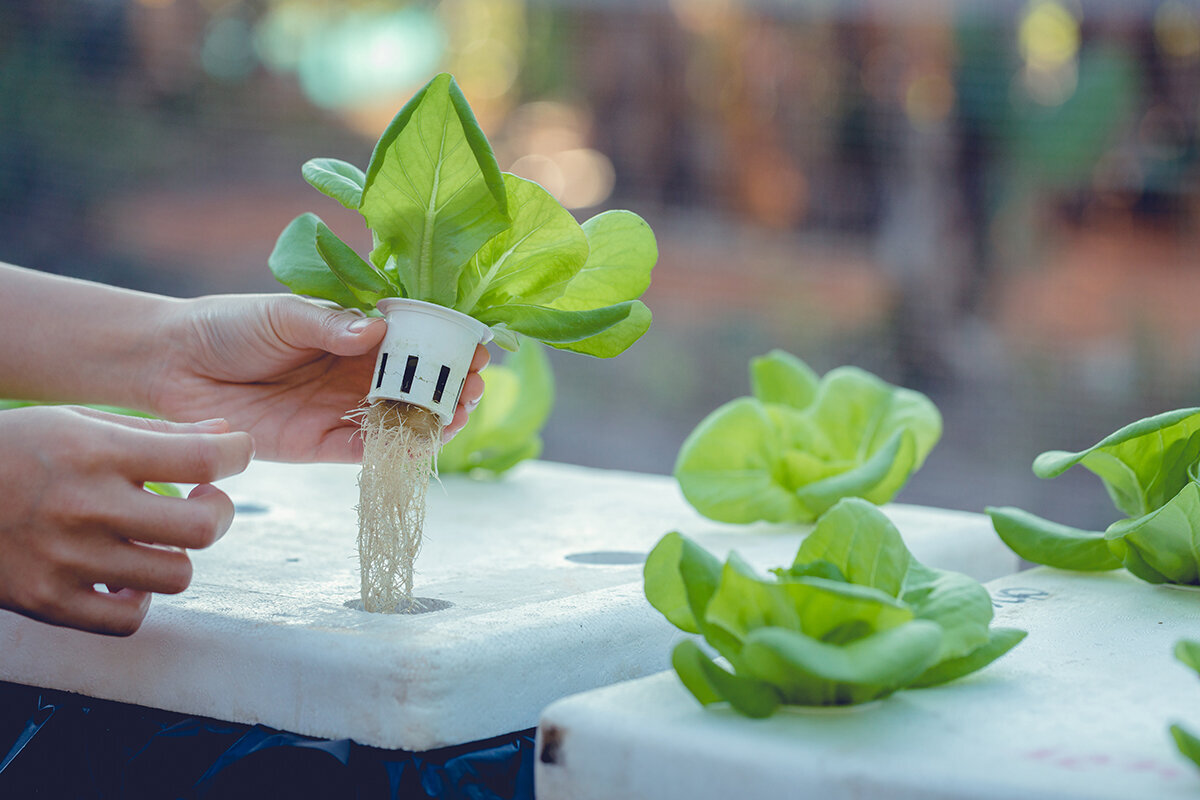
Net pot A perforated pot that supports the plant and gives roots access to air and solution.
EC Electrical conductivity: an indicator of the total dissolved salts in nutrient solution.
Root zone The roots’ complete working environment: solution, air, temperature, support material, surfaces and hygiene.
Chapter 02 · Choose success first
Grow a crop that explains the system.
Best first crop: Cut-and-come-again lettuce grows quickly, stays compact and visibly responds to its surroundings. Basil is equally rewarding in a warm, bright greenhouse. Both let you practise measuring and harvesting without long crop cycles, elaborate supports or pollination.
Choose just one crop, and ideally one variety, for the first reservoir. Leafy greens and herbs make change easy to spot: pale new growth, slow root growth, falling water level or a changed pump sound are easier to notice before a dense canopy obscures the view. Pak choi and Asian greens suit cooler autumn and spring conditions particularly well.
Tomatoes, cucumbers and peppers can thrive hydroponically, but belong in the second chapter of your experience. They need larger reservoirs, strong supports, more light and space, longer crop management, pruning and more reliable climate control. A first crop should train your eye, not test your endurance.
Use healthy, compact young plants or sow into clean hydroponic propagation plugs. Garden soil does not belong in net pots: fine particles, organic matter and possible pathogens burden the circulation. Begin with a few evenly sized plants. A clear reservoir teaches more than a densely planted trial wall.
Chapter 03 · Follow the water
Four system families – and one question: where do roots find air?
There is no universally best hydroponic system. For beginners, the right option is one whose water route, weak points and cleaning needs you can recognise confidently. These profiles show where the solution sits, how it moves and what to check first when something fails.
Still · aerated
DWC deep-water culture
Reservoir + air stoneShallow nutrient film
NFT
Pump + sloping channelMetered supply
Drip system
Drippers + substrateFlood · drain
Ebb and flow
Tray + timed returnDeep-water culture, or DWC: Plants sit above a reservoir while their roots reach into nutrient solution. An air pump and air stone move and aerate it. For lettuce and herbs, DWC is often the clearest introduction: there are few connections, water level and roots remain visible, and the reservoir can be maintained without a long network of channels.
Nutrient film technique, or NFT: A pump carries a shallow nutrient film through gently sloping channels. Roots touch the flowing solution while also having ample air contact. It is elegant and efficient for leafy crops, but requires even fall, clear returns and clean channels. Blockages or pump failures can affect plants quickly.
Drip systems: Drippers deliver measured nutrient solution to plants in soilless media such as clay pebbles, coco coir or rockwool. Excess solution either drains away or returns to the reservoir. The medium offers some buffer between waterings and suits larger individual plants, but every dripper, outlet and hose needs regular checking.
Ebb-and-flow systems: A growing tray is flooded temporarily and then drains again. As it drains, fresh air enters the pores of the root medium. The system is flexible for propagation plugs and pots, yet timing, level surfaces, reliable drainage and hygiene are critical. For many home gardeners, a small aerated DWC reservoir remains the easiest first lesson to read.
The central habit is the same in every system family: observe first, then correct deliberately. Choose a solution that gives you enough time and access for checking, cleaning and traceable adjustments.
A first DWC setup
Four visible essentials
01Lightproof reservoir
02Net pots and propagation plugs
03Air pump and air stone
04Nutrients and measuring tools
Excluding light matters as much as container volume: a covered, lightproof reservoir limits algae pressure. Net pots and clean propagation plugs support the plant base without enclosing it too deeply. Pump, tubing and air stone make oxygen a constant part of the root zone. pH and EC meters with calibration solutions replace guesswork with repeatable readings.
Chapter 04 · Buy with restraint
Buy essentials first. Automate later.
Essential A suitable lightproof lidded reservoir, net pots, air pump and air stone, hydroponic nutrients, pH and EC meters, calibration and cleaning solutions, plus a precise measuring vessel used only for the system.
Useful soon A spare air stone, spare tubing, nutrient-solution thermometer, labelled top-up container, plant labels, notebook and shallow drip tray beneath connections where droplets could form.
Unnecessary for the first crop Dosing computers, remote monitoring, large multi-channel loops, complex vertical towers, CO₂ equipment and automatic top-up systems. Buy extra complexity only once a simple routine clearly shows where time is genuinely lost or safety is lacking.
Over time, a greenhouse offers room for measured expansion. The Classic Aluminium Greenhouse provides a durable, visually calm setting for a compact reservoir beside a workbench and open service path. It is not, however, a reason to turn your first lettuce crop into a technical laboratory.
Chapter 05 · Before the first plant
Build dry. Fill slowly. Test without plants.
Commissioning is unglamorous, but one of the best safeguards for a first crop. Assemble the system on a level, load-bearing and easy-to-clean surface. Keep sockets, plugs, power supplies and multi-plugs dry, accessible and higher than likely leak points; form drip loops in cables. Give each reservoir a freely accessible service side, without stepping over plants.
01Position
Shield the reservoir from all-day direct sun and plan a safe route for controlled emptying.
Shield the reservoir from all-day direct sun and plan a safe route for controlled emptying.
02Fill
Run the assembled system with clean water and check every connection, hose, lid and outlet.
Run the assembled system with clean water and check every connection, hose, lid and outlet.
03Listen
Check that the pump runs evenly and bubbles reliably reach the whole reservoir.
Check that the pump runs evenly and bubbles reliably reach the whole reservoir.
04Mark
Mark the normal fill level. A visible waterline simplifies top-ups and reveals possible leaks sooner.
Mark the normal fill level. A visible waterline simplifies top-ups and reveals possible leaks sooner.
For planning crop areas, work routes and a calm separation between plant care and equipment, consider the Classic Aluminium Greenhouse. Good hydroponic planning keeps measuring, cleaning and checking within reach at all times.
Chapter 06 · Below the waterline
Water carries nutrients. The recipe remains a record.
Nutrient solution is not simply fertiliser stirred into water. Its behaviour depends on source water, crop and growth stage, reservoir volume, temperature, plant uptake and the products used. Check the current analysis from your local water supplier and measure it yourself. Drinking water can be hygienically sound while still carrying relevant hardness, alkalinity and dissolved minerals.
EC describes total conductivity and therefore the total dissolved salts. It helps show whether plants are taking up water or repeated top-ups are concentrating the solution; it does not identify individual nutrients. pH affects their availability. Follow the nutrient manufacturer’s crop-specific guidance instead of using one number for every plant.
pH 5.4–6.2Common mildly acidic working range
around 20–24 °CPractical temperature guide only
EC ≠ recipeAssess by crop and stage
These figures are working guides, not universal rules. Source water, crop and manufacturer guidance remain decisive. Set a baseline and record date, crop, water level, EC, pH, solution temperature and every adjustment. Only the trend makes a single measurement truly meaningful.
Chapter 07 · Healthy roots are pale, active and aerated
Root space and greenhouse climate must work together.
Roots need water, but also oxygen. DWC works because aeration moves solution at root surfaces. In NFT, only a thin film passes the roots, leaving plenty of airspace in the channel. Substrate systems rely on reliable drainage and the air-filled pores remaining after every irrigation cycle.
Clear, aerated root zone
- Lightproof reservoir
- Moderately cool solution
- Steady air supply or flow
- Pale, branched, firm roots
Warm, sluggish root zone
- Light exposure
- Solar warming
- Weak circulation
- Dark, soft or musty roots
The greenhouse climate
Hydroponics does not make greenhouse weather irrelevant. A bright structure can heat rapidly; without shade or careful siting, reservoir temperature often rises too. South African sun can make summer heat a major concern, while elevated and inland areas may still have cool nights. Ventilation must remove heat and moisture from leaves without leaving young plants in constant cold draughts.
- Light Give the first crop a bright, even position. Keep the reservoir shaded and completely lightproof so no sun reaches the nutrient solution.
- Heat Use roof vents, doors, shade and air movement early. Protect solution from solar warming rather than waiting for wilted plants or sluggish roots.
- Humidity Space plants so leaves dry promptly after condensation and leaf undersides, plant bases and root access remain inspectable.
- Air movement A small circulation fan can reduce pockets of still air. In hot weather, however, it replaces neither effective ventilation nor timely shading.
Chapter 08 · Routine keeps the system simple
Let the greenhouse show you something every day.
Mon Look
Tue Listen
Wed Measure
Thu Check
Fri Top up
Sat Harvest
Sun Review
- Monday: Check leaves, roots, waterline and air bubbles.
- Tuesday: Check pump and lines; keep the outside calm, clear and dry.
- Wednesday: Measure and record pH, EC and nutrient-solution temperature.
- Thursday: Look for algae, pests and early signs of leaf stress.
- Friday: Top up if needed, allow mixing, then measure again.
- Saturday: Harvest outer leaves, remove plant debris and wipe splashes.
- Sunday: Review notes and make a considered correction only when several observations support it.
The exact rhythm changes with plant size, weather and reservoir volume. During a hot South African summer week, water use can rise quickly; in cool, low-light weather, growth and uptake slow down. This does not mean adjusting every day. The key habit is noticing small changes daily.
Chapter 09 · Diagnose the setting, not only the leaf
Most beginner problems are signals, not mysteries.
When the system looks clean but plants stall
Pale new growth or slow growth can result from unsuitable nutrient concentration, pH drift, insufficient light, cool conditions or a reservoir that has become too small. Measure the solution, compare the climate with crop requirements and look especially at new growth. Only then make one justified correction.
Sudden wilting requires an immediate technical check. In NFT and drip systems, inspect the pump, lines, even flow, return and fill level. In DWC, aeration must run; roots must also not sit in distinctly overheated, oxygen-poor solution. A local flow failure often acts faster than nutrient deficiency.
Leaf-edge damage is not an automatic reason to add more fertiliser. First check EC, solution temperature, air movement and water availability. Excess salt can further damage roots and intensify existing climate or water stress.
When the root zone becomes warm or unclean
Algae need light, moisture and time. Cover the reservoir, close light gaps around net pots and hoses, remove visible deposits and clean all surfaces between crops. Correct the route of incoming light before reacting chemically.
Brown, slimy or musty roots point to a root-zone problem: high solution temperature, oxygen shortage, stagnant water, inadequate hygiene or disease pressure. Isolate severely affected plants. Correct aeration, circulation, temperature and water level first; clean the system thoroughly before restarting.
Recurring leaks usually point to a layout problem. Route hoses so they remain visible and free of tension, and place drip trays under vulnerable joins. Do not position the reservoir where even a little water can reach electrical connections, unprotected timber, thresholds or walkways.
The most common mistake: changing pH, nutrient concentration, water level and light on the same day. Correct only one justified variable, then give plants time to produce a readable response.
Chapter 10 · Harvest, clean, then expand
Expand your understanding before your pipework.
Harvest cut-and-come-again lettuce gradually by taking outer leaves and retaining the heart, or cut whole heads at the desired size. Do not refill immediately when a crop ends. Empty and clean the system, examine roots and deposits, and review your records. The most valuable outcome of the first crop is a dependable starting point for the second.
Keep one reservoir
Add one variable
Protect the work route
Grow the same crop again with a calmer, cleaner process before adding another system.
Try a second variety, a larger reservoir or another season – but not all three changes together.
An expansion works only when every plant, outlet, line, plug connection and surface remains reachable for checking and cleaning.
For durable materials, planned ventilation options and a calm architectural presence in the garden, learn more about the Classic Aluminium Greenhouse. A convincing hydroponic greenhouse garden feels welcoming and orderly: attractive enough to enter gladly, and clear enough to make maintenance second nature.
South Africa · Practical questions
Greenhouse hydroponics: FAQ
Can I use tap water for a hydroponic system?
Often yes, but not automatically. Check the current analysis from your local water supplier and measure the source water’s pH and EC. Water is not a neutral, mineral-free starting point: hardness and alkalinity in particular affect how steadily nutrient solution can be managed. Hygienically sound drinking water can still bring a substantial hydroponic starting load. Water from a softener is not automatically more suitable because of possible salts.
Which greenhouse hydroponic system is best for beginners?
For leafy greens and herbs, a small, lightproof, aerated DWC system is often the most accessible start. Its components are clearly visible, roots are easy to inspect, and there are fewer drippers or long channels that can clog. Keep the reservoir shaded, monitor water level and air supply, and position electrical connections safely away from possible leak paths.
Do I need heating and supplemental light for year-round hydroponics?
For a seasonal trial with lettuce or herbs, usually not necessarily. Year-round growing depends on region, plant, glazing, insulation, daylight and available temperature control. In South Africa, summer overheating can be the limiting factor, while cool inland winters and low winter light can slow demanding continuous production. Start seasonally and add heating, lighting or shading only for a specific, recorded need.
How often should I replace nutrient solution completely?
There is no useful universal interval. Plant uptake, reservoir size, source-water quality, temperature, crop stage and the stability of your readings all interact. Complete replacement and thorough cleaning are necessary after every crop cycle. Renew solution sooner when readings no longer stabilise predictably, contamination becomes visible or problems persist despite checked environmental conditions. Records make the decision more crop-specific each time.
Is hydroponic produce automatically organic or pesticide-free?
No. Hydroponics describes how plants receive water and nutrients; it does not define organic status or pest control. A clean, well-observed circulation can avoid some soil-related problems. Hygiene, regular pest checks and crop-appropriate plant care remain necessary.
Sources and further reading
Technical foundations for the next growing cycle
More from Bloomcabin: thoughtfully planned aluminium greenhouse · greenhouse curtains from Bloomcabin · sliding-door options for aluminium greenhouses
Your first hydroponic greenhouse season
Fill the first reservoir – not the whole greenhouse.
Choose one crop, one understandable system and one safe service route. These three decisions create a hydroponic garden you can read, maintain, enjoy and later expand for good reason.
One crop
Learn its leaves, roots and rhythm.
Learn its leaves, roots and rhythm.
One system
Keep the water route visible, understandable and easy to clean.
Keep the water route visible, understandable and easy to clean.
One service route
Keep access clear for measuring, cleaning, ventilation and harvesting.
Keep access clear for measuring, cleaning, ventilation and harvesting.
