
Growing onions in a greenhouse
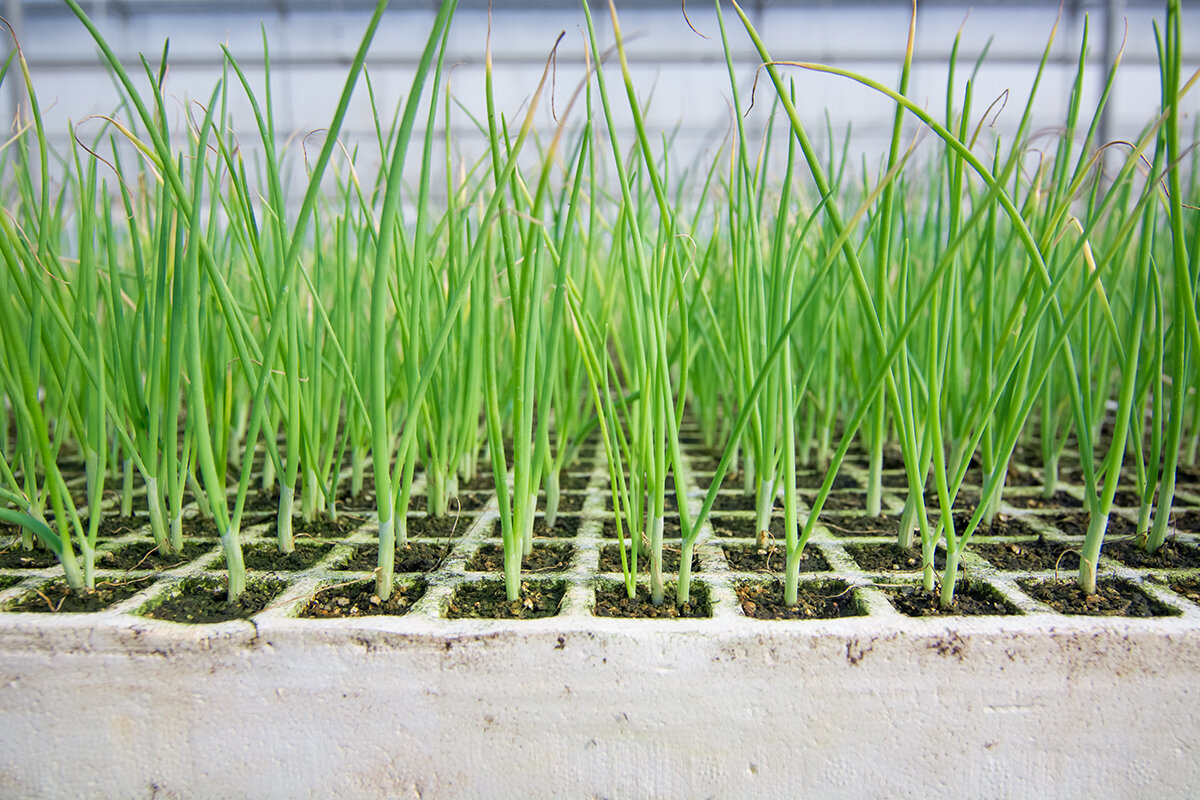
Why grow onions under cover?
Protected growth, not an artificial summer
A good onion is built layer by layer long before the bulb is visible. First, the plant needs enough healthy leaves before its variety-specific day length is reached.
What glazing changes
A greenhouse moderates difficult weather: prolonged rain, saturated soil, crusted seedbeds and sudden shifts. Young plants can be raised more reliably, prepared beds stay workable, and harvested bulbs can dry under cover. Watering, ventilation and hygiene are also easier to manage each day—valuable for shallow-rooted onions that dislike drought stress and warm, stagnant humidity.
What glazing does not change
Bulb formation is driven chiefly by photoperiod. A long-day variety still waits for long days under cover, while a short-day variety may bulb too early where summer light is unsuitable and remain small. Extra lighting is rarely needed for ordinary home growing. A variety recommended for your latitude and local growing season is more dependable.
Using the space well
For most home gardens, the greenhouse is especially useful for propagation and cooler-season growing. Sow varieties at the appropriate time for your area, or set out sturdy seedlings and sound sets once the bed is workable. In a well-ventilated side bed, onions can remain until harvest. When the house later becomes hot or crowded with tomatoes and cucumbers, plan light, airflow and separate watering zones carefully.
A well-planned classic aluminium greenhouse works particularly well for this routine: propagation trays begin in bright shelter, while low, accessible beds leave space for upright onion leaves, soil-level watering and a clean access path.
Starting material
Seed, sets or seedlings?
All three routes can produce onions. They need different schedules, offer different levels of variety choice, and place their own demands on greenhouse space.
For choice and control
Seed offers the widest choice of day-length type, colour, shape, keeping quality and maturity time. It is the best route when you want a long-day, intermediate or short-day variety specifically recommended for your area. Sow into a clean, fine, free-draining medium. Module trays or small soil blocks help produce an even crop and reduce early competition from weeds.
Seed needs planning, but under cover it can establish a healthy, even crop before the main garden season.
For speed and an easy start
Onion sets are small onions produced previously. They are easy to plant and can give a relatively early harvest. Buy only firm, dry and healthy sets. Soft, spotted or mouldy sets can introduce disease into the bed and belong neither in the planting row nor in storage.
Choose sets when a quick, straightforward crop matters more than the broadest range of varieties.
For an even early crop
Bought or home-raised seedlings shorten the growing period in the final bed. They combine deliberate variety choice with a fast start and are especially useful where greenhouse space is valuable. Use fresh, upright plants with compact, healthy rootballs. Discard plants that are very soft, rotting or visibly stressed.
For household quantities intended for storage, seedlings combine precise spacing with a dependable head start.
Bloomcabin recommendation. Start from seed when variety, storage potential or a particular colour matters. Seedlings suit a planned, even crop. Healthy sets are often the most relaxed option in a first greenhouse year—but they are not a universal substitute for choosing the correct day-length variety.
Light sets the rhythm
Choose onions by day length
Day length is the quiet architect of bulb formation. The greenhouse protects the plant, but the variety’s genetic response determines when its fleshy leaf bases begin to form a visible bulb.
Propagation and planting time
Build leaves first, then give the bulb room
Sow onion seed shallowly in a clean, fine, free-draining propagation medium. Keep it evenly moist, never waterlogged, until emergence. Afterwards, grow seedlings as brightly as possible and relatively cool. A greenhouse bench works if nights are adequately protected and ventilation is consistent on sunny days. Otherwise, begin sowing in a bright indoor position.
After emergence, give seedlings enough root room, individually or in small groups. High temperatures with weak light create long, unstable leaves and remove their compact advantage. Before transplanting, the rootball should be moist but not dripping. Acclimatise plants gradually to the bed and avoid unnecessary damage to leaf bases and roots.
Plant the final greenhouse bed in time for the variety’s normal bulb-forming stage. Choose the timing for your local climate rather than importing a northern-hemisphere calendar. The bed must be workable and drain water safely. Earlier planting can gain useful growing time, but requires early ventilation on bright days and allowance for local cold snaps where they occur.
On compact plots, a classic aluminium greenhouse can serve as an orderly propagation space for a manageable onion crop. Use stable shelves for sufficiently deep trays, then move strong plants into a prepared soil bed instead of forcing storage onions to remain in undersized containers.
Anatomy beneath the skin
An eating onion is not a root
An onion is made of swollen leaf bases arranged above a short basal plate. Fine roots emerge only below this plate. This structure explains why deep planting, heavy earthing-up and compacted, continually wet soil can interfere with clean bulb development.
Plant seedlings about as deeply as they stood in their propagation container. The pale transition to the leaf should sit only lightly in the soil. Plant sets very shallowly; their tips may remain visible or be barely covered. As the bulb swells, its shoulder should develop at the surface and dry quickly after watering. Every healthy green leaf contributes to later storage capacity.
Prepare soil that is loose, level and reliably drained. Well-matured compost applied earlier is more useful than fresh, nitrogen-rich fertiliser. Remove hard clods and compaction without disturbing the structure unnecessarily deeply. Where vegetables are grown continuously under cover, a soil test is a better basis than routine extra feeding.
The bed as a workspace
Spacing, water, nutrients and air
A row spacing of around 25 cm is a sound starting point for eating onions. Within the row, 7 to 10 cm is practical for medium storage onions. For larger bulbs or a more humid greenhouse, 10 to 12 cm can be useful. Dense planting does not automatically improve storage quality: crops dry more slowly and are harder to inspect. A proper access path protects shallow roots from compaction.
Onion roots work mainly in the upper soil layer and react badly to swings between complete drying and waterlogging. Water deeply at soil level during establishment, leaf growth and bulb growth. Check moisture 2 to 3 cm down instead of judging the dry surface alone. Drip irrigation suits covered growing because foliage stays dry. Reduce water gradually when bulbs ripen and necks naturally soften.
When onions do not cooperate
Read the cause before correcting it
Small bulbs, healthy leaves
Bulbing may have started before the plant was large enough, or the crop may have started too late. Check day-length type and planting time first. Late fertiliser cannot correct an unsuitable photoperiod.
Thick necks, poor storage
Too much late nitrogen, abundant watering during ripening, close spacing or early harvest can make neck tissue dry slowly. Reduce water and nutrients in good time, then cure the crop in moving air.
Yellow, wilting seedlings
Onion fly larvae can cause feeding tunnels and damage around the leaf base; affected plants may pull out easily. Remove suspicious plants and inspect the crop. Open doors and vents are not a complete barrier against flying pests.
Spots, collapse or grey mould
Fungal diseases benefit from wet foliage, close planting and stagnant air. Increase spacing if necessary, ventilate consistently and water only the soil. Remove badly affected plants. Do not grow onions and other Allium crops in the same area year after year.
A greenhouse is not automatically disease-free. Its advantage is close observation: condensation, overcrowding and declining foliage become visible early. Roof vents, generous doors and a considered interior layout are therefore practical equipment questions in a classic aluminium greenhouse.
Neck fall, harvest and curing
Let onions ripen to a papery finish
Storage quality begins before harvest. Wait until a large proportion of necks soften naturally, bend over and begin drying. Do not artificially bend or twist healthy green leaves. Forced collapse is not the same as natural ripening and can create injuries that make clean curing harder.
Harvest on a dry day if possible. Lift onions gently with a garden fork, remove loose soil and avoid damaging the outer skin or neck. Do not wash onions intended for storage.
Spread onions in a single layer where possible on mesh or slatted racks. Do not stack the harvest in a damp greenhouse corner or use closed plastic crates. An empty greenhouse can be a curing space if it is very well ventilated by day and night and bulbs are protected from harsh direct sun.
Mild onions are often used first. Designated storage onions usually last longer, provided their necks and outer skins are completely dry and bulbs are uninjured.
After curing
Only checked onions go into storage
Sort thoroughly after curing. Trim dry foliage to a few centimetres if needed, while keeping protective outer skins intact. Store firm onions cool, dark, dry and well ventilated—in nets, shallow open crates or on slatted racks, for example. Check the supply regularly through the storage season. Remove soft, sprouting or damaged bulbs immediately and use them first.
Keep storage onions away from damp places with large temperature swings, and do not store them directly beside potatoes. A greenhouse is often useful for curing but is not automatically a suitable long-term store. Dry air, cool conditions and frost protection are decisive. A suitable cellar, protected garage or well-ventilated utility room may be more reliable.
Best candidates Firm bulbs with dry skins, closed necks and no bruising.
Use first Thick-necked, scratched, soft, split or not fully dried onions.
Avoid completely Storing whole onions damp or keeping them in closed plastic bags without air exchange.
Season close Remove roots and crop debris, clean the growing area and change the site for future Allium crops if disease has been a problem.
Frequently asked questions
Answers for growing onions under cover
Can onions grow entirely in a greenhouse?
Yes, provided there is a sufficiently deep, loose, well-drained soil bed, plenty of direct light and dependable ventilation. The key limit is not the roof but the correct day-length variety. During warm weather, also avoid excessive heat, stagnant air and watering conflicts with thirsty neighbouring crops.
Can artificial light reliably make every onion variety bulb?
Not usefully for the ordinary home garden. Photoperiod triggers bulb formation, but technically extending lighting does not replace a variety suited to the region. Supplementary light can help raise compact seedlings. For the later crop, clean glazing, a bright site and the correct day-length variety matter far more.
Why do my greenhouse onions make leaves but few bulbs?
Common causes include an unsuitable day-length type, a late start or too little plant mass when the critical day length arrives. Close spacing, weak light, early leaf loss and water shortage during active growth also limit bulb size. Check these points before applying heavy fertiliser late in the season.
How often should onions under cover be watered?
Do not water to a rigid calendar; respond to soil moisture, weather, plant stage and soil type. During establishment and bulb growth, the root zone should remain evenly fresh but never saturated. Check soil 2 to 3 cm down. Deep morning watering at soil level is better than daily small amounts over the foliage.
Should I bend the leaves to make onions ripen faster?
No. Let necks soften naturally and foliage fall by itself. Artificially bending green leaves does not create reliable storage maturity and can cause injury. Lift a largely naturally ripened crop, then cure onions under shelter, in shade and with plenty of moving air.
Sources and further reading
Explore horticultural fundamentals
More from Bloomcabin: Classic aluminium greenhouse · Made-to-measure aluminium greenhouses · Premium aluminium greenhouses for South African gardens
- LWG Bavaria – Guide to organic gardening
- Bavarian Garden Academy – Sowing and planting dates at a glance
- North Rhine-Westphalia Chamber of Agriculture – Onion fly on eating onions
- Hortipendium – Commercial onion production
- FiBL, Bioland, KÖN and Bio Austria – Organic onion production
- FiBL factsheet – Organic onion cultivation
- LWG Bavaria – Plant health and natural ripening guidance
- Bavarian Garden Academy – Onion dates and row spacing
