
Hot Tub Delivery in South Africa: Gates, Routes and Lifting
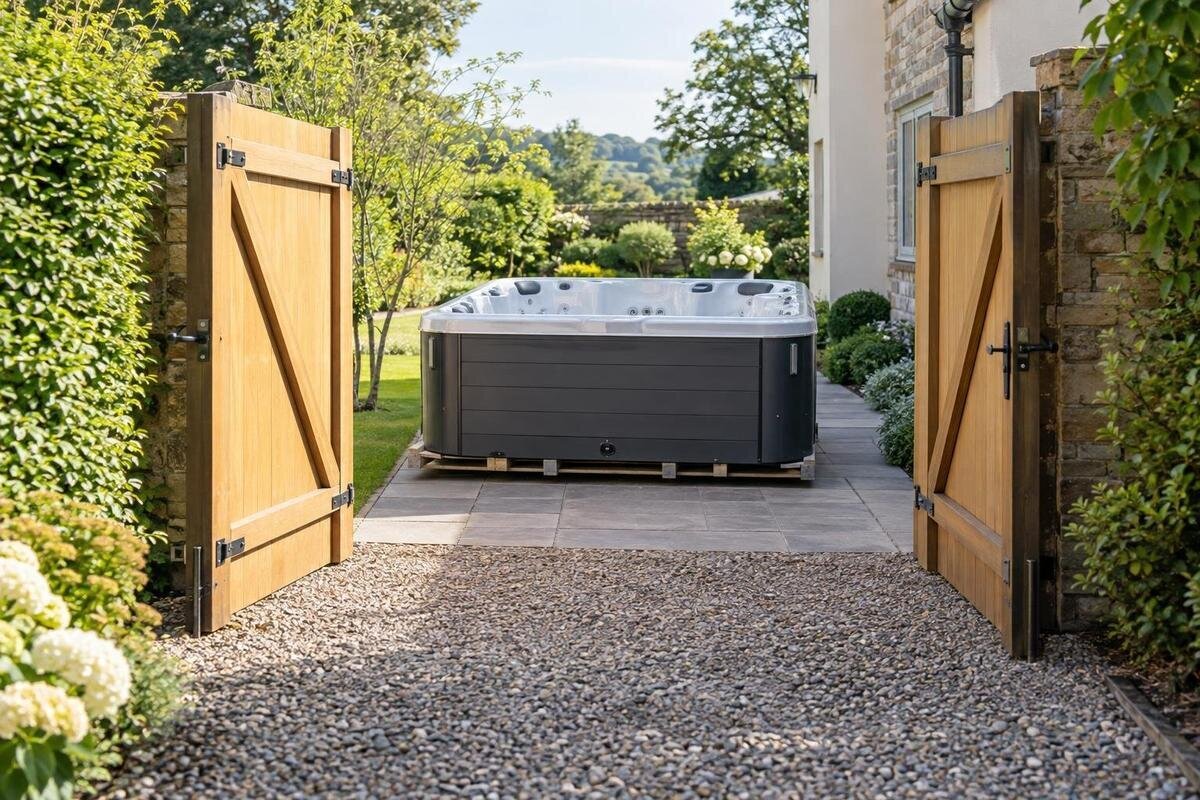
Delivery access planning
A hot tub can suit the garden without fitting through the delivery route. Before ordering, trace the journey from the delivery vehicle’s actual stopping point to the final position, then compare each restriction with supplier-confirmed transport dimensions, packaging and handling clearances. Installed dimensions alone cannot confirm that the packed unit can pass or be moved safely.
01
Delivery scope and access to the garden
A hot tub may suit the intended garden position but still be impossible to deliver there by the available route. The journey can include a driveway entrance, side passage, gate, narrow path or shared access, with each creating a separate restriction. The delivery vehicle’s access and the tub’s access are different questions: the truck may stop short, leaving a crew to move the package from another point. Start with the actual unloading point and map the complete route from there to the exact final position.
Ask the supplier to define delivery in writing. Does it include unloading, movement through the property and placement, or does the service end at the vehicle or property boundary? The scope affects who may need to supply labour or equipment, so do not treat the word delivery as proof that a difficult carry or lift is included. Resolve uncertainty before confirming an order. If standard access cannot be confirmed, consider changing the route or position, or arrange a specialist assessment before deciding whether to proceed.
Get transport details for the exact model
Request the dimensions and weight of the exact model in its transport state: outer length, width and height with packaging, and total packaged weight. Ask whether the figures include a pallet, skid, protective frame or other packing, and what orientation the unit will be delivered in. Also ask what handling clearance is needed beyond the outside dimensions. A figure for the installed tub may omit material that travels with it, so it is not enough to set a gate-opening target without confirmation. Keep the transport figures separate from the installed dimensions in your notes, with each dimension clearly labelled. If the supplier describes more than one delivery configuration, ask which one applies to your order and which figures the access assessment will use. Do not base the route on an assumption that packaging can be removed at the gate; ask whether that is part of the proposed delivery method.
Ask for the manufacturer’s handling guidance for that exact model, including any permitted orientation changes or lifting methods, if applicable. Confirm who will interpret the guidance for the delivery crew. Do not assume a method, lifting point or tilt is acceptable because it was used for another tub. If Bloomcabin Hot Tub Cove 2 is your candidate, name it in the request and ask for its current transport and handling details. The product identity helps specify the item; it does not establish its packed dimensions or handling method.
02
Map the route from the delivery vehicle’s stopping point
Choose a realistic point where the delivery vehicle can stop and unload, rather than drawing the route from the front gate by default. Ask the supplier or carrier what vehicle is expected, whether it can reach the driveway or must stop elsewhere, and who confirms the stopping point. If the approach includes a narrow entrance, low canopy, sharp turn or shared driveway, record that too. If stopping or unloading could affect shared property, a pavement or a road, ask who will coordinate arrangements with the relevant owner, property manager or local authority.
On a sketch, mark the proposed stopping point, unloading point, every section travelled by the tub and the final position. Add measurements for each straight section and mark gates, bends, steps and overhead restrictions; arrows can show the direction of travel. This separates the truck’s access from the unit’s access and helps the supplier see where questions arise. Number the route sections and use the same numbers on your photographs, so a close-up of a gate can be matched to its place on the sketch. If there are two possible routes, show them separately rather than combining their most generous measurements into one plan. Identify where each route starts and ends, and record any section you cannot inspect. If Bloomcabin hot tub Haven 6 is on your shortlist, label the sketch with that exact model so the correct specifications can be checked.
Measure the clear gate opening
Measure the usable opening with the gate in the position it would be in during delivery. Record the smallest clear distance between the obstructions the unit would actually pass, not the stated gate width or the width of the gate panel itself. Hinges, handles, catches, posts, wall returns and raised thresholds can reduce the opening. If it narrows at the top or bottom, measure at the relevant points and report the smallest figure. Note whether the gate swings into the route. Photograph the gate open as well as the approach to it, and mark any part that prevents it from opening further. For double gates, show the opening available with both leaves open and identify anything fixed in the middle. Keep the existing clear opening separate from any proposed opening after alterations, so the supplier knows which measurements describe the property as it stands.
Use consistent units and label exactly where each measurement was taken. A photograph with a tape measure can help show the location, but include the written measurement and a wider view of the approach. The comparison must use confirmed transport dimensions plus any supplier-specified handling clearance, not just the tub’s installed width. For Bloomcabin Hot Tub Fjord 8, ask for those figures for the exact model and package before treating an opening as passable.
03
Check each turn, not only the straight sections
A straight opening does not prove that the unit can make the turn behind it. A gate might open onto a short passage ending at a corner, or a wide path might narrow where it meets a wall, doorway or second gate. The shape of the packed unit, its permitted orientation and the handling method all affect the clearance needed to turn. Avoid treating a diagonal calculation based on an assumed tub size as confirmation that the manoeuvre will work.
Mark every change in direction on the sketch and measure the passage on both approaches to each corner, including the distance before the next obstruction. Note inward-projecting walls, steps, door swings, planters or posts that cannot be moved. Photograph each turn from both directions so the supplier can review the whole manoeuvre, not just one width. Include any adjoining open space in the sketch, but distinguish space within your property from a neighbour’s or shared area that you cannot assume will be available. Mark movable objects separately from permanent obstructions and explain whether they would be removed before delivery. Where a photograph hides the far side of a corner, add another view rather than leaving the assessor to guess what lies beyond it. If Bloomcabin hot tub Aurora 10 is being considered, ask the supplier or handling provider to assess its confirmed transport dimensions and handling clearances against the route.
Record steps, slopes and changes in level
Record each step and change in level, not simply the distance from the gate to the tub. Note the number of steps, the size of any landing if you can measure it safely, thresholds, ramps and whether the route rises, falls or slopes across its width. Describe the surface along each section and flag loose, uneven or soft areas for professional review. These details help the supplier decide whether ordinary delivery is realistic or whether another handling plan needs assessment.
Take a side-on photograph of stairs or a slope as well as a view along the route; include landings, handrails and nearby walls. Label which end is higher and show where the level change begins and ends on the route sketch. For separate flights of steps, record each flight and landing individually rather than giving only a total step count. If a height or slope cannot be measured safely, mark it as unmeasured and ask how the provider wants it assessed; do not substitute a guess. Do not assume that a unit which clears the width can be carried up or down steps, and do not improvise a ramp or attempt to tilt it to make the route work. Ask what equipment and crew the proposed method would require, using the manufacturer’s instructions. If you are considering the Haven 6 hot tub, send these notes with the request for model-specific guidance.
04
Check overhead clearance along the whole route
Inspect the full route above head height. Eaves, carports, balconies, pergolas, awnings, low branches and projecting gutters can restrict movement even where the path is wide at ground level. Record the lowest overhead point, where it is and the vertical clearance if it can be measured safely. A turn beneath a roof edge may be more restrictive than a straight section. If a lift is being considered, ask the provider what overhead space needs checking for the proposed equipment and movement.
Include utility lines and other cables in your notes and photographs; do not touch, move or cut them yourself. Ask the delivery or lifting provider to arrange a competent local assessment if a line or another overhead hazard could affect the route. A photograph can show what is present, but it cannot confirm safe clearance. When assessing access for the Fjord 8 hot tub, share overhead restrictions alongside the transport data rather than treating a clear gate as proof that the route works.
Check whether a gate or fence can be removed
Sometimes a gate leaf or removable fence panel is the main bottleneck. Ask whether temporary removal is feasible, who has permission to approve it, and which competent person would remove and reinstate it. Check what happens to hinges, posts, locks and adjoining sections; a panel that looks detachable may affect its supports when removed. For a rented or shared property, obtain agreement from the owner or property manager before treating removal as an option.
Measure the opening that would remain after the proposed change, including fixed posts and wall projections, then review the route beyond it again. A wider opening will not solve a tight turn, low eave, step or vehicle-stopping problem further along. Ask for a separate written scope and quote if removal and reinstatement are not part of the delivery service, and agree who restores security afterwards. Distinguish work that has merely been suggested from work that the responsible person has agreed to carry out. If removal is essential to the route, ask how its timing will be coordinated with delivery and what happens if the opening is not ready. Keep the unaltered route as a separate option only if it has also been assessed, rather than assuming it can serve as a fallback. If the Aurora 10 hot tub is your selection, identify it in the access enquiry so the supplier reviews the right item.
05
When to consider specialist lifting
If the ground route remains blocked, a specialist lift may be worth investigating, but it is not an automatic workaround. The supplier must confirm whether the manufacturer permits the proposed handling method and whether the packaged unit can be lifted that way. Never assume that straps, forks or a particular machine are suitable. Before discussing a lift for the shortlisted Cove 2 hot tub, request the exact packaged weight, transport dimensions and handling restrictions, then ask a qualified local lifting provider to assess the site.
The provider may need to assess where equipment can be positioned, the delivery vehicle’s access, overhead obstacles, the proposed lift path and the final landing area. Request an on-site assessment if photographs do not show the full situation. Ask for a written quote that sets out what is included, such as a survey, equipment, crew and coordination with the hot tub delivery, and what remains your responsibility. Ask whether permissions or arrangements with neighbours, property managers or local authorities are needed. Use local quotes rather than guessing a cost.
Access information and delivery responsibilities
Before ordering, send a labelled access pack: a sketch from the vehicle’s proposed stopping point to the final position; clear widths and heights for gates and openings; measurements and notes for turns; steps, slopes and landings; overhead restrictions; and any planned barrier removal. Include photographs of the entrance, each pinch point from both directions, level changes and overhead obstacles. A short video can add context, but it should supplement—not replace—written measurements and the supplier’s transport data. State the measurement units, date the pack and identify the model being assessed. Put unanswered questions beside the relevant route section, rather than burying them in a general message. If you later change the model, route or final position, send an updated pack and ask whether the earlier assessment still applies. Keep one agreed version so the supplier, carrier and any separate handling provider are not working from different sketches.
Ask who will compare the route with the exact packaged dimensions and manufacturer handling guidance, and whether a remote review is enough or an on-site survey is needed. Agree who coordinates the carrier, any specialist lift, barrier removal and final placement. Confirm where the delivery service ends and who is responsible for separately quoted work. Get the agreed method and responsibilities in writing before placing the order; then proceed on a confirmed route, change the access or position, or obtain a professional lift assessment first.
Frequently asked questions
How much clearance does a gate need?
There is no single clearance figure that works for every hot tub and route. Measure the narrowest clear opening, then compare it with the supplier-confirmed transport dimensions and any additional handling clearance. Ask the supplier or delivery provider to review the opening together with the turns immediately beyond it.
Can I use the hot tub’s installed dimensions?
Not on their own. Installed dimensions may not include packaging, a pallet or protective frame, and they do not establish how the unit can be manoeuvred. Ask for dimensions and weight in the transport state, plus the manufacturer’s handling guidance for the exact model.
Can the delivery team remove a gate or fence panel?
That depends on the delivery scope, the property and who is responsible for the work. Confirm permission, who will remove and reinstate the barrier, and any separate quote before ordering. Then check the remaining route: a wider gate will not solve a tight turn, step or low overhead obstruction.
When should I consider specialist lifting?
Consider an assessment if the usual route cannot be confirmed as workable or if changing it is impractical. The supplier must confirm the manufacturer’s permitted handling method, and a qualified local lifting provider should assess the site and equipment access. Do not assume a particular lifting method will suit the tub.
What if I cannot tell whether the route will work?
Send the supplier a labelled sketch, written measurements and photographs of the full route, including the stopping point, gates, turns, steps and overhead restrictions. Ask whether a remote review is enough or whether an on-site assessment is needed. Resolve the uncertainty before relying on standard delivery.
A reliable delivery plan joins three things: a measured route from the vehicle to the final position, model-specific transport and handling information, and clear responsibility for any changes or lift. If any part remains uncertain, resolve it before ordering. That leaves a clear choice: proceed with confirmed access, revise the route or position, or arrange a professional lifting assessment.
