
How to Clean a Hot Tub Without Damaging Its Surfaces
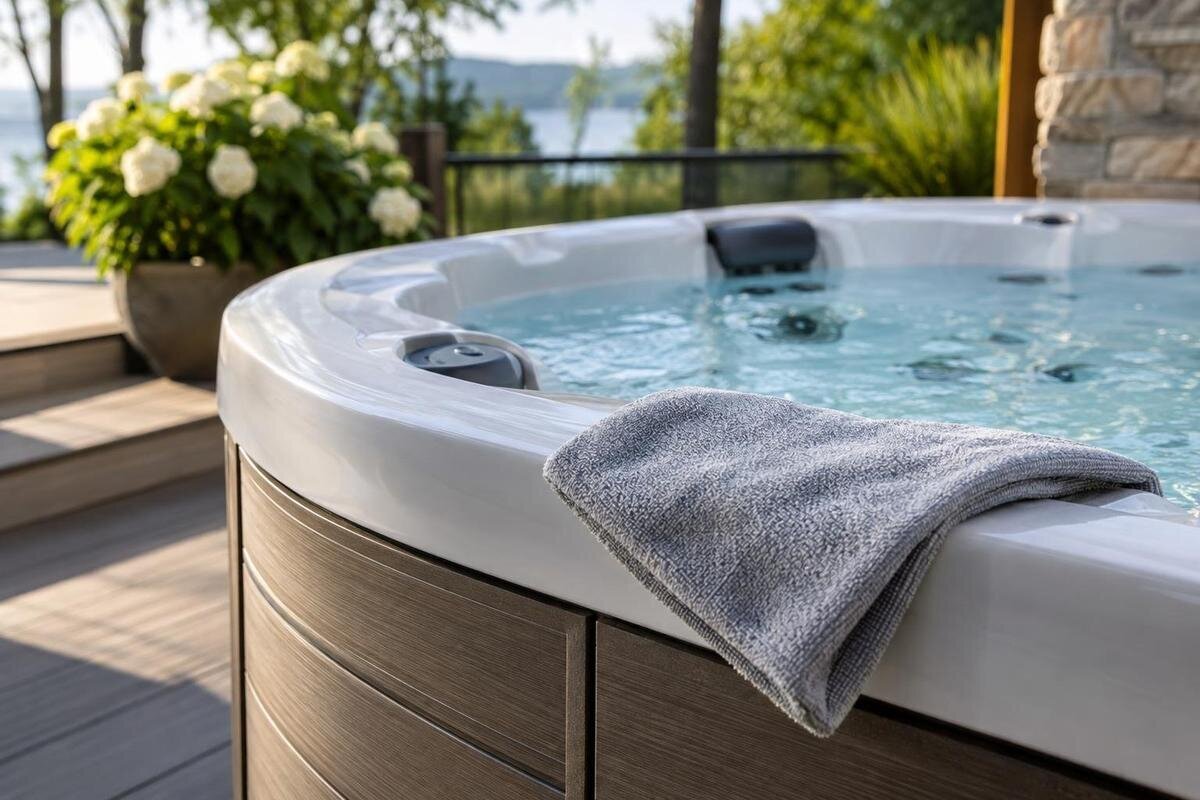
Hot tub surface care
Marks and residue can tempt you to reach for whatever seems gentle, but a cloth or cleaner suitable for one finish may not suit another. The shell, trim, cover and control face can have different care requirements, and a product described as a hot tub cleaner does not by itself confirm compatibility. First identify the exact model and surface, then check the manufacturer’s instructions and the cleaner label before applying anything. This guide focuses on cleaning documented surfaces; it does not cover water treatment or wooden-exterior care.
01
Identify each surface before cleaning
Start by naming the exact part you intend to clean: the bathing shell, rim, trim, cover, step or control face. These may not share a material or finish, even when they sit next to one another. A glossy look, colour or texture is not dependable proof of what a surface is made from, and the same broad description may not cover every component. Look for the material and finish in documents tied to the particular model and part. If the paperwork is unclear, ask the supplier to identify the surface before choosing a cleaner. This prevents advice for one area being applied to another by mistake.
Make a brief record of the area and its condition before you act. A clear photograph can help you describe where the mark is and what it looks like, but it cannot establish the material or show which cleaning method is permitted. Note whether you are dealing with the shell or a separate component, and use the terms in the manufacturer’s documents where possible. If the part cannot be identified with confidence, leave it alone until you have an answer. Treating an unknown surface as though it were the shell is an avoidable risk, particularly when a product or tool might also touch adjacent trim.
Find the instructions for your exact model
Look for the care instructions supplied for your particular hot tub, rather than relying on a general cleaning article or advice written for a different model. Check the product paperwork, owner’s manual and any current guidance available from the manufacturer or seller. If the model has versions with different finishes or components, confirm that the document covers yours. Use the exact name shown on your paperwork or product label; if there is a version identifier, include it when asking for help. A document that names the model but says nothing about the surface you need to clean may not answer the question.
When requesting instructions for the Cove 2, include the full model name and identify the part you intend to clean. Ask for guidance that covers the material and finish of that component, rather than accepting instructions for the tub in general. The answer should explain which cleaners and tools are allowed, how the cleaner should be applied and how any residue should be removed. If the manual does not cover one of those points, make it a specific question in your enquiry. Keep the response with the product documents so that you can find the relevant directions again without relying on memory.
02
Check the cleaner label against the care instructions
Read the manufacturer’s care guidance and the cleaner’s label together. The label should make clear that the product is intended for the surface you have identified, and its directions should not conflict with the hot tub instructions. Check all relevant conditions: where the cleaner may be used, how it is applied, any stated contact time, how it is removed and the warnings that apply. Do not guess at an amount, change a stated dilution or extend the contact time to tackle a mark more quickly. If the label is vague about the finish, or the manual does not address the product, ask the manufacturer before using it.
A cleaner described as being for hot tubs is not automatically suitable for every part of every tub. It may be intended for a particular surface, so check the wording rather than relying on the product category or packaging image. If you own a Haven 6 and are considering a cleaner, give the supplier its exact product name and the surface you want to clean. Ask whether the label and the model’s care instructions support that combination. A recommendation for the shell should not be extended to neighbouring trim or controls unless those components are also covered. Leave any unresolved area out of the cleaning plan until its compatibility is clear.
Choose a cloth or tool only when it is approved
Use the tool described in the model-specific instructions, if one is specified. If the guidance calls for a non-abrasive cloth, choose one that meets that description and use it only as directed. Do not assume that a sponge, microfibre cloth or soft-looking brush is suitable simply because it feels gentle. A cloth can have seams or trapped particles, while a brush can be firmer than its appearance suggests. When the manufacturer does not name an acceptable tool, ask which types are suitable for the particular finish rather than substituting one based on habit.
A tool should also be clean and in good condition; grit or a rough edge can be dragged across a surface and leave a mark. Check the part that will touch the finish, including any seams or edges, rather than judging the tool by its softest area. Follow any manufacturer instruction about preparing the surface before wiping, and avoid pressing harder when a mark does not lift. When asking about tools for the Bloomcabin hot tub Haven 6, specify whether you mean the shell, cover, control face or trim. If the recommendation does not clearly cover that component, ask for clarification before substituting a tool you already own.
03
Apply a surface cleaner exactly as directed
Before applying a product, check the instructions for the surface’s condition and the method of application. The manufacturer or cleaner label may specify whether to apply it to the surface or to a cloth, how much to use, how long it may remain and what to do afterwards. Follow those directions without adding extra product or changing the process to speed things up. If the instructions call for a test area, follow the stated procedure and location; do not invent your own test. When the product’s directions and the hot tub manual do not agree, pause and ask which guidance applies to your model and finish.
Keep the cleaning method within the area named in the instructions. A product that runs onto another component may reach a surface with different care requirements, so check whether the method is suitable for everything it could contact. If the area is near the water, follow the manufacturer’s and product label’s directions for removing the cleaner or residue; do not assume that a particular rinse or other step is appropriate. If the documents leave that point unanswered, seek advice before proceeding. This is a surface-cleaning question, not a reason to improvise a water-treatment method or combine cleaning products.
Approach marks and residue cautiously
A mark’s appearance does not identify its cause. It might be surface residue, a stain or a change in the finish, and colour or texture alone cannot tell you which. Avoid scraping or rubbing it to find out. Instead, note its location and appearance, photograph it and record any cleaner or tool already used. This gives the manufacturer or supplier useful context without risking further damage. If the mark appeared after a particular product was applied, include the product name and label directions in your notes; do not assume that using more of it will improve the result.
If the manual confirms a suitable method for that surface, follow it precisely and assess the result without escalating to a harsher product or tool. Stop if the mark remains after the approved method or the finish begins to look different. For a persistent mark on a Fjord 8, explain which part you cleaned and distinguish the original mark from any change noticed afterwards. Include the method you followed and whether the mark stayed the same, partly lifted or changed in appearance. These observations help frame a specific enquiry without guessing at the cause. Ask whether another method is recommended, and leave the area alone while awaiting advice.
04
Avoid improvised products and abrasive tools
Abrasive powders, rough pads, blades and stiff brushes are not safe default choices for a hot tub surface. They can scratch or otherwise alter some finishes, even when they seem effective on the mark. Cleaners intended for unrelated household surfaces are not automatically suitable either. If you are choosing supplies for an Aurora 10, check the instructions for the exact component before considering these products or tools. Look for explicit permission rather than treating the absence of a warning as approval. A familiar household use, packaging photograph or general marketing description does not establish compatibility with the documented finish. Do not choose an abrasive simply because a gentler approved method has not removed the mark.
Do not combine cleaners, make a stronger mixture, leave a product on longer than directed or repeat forceful rubbing because the first attempt did not work. These changes are not a substitute for model-specific instructions and can make it harder to identify what affected the finish. The same caution applies to homemade remedies: a familiar ingredient is not proof of compatibility. If the manual recommends a specific test or procedure, follow its wording rather than adding steps of your own. If it gives no direction for the mark, stop and ask instead of trying a succession of products.
Stop if the finish changes or the mark persists
Stop cleaning if you notice an unexpected change in colour, gloss or texture, or if the surface feels different after a product has been used. Do not follow up with another cleaner, a rougher tool or extra pressure. If you have already applied a product, follow its label and the hot tub instructions for removing it; where those directions are unclear, ask the manufacturer rather than trying a second substance. A mark that spreads, a new dull area or a change around the cleaning spot is a reason to pause, not proof of a particular cause. Record what happened and keep the product packaging or label available for the enquiry.
Contact the manufacturer or supplier when the instructions do not cover the surface, the mark does not respond to the approved method or you see a change in the finish. For an enquiry about the Bloomcabin Hot Tub Fjord 8, provide the full model name, the component and its location, photographs, and the names of any products or tools used. Refer to the instructions you followed so the recipient can understand what happened. Ask whether the method was suitable and what to do next, including how to deal with any remaining cleaner. A useful response should address the affected surface and the current situation, rather than simply suggest another product.

05
What to check before buying a cleaner or tool
Buy a cleaner only when its label and the care instructions support use on the exact surface you want to clean. Check that the product is intended for that material and finish, and that you understand its application and removal directions. A general claim such as hot tub cleaner is not enough to confirm compatibility with the shell, trim and other components alike. If the label does not identify your surface or the model’s instructions are silent, ask the manufacturer or seller before purchasing. This avoids spending money on a product that cannot be used on the area you need to clean.
Apply the same test to a cloth, pad or brush: look for clear suitability information, and ask the supplier if the description does not cover your surface. When buying supplies for the Bloomcabin hot tub Aurora 10, identify the component as well as the model so that the recommendation answers your actual cleaning question. Compare costs only after compatibility is confirmed, taking account of any usage directions on the label. Price or package size alone does not establish value if you cannot use the item as intended. You may find that your existing approved tool is sufficient; if suitability remains uncertain, postpone the purchase rather than buying something to try.
Ask about surface care before choosing a hot tub
If you are comparing hot tubs, ask for the material and finish of each surface you may need to clean, along with the current care instructions for that model. For the Bloomcabin Hot Tub Cove 2, make surface care part of your buying enquiry rather than choosing supplies from the product photograph. Ask the seller to distinguish the shell’s requirements from those of separate components and explain which cleaners and tools are approved for each. Also establish where to get advice about marks that do not respond to the stated method. These answers give you a clearer basis for assessing care requirements than appearance or a general description such as easy to clean.
Use the quality of the available care information as part of your comparison, without assuming that one model is easier to clean than another. Ask the seller to identify which instructions apply to the shell and which apply to other surfaces, and how to get model-specific advice if a stubborn mark appears. If you cannot establish which product or tool is permitted, include that uncertainty in your decision rather than relying on a generic cleaner later. The useful comparison is not a guessed difference between finishes; it is whether you can obtain clear, relevant guidance for the surfaces on the tub you are considering.
Frequently asked questions
Can I use a household cleaner on my hot tub shell?
Only if the hot tub’s instructions and the cleaner’s label confirm it is suitable for that exact surface and finish. A cleaner being described as suitable for hot tubs does not establish compatibility with every part.
Is a soft cloth safe for every hot tub surface?
Not automatically. Follow the model-specific instructions for the tool or cloth, and make sure it is clean. A cloth that looks soft may still be unsuitable for a particular finish.
Should I test a cleaner on a hidden spot first?
Do this only if the manufacturer’s instructions recommend a test and explain how to carry it out. An unapproved test can still mark a surface, even if the area is out of sight.
What should I do if I do not know what the shell is made from?
Pause before cleaning. Check the documents for your exact model and ask the manufacturer or supplier to identify the shell material and finish. A photograph or product name alone is not enough to confirm compatibility.
When should I stop trying to remove a stubborn mark?
Stop if the mark does not respond to the approved method, if the finish changes, or if the instructions do not cover the situation. Do not switch to a stronger cleaner or tool without model-specific advice.
Protecting a hot tub’s finish is less about finding the strongest cleaner than about matching the method to the documented surface. Identify the part, use the instructions for your exact model and follow the cleaner label without adding unapproved steps. If the finish changes, the mark persists or the guidance leaves a gap, stop and ask the manufacturer or supplier. A stubborn mark is not a reason to guess at a harsher product or tool.
