
Greenhouse aphids: spot colonies, prevent and control spread
Greenhouse file / T39
Aphids in the greenhouse Spot colonies, prevent them and control spread early.
Aphids often reveal their presence indirectly: a leaf catches the light with an unusual gloss, fresh growth puckers, or a pale cast skin rests against the midrib. Interpreting that sequence early keeps the problem contained instead of allowing it to undermine an entire growing season.
Inspection is easier when access shapes the set-up: keep fresh shoots within reach, expose the backs of leaves and reserve space away from the main crop for arrivals. A Classic aluminium greenhouse with planned ventilation provides keen home growers with a clear place to maintain that habit.
Chapter 01 / Building the evidence
Examine the plant before selecting a response.
One symptom does not prove an aphid infestation. Cold, heat, drought stress, root damage and unbalanced nutrition can also distort plant tissue. A sound diagnosis needs a chain of evidence: inspect closely, find live insects or fresh shed skins, then connect those signs with typical sap-feeding damage.
Active group
Cast exoskeletons
Honeydew
Black fungal growth
Misshapen tissue
Active group
On soft growing points, stalks, unopened flowers and beneath leaves, look for tiny insects with yielding bodies. Mature aphids, juveniles and a few winged individuals may share one cluster.
Cast exoskeletons
Papery shells ranging from white to silver are discarded skins, not living whiteflies or powdery mildew on the surface.
Honeydew
Excess plant sugars leave aphids as honeydew, producing a tacky shine across leaves and fruit as well as the pots, benches or lower foliage beneath a colony.
Black fungal growth
Sooty mould may colonise that sugary deposit. Because it develops afterwards, trace the residue back to the insect producing it.
Distortion
Fresh foliage may become puckered, twisted, rolled or stunted. Pay particular attention when this appears on young plants, culinary herbs, capsicums, cucumbers or ornamentals in flower.
Ants are an extra clue, not proof. They use honeydew and may disrupt natural enemies, so their trails should prompt a close look at plants above and beside them.
Chapter 02 / A closer look
Features visible at close quarters.
What a hand lens reveals
- Tapered, pear-like outline
- Prominent feelers and legs
- Cornicles
- With wings or without
Tapered, pear-like outline. Rather than wearing a hard shell, most aphids are fragile and soft, with bodies only several millimetres long. Magnification clarifies the outline when a crowd is packed around a growing point or leaf vein.
Long feelers, legs and paired cornicles. Two stubby tubes, or cornicles, project from the abdomen of many aphids, which also carry conspicuous antennae. Together, these traits separate them from flatter scale insects that stay largely immobile on woody twigs or stems.
Forms with and without wings. Wings do not make the insect a different pest; they enable an aphid to disperse. Once one appears, promptly extend the search to adjacent crops, recent arrivals, doorways and ventilation openings.
Use feeding position as another clue. Soft growth offers accessible sap, so colonies favour buds, unfolding leaves, bloom stalks and tender shoots. Shape combined with that location carries more diagnostic weight than colour.
Comparison / Look-alikes worth separating
Whitefly
Thrips
Scale
Predatory larvae
Whitefly
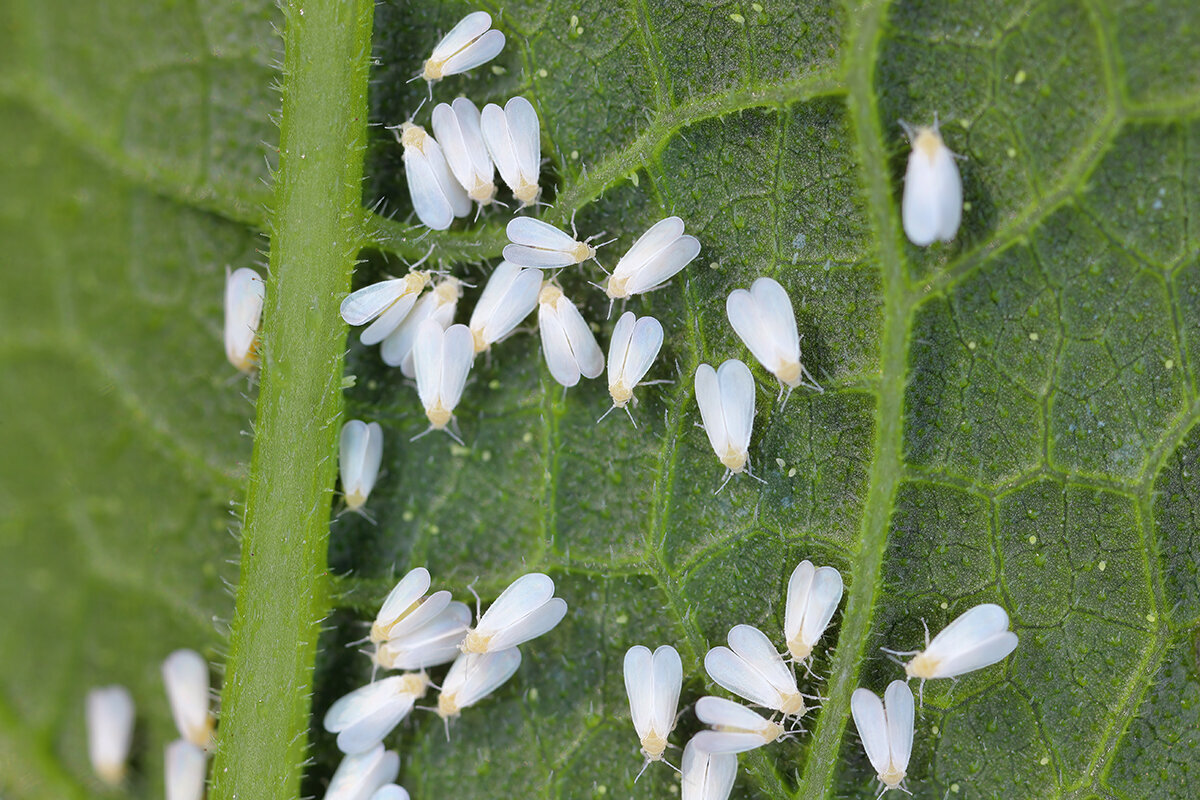
Disturbing a leaf sends the small white adults fluttering. Immature whitefly resemble little scales fixed underneath, rather than an aphid group moving over the plant.
Thrips
Long, narrow thrips move quickly and typically leave silvered feeding marks with dark faecal specks, not a coating of tacky honeydew.
Scale
Honeydew can also come from scale. Mature scale usually resemble raised, stationary discs or lumps, unlike pear-like aphids roaming over tender shoots.
Predatory larvae
Aphid-eating lacewing and ladybird larvae are allies. Pause before removing an unknown animal among the pests, because it could be preying on them.
Chapter 03 / Acceleration
Today's modest cluster can become tomorrow's widespread infestation.
A protected warm space with regular supplies of tender growth favours rapid colony increase. Through much of their active season, numerous common aphids give birth to live young without mating first. Temperature, daylight, host, species and crop condition govern the rate, so no single calendar applies. Prompt attention is still justified.
01Entry
02Colony feeds
03Sticky deposits
04Dispersal
After settling on a suitable plant, wingless aphids feed and produce young in the shelter of leaves and buds. Growing numbers make cast skins and honeydew easier to notice. Crowding, deteriorating host quality or another shift can trigger winged offspring that colonise elsewhere, but timing varies. A consistent weekly circuit is therefore better than a nominated calendar date; once aphids appear, shorten the gap between inspections.
Open doors and vents can admit winged aphids, and new plants can carry them in. If a basil pot, young capsicum or flowering ornamental has aphids, inspect every plant in the greenhouse. Keep severely distorted or otherwise suspicious plants separate for assessment rather than propagating, giving away or moving them through the crop.
Chapter 04 / Inspection map
These greenhouse locations are especially easy to miss.
Repeat one inspection circuit. Enter by the door, work methodically around the structure and leave recent additions until last. Even in a compact greenhouse, this pattern reveals change before damage becomes conspicuous.
- 1
Newest growth
Begin with folded foliage, tender stalks and active growing points, where aphids find vigorous tissue as it opens. - 2
Leaf backs and central veins
Lift and turn foliage, concentrating on low, crowded areas that a hurried check—or an earlier treatment—may not have reached. - 3
Recent arrivals
Herb pots, propagated cuttings, seedlings and containers brought out of winter shelter are frequent pathways inside. - 4
Hanging pots, weeds and margins
Colonies may remain concealed on weeds, behind crop foliage or in suspended plants outside your usual sightline. - 5
Openings and entry points
Include vents and doors because flying forms may use these openings to enter.
Cards coated in yellow adhesive may reveal winged aphids around openings, but their role is detection. They neither eliminate an established group nor substitute for examining plants. If you want orderly routes and easy-to-reach beds, consider the Classic aluminium greenhouse.
Chapter 05 / The boundary
Reduce fresh outbreaks through separation, screening and steady plant growth.
Insect mesh Small apertures without stifling airflow.
Quarantine Observe arrivals away from crops.
Hygiene Clear away weeds and crop waste.
Plant vigour Do not encourage sappy shoots.
Notes Log the plant, place and date.
A quarantine station can be simple: nominate a separate bench, a sheltered bright corner or another clearly divided space, then observe the plant closely for several days. Look beneath foliage and around stems, pot rims and compressed new growth. Finding nothing for a week is encouraging; extend observation for sensitive crops or anything suspicious. Ongoing fresh signs mean the plant should remain outside the main collection.
Screen openings while preserving movement of air; otherwise the greenhouse may become stagnant and excessively hot. Fine mesh can curb incoming winged insects only if ventilation and temperature remain manageable. Include roof vents, shading and sensible crop spacing in the solution. Our guide to aluminium greenhouse designs helps you assess glazing, accessories and ventilation as parts of one cultivation set-up.
Because weeds can quietly support aphids, clear them from bench undersides, the greenhouse perimeter and the approach to its entrance. Inspect decorative pots and plants kept under cover through winter as well. When geraniums, citrus or other cold-sensitive containers return outdoors in spring, they may carry aphids into vegetable seedlings.
Heavy feeding is not the answer to every crop. Aphids favour lush, sappy shoots produced by excessive nitrogen. Match fertiliser to the plant, pot volume and growth phase, irrigate consistently, and provide enough separation to examine fresh shoots without snapping them or brushing adjacent foliage.
Chapter 06 / Action sequence
Choose the least disruptive method that can still contact the pests.
The goal is effective management, not the most forceful chemical. Consider whether a response reaches the insects, suits the crop and can be checked afterwards. Escalate only if the earlier step cannot deal with the colony's density, the plant involved or its concealed feeding points.
01
Separate, label and track the source.
Move an affected pot aside only when you can do so without knocking aphids onto other plants. Label it with the crop and date. Until repeated checks find no active colony, do not carry it through the greenhouse, divide it, share the pot or take cuttings.
02
Cut out the worst pockets.
With sanitised tools, remove heavily curled tips, packed buds and foliage whose folds cannot be treated, then seal the waste in a bag. Never leave visibly infested cuttings exposed on compost beside the structure. For sturdy plants, a controlled low-pressure stream may wash off accessible aphids. Support the foliage during rinsing and let it dry with ample air circulation.
03
Choose beneficials with a plan.
Beneficial organisms can suit a multi-plant outbreak better than repeatedly coating the whole crop. Selection must account for the target aphid, crop, infestation pressure, temperature and day length, as well as residues left by any earlier treatment.
04
Apply a registered contact treatment only to accessible pests.
Contact oils or soaps succeed only when the spray touches aphids in the open; folded foliage and tight buds provide refuges. Use an APVMA-registered product or authorised permit whose label covers the crop, protected-cropping situation and intended user, then follow relevant state or territory use rules. Read every direction and never treat heat- or water-stressed plants.
Field note / Biological control
Biological allies work only when their environment suits them.
Suppression may come from ladybirds, lacewings, aphid midges or parasitoid wasps. The appropriate greenhouse organism is determined by the crop, aphid identity, age and scale of the outbreak, and the light, temperature and other conditions that can be sustained.
While predators consume aphids, parasitoids develop on or inside them and can leave rounded, discoloured aphid mummies. An unfamiliar insect should not be removed automatically: a papery mummy may confirm that a released wasp is already active.
Chapter 07 / Direct treatment
Labels govern every use of oils, soaps or conventional pesticides.
Contact soaps and oils
For home greenhouse use, consider an oil or soap only when an APVMA registration or permit and its label cover the plant, pest, protected-cropping use and intended user, with state or territory conditions also checked. Direct contact is essential. Move foliage carefully as the directions allow. Aphids seen afterwards may have survived in shelter or belonged to a missed pocket, rather than arriving anew.
Crop sensitivity varies.
Even an aphid treatment can damage a delicate cultivar or a plant already under strain. Tolerance changes with heat, intense sunlight, dry conditions and tender seedlings. Follow all label statements about trial applications, withholding periods and mixtures. Familiarity with two separate products never makes an unlisted combination acceptable.
Systemic and conventional products
Longer-lasting products, including some that travel within plant tissue, may have a place under professional management. Their use can have implications for food crops, blooms, pollinating insects, beneficials, harvesting and safe re-entry. Approval on outdoor ornamentals does not cover capsicums, tomatoes, herbs or leafy vegetables under glass unless the label or permit says so.
Australian registration and authorisation control use
Check PubCRIS for the current APVMA registration and consult the full label, plus the permits search where applicable; a shop listing is insufficient. Confirm the pest, precise crop or crop group, protected-cropping site, application technique, withholding period, safety controls, rate limits and permitted user. State and territory rules also govern chemical use. Never infer coverage for an application or crop that is absent.
Routine calendar sprays offer no assurance. No treatment, strength or interval is universally safe across greenhouse crops and aphid species. Follow the authorised directions exactly, including limits on repeats, harvest withholding, resistance management and protection of beneficial organisms. Where biological controls are being introduced, ask the organism supplier or a qualified horticultural adviser about compatibility before each application.
Chapter 08 / Recovery
Contact is only part of control; repeated inspection completes it.
A water rinse, pruning or contact treatment removes only aphids reached at that moment. It cannot confirm that nearby plants and every curled leaf are clear. Build another inspection into the response. This schedule complements mandatory label directions and crop-specific guidance; it replaces neither.
| Timing | Area | Record | Decision |
|---|---|---|---|
| Day 0 | Affected plant plus nearby pots | Moving aphids | Separate |
| Day 2–3 | Tender new tissue | Current movement | Cover missed areas |
| Day 7 | Adjacent plants | Trend | Review response |
| Every week | Known hiding places | Source recurring | Log |
Day 0
Survey the affected plant, its immediate neighbours, entrances, benches and the floor below. Log moving aphids, cast skins, sticky residue, winged individuals, pruned material and each action taken. Sanitise tools after handling the plant.
Day 2–3
Revisit tender tips and hidden leaf backs. Separate mobile aphids from empty old skins, then record any folded growth that the rinse, cutback or treatment failed to contact.
Day 7
Examine the first plant and the adjoining row or bench. Check for new distortion, honeydew, flying aphids on cards and—if beneficials are present—aphid mummies.
Later weeks
Keep the same weekly circuit through recurring trouble spots and recent additions. Increasing records often reveal a missed weed, a hard-to-access bed or another host that entered later.
Clean honeydew after dealing with its source.
Once the colony is controlled, clean sticky residue from benches, pots, nearby glass and other hard surfaces using a mild material-appropriate method; rinse where suitable. Robust foliage can be washed gently to clear honeydew and improve light. Avoid abrading tender leaves. Sooty mould can lessen when honeydew no longer forms. Focus on healthy working foliage and surfaces that can be inspected clearly, not instant cosmetic results.
Help damaged plants recover through steady care, not compensatory overfeeding. Prune only tissue that is dead, seriously misshapen or impossible to monitor. Balanced watering, open spacing and airflow let subsequent shoots demonstrate whether normal growth has resumed.
FAQ for Australian growers
What growers ask when an aphid group first appears.
Are soap sprays suitable for greenhouse vegetables?
Only when an APVMA registration or permit and the current label authorise that exact edible crop, pest, protected-cropping use and user, and destination state or territory rules allow it. Review all directions, precautions and withholding periods; ornamental approval does not extend to food plants.
Does a water jet kill aphids?
Low-pressure water directed at a small outbreak can dislodge numerous exposed aphids from a sturdy plant. It cannot consistently enter tightly curled foliage, crowded growth or bud folds, so return soon for another inspection.
Do ants cause aphid infestations?
Ants do not start the infestation. Honeydew draws them in, and they may defend the insects producing it, which complicates management. Address the aphids themselves and, where feasible, interrupt ant trails rather than blaming ants alone.
What explains aphids reappearing after treatment?
Possibilities include survivors hidden in folded tissue, an untreated plant nearby, weeds acting as hosts, a recent plant introduction or another entry through a vent. Inspect the wider area and identify the pathway before moving reflexively to a harsher treatment.
Will ladybirds control a severe outbreak by themselves?
They can assist, although one release may be overwhelmed by a large colony. Success depends on correct pest identification, reducing concentrated pockets mechanically, suitable environmental conditions, advice from the supplier and compatibility with pesticides already applied.
Is disposal always necessary for an affected plant?
Often it is not. Isolate and manage a small accessible colony on a plant worth keeping. Disposal becomes reasonable when infestation or distortion is extreme, or treatment would scatter aphids. Suspected viral disease needs separate diagnosis.
Sources and further guidance
Useful Australian checks, alongside the biological references.
Explore more with Bloomcabin: Planning a greenhouse interior · Protecting greenhouses from pests and weather · Conservatories and greenhouses
- German Environment Agency,Aphids—unwelcome garden visitors.
- German Environment Agency,Gardening with beneficial organisms.
- Chamber of Agriculture of North Rhine-Westphalia,Biological control of aphids.
- Chamber of Agriculture of North Rhine-Westphalia,Aphids on ornamental and house plants.
- Julius Kühn Institute,Beneficial organisms—general guidance.
- APVMA,Search registered chemical products and permits.
- Department of Agriculture, Fisheries and Forestry,Regulation of agricultural and veterinary chemicals.
The final finding
Finish the investigation before aphids spread again.
An aphid outbreak calls for alert observation rather than the harshest immediate response. Confirm live insects, isolate or remove the most straightforward source, favour proportionate methods and make reinspection part of regular greenhouse care.
Three actions that matter most
- Inspect the freshest shoots.
- Separate the affected source.
- Schedule the next check as part of crop care.
Support the habit with a greenhouse planned for unhurried access, sound ventilation and ongoing crop management.
Classic aluminium greenhouse