
How Long Does an Aluminium Pergola Last? Lifespan and Ongoing Costs
Long-range ownership guide
How long can an aluminium pergola serve you, and which future expenses deserve consideration?
Material is only one influence on an aluminium pergola’s working life. Its location, foundations, drainage, mechanisms and supply of compatible spare parts determine whether it remains a dependable feature of your outdoor space.
Aluminium suits outdoor structures because it does not require the recurring rot protection needed by untreated timber. Even so, low-maintenance is not maintenance-free. A realistic assessment covers the frame, finish, fixings, roof, drainage design and the conditions the pergola will face on site.
Rain and sunshine are not the only exposures an aluminium pergola encounters. Salt-laden coastal air, pollen, leaf litter, splashing water, rapid temperature shifts and an open, windy backyard can affect components in different ways. Rather than promising a universal number of years, identify local risks early and tailor upkeep to both the structure and its setting.
Ownership expenses tend to appear over time. Cleaning, small adjustments and timely replacement of wearing components can be anticipated, whereas neglected checks may lead to more demanding repairs. Use this guide to judge a pergola as a continuing part of your terrace, not simply by how it looks on day one.
01 · Know the materials
The frame is only one part
It is natural to focus on the frame when considering pergola longevity. Aluminium behaves differently from bare steel when exposed to corrosion, making it suitable outdoors. Lasting performance still depends on profile design, sound surfaces, contact points and correctly formed joints. Attend to scratches, trapped grime and persistently damp patches so the structure continues to look cared for.
Durability also depends on how the materials work together. Fasteners, seals, covers and anchoring points need not age at the same rate as aluminium profiles. Ask about the whole assembly rather than only its visible frame. Clear construction records make future inspections easier and help a technician service or replace the correct component.
- Regularly examine exposed joints and transitions for looseness, abrasion, colour changes and accumulated grime.
- Give extra attention to mixed-material junctions and places where rainwater is slow to clear.
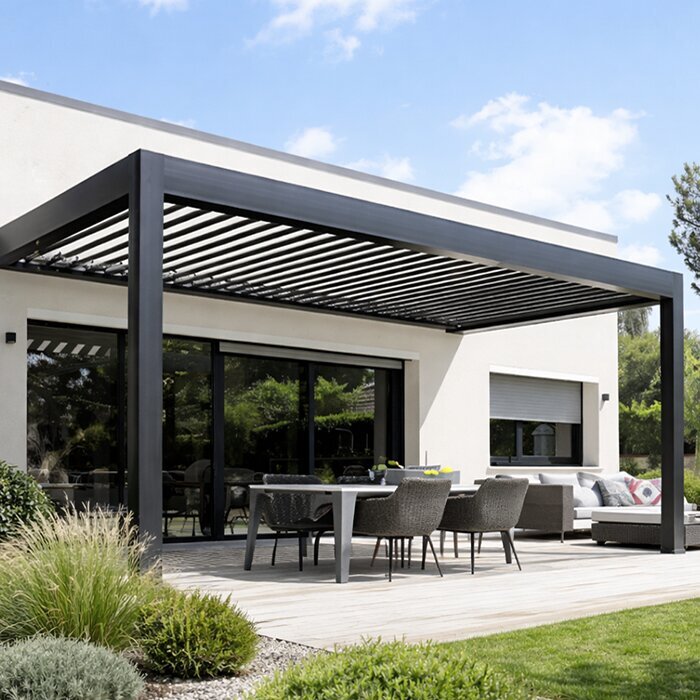
For a roof with more involved technology, consider louvred bioclimatic pergolas in aluminium as integrated systems rather than isolated components.
02 · Site assessment
Your garden shapes maintenance needs
An exposed freestanding pergola meets wind, rain and airborne debris differently from a terrace sheltered by buildings and planting. Close trees add leaf litter, blossom dust and twigs that may collect in gutters, joints and outlets. Observe the space through summer storms and autumn leaf fall before settling the orientation, roof style and position.
Urban sites may also bring road residue, dust and water splash. Where humidity or salty coastal air is prominent, cleaning frequency should reflect that exposure. The answer is not to label the location unsuitable, but to design around it. Easy access for washing and inspection is a valuable feature that can be missed during planning.
- Leave space around vigorous planting for airflow and for cleaning without branches pressing against the pergola.
- Following strong winds or substantial leaf fall, check gutters, outlets, post surrounds and ground junctions.
For an intentionally restrained outdoor area, consider classic terrace pergolas in aluminium as a simple, uncluttered option.
03 · Roof and mechanism
Moving components need extra attention
How adjustable elements are operated contributes to their condition over time. Moving components rely on unobstructed travel paths, undamaged seals and correctly seated fixings. If something becomes difficult to move, do not overcome the resistance with force. Arrange an inspection of the cause before the fault places strain on neighbouring parts.
A fixed roof still requires attention at junctions, drainage points and cover profiles. Adjustable designs add the need to monitor movement and water discharge. Retain the operating and assembly documents: they explain the care routine and help identify the exact component when making a future enquiry.
- Gently remove leaves and loose matter so drains remain open and debris does not enter joints or mechanisms.
- Promptly seek professional advice about new noises, inconsistent movement or seals that appear damaged.
If adjustable shade and roof control are priorities, assess bioclimatic pergolas fitted with adjustable louvres for practical access and ease of operation.
04 · Installation base
Foundations and connections matter long-term
A high-quality aluminium structure still needs an appropriate mounting base. Early planning should account for soil or slab conditions, the existing terrace layers, falls and the path of water. Visual levelness alone does not prove suitability. Obtain a professional site assessment, particularly where paving, insulation or services may be close to anchoring points.
Details at floor level affect both inspection and cleaning. When post feet remain visible, dirt and pooled moisture are easier to detect. Beside a building, wall junctions and drainage demand particular care. Before committing, ask the relevant council and state or territory authority whether approvals, setbacks or other controls affect the site, and seek specialist advice where appropriate.
- Keep a record of the assembly, anchor locations and any service routes so future work can be planned safely.
- Direct water away from the mounting area while retaining access for checks, cleaning and future repairs.
Where the design calls for a clearly defined fixed roof, standard aluminium pergolas provide a straightforward starting point for planning.
05 · Care in practice
Regular care prevents bigger jobs
Frequent light care generally achieves more than an occasional intensive clean. Begin by lifting away loose grime without abrasion, then choose a cleaner approved for coated finishes. Scouring pads, strong chemicals and untested household mixtures may harm the surface. If uncertain, consult the product instructions and trial the cleaner on a concealed spot.
Observation belongs in the routine as much as washing. Look for changes in coatings, seals, covers and visible connectors. A quick check after severe weather or ahead of spring gardening can catch concerns early. When damage or abnormal movement appears, seek qualified guidance instead of attempting a makeshift repair that might affect finish or operation.
- Choose a recurring seasonal date to clean the roof, gutters and nearby terrace surfaces together.
- Photograph and date anything unusual, creating a useful record for comparison during a future assessment.
When a structure combines several functions, examine aluminium bioclimatic pergola systems for ideas when developing its maintenance schedule.
06 · Planning ongoing costs
Budgeting happens over several stages
Repairs are only one category of future expenditure. Depending on the location and pattern of use, you may also need cleaning supplies, specialist servicing, adjustments and replacement wear items. Including these from the beginning gives a sounder plan than assuming one standard lifespan. Ask which tasks suit owner maintenance and which should be left to a professional for your model.
Plan how replacement parts would be sourced. Establish how the required component is matched, what records support identification and whether separate items can be dealt with individually. Retain receipts, assembly information and photographs. Because pricing varies with the model, configuration, condition and labour involved, a current quotation is the only way to obtain a specific figure.
- Allow for routine upkeep and keep a contingency for unexpected remedial work or later adjustments.
- Record the names of important components before purchase so any later parts request can be handled accurately.
If you prefer a simpler arrangement, assess classic designs without a louvred roof by their parts, upkeep requirements and intended role.
07 · Use and protection
Considerate use keeps finishes looking good
The way a pergola is used affects its appearance over the years. Attach only accessories designed for the structure or approved by a competent professional. Unplanned loads, temporary fasteners and unsuitable decorations may stress finishes or joints. Train climbing plants with adequate clearance so their stems do not enter gutters, hinges or spaces that are difficult to reach.
For exceptional weather, rely on the safety and operating directions provided for the product. They remain relevant beyond installation and support its long-term condition. Afterwards, inspect only what can be reached without climbing or approaching damaged areas. Where the safe response is uncertain, obtain a qualified assessment before deciding what to do next.
- Do not tape, drill or fit makeshift hooks to exposed profiles unless the product instructions expressly allow it.
- Prune growth before it reaches the structure, keeping downpipes, drains and moving zones free of plants.
For a terrace serving several purposes, select aluminium bioclimatic pergolas for outdoor living with furniture, daily use and service access in mind.
08 · Buying decision
Ask the right questions for lasting value
First impressions and a single feature are poor grounds for comparing aluminium pergolas. Ask for plain information about the build, base and installation needs, finish care, drainage and points of contact. Check that the proposed dimensions and placement leave workable maintenance access. A design that can be inspected and cleaned without difficulty is easier to manage throughout its service life.
Review all written information before ordering, including terms for assembly, operation, upkeep and potential claims. Expected service life is not the same as a guarantee: the latter has defined contractual conditions, while actual longevity reflects the way and place the structure is used. Ask your insurer how the proposed project affects your particular cover.
- Before seeking advice, assemble site photos, dimensions, base details and questions covering access, maintenance and replacement parts.
- Match the features to everyday needs, avoiding complexity that will not deliver useful value in regular operation.
For a crisp, uncomplicated layout, explore traditional garden pergolas made from aluminium when planning a seating area for lasting use.
Comparison
Which factors shape long-range planning?
Use this table to organise the influences on longevity and ownership costs, not as a substitute for checking the chosen model. The outcome for any project reflects the combined effect of its construction, setting, installation and use.
| Area | What to consider | Possible long-term outcome |
|---|---|---|
| Frame and finish | Coating, scratches, clean transitions | Regular care preserves appearance and protective performance. |
| Roof and outlets | Leaf-free gutters, accessible check points | Blockages may require cleaning and professional inspection. |
| Mechanical elements | Smooth operation, seals, correct use | Early checks limit consequential damage to adjacent components. |
| Foundation and fixing | Base, fall, documented installation | A suitable build supports stability and maintenance access. |
| Spare parts | Clear model and component identification | Documents simplify future enquiries and repair planning. |
Five steps towards a durable plan
Good preparation puts future operation, maintenance and care alongside appearance when you choose a pergola. Work through these five steps so the practical questions are settled early.
01
Study the location
Track wind, shade, falling leaves, splash and rainwater flow. The pattern will show where cleaning access and regular attention must be provided.
02
Arrange a base assessment
Have the layers, bearing capacity, falls and nearby services checked. Where the pergola approaches a building, include its junctions and drainage in that preliminary professional review.
03
Set the intended purpose
Choose between a mainly open seating place, controllable shade or a more clearly enclosed terrace zone. That purpose indicates how much mechanical complexity is worthwhile.
04
Draw in service access
Mark practical approaches to the roof, gutters, post feet and important junctions. Parts that can be reached safely are simpler to inspect and clean.
05
Retain the records
File the quotation, model identification, installation guidance and photographs together. They will assist with upkeep questions, parts requests and later professional assessments.
Pre-purchase checklist
Bring these questions to your planning discussion. They turn an abstract concern about durability into a choice grounded in your property, intended use and expectations.
01. Across the seasons, how much leaf litter, splashing water, wind exposure or dense growth affects the proposed location?
02. Has a professional assessed the supporting base, its fall and the route for water before selection?
03. Can you safely reach the gutters, junctions, post feet and other maintenance areas without makeshift access?
04. What requires routine visual inspection, and which product directions govern use and cleaning?
05. Which records identify the exact model, configuration and component when a spare part is requested?
06. If damage, noise or abnormal movement develops, who is qualified to inspect and repair the structure?
07. Before ordering, have you reviewed and understood the installation, maintenance and guarantee conditions relevant to the project?
08. Have the appropriate authorities and your insurer clarified site-specific requirements and cover early enough?
Pergola lifespan: common questions
Does aluminium automatically make a pergola long-lasting?
Aluminium works well in outdoor construction, but the material alone cannot establish a standard lifespan. Profile specification, surface condition, siting and installation all matter. Long-term appearance and operation are also shaped by the condition of seals, fasteners and outlets, together with consistent care.
How much should I budget for care over time?
The answer varies with location, dimensions, features and present condition. Cleaning and inspections are recurring possibilities, while some situations call for a technician or replacement components. To obtain a dependable current figure, have the actual model and required work assessed and request an up-to-date quotation.
How often does an aluminium pergola require cleaning?
A gentle cleaning routine is recommended. Clearing dust, pollen, leaves and other residue before it accumulates helps protect finishes and keeps drainage routes unobstructed. Follow the care directions supplied with the product when choosing methods and cleaners. Unless specifically approved, avoid abrasive tools and harsh chemicals.
Does a louvred roof demand more upkeep than a fixed one?
A roof that adjusts has mechanisms, so it introduces additional places to inspect. This need not make maintenance onerous, provided it is operated carefully and its travel and drainage paths stay clear. Fixed roofs still require attention around outlets and junctions. Base your comparison on service access as well as appearance.
What signs call for a professional assessment?
Seek timely advice if you notice stiffness, unfamiliar sounds, loosened parts, visible damage or water that repeatedly pools. Avoid forcing the mechanism or using an improvised fix when the cause is uncertain. Early assessment helps define the work and may prevent effects on neighbouring components.
Do guarantee length and useful life mean the same thing?
No. A guarantee applies according to its documented period, scope and conditions for specified circumstances. Useful life concerns how long the pergola remains serviceable in its own environment and pattern of use. Read the full guarantee terms, then separately consider installation, maintenance, location and correct operation.
Compare pergolas
Choose with the years ahead in mind
Asking how long an aluminium pergola will last is most useful when the entire project is considered. Material, foundations, exposure and upkeep operate together. Roof systems, moving parts and drainage particularly benefit when safe inspection and cleaning access are designed in from the outset.
A prepared buyer looks beyond outdoor styling to records, routes for obtaining parts and access to competent help. Bringing those details into the selection process creates a sound foundation for a pergola that suits daily life and can be maintained responsibly over the years.
Browse aluminium pergolas and choose a configuration that fits your site, design preferences and future care routine.
