
Whiteflies in Your Greenhouse: How to Control Them
Greenhouse upkeep · Integrated pest control
Controlling Whiteflies in the Greenhouse
A burst of pale insects reveals only part of what is happening. Under the foliage, eggs and larvae may already be producing another generation, so that concealed area is where control should begin.
01 / The visible warning
That sudden white cloud reveals only the most obvious part of the outbreak.
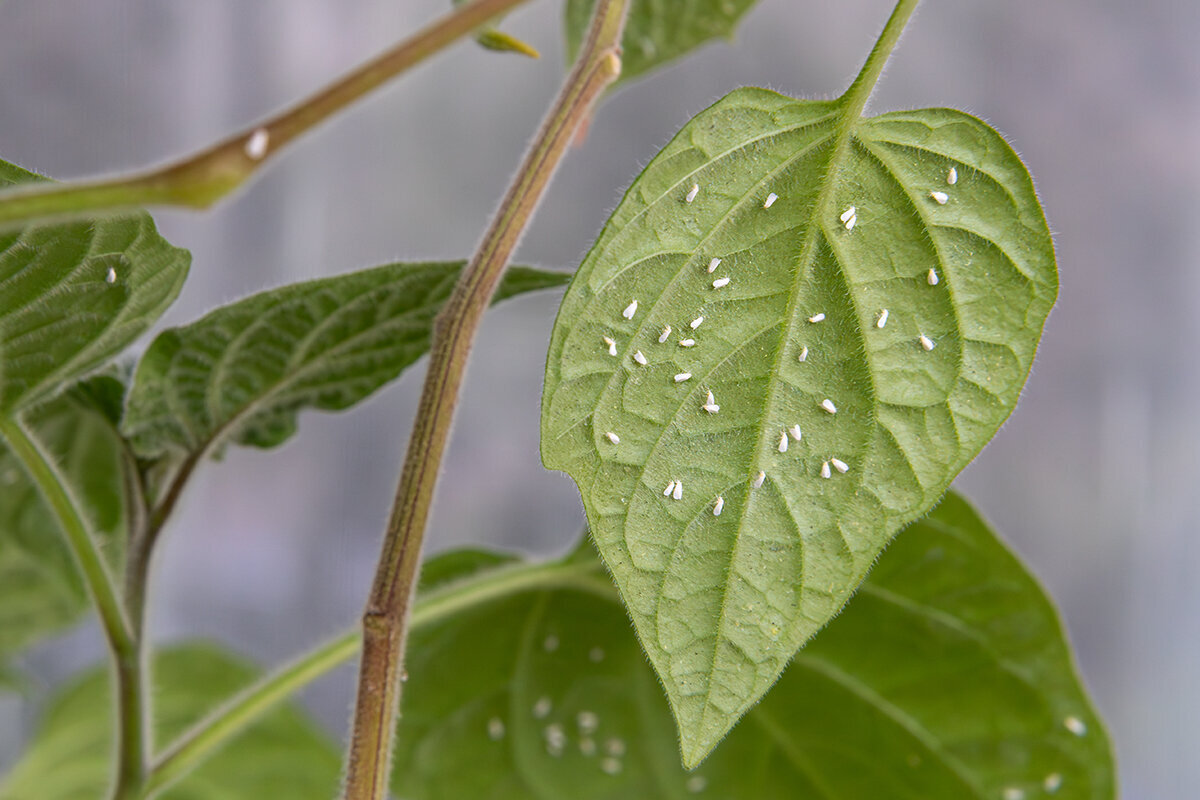
Brush against a tomato, cucumber, capsicum, eggplant or fuchsia and tiny white insects may rise from the foliage. Although this makes the problem obvious, flying adults account for only one mobile fraction. Eggs, newly hatched crawlers and later immobile stages remain on leaf undersides. Consequently, adults can reappear days or weeks after an intervention appeared to work.
Whiteflies feed by drawing sap from plants. Severe or prolonged infestations reduce vigour and productive foliage. Their honeydew is especially noticeable: sticky deposits collect on leaves, fruit, pots and benches, creating conditions for dark sooty mould. Greenhouse whitefly is common in German hobby glasshouses, while plants brought in can also carry Bemisia tabaci . Choose a response according to crop, species, infestation level, climate and any intended beneficial-insect release.
An orderly layout makes this work easier because plants, paths, vents and working areas can be inspected methodically and kept clean. In a permanent structure such as a Classic Aluminium Greenhouse , checking the leaves should sit alongside watering, pruning, ventilation and shading as part of normal care.
02 / Diagnose before acting
Let the leaf underside tell the story.
Viewed through a hand lens, an indistinct pest problem becomes a decision about particular life stages. Species, crop, temperature and conditions inside the greenhouse affect appearance and development, but the same inspection logic still applies.
Sample several leaves on several plants rather than reaching for the nearest specimen. Examine veins, soft new growth, the middle of the canopy and older foliage under dense leaves. Distribution is often patchy: a sheltered plant may be producing a large population while a nearby one holds only a handful of adults or newly laid eggs.
Eggs
Minute and pale, often clustered close to veins.
Mobile first-stage larva
Moves for a short period after hatching.
Later immature stages
Flat, shield-like forms that are easily overlooked.
Adults
Powdery white insects that fly when foliage is disturbed.
Four observations from one leaf provide a starting point. Verify what you see by sampling several plants in separate parts of the crop.
Use the pattern to guide inspection, not as a substitute for sound identification. The tiny eggs can alter in appearance as they develop. After hatching, the first larva travels briefly over the leaf on which it emerged, then settles at a feeding point. Subsequent stages scarcely move and look like pale, flattened scales. The easily noticed adults account only for the airborne portion of the infestation.
Other evidence includes new honeydew, sooty mould, pale feeding injury, shed skins and a growing concentration of settled immature insects. Exact features depend on age, host, temperature and species. Greenhouse whitefly and Bemisia tabaci are not always distinguishable from one field characteristic. Recognising the main stages is usually sufficient for home gardening decisions. Seek identification from a specialist supplier, plant-health adviser or suitable diagnostic service when plants are valuable, symptoms are unusual or a targeted beneficial-insect program is planned.
03 / Make sure you have the right insect
How whiteflies differ from other tiny flying pests
Whiteflies
When foliage is disturbed: Tiny powder-white insects lift together from the plant.
How to verify it: Inspect new shoots and the lower leaf surface for eggs and flattened, settled stages.
A common clue: Increasing numbers are accompanied by sticky honeydew and black sooty mould.
Fungus gnats
These dark, mosquito-like insects tend to hover near moist potting media. The larvae occupy the soil rather than forming flattened scales on foliage.
Thrips
Their narrow bodies are more often linked with silvered feeding damage, misshapen growth and minute dark faecal spots than with a rising white cloud.
Winged aphids
These are generally more pear-shaped, and their wingless colonies are often obvious on tender stems and shoots. They too can leave honeydew.
Correct identification determines the response. Yellow cards may catch insects from every group listed here, whereas eggs and settled whitefly stages are found by turning leaves over. A treatment selected for aphids, thrips or fungus gnats should never be assumed safe or effective for whitefly.
04 / Turn checks into comparable records
Repeat one defined route every week.
A chance sighting is useful, but it cannot show whether the population is shrinking, spreading or gathering in one area. Establish a short route through the structure: begin with doors and vents, then check recent arrivals, dense plant groups, growing tips, old foliage and finally weeds or discarded material beneath benches. Take a hand lens and maintain either a notebook or a consistent digital log.
1
Entry points
Inspect the door, vents and newly introduced plants.
2
Known clusters
Label plants that release flying adults.
3
Top growth
Look at tender tips and recently laid eggs.
4
Lower foliage
Inspect old leaves for developing stages.
5
Floor level
Clear away weeds and discarded foliage.
For a modest collection, sample several useful plants within each crop instead of returning only to the specimen nearest the entrance. Divide a larger greenhouse into permanent zones and examine an equal plant sample in each one. Log the date, crop, location, adult flights, immature stages, honeydew, leaf removal, treatments and beneficial releases. Consistent observations are more informative than a made-up threshold applied everywhere.
Pay particular attention to vigorous plants, sheltered corners and foliage that is awkward to reach. Dense growth can conceal reproduction for a long time. Quietly tag several affected plants for comparison at the next inspection and, where practical, identify one apparently clear plant as well. This makes it easier to distinguish an expanding infestation from damage that is simply old but still visible.
05 / Use yellow traps as a consistent measure
Sticky yellow cards reveal flight activity; they cannot resolve an established outbreak.
Understand the reading
Direction of changeThe catch covers adults, while foliage stages remain unseen.
Standardise each round
- Give every card a number.
- Return it to the identical position.
- Use an unchanged counting section.
- Write down the date and count.
Yellow attracts adult whiteflies. When card placement and counting remain consistent, catches reveal new arrivals, relative flying activity and change following an intervention. They say nothing definitive about whether eggs, crawlers or settled stages remain on plants. Use each card as one monitoring instrument within the wider program, not as a stand-alone remedy.
At each round, put cards back in the designated zones close to canopy height and move them upwards as the crop grows. Either count the entire surface or keep to one marked section. Changing that section mid-season breaks comparability. Replace a card when dust, moisture, plant fragments or accumulated insects make it hard to read, then compare its count only with earlier records for that same position.
In a small backyard greenhouse, several cards assigned to separate crop areas, including one near the entrance, are more informative than a lone card hung at random. Pair every count with turned-leaf observations. A falling adult count is welcome, but live settled stages or new larvae confirm continuing activity. Position cards away from released beneficials, splashing water, intense heat and regular contact with foliage.
06 / The missing dimension is time
Why a single action seldom reaches the whole population
Life stages within a greenhouse population do not advance together in a tidy cycle. One group of adults may still be laying while another group hatches and older immature insects have already settled. Protected warmth can shorten development and create greater overlap between generations. An action that reaches mobile larvae or exposed adults can consequently spare eggs and less accessible stages.
Randomly increasing product strength or frequency is not the solution. Build reassessment into the initial plan: remove important sources, identify what survives and, when appropriate and permitted, combine sanitation, biological control and direct action. Revisit the same sample plants before another increase passes unnoticed.
Generations that overlap
Eggs are deposited by adults.
New larvae emerge, travel and begin feeding.
Settled forms persist as another adult group appears.
Because development is staggered, an inspection usually finds more than one stage. Schedule reassessment at the outset rather than adding it later. Do not copy repeat intervals from a general online timetable; timing must reflect the crop, local conditions, observed population and, whenever a pesticide is involved, every direction on the current label.
07 / Cut down the sources of infestation
Quarantine arrivals, remove material selectively and manage entry points
Quarantine new plants
Separate newly purchased seedlings, potted plants and gifts before adding them to the collection. Gently disturb the foliage and inspect several turned leaves for every stage first.
Prune leaves with heavy colonisation
Where one area carries most of the insects, take off densely occupied leaves only when the plant will cope with the reduced foliage. Enclose each leaf before moving it across the greenhouse.
Clear overlooked host material
Volunteer seedlings, weeds, forgotten reserve plants and remnants of an earlier crop may carry whiteflies between plantings. Clean around containers, beside walls and underneath benches.
Prune with restraint rather than stripping the plant. Removing too much foliage can impede recovery, weaken growth and expose tender tissue or fruit. Give priority to leaves supporting dense egg and immature-stage groups. If one non-essential plant is severely affected and releasing many adults, complete removal may be appropriate. Seal the material; do not leave it exposed in the greenhouse or add it to compost. Follow local council or biosecurity directions for disposal.
Exclusion helps most before insects establish. Fine mesh at openings may reduce entry, provided essential air movement is not compromised during hot Australian weather. Everyday handling matters as well: shut doors promptly, keep affected plants away from entrances and avoid an untidy holding area for arrivals that have not been checked. A Classic Aluminium Greenhouse can provide straightforward routes, reachable plants and ventilation zones that are easier to manage.
Clean glazing, uncluttered paths and organised benches contribute to pest management as well as appearance. They expose honeydew to view, make the backs of leaves easier to reach and provide repeatable positions for monitoring cards. For a well-ordered growing area serving a demanding collection, the range of Aluminium Greenhouses includes layouts suited to accessible crops, defined planting areas and regular upkeep.
08 / Introduce biological control promptly
Success with beneficials depends on timing rather than luck.
Parasitoids and predators
A well-established biological agent against greenhouse whitefly is the parasitoid Encarsia formosa . Consider it while the population is still modest and residues from earlier products will not disrupt release. Where Bemisia tabaci is present, specialist advice may identify a different beneficial combination, potentially involving suitable Eretmocerus species. Ask a beneficial-insect supplier or plant-health adviser to consider the whitefly involved, crop, temperature, light, planted area and previous treatments.
Predators may also contribute. In German protected fruiting-vegetable programs, the mirid Macrolophus pygmaeus may be considered, but this does not establish its availability or suitability for an Australian home collection. Check locally rather than looking for one supposedly superior beneficial. Selection needs to reflect the pest, plants, infestation level, climate and treatment history; organisms are not interchangeable or equally suited to every setting.
Before discarding every dark immature stage, look for evidence that parasitism is occurring. Greenhouse-whitefly puparia attacked by Encarsia formosa can become dark. With magnification and a trustworthy identification reference, you are less likely to discard active biological control agents along with colonised foliage.
Biological management requires more than a token release. It depends on continuing observation, reliable identification, suitable conditions and time for establishment. Practical access helps: benches and walkways should permit leaf sampling, movement between crop areas and even distribution without an impenetrable mass of foliage. A Classic Aluminium Greenhouse can supply clear walkways and reachable growing zones for that work.
09 / Choose each tool for the stage present
Effective control combines layers rather than relying on one purchase.
Sanitation
Takes colonised material and concentrated hotspots out of the crop.
Yellow monitoring cards
Track changes among airborne adults.
Beneficial organisms
Gradually add biological pressure to the population.
Direct-contact options
Depend on reaching the lower leaf surface thoroughly.
Sanitation and removal can eliminate clusters of eggs and settled stages when colonised foliage, weeds, crop remnants or isolated hotspots are taken out. They do not affect insects left elsewhere in the crop.Yellow monitoring cards show relative activity among flying whiteflies without measuring all developing insects concealed below the foliage.Parasitoids and predators can establish sustained pressure when correctly selected and released early. They also need compatible conditions, protection from harmful residues and enough time to work.Direct-contact products affect only organisms they actually touch. A glossy upper surface does not demonstrate that the underside received adequate coverage.
A contact treatment must physically reach its target
Soaps, oils and other contact options have an effect only at the point where they reach the pest. Whiteflies mainly occupy the lower leaf surface, making technique, plant sensitivity, heat, moisture stress and the manufacturer's directions critical. Perform any label-directed test treatment when working with delicate crops or mixed plantings. Do not improvise mixtures or substitute household dishwashing liquid for an authorised product; tender foliage can be damaged readily in greenhouse warmth.
For an edible crop, verify immediately before use that the product or permit covers the crop, whitefly, protected-cropping situation and home-garden user where applicable. Consult current APVMA information, read the entire label and follow destination state or territory rules. Observe the specified rate, technique, application limit, withholding period, protective measures and beneficial-insect warnings. Current authorisation and label directions take precedence over old online recommendations.
10 / Every chemical decision is conditional
Use authorised pesticides cautiously and document each application
No single spray sequence can responsibly be recommended for every Australian home greenhouse. The crop, pest, application site, user category, plant condition, beneficial insects and current authorisation all affect the choice. Before applying a product, search APVMA registration and permit information, check the rules where it will be used and read the complete label. Confirm that both crop and protected-cropping use are covered, then comply with rates, application limits, withholding periods, safety directions and restrictions.
Even when an authorised treatment is justified, changing the brand while repeatedly using the same mode of action can still select for resistance across successive generations. A defensible resistance plan follows current authorisation, product details and specialist guidance. Some Bemisia populations are notably difficult to manage. Keep a complete application history so later decisions remain traceable and unidentified residues do not undermine a future beneficial release.
Seek regional plant-health advice early when the population keeps growing, persists or cannot be identified confidently. Do the same for unusual plant symptoms or uncertainty about permitted use. Integrated management reserves chemical action for a specific, justified role; it does not replace identification, sanitation, sound application technique or follow-up by life stage.
11 / Results are established after the action
Use fresh observations to judge recovery, not a single quiet afternoon.
Removing colonised leaves, applying a direct treatment or releasing beneficials can make the greenhouse appear calmer straight away. That is encouraging, but it is not the end point. Improvement means the repeated route shows declining adult counts on cards kept in comparable positions, fewer new eggs and crawlers on young foliage, fewer living settled stages and less fresh honeydew. Earlier sooty mould, feeding injury and empty skins will remain for a while. Concentrate on signs of current activity instead of expecting every leaf to look clean overnight.
A
Initial reassessment
Revisit each tagged hotspot and inspect several turned leaves. Note the stages that remain, removing newly crowded foliage only where enough healthy leaf area will be left.
B
Assess the direction
For each numbered card, compare the count only with records from that exact position and interpret it beside the foliage observations. Fewer trapped adults are favourable, but that result is not conclusive on its own.
C
Refine the response
If immature numbers are still rising, reconsider identification, sanitation, spray coverage, compatibility with beneficials and fresh entry from weeds, plants, vents or doors.
Maintain the routine as pressure falls. Resilience does not mean eliminating every insect from the greenhouse; it means detecting a small arrival before the entire canopy supports a population. Unobstructed paths, an assigned location for the lens and records, sensible ventilation and shade, and access behind the plants turn an intention to monitor into dependable long-term care.
FAQ / Australian backyard greenhouses
Straight answers to common whitefly questions
Will yellow cards eliminate every whitefly in the greenhouse?
No. The cards indicate airborne activity and remove a proportion of the adults, but they leave eggs and most developing stages on the lower leaf surface. Treat them as warning and comparison devices, with every count supported by a structured foliage check.
Does every affected plant have to be discarded?
No. Separate the plant, determine the severity and identify the stages involved. Where adequate healthy foliage will remain, remove only the leaves carrying dense colonies. Discarding one expendable plant can be sensible when a severe population on it is supplying adults and new generations to the wider collection.
What causes whiteflies to reappear after control?
Different stages were probably present together. An action directed at the obvious adults may spare eggs and settled immature insects, while poor coverage underneath foliage can leave survivors after a contact treatment. The population may also rebuild from unchecked arrivals, overlooked host plants or insects entering through openings.
Is a beneficial release possible after treatment?
Sometimes. The answer depends on the named product, active constituent, date of use, persistence, crop and beneficial species being considered. Retain the full application record and consult the supplier, a garden specialist or plant-health adviser before release. An incompatible contact product may seriously hinder the biological program.
Can whiteflies harm tomatoes, cucumbers, capsicums and herbs?
Yes. A continuing population may reduce vigour and productive leaf area. Sticky honeydew contaminates foliage and fruit while encouraging sooty mould. For edible plants, choose only techniques and products appropriate to the crop and covered by current authorisation, and comply with every withholding-period and safety direction.
How regularly should I inspect for whitefly?
During active growth, carry out a check no less than once a week. Inspect sooner in warm conditions, near established hotspots, after introducing plants or when card counts increase. The important feature is a repeatable route whose results can be compared. Monitoring frequency does not override label requirements or qualified advice.
References and further reading
Choose information that is current and technically sound.
Species biology, beneficial-insect programs and pesticide permissions can vary or change. The German technical references below support the life-stage approach; for Australian use, verify current APVMA product or permit status, the complete label and applicable state or territory requirements.
More from Bloomcabin: Greenhouse setup: planning, plants and ongoing care · Caring for a greenhouse through summer · Explore Bloomcabin greenhouses
- North Rhine-Westphalia Chamber of Agriculture – Whitefly on vegetable crops
- North Rhine-Westphalia Chamber of Agriculture – Biological management of whitefly
- North Rhine-Westphalia Chamber of Agriculture – Parasitoid wasps for whitefly
- Bavarian Garden Academy – Guidance on whiteflies and their control
- Julius Kühn Institute – Fact sheet on Bemisia tabaci, the tobacco whitefly
- German Environment Agency – Pest management and beneficial insects in vegetable gardens
- APVMA – Search registered chemical products and permits
- North Rhine-Westphalia Chamber of Agriculture – Recognising whitefly in home gardens
