
Greenhouse Glazing for Hail: Glass or Polycarbonate?

Greenhouse guide
A quick guide to planning for hail
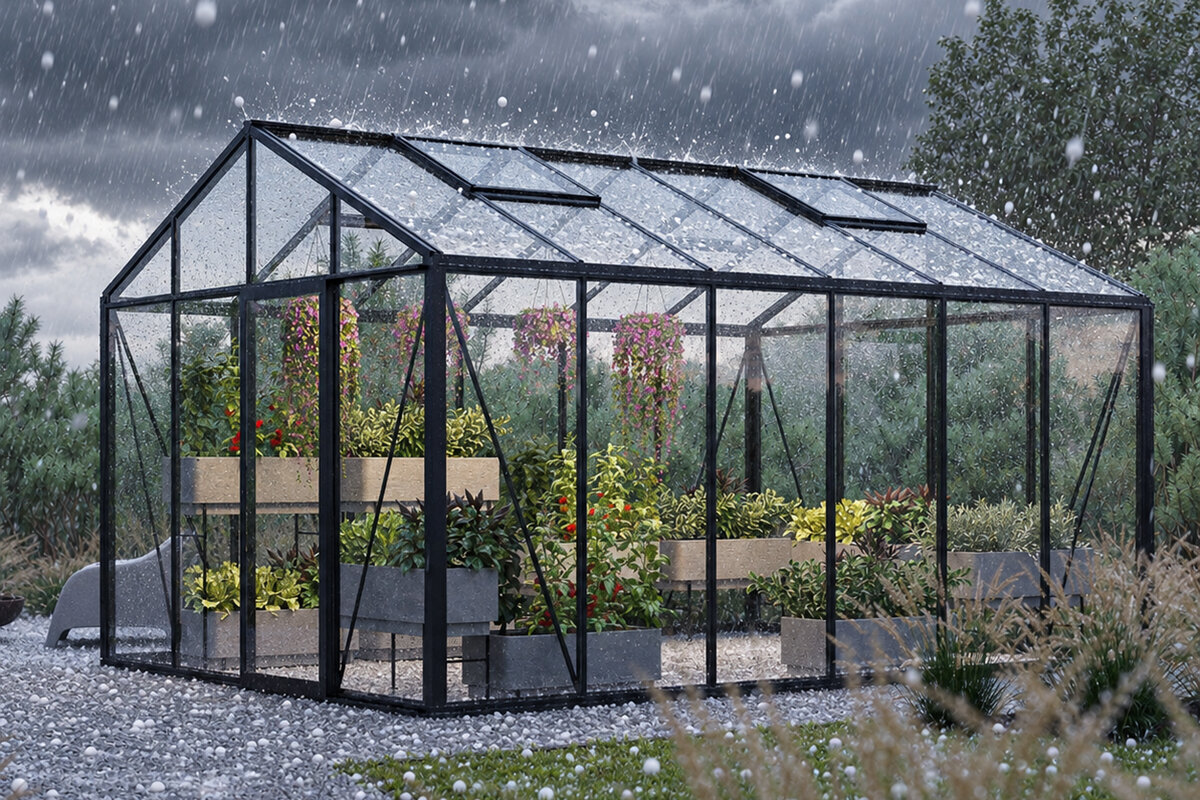
Where hail is frequent or severe, polycarbonate is often considered for its inherent impact resistance. Glass can still be the right fit when crystal-clear views and a traditional appearance matter most, provided site exposure, installation, and possible damage are considered carefully.
Treat the glazing as one element of the structure. Foundation stability, accurately seated profiles, and distance from preventable hazards also shape the plan. Before ordering, read your insurance wording and the documents for the particular option on your shortlist.
01
For hail-exposed sites
Polycarbonate may suit a hail-conscious project when sturdy panel construction and softly scattered light fit the way you intend to grow.
02
For clear garden architecture
Glass works well when transparency, disciplined architectural lines, and easy viewing of the planting are key design goals.
03
For a well-grounded decision
Build the decision from several factors: local storm experience, position, assembly quality, upkeep, and what a future repair could involve.
Greenhouse Glazing for Hail: Glass or Polycarbonate?
Across Canada, hail deserves a place in the glazing conversation alongside the other weather pressures a greenhouse may encounter. Storms differ in hailstone size, hardness, direction, and intensity, sometimes over short distances. A material that suits one property may not suit the next. Base the choice on exposure around the proposed location, your growing plans, and the architectural effect you want in the yard.
Glass provides an uninterrupted outlook and the composed appearance associated with traditional greenhouses. Polycarbonate softens the view and is commonly chosen when reduced susceptibility to breakage is more important. Performance is not determined by the panels alone: framing, fasteners, the foundation, and accurate assembly all contribute to the finished structure.
Use the sections below to build a property-specific comparison. Product instructions still govern the selected model, and unusual ground or exposure conditions may call for individual advice. Considering weather, daily use, and future care at the outset leads to a more durable and understandable choice.
01 · Material choice
Understand your hail exposure
Hail is not a uniform weather event. Small stones affect glazing differently from larger ones, while wind, direction of impact, and the duration of a storm also matter. Look beyond broad weather reports and ask neighbours about conditions at your specific location. An open rural property may face different exposure from a sheltered urban yard or enclosed garden.
Start with an honest assessment of risk, not an assumption of absolute protection. Glass and polycarbonate respond differently to impact because of their material properties. It is just as important that the glazing is correctly seated in the frame. Loose components, an uneven base, or unsuitable fixings can make a difficult situation worse.
Visible shelter tells only part of the story. A house wall may screen one storm direction, yet roof edges, downspouts, and swirling wind can create different problems nearby. Provide sensible separation from building features and direct runoff away from the greenhouse. Good access will make an inspection after rough weather much simpler.
Think about day-to-day activity as well. Door movement, access near the roof, stored tools, and maintenance paths all need space away from the glazing.
Record significant hail events from recent years and ask nearby residents about typical conditions at the exact site.
Take account of exposed wind corridors, large tree canopies, and roof edges that may create additional storm-related risks.
As a reference for freestanding layouts, the aluminium Standard Classic greenhouse provides a straightforward planning example.
02 · Location
Let the site guide the plan
Rain and hail meet a greenhouse beside a house, near a tall fence or wall, or under trees differently than they meet one on open ground. Some shelter may help, but dripping runoff, falling limbs, and snow sliding from a roof introduce their own concerns. Visit the proposed spot during wet and windy conditions before settling on it.
For a lean-to installation, plan the relationship between the building and greenhouse particularly carefully. Water management, access, and nearby downspouts need attention. A wall does not make glazing hail-proof, although it can influence the local microclimate and wind flow. Keep maintenance routes clear so panels, frames, and junctions remain accessible.
Beyond appearance, glass changes how you see into the greenhouse and experience the garden. If seeing plants, shelving, and structure clearly is important, weigh that transparency against possible sensitivity to concentrated impacts. Before installation, inspect every pane and fixing for undamaged edges and proper seating.
For a wall-side greenhouse, watch for leaves and dampness collecting in the narrow space beside the building. Keeping that area open improves access to frame joints and connections.
Avoid locations directly below vulnerable branches or where roof runoff strikes in a concentrated flow.
Plan a level, accessible base so inspection, cleaning, and any future replacement remain practical.
For a roomier greenhouse against the house, consider a full-size classic Lean-To greenhouse with a properly planned site.
03 · Glass
Choose clear views thoughtfully
Glass gives a greenhouse transparency and a timeless presence in the garden. It keeps plants, shelving, and work areas clearly visible, and it suits formal landscapes or traditionally arranged outdoor spaces especially well. In hail, however, glass as a hard material can be damaged by strong, concentrated impacts. A thoughtful comparison matters more than a simple verdict.
Bloomcabin specifies 4 mm tempered glass for its greenhouse glazing. That specification identifies the offered material; it is not a prediction of performance in the weather at a particular property. Start with clean frame supports, correctly placed seals, and the installation instructions for the model. Following a severe storm, examine pane edges, clips, and anything that appears to have moved.
Polycarbonate gives the interior a noticeably different light character. Individual plants and outside views appear less sharply defined, while illumination can look more evenly distributed. Balance storm exposure with propagation plans, planting arrangements, and your preference for transparency. Read the care instructions for the selected panel system before committing.
View samples under changing daylight if possible. The exercise can reveal how reflections, screening, and planted displays will read in your own garden.
Glass is the stronger visual fit when open sightlines and traditional greenhouse styling lead your brief.
For exposed locations, allow for visual checks after unusual weather events.
To pair transparency with structured garden design, review the glass-glazed Standard Classic greenhouse as one possible visual reference.
04 · Polycarbonate
Diffused panels for impact-conscious plans
Polycarbonate enters the comparison when response to impact is given more weight than the clarity of glass. It admits light with greater diffusion, leaving objects behind the panels less sharply outlined. That gentler appearance can suit many planting schemes, though it will not satisfy every gardener who wants a completely open view.
Bloomcabin polycarbonate greenhouse glazing is 6 mm. Review the exact construction, including profiles and installation guidance, with care. Polycarbonate is not maintenance-free: gentle cleaning, suitable products, and avoiding abrasive tools help keep the surface in good condition. Check panel edges and connections regularly, particularly after storms or heavy precipitation.
Keep drainage passages and covers free of debris during assembly. Pooled water, trapped seals, or holes added later may interfere with individual components. Repairs should use construction-compatible parts, and any alteration should be recorded. Those notes will support future checks and show how the assembly differs from its original state.
The visual effect of diffused panels also varies with planting and interior layout. Coordinate shelves, paths, and shading with this softer character.
Polycarbonate works well when diffused light and a less glass-like finish suit your intended use.
Avoid harsh cleaners and rough sponges so the panel surface is not unnecessarily damaged during care.
For a building-adjacent setting, a full-size classic Lean-To greenhouse with polycarbonate can complement the site plan.
05 · Construction
The frame matters too
A panel depends on the structure around it. Aluminium profiles, corner connections, glazing bars, and fasteners should be the components intended for the model and should be fitted as instructed. Makeshift alterations or mismatched replacement parts can introduce stress or weaken panel retention. Use the assembly manual, and bring in knowledgeable help whenever the correct approach is uncertain.
Foundation accuracy helps the greenhouse retain its shape. A twisted base may leave doors binding or place unwanted stress on the glazing. Prepare an even, durable, load-bearing surface appropriate to the ground and the selected model, then verify alignment after assembly. The benefit is felt in ordinary gardening as well as during harsh weather.
Approach inspections methodically. From a secure position, first scan for displaced components and loose debris; move closer only when conditions allow. Never set a ladder on wet or unstable ground. If damage or access cannot be assessed safely, call someone with suitable expertise.
Inspections should not happen only after storms. Watch doors, ventilation elements, and transitions during normal use so changes are noticed early and their cause can be identified.
Before any panes or panels go in, confirm that the framing is plumb and that every supporting surface is clean.
Keep installation documents so later maintenance or spare-parts enquiries can be based on the correct model.
For clearly legible framing, the Standard Classic greenhouse in a freestanding format is useful when mapping out the assembly work.
06 · Care
Check carefully after a storm
After a hailstorm, wait until the area is safe to access and inspect the greenhouse in good light. Begin outside with the roof, corners, and door area, then look inside for fine cracks, movement, or moisture. Photograph anything unusual without touching damaged parts unnecessarily. Where glass is broken, protecting people comes first.
With polycarbonate, look for visible impacts, cracks, loose end caps, or changes to fixings. Damage to glass can be obvious, while minor edge damage may be less noticeable. Check gutters, roof junctions, and the ground immediately around the greenhouse too. Removing fallen branches, debris, and standing water supports a clearer assessment and easier care.
Good documentation starts before any damage occurs. Store invoices, product information, and photographs so the model, glazing, and installation condition can be identified. If an incident occurs, photograph the condition and secure damaged areas only where it can be done safely. The next steps depend on your policy terms and your insurer’s response.
Keep people away from areas with visible glass damage and wear suitable protective equipment for cleanup.
Report a possible claim after orderly documentation and follow your insurer’s instructions.
Inspection remains convenient with a full-size classic Lean-To greenhouse along a wall that is kept clear.
07 · Insurance
Keep records ready
Insurance treatment of greenhouse hail damage depends on the policy, how the structure is classified, and the stated conditions and exclusions. Advice from other property owners cannot establish your cover. Contact the insurer before purchase to learn which records they want and how they approach freestanding and wall-side greenhouses.
File the receipt, product description, assembly material, and photographs of the completed build in one place. They may make a claim discussion clearer, although the insurer will still determine the outcome. Do not rush into repairs when an inspection or authorization could be required; agree on the next step with the relevant claims contact.
Write down the reasoning behind the purchase: the features you will not compromise on, the trade-offs you can accept, and known hazards around the property. This prevents appearance or a single material characteristic from dominating the project. Include future access to the roof, sides, and junctions. Glazing remains a sensible long-term choice only when the surrounding plan supports it.
Ask in advance about hail treatment, deductibles, documentation requirements, and any site-related conditions.
Photograph the greenhouse from several angles after installation and update the images following substantial changes.
For a greenhouse choice that is simple to record and maintain, the garden-format Standard Classic greenhouse provides an easily identified model reference.
08 · Purchase decision
Set your glazing priorities
Let your priorities determine the material. Glass may suit a brief led by transparency, traditional styling, and an unobstructed view of the planting. Where local hail is a recurring concern and panel impact behaviour carries more weight, polycarbonate deserves closer examination. Careful placement and assembly remain necessary with either option.
Use the available product details to compare options over several gardening seasons, not just on ordering day. Can the roof and sides be reached for checks? How much do transparency, light character, and cleaning matter? Which storms are plausible at the property? Answering these questions turns a material debate into a decision grounded in your own project.
If several criteria seem equally important, list the benefits and open questions for each option. A direct comparison makes a decision easier to revisit later.
Create your own ranking of hail exposure, light quality, appearance, cleaning routine, and site access.
If the build situation is unclear, check requirements with your municipality early and review the selected product configuration.
For a generous project beside a building, a full-size classic aluminium Lean-To greenhouse offers a distinct alternative to a freestanding model.



Glass and polycarbonate compared
Use the table to narrow the field, not to predict the outcome of a particular hailstorm. It summarizes customary material traits. Your eventual selection should also reflect the model documents, assembly conditions, and features of the property.
Appearance
Clear and transparent, with a classic look.
Diffused appearance; plant outlines are less distinct.
Hail consideration
Hard material; plan for the consequences of possible breakage.
Frequently shortlisted when impact response carries extra weight.
Interior light
Direct views and crisp light.
Diffused light with a softer effect.
Care focus
Inspect edges, panes, and fixings.
Clean gently and check connections.
Best suited priority
Architecture, transparent views, and traditional garden style.
Material character for weather-aware site planning.
A five-part route to a suitable glazing choice
Give the selection enough time. A structured plan reveals differences that can easily be missed in a quick material comparison.
01
Observe the site
Visit the proposed location in wet weather, in wind, and under changing daylight. Record exposed approaches, runoff from roofs, trees, and any existing shelter.
02
Gather local weather experience
Talk with nearby residents about the direction and character of past hail, wind, and heavy rain. First-hand observations near the property can sharpen a broad regional picture.
03
Clarify how the greenhouse will be used
Identify the leading purpose: transparent display, propagation, overwintering, decorative planting, or an everyday work area.
04
Plan the structure as a whole
Choose the foundation, location, and installation approach to suit the model. Make sure future checks of roof, sides, and joints will remain possible.
05
Review the documentation
Read the product documents, assembly directions, and insurance wording before ordering. Take unresolved site or construction questions to the appropriate municipal or provincial or territorial authority.
Before-you-buy checklist
Use this list to confirm that your choice between glass and polycarbonate suits everyday gardening, not only the first impression.
01. Hail experience at the property and in the immediate neighbourhood has been discussed and noted.
02. The proposed location is not unnecessarily beneath branches, roof edges, or concentrated water runoff.
03. Clear views or diffused light have been identified as a personal priority.
04. The foundation, access, and installation area are prepared for the size and construction of the greenhouse.
05. All glazing documents and assembly conditions for the selected option have been reviewed.
06. After a storm, the roof can be viewed or checked safely.
07. Insurance terms have been clarified with the insurer for this specific project.
08. Cleaning, maintenance, and possible repairs have been allowed for in the garden plan.
Hail and greenhouse glazing: questions for Canadian owners
Does hail exposure automatically make polycarbonate the best option?
No. Its characteristic impact resistance often makes polycarbonate worth investigating, but light preferences, appearance, the property, frame design, and care also influence the answer. Examine the chosen configuration on its own merits; neither material guarantees an undamaged greenhouse in every storm.
Can glass still make sense where hail occurs regularly?
Yes. It may remain an intentional choice when transparency and traditional styling matter. Account for possible damage, have the structure installed carefully—or follow every assembly instruction if building it yourself—and evaluate exposure around the property. Discuss the proposed greenhouse with your insurer beforehand so you understand the relevant policy conditions.
Which areas deserve attention once a hailstorm has passed?
Begin only when conditions are safe. Examine the roof, panes, panel edges, framing, and fasteners for movement or visible damage. Take photographs and restrict access around broken glass. If substantial work may be needed, first follow any reporting or evidence steps set by the insurer.
What does the foundation contribute during hail?
It cannot block hail, but an accurate foundation supports a stable structure with less unwanted stress. When the greenhouse sits out of square, loads on its framing and panels may become uneven. Build a level, load-bearing base in accordance with the model instructions and monitor alignment throughout assembly.
Why does polycarbonate cleaning matter?
Gentle care keeps the panels presentable and helps small defects stand out. Avoid abrasive equipment and cleaning agents that are incompatible with the material. Following severe weather, examine edges, connections, and fasteners in addition to the broad panel faces.
Is municipal approval required for my greenhouse?
There is no single answer for every Canadian property. Canada’s national building codes are models, so identify the code and regulations that apply in the province or territory and municipality. Before ordering, ask the municipal permit office whether zoning, a building permit, setbacks, drainage, or other site requirements affect the proposed greenhouse. For a rental, condominium, or otherwise shared property, confirm the separate approval route with the owner or corporation.
Explore greenhouses
Glazing shaped around your garden
Hail planning involves more than choosing the material you find most attractive. Glass offers transparent views and a traditional presence; polycarbonate brings a different response to impact and softer light. A dependable selection emerges only after weather exposure, placement, construction, and use have all been weighed.
Approach the greenhouse as an interconnected structure, allowing proper attention for the base, assembly, and later inspections. Combine local storm knowledge with the documentation for each option, then select the Bloomcabin configuration that complements how you intend to use the garden.
Compare greenhouse styles and glazing options against the requirements of your site.
