
Greenhouse Order Checklist: 15 Supplier Questions
A practical check before your garden project
Well-chosen questions bring clarity before you order a greenhouse.
A greenhouse should not be chosen on appearance and footprint alone. Focused questions help you determine whether the offer, included items and support suit your property, growing plans and approach to assembly.
Quick answer: what should be settled before ordering?
Start by confirming the exact model, the complete scope of supply, and the requirements for the site and foundation. Then ask about delivery, assembly instructions, tools, replacement parts and the process for follow-up questions. Every answer should relate clearly to your selected configuration.
A useful review keeps product specifications separate from services tied to the order. Ask for plain explanations of variants, optional components and who handles each task. For setbacks or construction requirements, check with the authorities responsible for the property’s province or territory and municipality; take insurance questions to your insurer rather than relying on a general supplier answer.

01
Identify the product precisely
Request the exact model name, dimensions and equipment version. This makes it possible to check that drawings, instructions and quotation all refer to the same greenhouse.
02
Request a full list of included items
Clarify which components, glazing, fixings and instructions are included. Ask separately about optional accessories, foundation materials and assembly services.
03
Understand the support route in advance
Find out which documents are available after purchase and how to proceed if parts are missing, goods are damaged in transit or technical questions arise.
A structured set of questions makes it easier to assess the product, site, assembly and future support.
Treat the conversation with a greenhouse supplier as a small project review. Materials matter, but so do clear documents, defined responsibilities and a scope of supply with no unexpected gaps. This gives you a sound basis for comparing offers instead of judging them from images or a short description.
For a home greenhouse, site conditions, the foundation, ventilation and intended use all work together. A design that looks ideal on a level display area still needs to work with access routes, slope and existing planting on your property. Describe the space carefully and ask for information you can verify later.
This guide gathers fifteen key questions for Canadian buyers and follows the usual order process. It is not a blanket buying recommendation; it is a practical framework for a supplier conversation. Keep answers in writing, compare them with the product documents and resolve open points before placing a binding order.
Inspection 01 · Review area one
Match the model to your intended use
Begin by asking which specific greenhouse the supplier recommends for your purpose and why. Are you mainly raising seedlings, growing vegetables or creating a sheltered work area? Your intended use affects the suitable size, door arrangement and interior layout. Ask for the chosen version to be named clearly in the quotation so assumptions do not slip between advice and ordering.
Also ask whether measurements refer to outer edges, usable area or the highest point. Planning needs more than interior space: allow room around doors, paths and access for plant care. A garden sketch can help put the answer in context. Check whether your shelves, tables or planting areas will fit the selected footprint realistically.
Record the supplier’s recommendation alongside your own requirements. This shows whether the proposed size genuinely suits your growing goals, circulation space and available routes. Where versions differ, ask for the distinctions to be explained from the relevant product documents, not only verbally.
Put the key dimensions and site characteristics into a short note for the consultation. It will be easier to compare supplier information with the actual installation situation later.
- Which model name and equipment version, including all selected options, will appear in the order summary?
- Which internal dimensions matter for my intended crops and working routes, and how are they documented?
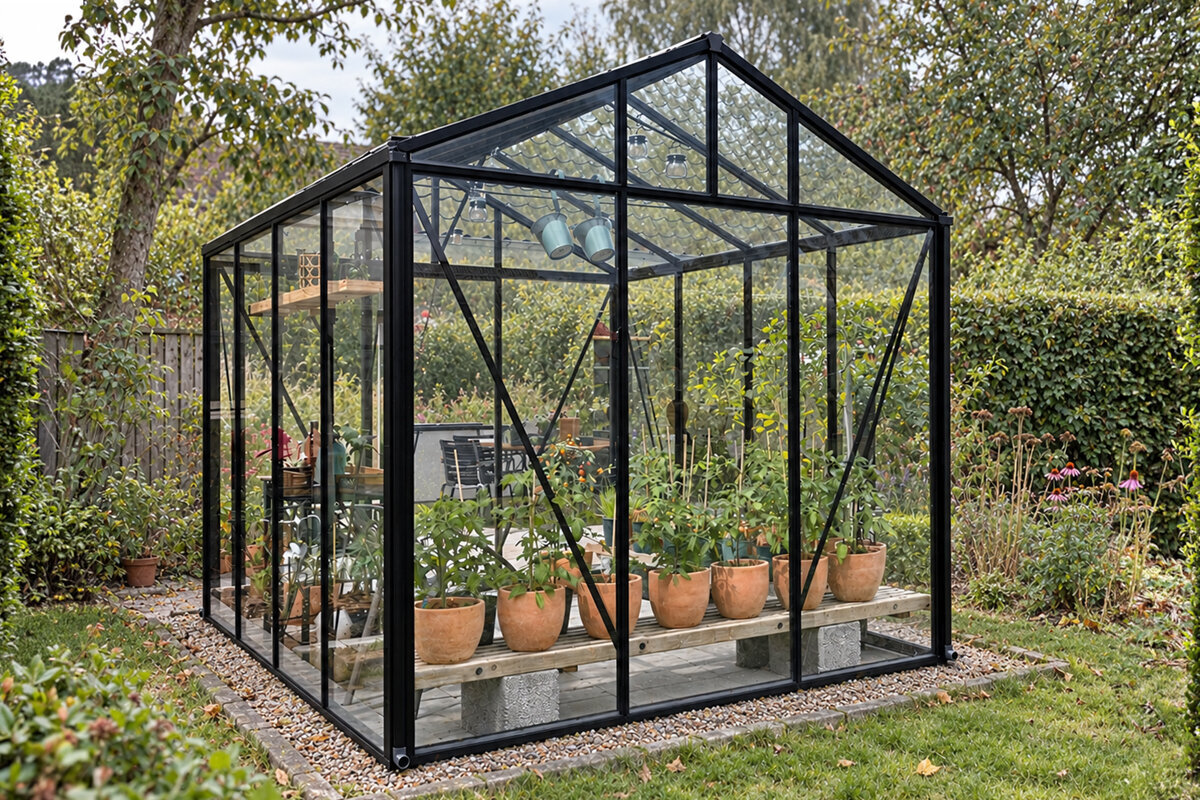
As a starting point for a freestanding garden plan, consider a standard Classic greenhouse with a configuration that can be checked clearly.
Inspection 02 · Review area two
Discuss the site, wall and foundation
The next question is: what does my site need to provide? Describe orientation, soil, slope, nearby trees and garden access. The supplier can explain the preparatory work described in its documents. You remain responsible for measuring the area carefully and arranging proper ground preparation where your site requires it.
For a greenhouse beside a wall, ask specifically about the existing wall. A suitable support, connection details, roof overhangs, downpipes and accessible assembly areas may all be relevant. Do not settle for a general statement of suitability: establish which measurements and building conditions need checking on site. Independent professional advice can be valuable where there is uncertainty.
Document the intended location with photographs from several angles and a simple sketch. This makes it easier to discuss obstacles, connection points and working space. Check that doors, windows and maintenance areas on the building will remain accessible.
Make sure product documents belong to the version actually selected. This link between documents and configuration helps prevent misunderstandings when images show optional elements or different opening arrangements.
- What information about soil, slope and foundation does the supplier need before assessing the appropriate version?
- Which existing features on the house wall could affect the greenhouse layout, access or connection?
For a greenhouse attached to a façade, examine a full-size regular Lean-To greenhouse and its site-specific requirements.
Inspection 03 · Review area three
Review materials and components
Ask what the frame, glazing, doors, roof vents and fixings are made from in the proposed version. A material name alone is not enough; it must be linked to the chosen configuration. Ask which components are standard and which are selectable. This avoids confusing a product image with a different equipment package.
Care guidance for visible finishes and transparent elements is also useful. Ask which cleaning products and methods the instructions allow or discourage. For future replacement parts, ask how individual components are identified. A clear parts list makes a later enquiry much more precise.
Compare material details only within the same configuration. Images may show accessories or variants that are not automatically included with your selection. A written listing of frame, glazing, opening elements and fixings provides a reliable way to assess the offered version.
Check the packing list against your order summary. Marking items as verified is a simple way to record differences and make later questions more exact.
- Which components and finishes belong to the offered version, and where are they listed in writing?
- What care instructions apply to the frame, glazing, hardware and moving parts in everyday use?
When comparing a freestanding option, assess a freestanding Classic greenhouse through its documented components.
Inspection 04 · Review area four
Keep supply and delivery arrangements separate
Ask the greenhouse supplier how the shipment is divided and which items should be checked on receipt. A detailed packing list is especially helpful when components arrive in separate packages. Also ask what information is needed before delivery so vehicle access, a storage area and helpers can be prepared realistically.
Distinguish delivery of goods from extra services. Ask explicitly whether moving items to the assembly location, installation or packaging disposal is included in your selection or must be arranged separately. Do not make assumptions about property access. Assess and report narrow passages, steps, gates and long carrying distances beforehand.
Set aside a sheltered, accessible place where packages can remain organized until assembly. Photograph damaged-looking packaging or missing items promptly, then compare your observations with the order documents.
Avoid scheduling assembly under unnecessary pressure. A prepared work area, sorted packages and a read-through of the instructions support careful work in the intended sequence.
- Which packages, documents and checks should I review against my order paperwork when delivery arrives?
- What requirements apply to vehicle access, storage space and moving components to the intended assembly area?
When planning a façade installation, it helps to review a wall-attached regular Lean-To greenhouse with its coordinated scope of supply.
Inspection 05 · Review area five
Prepare realistically for assembly
A central question concerns assembly: which steps are described in the instructions, what tools are required and how many people should be allowed for in practice? Request access to the relevant documents before ordering. Pay particular attention to foundation requirements, component sequence and safety guidance. This helps you decide early whether you want to assemble the greenhouse yourself.
Ask which checks are expected after individual assembly stages. Alignment, secure connections and correctly fitted components deserve particular attention. If you are considering an independent installer, provide that person with the model documents in good time. The supplier should be able to state which preparation remains your responsibility and which instructions apply to the chosen configuration.
Read assembly documents for their sequence as well as individual steps. Prepare tools, the work area and any necessary aids beforehand. You can then judge more clearly what you can handle yourself and where help may be appropriate.
Make an accessory priority list: necessary function, preferred comfort and later additions. This distinguishes choices needed for assembly from decisions that can remain open.
- Which tools, helpers and preparatory tasks does the documentation expressly name for my selected version?
- Which assembly steps should I discuss with an installer before work starts, using the product documents?
For an independent garden project, review the assembly documentation for a Classic greenhouse for the garden particularly carefully.
Inspection 06 · Review area six
Plan climate control, ventilation and accessories
Do not only ask what accessories are available; ask what job each one performs for your intended use. Ventilation, shading, shelving and watering are easier to select when you describe your crops, care routine and sun exposure. Request a clear distinction between standard equipment and additional options, keeping both the quotation and your budget understandable.
Discuss future additions as well. Some extras make more sense after assembly, while others should be planned early because they affect the structure or interior arrangement. Ask what information you need to make that decision. Avoid broad expectations about temperature or harvests: results always depend on site, weather, care and selected equipment.
When planning accessories, consider future care routes and access to plants. A well-organized interior allows not only for growing space, but also ventilation, movement and the location of items that need regular use or cleaning.
Store photographs, correspondence and product documents with the order summary. This record makes it easier to identify your configuration if a question arises during assembly or later.
- Which accessories directly support my intended crops, and which are already included in the selected scope of supply?
- Which additions should be decided before assembly, and which can be considered later after consultation?
On a sunny wall, a regular Lean-To greenhouse beside the house can be planned with the accessories you need.
Inspection 07 · Review area seven
Documents, contacts and replacement parts
Before purchase, ask which product documents you will receive and how they will be provided. These may include assembly guidance, care information, parts lists and operating notes. Ask how to reach the appropriate contact if a specific question arises during preparation or assembly. A clear communication route is often more useful than a vague service promise.
Also ask about the process for missing, damaged or later-required parts. Important details include what the supplier needs for identification, such as order information, photographs or a reference from the parts list. Keep the order confirmation and documents organized so an enquiry is not based on an unclear model description.
Create one project folder for the quotation, order confirmation, instructions and photographs. Record the model name and selected options there. If questions arise later, you can give the supplier complete information without unnecessary delay.
- Which instructions, care information and parts lists will I receive for my configuration in a usable format?
- What information should I keep for a future parts enquiry so the component can be identified clearly?
For documentation of a freestanding model, choose a Classic greenhouse as a standard model with clearly matched documents.
Inspection 08 · Review area eight
Read warranty and written terms
Finally, ask which written terms apply to your order and where they can be read before purchase. Ask how a report of a problem is handled and what information is needed. Advice given during a consultation can help, but it does not replace the applicable documents. Take time to review the scope, requirements, exclusions and procedure in the written terms.
If you have questions about insurance, distance from a property line or possible construction requirements, consult your insurer, the authorities responsible for the property’s province or territory and municipality, or a qualified professional as appropriate. The greenhouse supplier can provide product information but cannot determine the rules or coverage for your site. Keep the replies and documents together for your records.
Read written terms in connection with your specific order and retain the relevant documents. If language or procedures remain unclear, ask for an explanation. Keep product questions separate from matters requiring an individual professional assessment.
- Review the written terms for your order and the reporting process they describe before committing.
- Where can I find the written terms for my order, what steps does the supplier set out for reporting an issue, and which local questions about siting, insurance or construction requirements must I check independently with the appropriate authorities?
If you are comparing an attached design, review the documents for a large Lean-To greenhouse for a house wall in full before ordering.

Comparison
Compare quotations through the answers
Use this table to assess supplier replies as well as collect them. A strong offer identifies the configuration, separates the product from additional services and points to relevant documents. Add your own site-specific notes alongside it.
| Question to assess | Helpful answer | Warning sign when comparing |
|---|---|---|
| Which model is offered? | A clear name with selected options. | Only a broad product group with no configuration. |
| What is included? | A packing list separates components from accessories. | The scope remains unclear after questions. |
| What does the site need? | Specific documents identify preparatory checks. | A blanket assurance with no site context. |
| How is assembly handled? | Instructions explain sequence and prerequisites. | The assembly effort is not explained. |
| How does support work? | The contact route and required information are stated. | Service is left as a general promise. |
Prepare for the supplier conversation
A little preparation turns a general enquiry into a productive discussion. Gather facts about your garden, describe your intended use and decide which answers you want in writing.
01
Record the site
Measure the available area, routes and obstacles. Note slope, sun exposure, trees and any relevant features of a possible house wall.
02
Define the intended use
Describe crops, work routines and desired storage. This leads to useful questions about size, access and interior equipment.
03
List the variants
Record the model, preferred options and open alternatives. Ask for each version to be explained separately and clearly.
04
Think through delivery
Check vehicle access, a storage area and the route to the assembly location. Share restrictions rather than raising them only at delivery.
05
Document the answers
Keep the quotation, drawings and terms together. Mark points that still need written confirmation before ordering.
Pre-order checklist
Use these points once the model and site are broadly settled. Each answer reduces the chance that an important assumption only becomes visible during delivery or assembly.
01. The exact model name and every selected option are shown clearly in the order summary.
02. External dimensions, interior space and the door area suit your planned routes, crops and garden furniture.
03. The proposed location has been recorded, including ground conditions, slope, access and nearby obstacles.
04. For a house wall, the connection area, roof overhangs and possible downpipes have been considered in advance.
05. Included items and optional accessories are listed separately rather than assumed from images.
06. You know the assembly documents, required tools and preparatory work for your property.
07. Documents about care, parts and contacts can be found for your selected configuration.
08. You will clarify individual questions about requirements or insurance with the relevant authorities or insurer.


Frequently asked questions before buying a greenhouse
Should I already have a foundation before ordering?
You should understand the ground and foundation requirements before ordering and have measured your site. Whether work can already proceed depends on your project schedule. Follow the documents for the selected version and seek professional advice where construction details are uncertain for your situation.
What information does a supplier need for useful advice?
Helpful information includes photographs, area dimensions, slope and access details, plus your intended use. For a wall-adjacent site, information about the wall and neighbouring building features is important. The more clearly you describe the starting point, the more focused the supplier’s product information and questions can be.
How do I know whether I really need an accessory?
Choose accessories from how you plan to use the greenhouse, not from a wish list. Ask what function an item performs and whether it is included in the base scope. Consider care time, crops and site conditions. Some choices can be made later, while others should be resolved in time for assembly.
What should I clarify about delivery?
Confirm the scope of supply, packages, required storage space and conditions along the delivery route. Also establish who will move components to the assembly location and how you should respond to a discrepancy. Keep order documents ready so delivered items can be checked accurately.
Is a verbal statement about warranty enough?
No. Ask to see the written terms that apply to your order and read them before committing. The scope, requirements, possible exclusions and reporting process are particularly important. If you have questions, request a clear explanation for the selected configuration rather than relying on general wording.
Should I ask the supplier about permits or insurance?
The supplier can explain the product and provide its documents. It cannot decide which approvals apply to your property or how the structure will be insured. Check requirements with the authorities responsible for the property’s province or territory and municipality, and confirm coverage with your insurer. Canada’s national model codes do not create one automatically applicable rule for every location.
Compare greenhouse solutions
Make a more confident decision with clear answers
The most useful questions for a greenhouse supplier are specific, recorded in writing and connected to your property. Assess the model, scope of supply, assembly and support as one project. You will spot earlier which decisions remain open and which documents are needed for an informed order.
Bloomcabin can help you explore freestanding and wall-attached greenhouse solutions. Prepare your site information, compare configurations carefully and check individual construction or insurance questions with the appropriate local sources.
Explore suitable models and use your prepared questions to make a clear, structured selection.
