
Is a Greenhouse Worth Having in Shade or Part Shade?
Assessing a garden site
Is a Greenhouse Worth Having in Shade or Part Shade?
A greenhouse in shade can be worthwhile when its purpose, crop selection and your expectations suit the light that actually reaches the site. The key is not simply the number of sunny hours, but when light arrives, what casts the shade and how flexibly you can plan your growing.
Quick answer: often in part shade, selectively in permanent shade
A part-shade greenhouse can work well for salads, herbs, seedlings and many leafy crops. Heat- and light-loving plants such as tomatoes, peppers and eggplants benefit far more from reliable direct sun. Review the changing light through the season before choosing a model.
Dense shade is not an automatic reason to abandon the idea, but it is rarely an ideal starting point for a traditional summer-vegetable greenhouse. In that situation, the greenhouse may be better used for potting, propagation or protected harvesting. Plan for closer attention to ventilation, watering and persistent dampness.

01
A promising start
Part shade with several bright periods can be workable, particularly where sunlight is not limited to the cooler early morning.
02
A challenging position
Continuous shade from buildings or dense planting reduces warmth and light, making fruiting crops harder to plan successfully.
03
Choosing the greenhouse
Observe the site before selecting the size, form and equipment, then base the intended use on the light that is realistically available.
A practical guide for garden areas with less light.
Many gardens do not have an uninterrupted sunny spot. House walls, tall hedges, mature trees and neighbouring buildings all alter the pattern of light across the day and through the seasons. That does not prevent a greenhouse installation, but it does call for an honest site assessment. Reduced direct light affects warmth, growth rate, moisture and suitable plant choices much more strongly than it does in an open, sunny location.
Part shade is very different from deep, continuous shade. A site that catches sun in the morning or afternoon can be appealing for many crops. A location mainly beneath a tree canopy or beside a permanently shaded north-facing wall makes light-loving summer crops much more demanding. Careful observation of your own garden gives a much sounder basis for weighing the effort against the value of a greenhouse.
This guide focuses on whether a shaded site can suit a greenhouse. It explains how to assess light, distinguish difficult types of shade and develop a realistic use plan. Instead of treating a shaded greenhouse as a yes-or-no question, you can make a purchase and planning decision that fits your property and gardening aims.
Inspection 01 · Checkpoint 01
Track light rather than relying on a single impression
A garden can look bright during one visit yet perform very differently over a full day. Watch the proposed location on several days in the morning, at midday and in the afternoon. Record when direct sun reaches the area and when it leaves. Season matters too: a pleasant midsummer site may be substantially darker in spring because of lower sun angles or nearby structures.
Separate direct sun from bright, diffuse light. Diffuse light can still help some plants, but it contributes less greenhouse warmth. Note shadows from the house, fence, shed and trees individually. This will show whether you are seeing brief interruptions, recurring part shade or shade that remains for many hours.
Look beyond the future greenhouse footprint and assess the open sky above it. A narrow strip of light may move during the day and reach only part of the growing area. Add shadow edges to a site sketch so you can decide early where shelves, a workbench and plants could be arranged.
- Keep a light diary on different days of the week and include both overcast and sunny conditions.
- Pay particular attention in spring, when early sowing and propagation benefit from adequate light.
For a garden location that has been properly assessed, a standard Classic greenhouse provides a straightforward starting point for your own growing plan.
Inspection 02 · Checkpoint 02
Identify the source of shade
Building shade and tree shade behave differently. A wall usually creates a defined, predictable shadow governed by the sun’s path. Trees create moving shade that changes during the year. Leaf growth can reduce light in summer, while dripping water, leaves and roots create additional practical considerations.
A site below a dense canopy requires particular care. It receives less light, dries more slowly and may be harder to maintain because of fallen branches and leaves. A position near a wall can still work when its open side receives enough light. Check access, the base area and whether windows, doors and paths can remain clear.
Reflected light from pale walls or paved areas can make a site appear brighter. It does not replace direct sun, although it may soften a dark corner. Observe the location in varied weather rather than deciding after one exceptionally bright summer day. What matters is the repeated light pattern over time.
Also check whether rainwater from roofs or tree canopies reaches the proposed site. Repeated drip points affect paths, maintenance and moisture around the greenhouse.
- With trees, consider summer foliage as well as future work around branches, roots and falling leaves.
- Do not judge a wall-side site by proximity alone: orientation, clearance and visible sky are decisive.
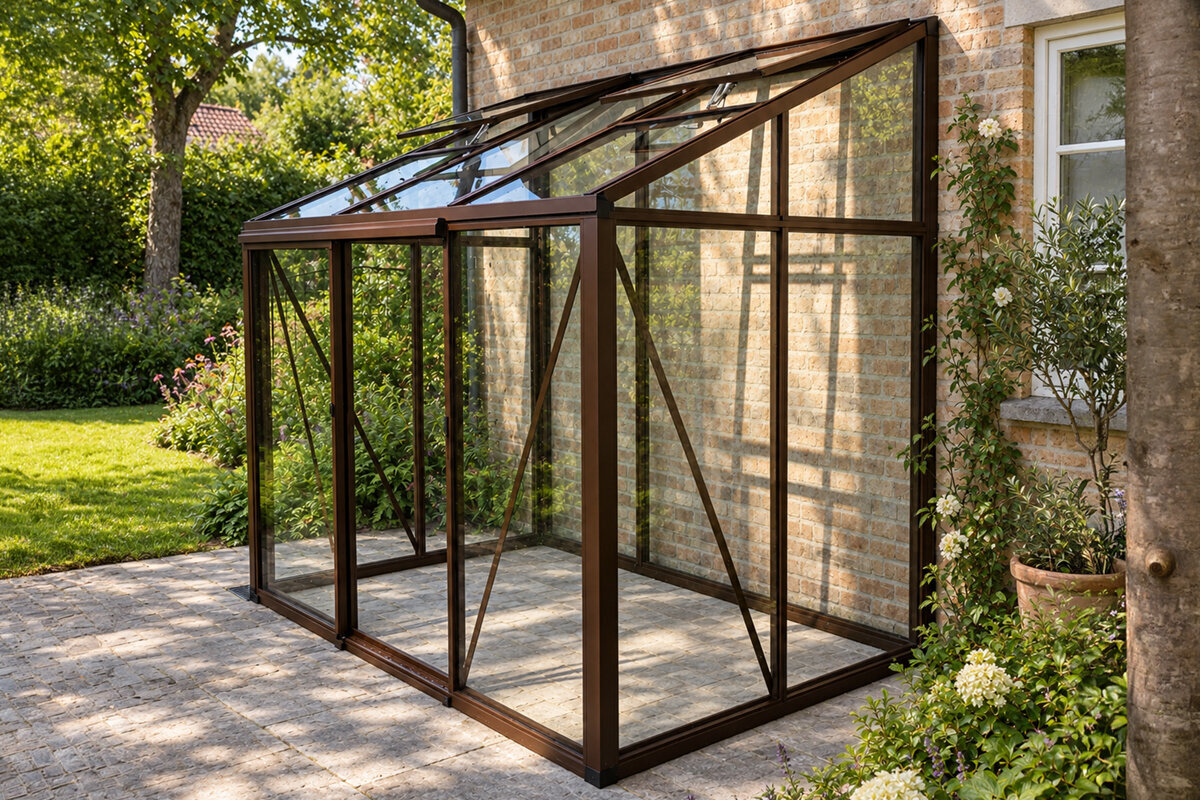
Along a suitable open wall, a full-size Lean-To greenhouse can make useful use of the available outdoor area.
Inspection 03 · Checkpoint 03
Match part shade with the right use
A partly shaded location becomes more valuable when you use its strengths deliberately. Leafy vegetables, herbs, many young plants and some cool-growing crops do not demand the same light and heat as Mediterranean fruiting vegetables. A greenhouse can also be useful for pricking out seedlings, protecting sensitive pots or extending the season without relying on peak summer heat.
Plan around seasons as well as plant types. Every bright spell is welcome in spring, while diffuse light can be helpful during midsummer. Light intensity drops again in autumn, making an already dark site more limiting. Flexible planting with crops suited to each season keeps the greenhouse from being asked to do more than the site can support.
Use the available light in zones. Put plants with higher light needs in the brightest places, and reserve dimmer areas for propagation, herbs or storage. Notice whether taller plants add shade to neighbouring areas. Movable pots and an adaptable layout make it easier to respond as the season changes.
- Place light-hungry fruiting crops in the brightest position and keep edge areas for tougher leafy crops and herbs.
- Adjust the planting plan with the season rather than repeating the same crop sequence regardless of light.
For varied planting in an open garden, a standard Classic greenhouse offers accessible space for changing crops.
Inspection 04 · Checkpoint 04
Consider warmth, moisture and airflow
Less sun often means slower warming. That can be welcome on hot days, but in cooler periods plants and growing media take longer to dry. Damp leaves and wet surfaces do not automatically make a site unsuitable, but they call for attentive growing. Water according to need, avoid standing water and observe how air moves inside the greenhouse.
A shadier greenhouse still needs thoughtful ventilation. Open and close it in response to temperature, humidity and weather rather than the calendar. A spot between a thick hedge and a wall may be sheltered from wind but lack fresh airflow. Leave room for tending plants and air exchange, and avoid filling paths and beds so tightly that moisture lingers.
Shade is not the only cause of slow drying. Crowded plants, wet paths and close surrounding structures can have the same effect. Keep sensible spacing and inspect areas near the floor and walls regularly. An orderly interior makes condensation, moisture and maintenance needs easier to spot early.
- Check condensation, wet leaves and growing-medium moisture in the morning before settling into a fixed watering routine.
- Keep the exterior around openings clear so hedges, pots and stored items do not restrict air circulation.
Where a house wall is suitable, a full-size wall-mounted Lean-To greenhouse creates a close, easy-to-monitor space for daily care.
Inspection 05 · Checkpoint 05
Choose crops without unrealistic expectations
Tomatoes, cucumbers, peppers and eggplants are often the reason people want a greenhouse. These crops generally benefit greatly from light and warmth. In a shaded place they may grow more slowly or ripen less reliably. If these harvests are your main goal, give priority to the sunniest available area rather than expecting the roof to compensate for missing sunlight.
Salads, spinach, Asian greens, parsley, chives and many seedlings are a different proposition. Depending on the variety and season, a gentler microclimate can suit them well. Start with small trial plantings before committing the whole space. Your own observations will help shape a practical crop sequence for future seasons.
Your gardening routine matters too. If you can tend the greenhouse only at weekends, a tidy and resilient planting plan may serve you better than a demanding assortment of crops. After the first season, record which plants were manageable at the site; those notes are more useful than a general plant list.
Consider everyday access as well. Short walks encourage regular checks, while a difficult-to-reach site can make practical use harder even if its light is better.
- Before buying, identify your priority crops and give each one a realistic light requirement.
- During the first season, trial different areas instead of placing sensitive crops only in a dark corner.
For changing beds and trial crops, the standard Classic greenhouse is a useful base for an evolving planting plan.
Inspection 06 · Checkpoint 06
Select a structure for the property
The form of the greenhouse should respond to light, access and available space, not only appearance. A freestanding greenhouse can be positioned where the sky is most open. Still check paths, water access and future planting. A place that is clear today can become much darker as shrubs, privacy screening or trees grow.
A wall-side greenhouse can shorten trips and use an existing area efficiently. Whether it works in part shade depends on the wall orientation and nearby obstructions. Measure carefully and allow for door movement, tending access and the foundation. Before ordering, check installation requirements and any local questions with the relevant municipal permit office.
Path layout deserves as much attention as the structure itself. An accessible entrance makes daily checks, harvesting and carrying water or growing medium easier. Make sure adjacent areas remain free for open doors, tools and maintenance. Downspouts, windows and established planting can all affect a house-wall plan.
- Draw the footprint, door area, working route and reachable planting space onto a scaled garden plan.
- Include future privacy screens and planting projects so the light gain is not lost after a short time.
To use a suitable house wall, consider a regular full-size Lean-To greenhouse with adequate access planned around the structure.
Inspection 07 · Checkpoint 07
Test the location before buying
A simple on-site trial is more dependable than guesswork. Set out pots or a temporary outline at the proposed size for several weeks. You will see how shade moves across the future footprint, whether the route remains comfortable and where water settles after rain. Photos taken at the same time each day make observations easier to compare.
Use the trial period to clarify how you want to use the greenhouse. Do you need frequent herb access, mainly want to raise young plants, or plan to cultivate larger beds? A nearby but moderately bright site may be more valuable for daily tasks than a distant sunny patch. Your priorities determine which compromise is sensible.
Repeat the test after a weather change where possible. This can reveal pooling water, soft ground or awkward access. At the same time, see whether hedges, fences or garden furniture tighten the intended work area. A realistic mock-up can prevent avoidable conflicts from appearing only after installation.
- Mark the outside dimensions and access route with stakes or string so shadows, passages and sightlines are visible realistically.
- Note puddles, drip lines and awkward pinch points straight after rain or while working in the garden.
After a successful site trial, you can plan a freestanding Classic greenhouse where light and your working routine meet.
Inspection 08 · Checkpoint 08
Support a long-term purchase decision
A greenhouse in part shade is a convincing purchase when its value extends beyond a maximum summer harvest. Consider propagation, sheltered workspace, seasonal crops and the enjoyment of gardening together. Compare models against your measurements, foundation and intended use. A current individual enquiry is more useful for clarifying configuration and options than broad price assumptions.
Before purchase, read the product information, assembly guidance and applicable written terms carefully. Establish what preparation your property needs and contact the relevant local authority if you are unsure about local requirements. If you wish to consider the greenhouse within existing property or contents insurance, discuss the specific project with your insurer.
Keep the results of your site assessment in a short decision list: light pattern, available area, preferred crops, access and maintenance effort. This makes compromises clear and helps you compare product information with purpose. A site that suits only certain uses is not a disadvantage when your expectations and planting plan are aligned with it.
- Put the purchase on your priority list only after recording light, measuring the area and preparing a clear crop plan.
- Seek definitive advice from the appropriate contacts about foundations, setbacks or insurance cover.
For a wall-side project with a clear purpose, consider a full-size Lean-To greenhouse for a house wall using the current product documentation as your reference.

Comparison
Comparing site types
This overview does not replace on-site observation, but it can help set realistic expectations for crops and care. The duration, timing and quality of light on your own plot remain decisive.
| Site type | Light pattern | Suitable focus |
|---|---|---|
| Open sunny site | Long periods of direct sun, usually with good warming. | Wide crop choice, including heat-loving fruiting vegetables. |
| Bright part shade | Direct sun in distinct windows during the day. | Salads, herbs, propagation and selected fruiting crops. |
| Part shade beside a wall | Sun windows depend on orientation and building shade. | Short journeys, but check light and access carefully. |
| Dense tree shade | Unsettled light and often higher moisture. | More specialized use, robust leafy crops and propagation. |
| Permanent shade beside a building | Little direct sun and slow drying. | Plan only with restrained harvest expectations. |
A five-step plan
Use this sequence to decide whether a shaded greenhouse suits your garden before committing to a size or structure type.
01
Map the light
Observe the area at several times of day and, where possible, in different seasons. Record direct sun, diffuse light and lasting shade separately.
02
Identify the shade source
Assign each shadow to its source: a building, hedge, tree or planned planting. Check how predictable and seasonal that source is.
03
Set the intended use
Decide whether propagation, herbs, leafy vegetables or heat-loving fruiting plants are most important. A clear priority exposes site compromises.
04
Simulate the footprint
Mark the base area, door zone and working paths. Test access, drainage and care routines after rain and during ordinary garden use.
05
Review the documentation
Compare the dimensions and intended installation with current product information. Resolve local questions and, where relevant, insurance questions before making a binding decision.
Checklist for shaded sites
Work through these points before choosing a greenhouse for a partly shaded or shaded part of the garden.
01. Direct sun has been observed at several times, not only on one pleasant day.
02. The shade source has been identified and changes caused by season or growth have been considered.
03. Your priority crops match the available light rather than wishful thinking alone.
04. There is a plan for ventilation, watering according to need and drying damp areas.
05. The footprint, door opening, working paths and care access have been marked realistically on site.
06. Trees, hedges, drainage routes and drip lines have been assessed for their practical effect on the site.
07. The foundation and installation are being prepared using current product information.
08. Local requirements and any insurance classification will be clarified individually if needed.


Frequently asked questions about greenhouses in shade
Can a greenhouse in part shade be worthwhile?
Yes, especially where the site receives regular bright periods or direct sun at particular times of day. Salads, herbs, seedlings and many leafy crops can fit the plan well. The important point is not to buy the greenhouse solely for highly heat-demanding summer crops, and to observe the light pattern first.
How much sun does a greenhouse need?
There is no single useful number because crop goals, season and the type of shade all interact. The sunniest possible position is advantageous for a broad range of light- and heat-loving plants. Bright part shade may be enough for propagation, herbs and leafy vegetables. Always assess your garden’s actual sun windows.
Is tree shade more difficult than building shade?
Not necessarily, but tree shade is often more variable and brings other considerations. Foliage changes conditions seasonally, while drip water and falling material can affect maintenance. Building shade is usually more predictable but can remain dense for a long time. Duration, timing and open sky above the site matter most.
Which plants suit a shadier greenhouse?
Salads, spinach, herbs and young plants are sensible starting points. The best variety depends on season and the precise light available. Try small quantities in different areas. Heat-loving fruiting vegetables can occupy the brightest position, but should not be planned with the same expectations as they would have in full sun.
Can a greenhouse compensate for missing sunlight?
A greenhouse creates a protected growing space, but it cannot replace direct sunlight. With limited sun, the interior and soil usually warm more slowly, and plants receive only the light that reaches the location. Its value lies in appropriate use, attentive care and crops selected for the conditions.
Do I need approval for a greenhouse in my garden?
That can depend on the location, size, design and local rules. Do not rely on broad statements or outcomes in another municipality. Identify your province or territory and municipality, then ask the local permit office about the specific project, particularly where setbacks, foundations or a wall-side installation are involved.
Plan the site with purpose
Conclusion: assess light honestly and plan the use accordingly
A greenhouse in shade is worthwhile not because of a blanket promise, but when it suits the real conditions of your garden. Bright part shade can provide a very useful setting for propagation, herbs and leafy crops. Where light remains low, adjust both plant selection and harvest expectations accordingly.
Take time for a light diary and a footprint test. They usually show whether a freestanding or wall-side position is more appropriate and which use will remain enjoyable over time. A grounded site assessment helps you choose not the seemingly sunniest concept, but the greenhouse that fits your everyday garden life.
Explore greenhouse options after assessing your light pattern, measurements and preferred crops.
