
Greenhouse Fungus Gnats: Causes, Prevention and Control
Greenhouse plant care · monitor the adults, investigate the larvae
Greenhouse Fungus Gnats: Causes, Prevention and Control
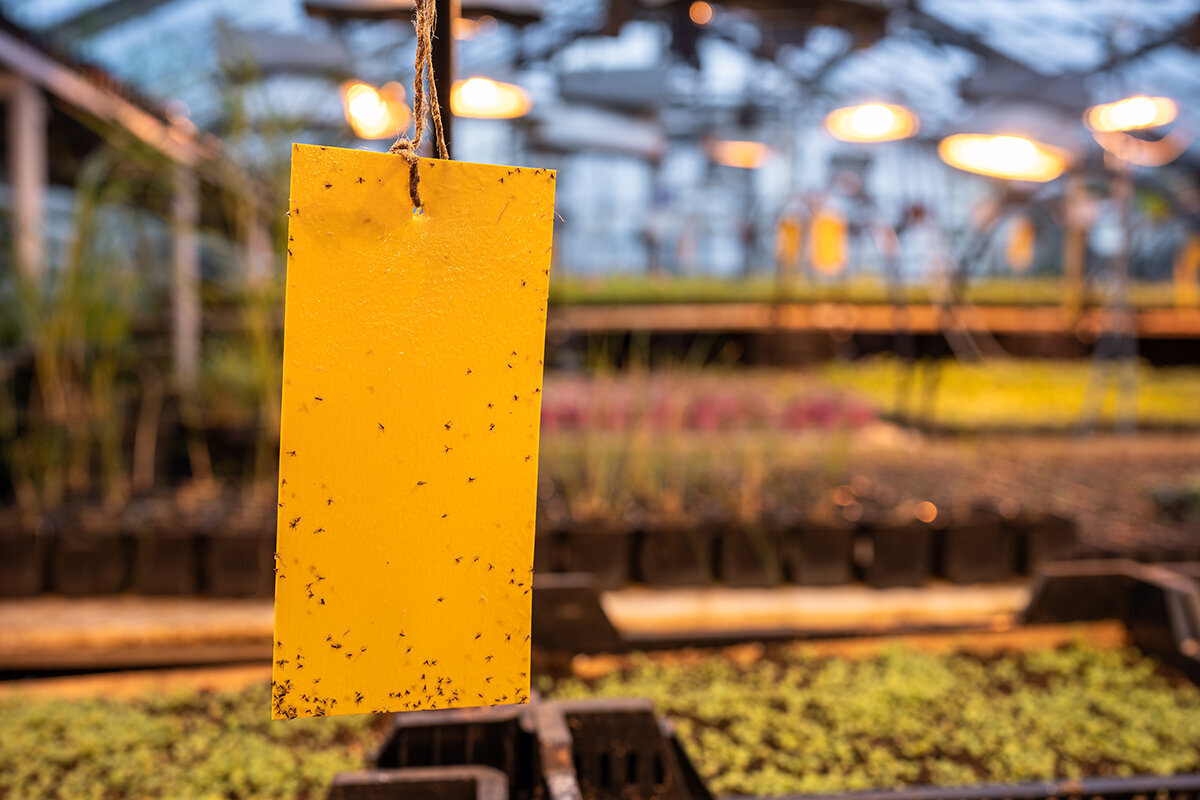
Yellow sticky cards reveal flying fungus gnats, yet they cannot repair conditions around the roots. Adults caught above a crop commonly point towards a damp ecosystem in the top layer of its growing medium.
That difference should guide the response. Trapping flies helps you follow a trend and may ease adult pressure, but the decisive factors lie elsewhere: moist surfaces, algae, decaying matter, tender propagation crops and larvae beside the roots. Do not dehydrate every container. Instead, give each crop the water it needs while reducing the uninterrupted damp periods in which fungus gnats prosper.
Use each yellow card as a clue. When catches rise from week to week, examine dampness, housekeeping and propagation practices below the foliage rather than expecting the trap to solve the infestation.
Your first 48 hours
Begin with the most vulnerable plants
Propagation areas can be particularly vulnerable despite careful attention: seed trays, rooting cuttings, newly potted plants and slow-establishing youngsters have limited reserves. Established, vigorous crops often withstand a modest infestation more readily. Protect seedlings and their delicate roots by separating the affected nursery area before considering treatment of the entire greenhouse.
01
Temporarily pause automated watering
See whether timers kept their usual schedule through cool, overcast weather or a period of lower plant demand. Last week's appropriate setting may leave today's compost excessively wet.
See whether timers kept their usual schedule through cool, overcast weather or a period of lower plant demand. Last week's appropriate setting may leave today's compost excessively wet.
02
Clear algae and pooled water
Empty trays and saucers, dry puddles beneath benches, and remove green deposits from irrigation points, containers and floors.
Empty trays and saucers, dry puddles beneath benches, and remove green deposits from irrigation points, containers and floors.
03
Keep new arrivals apart while checking them
Do not bring young plants, houseplants or moist bags of compost directly beside propagation crops. Examine them first and set a dated yellow card close by.
Do not bring young plants, houseplants or moist bags of compost directly beside propagation crops. Examine them first and set a dated yellow card close by.
Confirm the identity before acting
A tiny dark fly may be something else
Adult fungus gnats are slender, dark flies with conspicuously long legs, commonly measuring about1.5to3.0millimetres. They are weak fliers, often drifting unsteadily beside pots or walking over the compost surface. A correctly placed sticky card may show long legs and fine, thread-like antennae. If the detail is visible, inspect the characteristic Y-shaped wing vein with a hand lens.
Look in the compost for a slender, legless larva, whitish to translucent, with a shiny black head that stands out clearly. Inspect the damp upper layer as well as deeper material. Saturated propagation cells, dead leaves and consistently wet pot edges are useful places to search.
Probable fungus gnatFine-bodied · conspicuously long legs
Shore flyCompact body · pale marks on wings
Protect helpful insectsCheck for a pinched, wasp-like waist
Identification ruleVerify both the insect and its breeding conditions
Signs pointing to a fungus gnat
Watch for hesitant, wandering flight, clear wings and long, filament-like antennae. Larvae should display a dark head capsule. Their usual foods are fungi, algae and decomposing organic matter, although dense populations may threaten root hairs and other delicate root tissue.
Similar insect: shore flies
Algae and excessive wetness also attract shore flies. Their adults are stockier and show pale wing spots. The mainly algae-feeding larvae lack the conspicuous black head capsule characteristic of fungus gnats.
Do not sacrifice beneficial insects needlessly
Sticky cards sometimes catch minute parasitic wasps or predatory midges. Examine several insects when the identity is doubtful, particularly if one has a narrow waist. Plenty of very small winged greenhouse visitors cause no plant damage.
Why an accurate identification changes the response
Removing algae benefits either situation. Root protection and measures directed at larvae become more important once fungus gnats have actually been verified. Numbers on a yellow card cannot establish the species on their own.
Work across both parts of the life cycle
The same pest occupies two separate zones
A fungus gnat develops from egg to larva, then pupa and adult. Temperature, food and moisture alter the pace, so no fixed timetable guarantees control. The more useful distinction is spatial: flying adults can be watched and trapped above plants, whereas the immature stages remain connected with damp surface compost. Effective management therefore links action in both places.
Over the foliage
Adult surveillance zone
Adult surveillance zone
Flying adults→
Egg deposition→
Cards track the trend→
New flies emerge
Within and beside the
top layer of growing medium
top layer of growing medium
Egg stage→
Feeding larvae→
Pupal stage→
Possible root exposure
What cards tell you above the plants
Because adults fly poorly, they linger around containers, lower foliage and wet compost. Females choose moist organic sites that provide food for newly hatched larvae. Comparable yellow cards show whether flying activity is increasing or falling, but they cannot count larvae within a particular pot. Every new emergence begins another visible wave.
Why the compost surface is the critical intervention point
Tiny eggs lie at or near moist compost surfaces. Newly emerged larvae eat available fungi, algae and decaying material, then pupate in the growing medium or organic residues. Numerous larvae are especially concerning around seedlings, cuttings and roots already under stress.
Conditions that encourage an outbreak
Plants require water; the problem is unbroken wetness
Sheltered warmth + saturated surface compost + decaying residues + frequent watering without dry-back = an inviting breeding site for fungus gnats.
Peat-rich composts and other organic media may be excellent for cultivation. Difficulties begin when their surface stays soaked for several days, drainage leaves too little air around roots, algae spreads, leaves accumulate or containers sit in runoff. Fungus gnats do not automatically indicate neglect or damaged roots. They do, however, invite a closer look at irrigation, drainage and everyday working practices.
Drainage
Give surplus water somewhere to go
Clogged pot holes, compressed compost, water-filled saucers and poorly drained floor areas keep the space under benches wet well beyond the point when plants have taken what they need.
Algae
A green film signals recurring dampness
Algae signal recurring surface moisture and available nutrients. These conditions particularly encourage shore flies, while the same persistent wetness can sustain fungus-gnat problems.
Decaying organic matter
Clear moist residues without delay
Discarded compost, dead foliage, spent propagation plugs and other plant scraps hold water and support fungal growth. Remove them before another generation can use the material as food and shelter.
Interpret plant symptoms with care
Root injury is possible, but the evidence needs context
Fungi and decaying organic material form the larvae’s main diet. Crowded populations may also chew root hairs or penetrate soft roots. Even limited injury can hinder establishment of seedlings or cuttings. Damaged and stressed roots may face further problems, so inspect plant condition and root health alongside adult fly activity.
Yellow leaves, stalled growth, wilting and weak rooting have many possible causes. Poor light, chilled compost, compact soil, nutrient imbalance, root disease, overzealous drying and repotting damage may produce similar signs. Check roots and moisture before blaming fungus gnats alone. A durable structure in which inspection zones can be organised is the Classic Aluminium Greenhouse.
Sound root zoneLight-coloured fine roots with moisture matched to the crop.
Feeding habitatAlgae, discarded plant matter and used propagation material.
Higher-risk habitatA continually soaked surface where larvae are verified.
Avoid a premature conclusionSeeing adult flies does not demonstrate feeding damage below.
A practical point for action: Finding larvae among propagation crops should trigger an immediate improvement in their growing environment. Waiting until severe wilt appears makes recovery harder and leaves fewer gentle, precisely targeted options.
Watering is your strongest everyday control
Create sensible dry-back rather than imposing drought
Telling a grower simply to dry the compost ignores plant type, rooting volume, weather and stage of development. Basil in a plug, an established cutting, a citrus plant in a large pot and a dormant succulent all follow different schedules. Where the crop permits, let the surface lose some moisture between waterings while keeping the active roots adequately supplied.
Irrigate according to needLet the top layer lose some moistureWater again before the plant becomes stressed
1. Inspect moisture below the surface
Test the top few centimetres with your finger, assess weight by lifting the pot, or choose a sensor suitable for its size. A pale top can hide a saturated lower root zone; darker compost may suit a plant needing moisture. Read surface appearance, pot weight and plant condition together.
2. Coordinate quantity with timing
When a bench repeatedly stays wet, inspect dripper output, runoff and drainage. Apply enough water to serve active roots rather than adding frequent small pulses simply because a timer activates. Drain closed trays once the plants have absorbed their requirement instead of leaving them full for days.
3. Adjust to changing weather
Reduce watering after cool, overcast weather and when limited ventilation slows drying. Irish Atlantic conditions vary between sites and weather spells, so observe your greenhouse locally. Bright, hot conditions can raise demand substantially without encouraging gnats, provided excess water drains and the surface has an appropriate break from persistent wetness.
Tomatoes make this crop-first principle particularly clear: their demand changes with foliage, available light and fruit load. A manageable setting for following those changes is the Classic Aluminium Greenhouse. Carry that approach to every container: irrigate according to the living roots rather than maintaining a fungus-gnat nursery through habit.
Build a diagnosis from four checkpoints
Compare several observations before selecting treatment
No single test describes the complete greenhouse system. Bring together card catches, compost inspections, representative root checks and short dated notes. The combined picture answers more useful questions: where is activity concentrated, can larvae be found, which plants need protection, and did the trend change after sanitation or irrigation improved?
Sticky-card trend
Movement of flying adultsCompost sampling
Larvae close to the surfaceRepresentative root check
Plant susceptibilityIrrigation notes
Patterns in moisture and habitatUsing yellow cards
Set cards slightly above plants or beside the compost in vulnerable sections. Mark the place and date on each one, then compare equivalent positions each week rather than reacting to one catch. The cards measure adult movement, not larvae per container. Use adhesive traps cautiously outside an enclosed greenhouse because other insects may be caught.
Checking for larvae
Search damp compost near pot rims, underneath plant litter and inside wet propagation cells. Sample several typical containers rather than choosing only the worst-looking pot. A positive finding confirms larval activity near the top, but says neither how healthy every root is nor how widely the insects are distributed.
Examining roots
Select two or three typical seedlings, cuttings or struggling pots. Sound roots are usually firm, branched and pale. At the same time, note decay, unusual smells, waterlogging and any larvae you can see. This reveals the plant's vulnerability; it does not measure adults flying elsewhere.
Keeping an irrigation record
Write down the crop, water applied, recent weather, leaks, algae and sticky-card results. One brief weekly entry may expose a local pattern that recollection misses. Such notes can connect moisture practices with pest pressure, although they cannot determine the insect species.
An order of treatment that makes sense
Repair the growing conditions before narrowing control towards larvae
Combine compatible steps rather than relying on one dramatic treatment. First change the damp, debris-rich environment maintaining the cycle. Introduce biological organisms when larvae are present or pressure continues. In Ireland, an amateur home or garden user should consider only a plant protection product authorised for amateur use and for the relevant crop, pest and setting. Approval for ornamentals does not establish permission or suitability for edible plants.
1
Drainage, clean storage and housekeeping
Drain puddles and saucers, clear algae and dead material, and discard badly affected used compost where doing so suits the crop. Keep fresh bags closed, clean and raised away from damp flooring. Unblock drainage openings and make sure pots receive consistent water without remaining saturated. These basics reduce the chance of another surge after further action.
A useful starting point for:
Any crop, season or level of infestation.
Any crop, season or level of infestation.
2
Trapping, spacing and crop care
Use yellow cards to detect adults early, compare activity and remove some flying insects. They do not replace an inspection for larvae. Clear old foliage from pot surfaces, leave enough room for air to move and avoid soaking small propagation cells merely because larger neighbouring plants need more water.
Most useful for:
Early action when pressure is low or moderate.
Early action when pressure is low or moderate.
3
Living organisms directed at larvae
Subject to availability, temperature, crop and cultivation method, larval controls may include the entomopathogenic nematode Steinernema feltiae or a soil-living predatory mite such as Stratiolaelaps scimitus . They are beneficial organisms supplied alive , and results depend on freshness, temperature, correct application and moisture suited to the organism . Arrange delivery only after preparing the area and timing. Follow the specialist supplier's current instructions on storage, quantity, water quality and compatibility. Nematodes require enough moisture to travel through compost, not a tray left under water.
Particularly relevant for:
Verified larvae, propagation zones and coordinated preventive plans.
Verified larvae, propagation zones and coordinated preventive plans.
4
Apply only Irish-authorised products and follow their labels exactly
If improvements to cultivation and biological measures do not suffice, consult the DAFM information for home and garden users. Select only a product authorised in Ireland for amateur use where applicable and covering the intended pest, crop and place of use. Read and obey the complete label. Broad-action products may injure beneficial organisms while leaving the wet conditions around roots unchanged.
Reserved for:
Persistent problems after the insect has been identified confidently.
Persistent problems after the insect has been identified confidently.
Confirm compatibility before combining steps: Check compatibility before combining beneficial organisms with other treatments. Nematodes and predatory mites need suitable moisture, but pesticides, cleaners and tank mixes are not automatically safe alongside them. Coordinate releases, hygiene and product use, following current supplier advice and the binding label. Combine measures only with explicit supplier confirmation of compatibility.
Refresh the propagation zone
Start the next crop with fewer breeding opportunities
Once a crop finishes, clear loose compost and plant matter from benches, floors, joints and water channels. Wash tools and reusable containers, clean algae from splash areas and correct surfaces that retain a shallow film. For the new crop, prepare clean pots, fresh medium kept dry in storage, labelled trays and monitoring cards marked with their start date.
Set a separate irrigation pattern for each crop group. Routinely misted cuttings need something different from strong young tomato plants, and neither should dictate the other's schedule. Where practical, divide sowings, cuttings and established containers. The result is both more accurate cultivation and a measured form of integrated pest management.
Sequence for a prepared propagation bench
ClearTake away plant scraps and spent compost.
WashClean containers, implements and worktops.
DrainRepair leaks and eliminate pooled water.
ObserveMark yellow cards with the date before planting.
When a greenhouse will serve as both a productive workspace and an enduring garden room, accessible benches, controllable ventilation and well-defined zones make routine care easier. Explore the durable and configurable Classic Aluminium Greenhouse and arrange roof ventilation, bench access and propagation space around the work you regularly perform.
Questions growers often ask
Straightforward answers for the greenhouse bench
Steady observation followed by a coordinated environmental reset usually works better than one severe product treatment or indiscriminate drying of every plant.
Can yellow sticky cards remove the whole infestation?
No. Cards catch adult flies and help locate concentrated activity; they cannot directly provide reliable control of compost-dwelling larvae. Continue monitoring, correct persistent wetness and choose an appropriate measure after confirming larvae.
How far should pots be allowed to dry?
Let plant tolerance determine drying. Where suitable, allow controlled drying of the upper compost, while protecting seedlings, cuttings and moisture-loving species from completely dry root balls. Judge pot weight, compost feel, weather and plant condition rather than counting a universal interval between waterings.
Are established plants vulnerable as well?
Adults around a vigorous, well-rooted plant are commonly more irritating than destructive. A dense larval population may still affect fine roots, especially in waterlogged compost or where roots are already weak. Similar injury is more serious for cuttings and seedlings. Inspect below the surface before attributing unrelated poor growth to fungus gnats.
Should shore flies be managed identically?
Both situations improve when algae is removed and surfaces are not kept continually soaked. Shore flies, however, depend more closely on algae, and their larvae do not normally feed directly on roots. A stocky body and light wing marks help separate them from a fungus gnat's finer shape and long legs.
At what point are predatory mites or nematodes worthwhile?
Consider them after finding larvae and reviewing the crop, temperature, water regime and local availability. As living organisms, they have precise handling, storage and moisture needs. Follow the current directions from the specialist supplier, while improving drainage, irrigation and cleanliness alongside their use.
References and useful next checks
Identification resources and Irish product-use guidance
Availability, authorisations and mandatory directions may change. Before buying a pesticide or biological organism, read the current label and supplier information. Irish amateur users should verify that a plant protection product is authorised for home or garden use through the current DAFM guidance rather than relying on approval in another country.
Related Bloomcabin reading: Planning a Greenhouse: Layout, Crops and Care · Made-to-Measure Aluminium Greenhouses · Intelligent Greenhouses for Home Growing
- German Environment Agency: identifying fungus gnats, preventing outbreaks and using yellow cards
- North Rhine-Westphalia Chamber of Agriculture: nematodes used against fungus-gnat larvae
- Hortipendium, Germany: development and biology of fungus gnats
- DAFM: rules for amateur home and garden users
- DAFM: Irish authorisation and label guidance
- DAFM: information on home and garden plant protection products
A weekly check you can repeat
Shorten each spell of uninterrupted dampness
Low fungus-gnat pressure seldom comes from a flawless trap or a single forceful intervention. It is more often achieved through a brief, regular inspection that catches excess water before moist compost becomes a stable breeding habitat.
Compare moisture levelsBefore scheduled irrigation, assess both the upper compost and the deeper section occupied by active roots.
Drain pooled waterInspect saucers, watering trays, benches and floor margins, then repair leaks or places that remain soaked.
Read the card trendMark cards with dates and compare equivalent positions week by week rather than trusting recollection.
Examine sensitive root systemsIf catches climb or development slows, check one representative seedling, cutting or propagation container.
